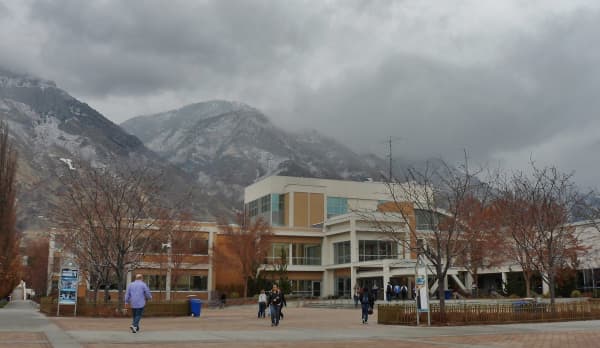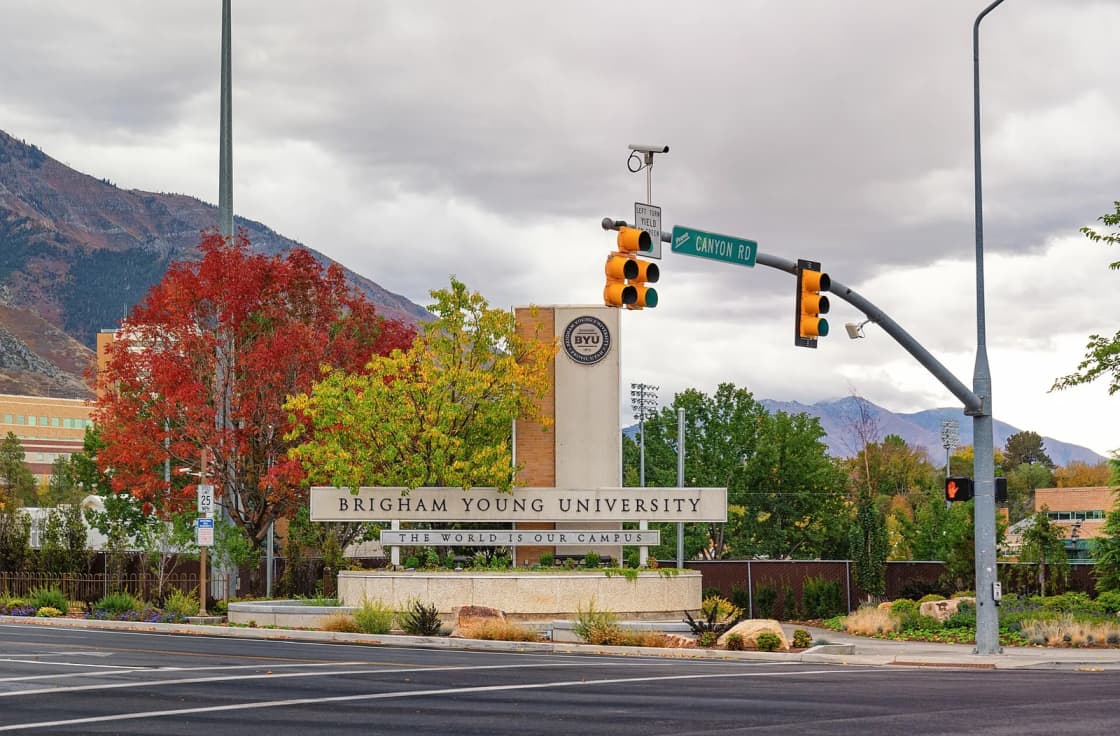

BYU and UVU sit three miles apart, share a metro area, and draw from overlapping applicant pools — but they're fundamentally different institutions serving different students. Choosing between them isn't about which is "better." It's about which one fits your situation, your goals, and how you want to spend the next four years.
This guide compares them across the categories that matter.
The Fundamentals
| BYU | UVU | |
|---|---|---|
| Type | Private, sponsored by The Church of Jesus Christ of Latter-day Saints | Public, open-enrollment |
| Enrollment | ~38,000 (fall 2026 daytime) | ~48,000+ |
| Acceptance Rate | ~69% freshman, 59% transfer | Open enrollment (all applicants accepted) |
| Tuition | Two rates: the non-member rate is roughly double the member rate, because the sponsoring church subsidizes tuition | Two rates set by the Utah Board of Higher Education: non-resident runs several times resident |
| Campus Culture | Residential, faith-centered | Commuter, diverse |
| Honor Code | Yes (strict) | No |
On the tuition row. Both schools are among the most affordable in the country and the ordering between them is stable, but this guide deliberately prints no annual figure. Rates are reset most years — BYU's by the sponsoring church, UVU's by the Utah Board of Higher Education — and a number copied from a comparison page is the single most common way a family budgets against a rate that expired. Get the current figure from each school's financial services page, and check what it excludes: fees, differential tuition for some majors, and per-credit charges above or below full-time bands all move the real number. The structural point survives every reset: at BYU your rate depends on church membership; at UVU it depends on Utah residency.
Academics
BYU is a nationally ranked research university with strong programs across business (Marriott School), law, engineering, accounting, computer science, and the humanities. The acceptance rate has tightened considerably, and the academic culture is competitive. Faculty-to-student ratios are favorable, and professors are generally accessible. Graduate programs are well-regarded, particularly the MBA and law school.
UVU is an open-enrollment institution, which means anyone can attend — there's no minimum GPA or test score requirement. This accessibility is UVU's defining strength. The university has evolved from a technical college into a comprehensive university offering bachelor's and master's degrees across a wide range of programs. Nursing, aviation, digital media, and business are among the strongest programs. The academic experience is more varied — some programs are excellent, others are still developing.
The honest take: If you're a high-achieving student with a strong GPA who wants a traditionally rigorous academic environment, BYU offers more prestige and stronger graduate school placement. If you're a nontraditional student — working full-time, returning to school after a gap, changing careers, or building your academic record — UVU's accessibility and flexibility are better suited to your path.
Cost
BYU is one of the best values in American higher education — a private university at less than public-university prices, because the sponsoring church subsidizes tuition heavily. There are two published rates and the non-member rate is roughly double the member rate; even doubled it stays competitive against comparable private universities.
UVU's resident rate is broadly comparable to BYU's member rate, and its non-resident rate runs several times higher — which is why Utah residency is the variable that decides an out-of-state family's cost, and why the one-year residency route is worth understanding before you enroll rather than after.
The real cost comparison: Tuition is close. The difference shows up in housing and lifestyle. BYU students are more likely to live in traditional student housing near campus (social but more expensive). UVU students are more likely to live at home or in cheaper apartments farther from campus (saving money but sacrificing campus community). See our Cost of Living Guide for detailed numbers.
Campus Culture
This is where the schools diverge most dramatically.
BYU's culture is defined by its sponsorship by The Church of Jesus Christ of Latter-day Saints. The Honor Code governs student behavior — dress standards, curfews in contracted housing, no alcohol or drugs, no premarital sex, and an annual ecclesiastical endorsement requirement. The student body is predominantly Latter-day Saint, and campus life integrates faith and academics in a way that feels natural to some students and restrictive to others. The social scene is active, community-oriented, and uniquely sober.
UVU's culture is defined by diversity and flexibility. No honor code, no religious requirement, no lifestyle restrictions beyond standard student conduct policies. The student body is more diverse in age, religion, background, and life stage, with many first-generation students and students 25 or older. Because UVU is largely a commuter school, the "campus community" feeling is less intense than BYU's — students come for class and leave.
The honest take: BYU gives you a more immersive college experience with a built-in community (if you're LDS and comfortable with the Honor Code). UVU gives you more freedom and flexibility, but you have to build your own social life more intentionally. Neither approach is wrong — they serve different people.
Student Life
At BYU: Hundreds of clubs, intramural sports, campus events, performing arts, and a vibrant ward-based social system. The campus is large, beautiful, and buzzing with activity. Sporting events (especially football and basketball) are major social events. The Richards Building fitness center is one of the best in the country and is covered by tuition — though it takes a Student Wellness membership and waiver rather than a walk-in with a student ID.
At UVU: Growing club and organization offerings, strong outdoor adventure programs, and improving campus amenities. The Outdoor Adventure Center rents gear at student-friendly prices. The campus has invested heavily in facilities, including the NUVI basketball center and student life buildings. The social scene is more decentralized — events happen, but you need to seek them out rather than having them surround you.
For Specific Students
If You're LDS and Traditional College-Aged
BYU is the natural fit. The tuition subsidy, the built-in community, and the integrated faith environment are designed for this exact student.
If You're Working Full-Time
UVU's scheduling flexibility — evening classes, online options, and a culture that accommodates working students — is better suited to your reality. BYU can work for working students, but the campus culture assumes full-time enrollment as the default.
If You're a Non-LDS Student
UVU is the more comfortable fit for most non-LDS students. BYU welcomes non-LDS students, but the Honor Code applies equally to everyone, and the social dynamics can feel isolating if you're not part of the faith community.
If You're a Returned Missionary
Both schools serve RMs well, but BYU's culture is built around the mission experience — the social scene, the dating culture, and the academic calendar all accommodate the RM timeline. UVU is equally welcoming but less structured around this life stage.
If You're Transferring
UVU accepts transfers more readily (open enrollment), and credit transfer is generally straightforward. BYU's transfer acceptance is competitive, and credit evaluation can be strict. Either way, plan the timeline honestly: our guide for transfer students in Provo walks through credit evaluation at both schools and notes that most BYU transfers end up needing at least one semester beyond what they expected.
Can You Experience Both?
Sometimes. BYU lets non-degree adults apply through its Office of Visiting Students to take courses such as evening classes, at BYU tuition. Before counting on a specific course at the other school, ask both schools' advising and records offices how it would work and whether the credit transfers.
Admissions and Access: The Real Structural Difference
The single most consequential difference between these two schools is not tuition, culture, or academics. It is who gets in.
UVU is an open-enrollment institution. That is the defining fact about it and the thing most comparisons bury. If you meet the basic requirements, you are admitted. There is no rejection letter, no waiting to hear, and no rebuilding a plan around a decision someone else makes in March.
BYU is selective, and meaningfully so. Admission depends on academic record alongside an ecclesiastical endorsement, and a strong application is not a guarantee.
This changes the shape of the decision entirely. For many students the honest question is not "which of these two is better" but "am I choosing UVU, or am I applying to BYU with UVU as the plan that definitely exists." Those are different questions and they deserve different planning.
It also explains a great deal about the two student bodies that gets misattributed to culture. UVU's population is older on average, more likely to be working substantial hours, more likely to be transferring in, and more likely to be the first in a family to attend university — all downstream of open enrollment rather than of anything about the institution's character. Our first-generation student guide goes deeper on that specific experience, and the transfer student guide covers moving between the two.
Timelines: How Long This Actually Takes
Comparisons tend to assume a four-year degree at both schools. That assumption holds far better at one than the other.
At BYU, the traditional pattern is common but frequently interrupted — missions displace a year and a half to two years for a large share of students, and the resulting graduation timeline is normal here in a way it would not be elsewhere. Nobody at BYU thinks a student who takes six calendar years is behind.
At UVU, the interruption is usually work rather than service. A substantial share of students are employed enough hours that a full course load is not realistic, and part-time enrollment stretches the degree accordingly. UVU's structure accommodates this deliberately — evening sections, online options, and a stackable credential path where an associate degree is a real exit point rather than a consolation.
That stackability is worth understanding if you are weighing the two. UVU allows you to finish a shorter credential, work with it, and return for the bachelor's later. BYU is not built that way, and the practical implication is that UVU carries less risk if your circumstances might change midway.
Commuting and Where You Will Live
Where you attend determines where you live, and the two schools produce almost opposite patterns.
BYU students overwhelmingly live in Provo, much of it within walking distance of campus, in a housing market shaped around the university's contracted housing requirements for single undergraduates. The result is a walkable student experience and a rental market with its own rules.
UVU is a commuter campus, and its students are distributed across the whole valley — Orem, Provo, Vineyard, Lehi, Spanish Fork and further. Many live at home. Parking, not walking distance, is the constraint that shapes daily life, and transit is a live question rather than an afterthought. Our UVU housing guide covers the options for students who do want to live near campus.
This is the difference that most affects your actual day, and it is the one prospective students weigh least. A walkable campus and a commuter campus are different lives regardless of what is on the diploma.
What Neither School Tells You in the Brochure
A few things that decide satisfaction more than any published statistic, and that neither admissions office will lead with.
Provo is one town, and you will share it. Whichever school you pick, you live in the same valley, shop in the same stores, and queue behind the other school's students. The rivalry is real on a football Saturday and largely theatrical the rest of the year. Students transfer, date across, and take jobs at each other's campuses constantly. Choosing one school does not close the door on the other's social world the way it would in two separate cities.
Class sizes converge more than the numbers suggest. Both institutions run large introductory lectures and small upper-division seminars. The published student-to-faculty ratio is a blended average that describes neither experience, and the year that matters — your third and fourth — looks broadly similar at both.
The alumni network question splits by geography. Inside Utah, both degrees are well understood and both open doors. Outside Utah, BYU's name recognition is substantially higher, and that gap widens the further you go. If you intend to work in the Mountain West, it matters little. If you intend to leave, it is a real consideration and worth being honest with yourself about.
Neither school is a fallback for the other in practice. They select for different lives. A student who thrives on a walkable campus with a dense residential culture and a student who is working thirty hours a week and driving in from Spanish Fork are not the same person choosing between two options — they are two people, each with one obvious answer. Most of the agonising over this decision comes from students who have not yet worked out which of those two they are.
The most useful exercise is not comparing rankings. It is describing your actual week — hours worked, distance driven, where you sleep — and seeing which campus that week fits.
The Governance Difference Underneath Every Other Difference
Most comparisons of these two schools stay at the level of culture, cost, and admissions. Underneath all of that sits a structural fact that determines more than any of it: they are different kinds of legal institution, and almost every downstream difference follows from that.
UVU is a public university within the Utah System of Higher Education. BYU is a private university operated within the Church Educational System. Both are accredited by the same body, the Northwest Commission on Colleges and Universities, and are held to the same institutional standards by it. Everything else about how they are governed diverges.
The consequence that matters most to students is the one nobody explains. A public university is an arm of the state, which makes it a state actor in legal terms. Constitutional constraints run directly against it: the First Amendment limits how it can regulate speech, and procedural due process attaches to serious disciplinary decisions because the institution is the government acting. A private university is not a state actor. The Constitution restrains government, not private parties, so those provisions do not operate against BYU in the way people routinely assume when an incident makes the news.
That does not mean a private university's students have no protections. It means the protections come from somewhere else — principally contract. Enrollment creates an agreement, and the policies incorporated into it are enforceable as terms rather than as constitutional rights. Institutional accreditation standards independently require certain kinds of fairness and published process. The practical difference is which body of law answers the question when something goes wrong, and the answers are different.
This is also why the two schools' Carnegie classifications diverge without either being a criticism. BYU sits among R1 doctoral universities, defined by research spending and doctorate production. UVU was designated an Opportunity College and University in 2025 under Carnegie's Student Access and Earnings Classification, measured on access and graduate earnings. Those are two different missions described accurately, not a ranking with a winner. A student comparing them as though one scale governs both is comparing the wrong thing — which is the single most common error in this entire comparison.
UVU also carries something BYU does not: the campus was the site of the September 10, 2025 killing of Charlie Kirk. See what happened and what the year since has looked like.
Related Guides
- The BYU Guide · The UVU Guide — our full hubs for each school
- The Complete BYU Student Guide
- UVU Student Guide
- Your First Semester Survival Guide
- Best Apartments Near BYU
- Student Discounts & Deals
- Cost of Living in Provo
- Provo for Grad Students & Young Professionals
- The Provo Dating Show: How a Student YouTube Series Became a Genre
- The International Student's Guide to Provo (2026)
- Student Budget Calculator — run both schools' numbers through the same arithmetic
- In-State Tuition in Utah
- BYU vs BYU–Idaho
- The Institute of Religion at UVU
- BYU Devotionals and Forums, Explained
- Graduating from BYU or UVU? How to Actually Stay — the handoff from student to resident
- UVU's New Concurrent Enrollment Scholarship — a new merit award that only UVU offers
Last updated: April 2026. Tuition and enrollment figures reflect the most recently available data.
Frequently Asked Questions
Should I go to BYU or UVU?
Is BYU better than UVU?
How is UVU different from BYU?
Is it harder to get into BYU or UVU?
Why is UVU's student body older than BYU's?
Is UVU a commuter school?
Can you start at UVU and transfer to BYU?
Which school is cheaper, BYU or UVU?
Sources
The facts in this guide were checked against these sources. Hours, fees and rules change, so confirm anything time-sensitive with the source before you go. How we make Provo.com.
- Facts & Figures | Brigham Young University, Brigham Young University. Checked October 12, 2026.
- Utah Valley University Continues Educating the Most Utahns With New Record Enrollment, Utah Valley University. Checked October 12, 2026.