
This guide used to open by telling you that Utah Valley had no dedicated ramen shop and that serious ramen meant a forty-five-minute drive to Salt Lake City. Both halves of that were wrong, and they were wrong while our own Utah Valley Asian food guide was already saying the opposite on the same site.
Here is the accurate version. There is no dedicated ramen-ya inside Provo city limits. That much is true and it is worth stating precisely, because it is the reason the wrong version survived so long. But the valley has at least five ramen specialists, two of them in Orem within about ten minutes of BYU campus, and the nearest one has accumulated more reviews than most restaurants in Provo have.
The correction matters practically, not just editorially. A reader following the old advice would have driven past two ramen shops to reach a third city.
The dedicated ramen shops
Asa Ramen
Ramen · $$ · 1120 S State St, Orem
The most-reviewed ramen restaurant in Utah Valley by a wide margin, and the one people mean when they say the valley finally got ramen. It is small — a genuine hole-in-the-wall, better for two people than for eight — and it runs a proper build-your-bowl menu where the broth and the seasoning base are separate choices. Chashu, karai and shoyu come up repeatedly in local reviews as the reliable orders, and the lunch set gets named as unusually good value.
⚠ It runs a split service. Posted hours break from 3 to 5 p.m. between the lunch and dinner services Monday through Friday (Saturday runs straight through), and it posts Sunday closed. A four o'clock arrival on a weekday finds it shut, which is the single most common way people miss it.
Order this: A tonkotsu or shoyu base with chashu. Gyoza as the side everyone names.
Tamashi Ramen
Ramen · $$ · University Parkway, Orem
The other Orem specialist, and the more accessible of the two — a larger room, a longer menu that includes sushi and bao, and, decisively, a Sunday service. In a valley where most independent kitchens shut on Sunday, a ramen shop that opens is a useful thing to know about.
Miso and black garlic bowls get named most often, along with the chicken katsu ramen. Portions run large. Takeaway packaging is unusually well thought through — broth separate, with reheating instructions — which matters more here than it sounds, because a ramen bowl that travels badly is a ruined dinner.
Order this: Miso base. The pork bao as a side.
Haku Ramen House
Ramen · $$ · American Fork
The north valley's ramen specialist, about twenty-five minutes from Provo, and the one that keeps the widest hours: open seven days including Sunday. Tonkotsu is the house bowl, the deep-fried gyoza gets specifically praised, and there is sushi alongside. Like Asa, it posts a mid-afternoon break on weekdays, so aim for lunch or dinner rather than the gap between them.
JINYA Ramen Bar
Ramen · $$ · Thanksgiving Point, Lehi
The one national ramen brand in the valley, at Thanksgiving Point in Lehi — a more polished room than the independents, with a full bar, a numbered heat scale on the spicy bowls and, notably, a proper vegan section, which is rare in ramen anywhere. Open Sunday.
Earlier versions of this page mentioned JINYA with the parenthetical "if open in the area," which was a hedge standing in for a check. It is open, it is in Lehi, and it has been for some time.
Hakata Ramen
Ramen · $$ · Springville
The south valley's option, on Springville's Main Street, smaller and newer than the others and correspondingly less known. Tonkotsu, udon and yakisoba alongside a short sushi list. Posts Sunday closed. Worth knowing if you live south of Provo, because it saves the drive north entirely.
Kabuto Sushi and Ramen Bar
Sushi and ramen · $$ · Spanish Fork
Primarily a sushi restaurant but with ramen given real menu weight rather than treated as an afterthought, and open seven days including Sunday, which puts it on a very short list in south Utah County.
Noodles inside Provo
No ramen specialist has opened inside the city yet. These are the noodle bowls that are in Provo.
Saida
Japanese and Vietnamese · $$ · University Avenue, Provo
The answer to "where can I get pho in Provo," and it took this guide far too long to name it. Saida serves pho alongside a full sushi menu in a small room on University Avenue, and the pho gets named as often as the sushi in local reviews. Posts Sunday closed. Our sushi guide covers the rest of the menu.
TAICHI
Pan-Asian · $ · North University Avenue, Provo
A boba, poke, sushi and ramen counter near campus, with the latest weekend hours of any noodle option in the city — posted to around midnight on Friday and Saturday — and a Sunday service. It is not a ramen specialist and does not present itself as one. What it is, is open when almost nothing else is, which on a Sunday evening or after 10 p.m. is the whole argument.
Yummy's
Korean and Hawaiian · $$ · Center Street, Provo
Ramen sits on a menu built around Korean barbecue, meat jun, corn dogs and musubi. It runs a split service and posts Sunday closed. Our Korean food guide covers it properly.
Five Sushi Brothers
Japanese · $$ · 445 N Freedom Blvd, Provo
Ramen and udon as competent secondary items on a sushi menu. One correction: this is a single restaurant, not a chain with multiple locations. Its own site lists only the Provo location. Our full profile has the story. It also runs a split service, closing between mid-afternoon and dinner.
The hand-pulled noodle bowl, and a correction
Tai Lai Shun
Chinese noodles · $ · Midtown 360, South State Street, Orem
Not ramen, and the best noodle soup in the valley regardless. The kitchen makes its noodles in house and lets you choose the cut — knife-cut and wide noodles are the two people come back for — dropped into braised beef, braised pork rib or Sichuan-style broths. Bowls are large, prices are low for what arrives, and ordering runs through a code at the table.
Two corrections. Earlier versions of this page placed it in Pleasant Grove, in the body and inside an FAQ answer, and sent readers fifteen minutes in the wrong direction. It is in Orem, at Midtown 360 on South State Street — which our own Orem restaurant guide already had right. And it posts Sunday closed.
One thing this guide will not resolve: our Orem guide files it as Taiwanese and Chinese, this page previously called it northern Chinese, and the dishes people order most are Sichuan-style. Those framings are not identical and no source settles it, so the honest description is what the kitchen does — house-made noodles, several cuts, rich braised and numbing-spiced broths — rather than a regional label picked to sound authoritative.
Saigon Café
Chinese and Vietnamese · $ · Provo
Cheap, generous and long-loved, with combination plates that feed a person for very little. Confirm the current address before you go, because listings for it have not always agreed. Most listings type it as a Chinese restaurant and most reviews talk about the Chinese side of the menu, so treat the Vietnamese dishes as an option rather than the main event. Posts Sunday closed.
Noodle soups that are not ramen
The page title says noodle shops for a reason. Ramen is one tradition of noodle soup among several, and Utah Valley is deeper in some of the others than it is in ramen.
Vietnamese pho. Inside Provo, Saida on University Avenue is the practical answer. The valley's real depth is on the fast-growing west side — Saratoga Springs and Lehi have several dedicated Vietnamese kitchens, and American Fork has one long-standing bistro — most of which opened in the last few years to serve new rooftops rather than an established community. Our Utah Valley Asian food guide maps them. Pho rewards a different kind of attention from ramen: the broth is clear rather than emulsified, aromatics do the work that fat does in tonkotsu, and the garnish plate arriving alongside is part of the dish rather than a decoration.
Thai noodle soups. A different category, and under-ordered here. Thai Simple Dish at 287 E 300 South in Provo is the kitchen most often named first by people who eat Thai here regularly — and note it is closed Mondays. Tom yum's sour-hot profile, boat noodle broth's dark depth, and coconut curry noodles all sit a long way from a Japanese bowl. Ask for Thai spicy explicitly if you want real heat. Our Thai guide has the full picture, including two other Provo kitchens.
Chinese and Taiwanese beef noodle soup. Covered above at Tai Lai Shun, and worth understanding as its own tradition rather than a ramen substitute. The noodle is the point — pulled or knife-cut, made to order — where in ramen the broth usually is.
Why the ramen is in Orem, not Provo
It is worth noticing where these restaurants are. Every dedicated ramen shop in Utah Valley sits outside Provo city limits, and almost all of them sit on a high-traffic commercial corridor rather than in a walkable downtown: State Street in Orem, University Parkway in Orem, State Street in American Fork, Main Street in Springville, the Thanksgiving Point frontage in Lehi.
That is not an accident of taste. A ramen kitchen is a small-footprint, high-turnover, equipment-heavy business that depends on parking and drive-by volume rather than on foot traffic, and Utah Valley's corridors supply exactly that while downtown Provo's Center Street — where rents are higher and the rooms are older and smaller — does not. It is the same commercial logic that put most of the valley's sushi outside the historic core.
The practical consequence for a reader is simple and slightly counterintuitive: for this category, do not search "Provo." The good bowls are ten minutes north on a road you already drive.
The Sunday map
The pattern that governs eating out in this valley applies to noodles with unusual force, because ramen kitchens here skew independent and independents skew closed on Sunday.
Posting a Sunday service: Tamashi Ramen in Orem. JINYA in Lehi. Haku Ramen House in American Fork. Kabuto in Spanish Fork. TAICHI in Provo.
Posting Sunday closed: Asa Ramen. Hakata Ramen. Tai Lai Shun. Saigon Café. Saida. Yummy's. Five Sushi Brothers.
If it is Sunday and you are in Provo, the in-city answer is TAICHI and the good answer is the drive to Tamashi in Orem. Our guide to restaurants open on Sunday covers the wider picture, and the mechanism behind it.
The mid-afternoon trap
More noodle kitchens here run split services than in most American cities, and it catches people out constantly. Asa Ramen, Haku Ramen House and Five Sushi Brothers all post a break between a lunch service and a dinner service — typically closing somewhere around three and reopening around five.
This is not unusual for the format. A ramen kitchen that boils bones for hours needs the gap to reset, and a small room needs it to turn staff over. But it means the window between about 3 p.m. and 5 p.m. is close to a dead zone for noodles in Utah Valley. If that is when you are free, TAICHI in Provo and Tamashi in Orem both post continuous hours.
How to read a ramen menu
Four words do most of the work, and menus rarely explain that they describe two separate decisions.
The broth. Tonkotsu is pork bone boiled hard enough that fat and collagen emulsify into the liquid — that is what makes it opaque and heavy. Chicken and vegetable broths run clearer and lighter.
The seasoning base, or tare. Shoyu is soy-sauce based, miso is fermented soybean paste, shio is salt. This is the seasoning stirred into the bowl before the broth goes in, and it is why one kitchen's shoyu tastes nothing like another's.
So "tonkotsu shoyu" is not a contradiction — it is a broth and a base, and several local menus ask you to pick each separately.
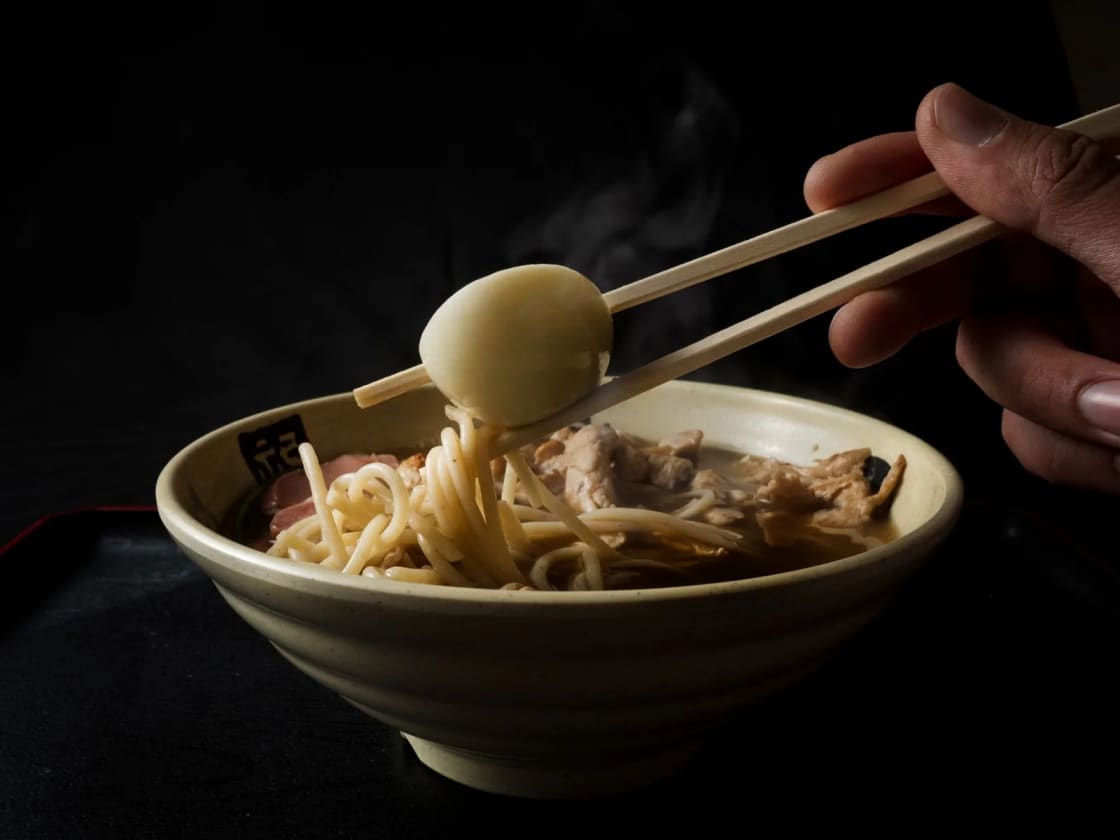
The toppings that matter. Chashu is the rolled, braised pork. Ajitama is the marinated soft-boiled egg, and it is the fastest way to judge a kitchen: the yolk should be jammy rather than set. Menma is fermented bamboo shoot. Karai on a menu means spicy.
Noodle firmness is often a choice. If you are eating in, ask for firmer than default — the noodles keep cooking in hot broth and a soft start becomes mush by the bottom of the bowl.
Making it at home
Provo has better home-ramen infrastructure than its restaurant count suggests.
Where to shop. There is an Asian Market in Provo at 24 N 500 West, open seven days including Sunday afternoons — earlier versions of this page sent readers to Orem without mentioning it. Orem's State Street also has Asian grocers, covered in our grocery guide. Between them you can buy fresh and frozen ramen noodles, miso, dashi, nori, menma and chilli oil for a fraction of what mainstream supermarkets charge for worse versions.
The upgrade path. The cheapest meaningful improvement to a packet of instant noodles is to stop using the sachet as the whole seasoning: build a base with miso or soy, add a soft-boiled egg, sliced spring onion, a spoon of chilli oil and any leftover protein. Ten minutes, and the difference is not subtle.
The long version. A true tonkotsu means a rolling boil on pork bones for many hours, which is a weekend project rather than a dinner. A shortcut worth knowing: a chicken-based chintan broth reaches a very good bowl in about two hours and is far more forgiving of a first attempt.
Ramen is the hardest thing to deliver
This is the category where delivery is most likely to disappoint, and the reason is physics rather than the kitchen. Noodles sitting in hot broth keep cooking and keep absorbing; a bowl built to be eaten immediately is soft and swollen by the time it has traveled twenty minutes, and there is no packaging fix. Ask whether broth and noodles pack separately. Some shops do it as standard for takeout and it is the single thing that makes delivered ramen worth ordering; where it is not offered, the honest expectation is a lesser bowl. Take-home or frozen kits, where a shop sells them, are a better buy than delivery — you finish the noodles yourself and get the texture the bowl was designed around. Sunday is the valley's structural problem. Delivery demand peaks on the day a large share of independent kitchens close, so a Sunday app search returns a shorter and more chain-weighted list than a Saturday one. Ramen is a walk-in food. This page's list is worth the drive.
Related Guides
- Best Asian & Sushi in Utah Valley
- Best Sushi in Provo & Orem
- Best Chinese & Asian Food
- Best Thai Food
- Best Korean Food & BBQ
- Restaurants Open on Sunday in Provo
- Student Meal Prep Guide
- Best Indian Food in Provo & Orem (2026)
- Dumpling Bao: The Chinese Kitchen Hidden Inside an Orem Grocery Store
- The Provo & Orem restaurant directory — every place we cover in these two cities, with its address, filterable by cuisine
- Best Pho & Vietnamese Food in Provo & Orem
Last updated: August 2026. Addresses and cities verified this update against current business listings; the Pleasant Grove, State Street and multiple-locations claims in earlier versions were corrected here. Hours change constantly in this category — confirm before you drive.
Frequently Asked Questions
Is there good ramen in Provo?
Where is the closest ramen restaurant to BYU?
Do I need to drive to Salt Lake City for ramen?
Which ramen shops near Provo are open on Sunday?
Why was the ramen place closed when I arrived mid-afternoon?
Where can I get pho in Provo?
Where can I get hand-pulled noodles near Provo?
What is the difference between tonkotsu, shoyu, miso and shio ramen?
Sources
The facts in this guide were checked against these sources. Hours, fees and rules change, so confirm anything time-sensitive with the source before you go. How we make Provo.com.
- Asa Ramen. Checked October 12, 2026.
- Five Sushi Brothers. Checked October 12, 2026.