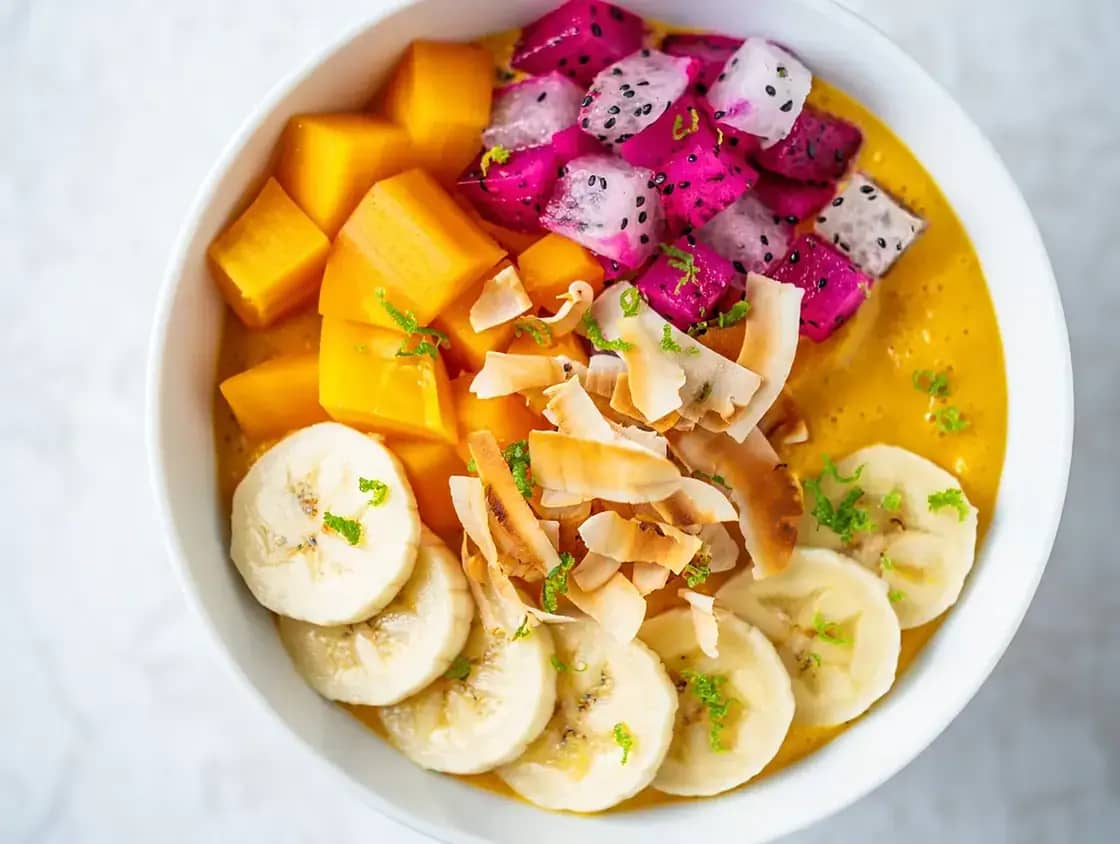

Provo drinks a lot of blended fruit, and the reason is not only the fitness culture that every guide to this subject leads with. It is also that a city where most of the adult population does not drink alcohol or coffee has to put its social ordering somewhere, and a large share of it goes into cold, sweet, customizable cups. That is the same demand the dirty soda shops serve. The smoothie bars are the health-coded half of one market.
Which makes the honest question about them more interesting than "which is best." It is: is the thing you are ordering what you think it is? The menus answer that themselves, and this guide takes them at their word.
The one thing worth knowing before you order
Read the base, not the name. A smoothie shop's own descriptions will tell you exactly what is in the cup if you look, and what is in the cup is frequently not just fruit.
Roxberry, to its credit, publishes this plainly. Its own description of one weekly special lists orange sherbet among the ingredients. Another describes a chocolate blend built on almond milk and non-fat frozen yogurt. Neither is a scandal and neither is hidden — but sherbet, frozen yogurt, sorbet and juice concentrate are standard smoothie-bar ingredients across the whole category, and a drink built on them is a dessert with fruit in it rather than a fruit drink with a treat in it.
The practical version of this, which applies at every shop in the valley:
- A build on whole fruit, milk or a milk alternative, and a protein add-in is a meal replacement and behaves like one.
- A build on juice, sherbet or frozen yogurt is a dessert, and a large one can carry more sugar than the soda across the street.
- Both are on the same board, priced within a dollar of each other, and the names give you almost no signal about which is which.
Ask what the base is. Staff at every shop named here will tell you without any fuss.
The shops
1. Roxberry Juice Co.
Smoothies, bowls and pressed juice · $ · Utah Valley locations
A reliable local option. Roxberry is Utah-based and positions itself explicitly against the category's shortcuts — its own copy says it does not believe in syrups, purees, powders and potions — which is a claim you can partly check by reading its ingredient lists, and which mostly holds up.
Check Roxberry's own locator for the store nearest you and its current hours.
The bowls come under the house granola on an acai or pitaya base.
2. Bowls Superfoods
Acai and superfood bowls · $$ · Provo
The specialist, and the omission that most needed fixing here. Bowls Superfoods ranks at or near the top of Provo's juice-and-smoothie listings and top of the listings taken from BYU's campus, and the reviews are unusually specific about the things that separate a good bowl from a scooped one: the build is generous to the rim, the toppings are treated as part of the construction rather than a garnish, and the shop makes its own variations on ingredients like peanut butter rather than buying them in.
It also handles dietary questions properly, which is rarer in this category than it should be. If you are managing coeliac disease, our gluten-free guide explains why that responsiveness matters more than a label on a menu.
3. Guru's Cafe
Cafe with a serious bowl and smoothie menu · $ · Center Street, Provo
Not a smoothie shop, and on this page anyway, because its acai bowls are among the best in the city and its smoothies are made with the same attention as the rest of a full menu.
Guru's sits on Center Street near University Avenue, the intersection Provo's address numbering runs outward from, which our University Avenue guide explains.
Check Guru's current hours before a Sunday visit.
4. Ivie Juice Bar
Smoothies, bowls and juice · $ · Provo
A local option that customers name specifically on value: reviewers comparing it against nearby shops single out the size of the bowl relative to what they paid. Worth knowing if you are ordering a bowl as an actual meal rather than a snack.
5. Jamba
National chain · $ · Provo
The predictable option, and predictability is a real feature when you are ordering for someone else or feeding a group with fixed expectations. Jamba's menu is broad, the protein-boosted builds work as meal replacements, and there is no learning curve.
Two honest notes. Compare prices for a comparable size, and check Jamba's locator rather than assuming a branch near you.
Also worth knowing
GreenMe Smoothies, Juice 'n Java and Tossd all appear in current Provo juice-bar listings and cover the smaller end of the market. On the frozen-and-sweet side rather than the fruit side, Bahama Buck's does shaved ice, and the boba shops — Coco Bubble Tea and others near campus — occupy the same cold-customizable-cup niche from a different direction.
Juice, which this page is also about and has never covered
The title says juice bars and until now the guide has been entirely about smoothies. Juice is a different product with different economics and it deserves its own paragraph.
Fresh-pressed juice is the expensive end of the menu everywhere, and the reason is mechanical rather than marketing: it takes several pounds of produce to fill a bottle, and unlike a smoothie there is no ice, no milk and no frozen base doing volume work. When a juice costs half again what a smoothie costs at the same counter, that is the fruit-to-cup ratio showing up on the receipt.
Cold-pressed and centrifugal are not the same thing. A centrifugal juicer spins a fast blade and introduces heat and air; a hydraulic press does not, which is why cold-pressed juice keeps longer and tastes less oxidized. Shops that press rather than spin generally say so, because it costs them more. Roxberry makes fresh-pressed juice, made to order, part of its own pitch.
On cleanses, this guide is deliberately non-committal. Roxberry sells them, including an original cleanse and mixed variations, and describes benefits around digestion and energy. Juice cleanses are popular and they are also one of the least well-evidenced things in mainstream nutrition — the strongest honest statement is that replacing meals with juice for a day or two is unlikely to harm a healthy adult and is not a detox in any physiological sense, since that is what a liver is for. If you have diabetes, kidney disease, are pregnant, or take medication affected by grapefruit or vitamin K, a juice-only day is a conversation for a doctor rather than a counter. We are naming the product because the shop sells it, not endorsing the claim.
The single most useful juice-bar habit is unglamorous: ask what was pressed today. Fresh juice is a same-day product, and the difference between a bottle pressed this morning and one pressed two days ago is the whole reason to buy it from a bar instead of a supermarket shelf.
What the add-ins cost you
Every shop on this page sells boosts — protein, multivitamin, collagen, greens, energy — and they are the highest-margin item on the board. Each add-in usually adds to the price, so the boosts add up quickly.
Two rules make that money work harder:
A protein boost changes what the drink is; most other boosts do not. Protein and nut butter turn a fruit drink into something that holds you for a few hours. A multivitamin scoop in a cup of sugar is a multivitamin in a cup of sugar.
Greens are cheaper as an ingredient than as a boost. A handful of spinach blended into a fruit base is invisible in flavor and free at home; ordered as a powdered add-in it is a line item.
What to order after a hike or a workout
The intro to this page invokes trail traffic, so here is the version that applies to it.
Coming down Y Mountain or off the Bonneville Shoreline in July, the drink you want is cold, liquid and salted — and no smoothie shop sells salt. A blended drink is a poor rehydration vehicle and a good recovery one: it is thick, it empties from the stomach slowly, and on a hot descent that is the opposite of what you need first. Drink water first, then have the smoothie.
For recovery specifically, the useful build is fruit plus a protein source — the carbohydrate and the protein together do more than either alone, and a bowl eaten with a spoon does it better than a drink because you eat it more slowly.
And the timing that matters most is nothing to do with the drink. In summer the trails empty by mid-morning because the heat arrives early, which means every shop on this page hits its first rush around the same time. Our hiking guide and gyms guide cover the two halves of that traffic.
Where this fits in Provo's actual drinks culture
A guide that treats smoothie bars in isolation misses the point of them here. The blended-drink market in this city has three lanes and most people use all three depending on the day.
The health lane is the one on this page.
The indulgent lane is dirty soda, and it is much larger. Swig, Sodalicious and FiiZ all run frozen and blended options alongside the sodas, and if what you want is cold, sweet and heavily customized, that is often the closer match. Our soda shop guide covers the culture properly — including the finding that Sunday opening is a store-level decision here, not a brand-level one, which catches people out constantly.
The caffeine lane runs through the cafes and the drive-through coffee chains, most of which blend. Our coffee guide maps that, and our soda shops guide covers why the caffeine question in this city is more complicated, and less doctrinal, than visitors assume.
The custom energy-drink shops — a Monster or Red Bull base built out with syrups and cream — sit somewhere between the second and third lanes. They are not smoothies by any definition, but they compete for the same order.
Making it at home, properly
The most cost-effective smoothie in Utah Valley is the one you make, and the gap is not small: a shop drink costs several times what the same build costs from a freezer bag.
The working formula: frozen fruit, a liquid, and something with protein or fat in it. Frozen banana plus berries or mango; milk, a milk alternative or juice; then Greek yogurt, protein powder, nut butter or oats. Blend. Three minutes.
The two mistakes people make. The first is using fresh fruit and ice instead of frozen fruit — ice dilutes, frozen fruit thickens, and that single swap is most of the difference between a home smoothie and a shop one. The second is skipping the fat or protein entirely, which produces a drink that tastes healthy and leaves you hungry in forty minutes.
For bowls, frozen acai packets are the ingredient to hunt for, and the larger stores plus Trader Joe's in Orem stock them near the frozen fruit. Blend a packet with barely any liquid — a bowl base should be too thick to drink — and put the money you saved into the toppings, which is where a bowl succeeds or fails.
Our grocery guide covers which Utah Valley stores carry the wider frozen and international ranges, and our student budget eating guide does the arithmetic on this kind of substitution across a whole semester.
Quick answers
- Reliable local chain: Roxberry.
- Best bowl: Bowls Superfoods.
- Bowl as part of a real meal: Guru's Cafe on Center Street.
- Most food for the money: Ivie Juice Bar.
- Know exactly what you are getting: Jamba.
- On a Sunday: verify the specific store, because in this city Sunday is a location-level decision.
Cold-pressed, raw, unpasteurized: which of those is a regulatory word
"Cold-pressed" and "raw" are marketing terms. "Unpasteurized" is close to a regulatory one, and the difference decides what a juice bar has to put on the container.
The FDA's juice rule lives at 21 C.F.R. Part 120 and was published as a final rule at 66 Fed. Reg. 6138 on January 19, 2001. Its core requirement is at Sec. 120.24(a): a juice processor must establish control measures that achieve a 5-log reduction — a hundred-thousand-fold cut — in what the regulation calls the pertinent microorganism, meaning the most resistant organism of public health significance likely to be present in that particular juice.
Most Provo juice bars are not juice processors in the sense Part 120 means. The rule carves out the retail establishment: an operation that provides juice directly to consumers and does not sell or distribute it to other businesses. "Provides" is defined broadly enough to cover storing, preparing, packaging, serving and selling. A storefront that presses oranges and hands you the cup is squarely inside that exemption and owes no HACCP plan for the juice.
The exemption is narrower than it sounds, though, and this is the part worth knowing. A retail establishment still has to comply with 21 C.F.R. Sec. 101.17(g), the food labeling rule that requires a warning statement on packaged fruit and vegetable juice that has not been processed to achieve that same 5-log reduction. That requirement has been in force since September 8, 1998 for apple juice and cider and November 5, 1998 for everything else. Juice that has been treated to the standard is outside it.
So the line is not raw versus pasteurized in the abstract. It runs between the cup and the bottle:
- A drink poured to order and handed across the counter is not packaged juice, and the warning statement provision is aimed elsewhere.
- A bottle in the cold case is packaged. If it has not been treated to the 5-log standard, the warning belongs on it — and a shop that sells its cold-pressed line in bottles has stepped into that requirement even though it is still a retail establishment for HACCP purposes.
- A shop that starts wholesaling to a cafe or a gym has stopped being a retail establishment altogether and has walked into Part 120 proper.
Two things this does not tell you. It says nothing about whether unpasteurized juice is bad for you — the rule exists because juice is a recognized vehicle for pathogens and the population most at risk is small and specific, not because fresh juice is generally unsafe. And it says nothing about nutrition, which is a separate argument entirely and one where "cold-pressed" carries no regulatory meaning at all.
If you are pregnant, immunocompromised, elderly, or buying for a young child, the practical move is to read the bottle rather than the chalkboard, and to ask whether a poured drink was made from treated or untreated juice. Good shops answer that instantly, because it is a question they have already had to think about.
Smoothies, delivery and the separation problem
Smoothies deliver better than ice cream and worse than most food. A blended drink starts separating the moment it stops moving: the heavier fruit settles, the ice melts into the top layer, and what arrives after twenty minutes is drinkable but thinner and less cold than what left. Shake it before you judge it — a good part of that is reversible. Açaí bowls and anything with a topping fare worse, because the granola softens into the base. Juice travels better than anything blended, since there is no ice structure to lose. Sunday is the valley's structural problem. Delivery demand peaks on the day a large share of independent kitchens close, so a Sunday app search returns a shorter and more chain-weighted list than a Saturday one. The morning window matters here too: several places on this page are built around a pre-work and pre-class rush and close far earlier than a restaurant would.
Related Guides
- Best Healthy & Clean Eating Restaurants
- Best Coffee & Cafe Spots
- Soda Shops & Dirty Soda Guide
- Eating on a Student Budget
- Best Grocery Stores in Provo
- Gluten-Free Restaurants in Provo
- Best Gyms & Fitness Options
- Best Ice Cream in Provo & Orem
- Boba in Provo & Orem: Why Utah Valley Has So Much of It, and How to Order Properly
- Drinking in Provo: Utah's Alcohol Laws, Where to Drink & Why There's No Happy Hour (2026)
- The Provo & Orem restaurant directory — every place we cover in these two cities, with its address, filterable by cuisine
Ingredient observations are quoted from Roxberry's own published flavor descriptions. No prices, addresses or hours are printed, because they change: confirm the specific location and its hours, especially on Sunday, which in Utah Valley each store sets independently of the brand.
Frequently Asked Questions
Where can I get a good smoothie in Provo?
Where are the best acai bowls in Provo?
Is a smoothie healthier than a soda?
Which smoothie shops in Provo are open on Sunday?
Is Roxberry a Utah company?
What is the cheapest way to get a smoothie in Provo?
What is the difference between acai and pitaya bowls?
Where can I buy acai to make bowls at home?