
Thai is quietly the deepest restaurant category in Utah Valley, and almost every list written about it dramatically undercounts it, and this guide used to be one of them.
Search Provo alone and you will surface ten or more Thai kitchens without leaving the city limits: Thai Simple Dish, Silver Dish, Thai Time, Thai Papaya, Spicy Thai, Golden Thai, Thai Evergreen, Savory Thai, Thai Village, Thai Neighbor. Add Orem, Lindon and Lehi and the count keeps going. For a metropolitan area this size, in a state not historically known for Southeast Asian food, that is an unusual concentration.
This guide covers the rooms worth driving to, what separates them, and the two practical things — heat calibration and closing days — that determine whether your Thai dinner happens.
The rooms worth knowing
Thai Simple Dish
300 South, Provo · $$
A small, family-run kitchen a few blocks southeast of downtown, and the one most often named first by people who eat a lot of Thai food here. The operation describes itself plainly — a Thai family cooking Thai food — and the output matches: curries with actual depth, properly balanced noodle dishes, and a kitchen willing to take a heat request seriously.
It is modest in scale and presentation. That is not the point. This is the room to send someone to when they say Utah Valley cannot do real Thai.
What to order: the curries, particularly the massaman, and the crispy pork dishes. Note the closing day. Thai Simple Dish is shut on Mondays, which is the most common way people miss it.
Thai Papaya Cuisine
University Parkway, Provo · $$ · near BYU
The student-budget standard, and it has held that position for years without coasting. Thai Papaya serves the full range of classics — pad Thai, pad see ew, yellow and red curries, tom yum — at prices calibrated to a campus population, with lunch specials that are the best value in the category.
Heat levels are adjustable and the kitchen honors the request. Asking for Thai spicy here produces Thai spicy.
What to order: pad see ew, yellow curry, or whatever the lunch special is.
Bangkok Wasabi
124 S State St, Suite C, Orem · $$ · closed Sundays
The most useful room on this list for a mixed group, because it runs two full menus — Thai and Japanese sushi — out of one kitchen at a consistently high standard. The curries are legitimate rather than an afterthought bolted onto a sushi bar; the Massaman in particular gets singled out repeatedly, and the sushi side is not a compromise.
If half your party wants drunken noodles and the other half wants a dragon roll, this solves an argument that has no other good answer in the valley.
What to order: Massaman or pad kee mao on the Thai side, and let someone else order sushi. Address correction. Older listings — ours included — placed Bangkok Wasabi on Center Street. It is on South State Street in Orem, in a small plaza. The operator's own site, its social accounts and the delivery platforms all agree on 124 S State St.
Silver Dish Thai Cuisine
278 W Center St, Provo · $ · downtown
Downtown Provo's Thai option, family-owned, made to order, and one of the most consistently well-reviewed Thai kitchens in the city. It is casual and unfussy — this is a neighborhood restaurant rather than a destination — and it delivers, which matters more in this category than it does in most.
What to order: pad Thai and the massaman curry are the dishes regulars keep returning for.
Thai Evergreen
University Parkway, Orem · $ · family-run
An Orem long-runner on University Parkway with a large review base and a reputation built on volume of regulars rather than any single signature dish. Prices sit at the low end of the category. If you are in Orem and want Thai without a decision, this is the default.
Thai Time Provo
Cougar Boulevard, Provo · $$
Close to campus on Cougar Boulevard, and a useful alternative when Thai Papaya has a line — which, at lunch during term, it will.
And the ones on the edge of the map
Two places get named in valley Thai conversations that sit outside Provo and Orem, and both are worth the drive if you are already north.
Baan Thai, in the Traverse Mountain area of Lehi, is roughly a twenty-minute drive from Provo and gets described as the most polished traditional Thai room in Utah Valley — higher price point, more careful plating, a step up in atmosphere. Treat it as a special-occasion trip rather than a weeknight one, and note that it is a Lehi restaurant appearing on a Provo-and-Orem list for a reason: nothing in the two cities occupies quite that slot.
Thai Drift in Lindon comes up regularly in local recommendations and sits between the two clusters.
Heat: the thing everyone gets wrong
Thai restaurants across Utah calibrate spice for a local palate that trends mild. This is not a criticism of the kitchens — it is a rational response to their actual customers — but it does mean the number on the menu is not the number you think it is.
Medium at most Utah Valley Thai restaurants is mild in Thailand. If you want heat, the phrase that works is "Thai spicy," said explicitly, ideally with a note that you mean it. Thai Simple Dish, Thai Papaya and Bangkok Wasabi will all deliver genuine heat when asked.
The corollary matters too: if you do not like heat, you are safer here than almost anywhere, because the default is already conservative. Order medium and you will be comfortable.
A word on ordering heat you cannot handle. A kitchen that takes your request seriously will take it seriously. Escalate one level at a time across visits rather than jumping to the top on a first order, particularly with the salads and larb dishes, where the chilies are not cooked down.
The closing-day problem
This is the practical thing that ruins more Thai dinners in Utah Valley than any question of quality, and no list covers it properly.
Thai restaurants here do not close on a common day. Bangkok Wasabi is shut Sundays. Thai Simple Dish is shut Mondays. Others take a different day again, or close between lunch and dinner service, or shut early on a slow weeknight. There is no valley-wide pattern to memorize, because these are individually owned small businesses making individual staffing decisions.
The practical rule: check the specific restaurant, not the category. Assuming "Thai is open Sunday" or "everything's closed Monday" will get you wrong about half the time. And because Utah Valley's Sunday closure norm is real but not universal, Sunday is the day where the guesswork is worst — our Sunday dining guide covers which categories of restaurant are structurally reliable.
What to order
Most people order pad Thai forever because it is the one name they know. It is also, at most restaurants, the least interesting thing on the menu — the dish calibrated hardest toward an American palate. Here is what the rest of the menu is.
The curries. Thai curries are built on coconut milk and a chili paste, and they differ mainly in what goes into the paste.
- Green is usually the hottest of the three standards — fresh green chilies, bright and herbal.
- Red is milder and rounder, built on dried red chilies.
- Yellow is the gentlest, with turmeric and cumin, closest to what most people picture as curry.
- Massaman is the outlier and the one to order if you order one: sweet, mild, thick with peanut and potato, and carrying warm spices that come from Persian and Indian trade rather than from Thailand. It is the dish that most reliably separates a good valley kitchen from an average one.
- Panang sits between red and massaman — thicker, sweeter, less soupy.
The noodles.
- Pad see ew — wide flat rice noodles charred in a hot wok with dark soy and Chinese broccoli. Savory rather than sweet. If pad Thai bores you, order this.
- Pad kee mao, drunken noodles — the same wide noodles with chili and holy basil. The spicy noodle dish.
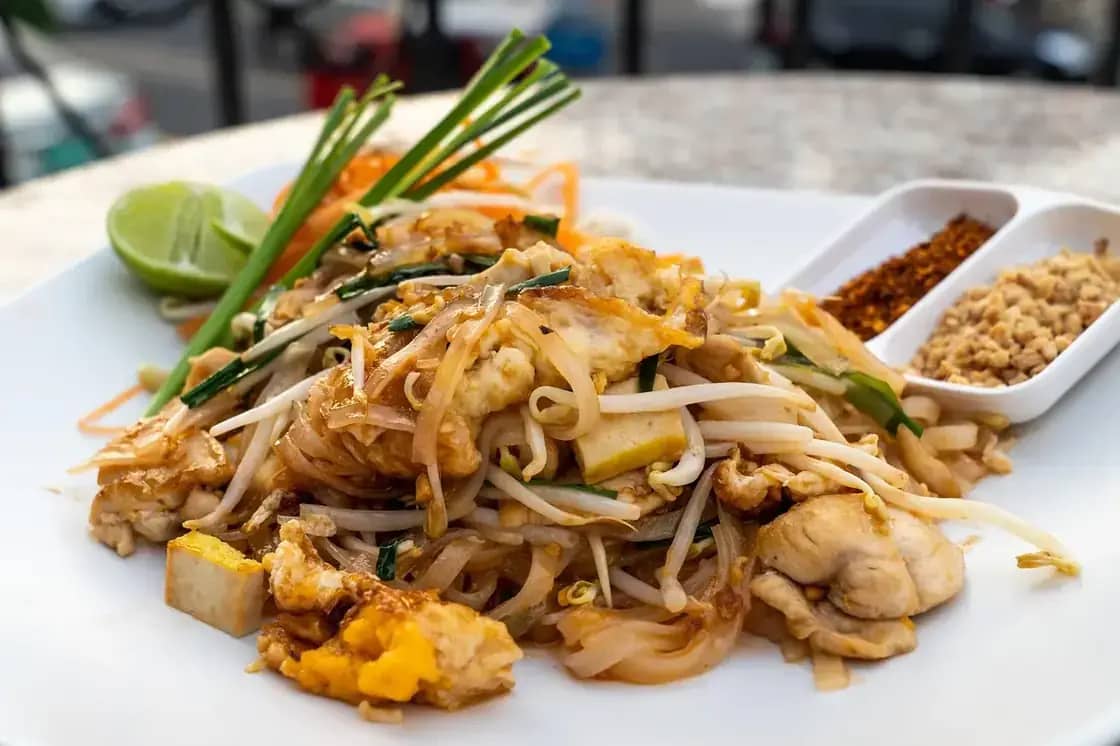
- Pad Thai — thin rice noodles, tamarind, egg, peanut. Fine, and better at some of these kitchens than others.
- Khao soi — northern Thai curry noodle soup, crisp noodles on top of soft. Rarely on valley menus. Order it when you see it.
The soups and salads.
- Tom yum — hot and sour, lemongrass and lime leaf, sharp and clean.
- Tom kha — the coconut-milk version, mellower and richer.
- Som tum, green papaya salad — shredded unripe papaya, lime, fish sauce, chili, pounded in a mortar. Genuinely spicy in a way the cooked dishes are not, because nothing gets tamed by heat.
- Larb — minced meat with lime, chili and toasted rice powder. Isan food from northeastern Thailand, and one of the best things on any menu that carries it.
Dessert. Mango sticky rice when mango is in season, which is not always. Fried banana with ice cream year-round.
Ordering for a table
Thai food is built to be shared, and ordering it the way most Americans order — one entree each — produces a worse meal than the same money spent well.
The structure that works for four people: one curry, one noodle dish, one stir-fry, one salad or soup, and rice for the table. That gives you contrast across sweet, sour, salty and spicy, which is the point of the cuisine. Four individually ordered pad Thais give you one flavor four times.
Two more things worth knowing. Order the salad or the larb spicier than the rest — those dishes are supposed to carry the heat, and keeping the curries moderate means everyone can eat everything. And order rice separately and generously; jasmine rice is usually included with entrees but never enough for a shared table, and sticky rice is worth ordering if the kitchen has it.
On takeout. Thai travels better than most cuisines, with two exceptions: anything fried loses its texture within fifteen minutes, and pad see ew suffers because the wok char does not survive a steaming container. Curries and soups are as good at home.
Lunch specials are the value play
Nearly every Thai restaurant in the valley runs a lunch special — a smaller portion of a main dish with rice, at a meaningful discount on the dinner price, typically served on weekdays until mid-afternoon.
This is the best value in Utah Valley dining, full stop. It is a full plate of made-to-order food for less than most fast-casual chains charge for a bowl. If you have flexibility at midday, the lunch menu is the reason to use it.
Portions are smaller than dinner, which is worth knowing if you are ordering for someone hungry rather than for yourself.
The mid-afternoon gap
Alongside closing days, the other scheduling trap is the split shift. A number of Utah Valley's independent Thai kitchens close between lunch service and dinner service — commonly somewhere in the 2:30 to 4:30 window — and reopen for the evening.
This is standard practice for small family-run restaurants everywhere and it is not a sign of anything wrong. It does mean that a three o'clock Thai craving is the least likely to be satisfied of any hour in the day, and that a late lunch needs checking more carefully than a late dinner.
The kitchens that run continuously through the afternoon tend to be the ones with larger staffs or a strong delivery business. If you need mid-afternoon specifically, that is the thing to look for.
Where Thai sits in the valley's Asian food
Utah Valley's Asian restaurant scene is deeper than its reputation, and the categories are not interchangeable. A quick orientation if you are choosing between them:
Thai is the strongest category for shared tables, for vegetarians, and for anyone who wants heat available on request. It is also the most consistently affordable at lunch.
Sushi and Japanese is the deepest category by sheer count, and the one with the widest quality range — see our Asian and sushi guide.
Ramen is a smaller, more specialized field where a few rooms do it seriously; our ramen guide sorts them.
Chinese is the largest category by number of storefronts and the most variable, covered in our Chinese and Asian food guide.
Korean and Vietnamese are the thinnest fields locally but include some of the valley's best individual restaurants.
If you are cooking a decision down to one line: Thai for a group, sushi for a date, ramen for a cold night, Chinese for takeout volume.
Vegetarian and gluten-free
Thai is one of the strongest cuisines available for both, and Utah Valley's Thai restaurants are more accommodating than most categories here.
Vegetarian. Tofu substitution is standard across every restaurant on this list. Green papaya salad, vegetable curries and pad Thai with tofu are substantial mains rather than side dishes. The thing to ask about is fish sauce, which appears in many dishes that read as vegetarian — most kitchens will leave it out on request, and a strict vegetarian should say so rather than assume.
Gluten-free. Rice noodles and rice make Thai naturally easier than most cuisines, and several valley Thai restaurants are specifically flagged by gluten-free diners as reliable, with a number marking gluten-free items on the menu. Soy sauce is the usual hidden source; ask, and most kitchens will adapt. For dedicated gluten-free operations in the valley, our gluten-free guide covers the kitchens built for it.
Rice, curry, and the clock a kitchen is allowed to run instead of a thermometer
Thai kitchens hold more finished food at once than almost any other format in this valley — rice in a warmer, curries in inserts, sauces prepped in the morning for a dinner rush — and there is a specific provision of the Food Code that governs the alternative to holding everything hot or cold. It is worth knowing because it explains what "made fresh" can and cannot mean on a lunch line.
Utah runs on the 2022 FDA Food Code by way of Utah Admin. Code R392-100-4. The default is § 3-501.16: time/temperature control for safety food is held at 135°F or above if hot, or 41°F or below if cold. The alternative is § 3-501.19, time as a public health control, and it is a real option rather than a loophole — but it comes with conditions that a kitchen either meets or does not.
Written procedures must exist before the fact. Paragraph (A) requires that where time alone rather than time with temperature is used as the control, written procedures be prepared in advance, maintained in the establishment, and made available to the regulatory authority on request, specifying the methods of compliance and how food that is prepared, cooked and refrigerated before time control begins will still meet the cooling rule.
The four-hour option. Under ¶ (B), food starts at 41°F or below coming out of cold holding or 135°F or above coming out of hot holding; it is marked to show the time four hours after it left temperature control; and it is cooked and served, served as is if ready-to-eat, or discarded within four hours. Food in unmarked containers, or marked beyond four hours, is discarded.
The six-hour option. Under ¶ (C), food starts at 41°F or below, its temperature may not exceed 70°F at any point in the window, and it is served or discarded within six hours or on reaching 70°F, whichever comes first.
That is the whole mechanism, and the useful thing about it is that it is observable. A container of prepped food with a time written on the lid is a kitchen running § 3-501.19 correctly. A steam table sitting at temperature is a kitchen running § 3-501.16. Both are legitimate; the failure mode is the third option, which is neither.
The rice question, answered properly
Cooked rice held warm is the textbook Bacillus cereus problem, and it is worth being precise about why. The organism forms spores that survive boiling. Cooking does not eliminate them; it removes the competition. If cooked rice then sits in the temperature range between refrigeration and hot holding, the spores germinate, and one of the toxins produced is heat-stable — meaning reheating the rice later kills the bacteria and does not destroy the toxin. This is the single clearest illustration of a principle that runs through the entire Food Code: the hazard is usually cooked food held badly, not raw food.
The rule follows from the biology. Rice held hot sits at 135°F or above. Rice cooled for tomorrow follows the two-stage rule at § 3-501.14 — 135°F to 70°F within two hours, then to 41°F within four more, six hours total. Rice under time control is marked and discarded on schedule. A rice cooker on "keep warm" in a home kitchen is a different risk profile from a commercial warmer, which is the practical reason takeaway rice should go in the refrigerator rather than staying on the counter while you finish the curry.
Heat, chilies and the thing the code does not regulate
Nothing in the Food Code has an opinion about spice level, and it is worth saying plainly because the two questions get tangled. Thai heat scales — the "Thai hot" that Utah Valley menus render as a number from one to five — are a service convention rather than a standard, and they are calibrated per restaurant. A four at one room in Orem is a two at another. The only reliable approach is to order low the first time at a new kitchen and adjust upward, which is advice about palate rather than safety.
What the code does have an opinion about is raw and undercooked animal food, which shows up on Thai menus in a couple of places people do not expect: larb served rare in the traditional style, and raw shrimp in some salads. Under § 3-603.11 those require the two-part consumer advisory — a disclosure identifying the items and a reminder about the increased risk. And any raw fish served ready-to-eat has to have cleared the parasite-destruction freeze at § 3-402.11, covered in more detail in our seafood guide.
The practical summary for ordering here: the kitchens in this guide that visibly mark and time their prep containers are running a documented system, and the ones with a properly hot steam table are running the other one. Both are fine. Rice is the item worth eating soon rather than later, and the fastest way to improve a takeaway order is to put it in the refrigerator the moment you are done rather than after the film. For the permitting layer, see food permits and inspections in Utah County.
Thai Food and the Delivery Drive
Thai is one of the better cuisines to have delivered here, with a couple of specific exceptions that are worth knowing before you order.
Curries travel very well. They are already a sauce, they hold temperature, and twenty minutes in a container does them no harm at all. Noodle dishes are mostly fine, though they continue to absorb sauce on the way, so a dish that was perfectly balanced at the restaurant can arrive slightly drier and softer. Ordering a little extra sauce on the side fixes it.
What suffers is anything fried and anything fresh. Spring rolls go soft. Fresh rolls with rice-paper wrappers dry out and stick to each other. Crisp-fried fish or tofu arrives steamed.
The detail most people lose in an app order is heat level. Spice numbering is not standardized between kitchens here, and it is the single most common source of a disappointing Thai order. In person you can ask what a given number means at that restaurant, and you can say so if you are ordering for someone who cannot handle it. In an app you are picking a number off a dropdown and hoping the kitchen shares your definition. If you are ordering from a kitchen for the first time, order a step milder than you think you want, and adjust on the next order once you know their scale.
Rice is worth ordering generously. It is inexpensive, it survives the trip perfectly, and it rescues a curry that arrived hotter than expected.
Our food delivery guide covers how the platforms work in Utah Valley, including why a restaurant showing as listed is not always a kitchen that is open.
Related Guides
- 30 Best Restaurants in Provo
- Best Restaurants in Orem
- Best Indian Food in Provo & Orem
- Best Food Near BYU
- Best Ramen in Provo
- Best Asian & Sushi in Utah Valley
- Haveli Modern Cuisine: North Indian Cooking on Orem's State Street
- Pupusas and Salvadoran Food in Provo: Where to Go and What to Order
- The Provo & Orem restaurant directory — every place we cover, with its address, filterable by cuisine and city
- Best Pho & Vietnamese Food in Provo & Orem
Frequently Asked Questions
What is the best Thai restaurant in Provo?
How many Thai restaurants are there in Provo and Orem?
Is Thai food spicy in Provo?
Where can I get cheap Thai food near BYU?
Where is Bangkok Wasabi in Orem?
Are Thai restaurants in Provo open on Sunday?
Is Thai food a good option for vegetarians in Utah Valley?
Can you get gluten-free Thai food in Provo?
Sources
The facts in this guide were checked against these sources. Hours, fees and rules change, so confirm anything time-sensitive with the source before you go. How we make Provo.com.
- Food Code 2022, U.S. Food and Drug Administration. Checked October 12, 2026.
- Silver Dish Thai Cuisine. Checked October 12, 2026.
- Bangkok Wasabi. Checked October 12, 2026.