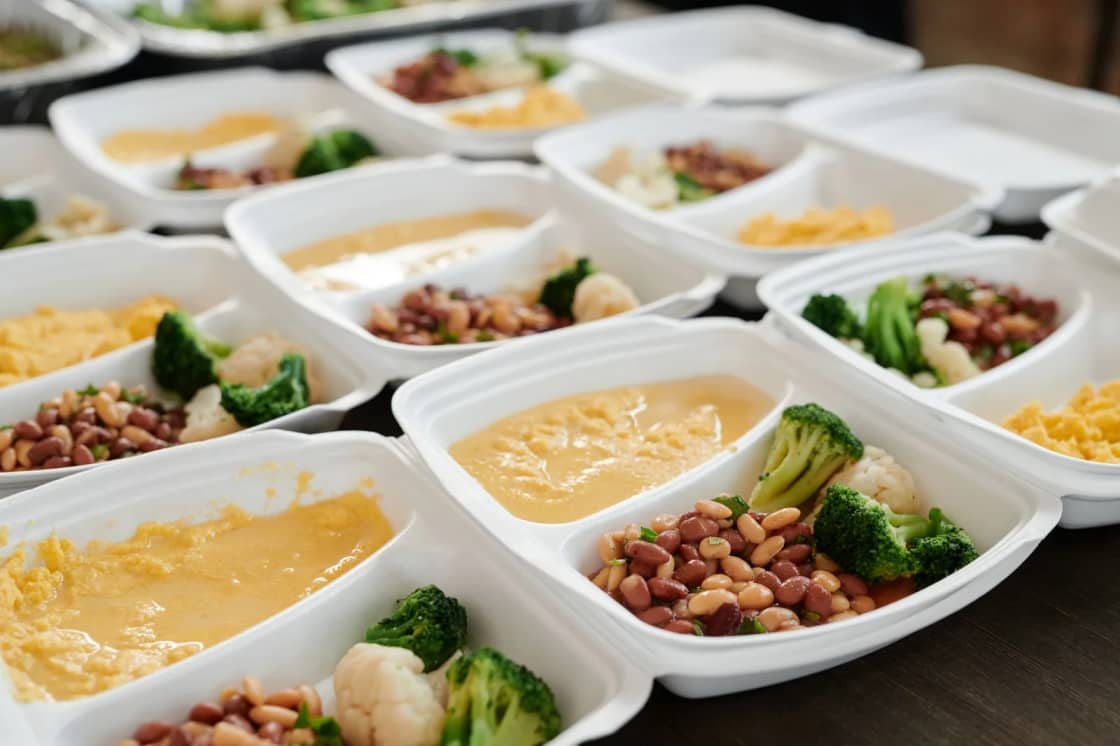

Meal prep is the highest-return habit available to a student, and it is not close. Cooking two or three components once a week instead of buying lunch five times cuts a food bill by a large fraction, and over four years the difference is a semester of rent.
Every guide says that. What almost none of them do is survive contact with 2026 grocery prices, or with the fact that some students cannot cook at all where they live, or with the question of what to do when the budget does not stretch.
This one is written for Provo specifically, and it is built to still be true a year from now.
Why This Page Does Not Lead With Prices
The title says $200 a month because that is the question people search, and it is a reasonable target for one person cooking most meals at home. But a published per-serving price is a fossil with a timestamp nobody can see. Grocery prices move, promotional prices revert, and a guide that tells you a meal costs $1.50 is telling you what it cost when someone wrote the sentence.
What does not move is the ratio. Whatever your total is, a student grocery budget splits into roughly the same shape:
| Category | Share of the weekly spend | Why |
|---|---|---|
| Protein | The largest single line, usually a quarter to a third | Meat, eggs, dairy protein and tofu are the expensive calories |
| Produce | Next largest, around a fifth to a quarter | Frozen is cheaper than fresh and keeps the number down |
| Grains and starches | The smallest line, often barely a tenth | Rice, oats, pasta and potatoes are the cheapest calories sold |
| Dairy, fats and pantry | Roughly a tenth to a seventh | Oil, butter, cheese, spices, condiments |
| Everything else | Whatever is left | Snacks, drinks, the thing you forgot |
Use it as a diagnostic. If protein is eating half your budget, that is the line to work on, and the fix is not shopping harder — it is swapping two meat dinners a week for bean dinners. If snacks are a quarter of it, that is a different problem with a different fix.
Build your own number from one real receipt. Shop a normal week, keep the receipt, sort it into those five buckets. That takes ten minutes and it beats any figure published on the internet, including this one.
First: Can You Actually Cook Where You Live?
This is the question every meal prep guide skips and it decides whether the rest of the page applies to you.
Helaman Halls is traditional dorm housing with a required meal plan. There is no in-unit kitchen. If you are living there, meal prep in the sense this page means is not available to you, and the useful version of this guide for you is the shopping section — bulk oats, fruit and snacks to fill the gaps between dining-hall hours.
Heritage Halls is apartment-style with a kitchen and an optional meal plan. This is why the choice between the two buildings is usually described as a choice about food rather than about social life. If you intend to cook, that is the one.
Off-campus contracted housing almost always has a kitchen, though a shared one, and often a single fridge for six people — which quietly caps how much you can batch at once. Our BYU student guide covers the housing options, and college move-in covers what to buy once you know.
The practical instruction: read the kitchen clause of your specific contract before you buy a rice cooker. A shared fridge with one shelf per person is a different meal prep problem than a private kitchen, and it is solved with more frequent, smaller batches rather than one big Sunday cook.
Where to Shop, in Order of Cheapness
The bulk tier
WinCo Foods is the standard answer for staples, and it earns it: bulk bins for rice, beans, oats, pasta, flour, nuts and spices at per-unit prices the conventional chains do not match. Bulk bins also let you buy a spice in the quantity you will use rather than a jar you will throw out in three years.
Two things to know before the first trip. The nearest WinCo is in Orem, not Provo, so it is a drive or a bus ride rather than a walk. And WinCo does not take credit cards — cash and debit only, which has stranded more than one student at the till with a full cart.
The home storage centers are the resource almost nobody tells students about. The Church of Jesus Christ of Latter-day Saints operates them selling long-shelf-life bulk staples — wheat, oats, flour, rice, pasta, beans, dried milk and similar — largely in number-ten cans at prices that are hard to match anywhere. The home storage side is open to the public and is not restricted to members of the Church. Utah Valley has two: one at 940 W Center Street in Lindon and one at 1672 W 700 South in Springville.
Two warnings. The Lindon center is closed Friday and Sunday, which is not what anyone expects from a grocery-type building and sends people on a wasted trip. And number-ten cans are a serious quantity — economical if you split them with roommates or have somewhere to store them, and a waste of money if a case of dried beans is going to sit under your bed for two years. Our grocery stores guide covers the hours and the rest of the landscape.
The weekly-shop tier
Macey's is the local chain most students under-use, and it is worth knowing why it exists: it belongs to Associated Food Stores, a Utah retailers' cooperative, which is why its pricing and its case lot sales behave differently from a national chain. Case lot sales — bulk pricing on canned and dry goods a couple of times a year — are the single best restocking event on the local calendar if you can time a pantry build to them.
Smith's runs weekly produce deals worth checking through the app, and Walmart covers the gaps.
Costco and Sam's Club make sense only if roommates split a membership and you have somewhere to put a case of anything. Run that conversation before anyone pays for a card.
The seasonal tier
The farmers markets in Provo and Orem run summer into October and are better value than their reputation suggests, particularly late in the morning as vendors clear stock. They accept SNAP/EBT, and a matching program stretches those benefits on fresh produce — the Orem market's operator states you can get up to $20 of free Utah-grown produce per market day on top of what you load, and Utahns Against Hunger describes the statewide program as a dollar-for-dollar match capped at twenty dollars per market day. You take it as tokens at the information booth, and the matched portion is produce-only while your base tokens cover the wider range. Our Orem farmers market guide has the schedule and the mechanics; confirm current match terms at the booth, since they are funded season to season.
One Provo-specific timing note
Plan the shop for Saturday, not Sunday. A large share of this city closes on Sunday, and the grocery landscape is split — Macey's broke a roughly seventy-year closed-on-Sunday tradition in 2017, while Ream's still closes. A Sunday cooking session works fine. A Sunday shopping trip is a coin flip, and our Sunday guide exists because the fallback is not obvious either.
The System
The weekly cook
Give it two hours once a week — Sunday is traditional here because the city is quiet and nothing else is competing for the time.
The template is four components, not seven dinners:
- A large batch of protein. Chicken thighs, ground turkey, or a pot of beans.
- A large batch of a grain. A rice cooker full of rice, or a pot of pasta.
- A sheet pan of vegetables. Whatever was cheapest — broccoli, sweet potatoes, peppers, onions, carrots.
- Grab-and-go items. Hard-boiled eggs, cut fruit, portioned nuts.
Those four recombine into rice bowls, pasta, wraps, fried rice, quesadillas and salads without producing the same plate twice. This is the entire method. Everything else on this page is detail.
The failure mode is ambition. Three or four recipes on rotation beats seven, every time. Meal prep does not collapse because the food is boring; it collapses because week two required a shopping list of nineteen items.
Recipes, Ranked by Cost per Serving
Cheapest first. The ordering is durable even when the prices are not.
Overnight oats. Oats, milk, yogurt and fruit mixed the night before and eaten cold. No cooking, no morning decisions, and by a wide margin the cheapest breakfast available.
Black bean quesadillas. Canned or cooked beans, cheese, tortillas, salsa. Five minutes, endlessly variable, and the cheapest hot meal on this list. Add rice to make it substantial.
Chili or bean soup. Cooks in one pot, freezes well, costs almost nothing per serving from dried beans, and improves for three days.
Fried rice. Day-old rice, eggs, frozen mixed vegetables, soy sauce. The leftover transformer. High heat and a pan that is not crowded are the only technique that matters.
Pasta with meat sauce. Ground turkey or beef, jarred marinara, pasta. Double the batch and freeze half. Frozen spinach stirred in disappears completely.
Chicken rice bowls. Chicken thighs cooked with soy sauce and garlic over rice with roasted broccoli. Thighs rather than breasts — cheaper, more forgiving, better reheated.
Sheet-pan chicken and vegetables. Chicken pieces, whatever vegetables are on sale, oil, seasoning, one pan at 400°F for about half an hour. Most food, least washing up.
Equipment
Six items cover nearly all of it:
- A rice cooker — the best single purchase a student cook makes. Also does oatmeal, quinoa and steamed vegetables, and it does them while you are not in the room.
- One large skillet, twelve inches, nonstick or cast iron.
- One pot for pasta, soup and beans.
- A sheet pan.
- One decent knife and a cutting board. This is the item to buy better than you think you need; a drawer of cheap knives is worse than one good one.
- Storage containers, microwave-safe.
Buy the bulky things after you arrive rather than shipping them — Walmart, WinCo, Target in Orem, IKEA in Draper and local thrift stores all cover it, and thrift stores in a college town in August are unusually well stocked with exactly this list. Coordinate with roommates first or you will end up with four sheet pans, three microwaves and no pot.
When the Budget Does Not Stretch
This section is the one most guides leave out, and it is the one that matters most. Food insecurity among university students is common, under-reported, and has nothing to do with being bad at budgeting.
The SNAP rule that catches students out
Most people assume that a low income is the whole test. For students it is not.
Under federal regulation, individuals aged 18 to 49 who are enrolled at least half-time in an institution of higher education are generally ineligible for SNAP unless they meet a specific student exemption — and the institution, not the government, decides what counts as half-time.
The permanent exemptions include, among others:
- Working an average of 20 or more hours a week, paid
- Participating in state or federally financed work-study
- Being responsible for a dependent child under a qualifying age
- Single parents enrolled full-time caring for a child under 12
- Receiving TANF assistance
- Having a physical or mental disability
- Being under 18 or 50 or older
- Placement through SNAP Employment and Training or a qualifying workforce program
Two important corrections to advice you will find online. First, if you are enrolled less than half-time, the student restrictions do not apply to you at all — you are assessed like any other applicant. Second, the two temporary pandemic-era exemptions that opened SNAP to students eligible for work-study or with a zero expected family contribution have lapsed, so a great deal of guidance published between 2021 and 2023 describes rules that no longer operate.
Utah administers SNAP through the Department of Workforce Services, with benefits loaded onto a Horizon card. Apply there and let them assess you rather than deciding in advance that you do not qualify — the exemption list is longer than most students realize, and a 20-hour campus job clears the most common one.
Campus and community food help
Utah Valley University runs an on-campus food pantry through its student care office, in partnership with Community Action Services and Food Bank, open to students, faculty and staff. It stocks shelf-stable food, hygiene items and some baby supplies including formula and diapers. UVU also runs:
- Fresh Food Fridays, a free pop-up produce market for students, stocked with produce grown on campus in the GRIT Garden and fruit gleaned from local trees.
- A mobile pantry that visits UVU's satellite campuses so students who never set foot on the Orem campus are not excluded.
- A delivery option run with United Way and DoorDash for students living within about ten miles of the Orem campus, by application.
Notably, the UVU pantry does not accept direct food donations — donations go to Community Action Services, which processes everything and stocks UVU based on need. That is worth knowing if you want to help rather than be helped.
Community Action Services and Food Bank, at 815 S Freedom Blvd in Provo, has operated since 1967 and is the largest food bank serving Utah, Wasatch and Summit counties. It serves the county regardless of which institution you attend, and its published pantry hours have changed more than once recently and are not consistent across its own pages, so call before you go. The Food & Care Coalition at 299 E 900 S in Provo serves meals and runs day services.
Our volunteering guide covers both organizations from the other side, for anyone with a spare shift rather than an empty cupboard.
One framing worth stating plainly: using a campus pantry while you sort out a semester is what the pantry is for. Students who use these resources report better grades and attendance than students who go without and try to power through, which is the entire reason universities fund them.
Common Mistakes
Cooking too much variety. Three or four recipes on rotation. Boring consistency beats ambitious burnout.
Ignoring frozen vegetables. Cheaper, longer-lasting, and nutritionally comparable to fresh. Keep broccoli, mixed vegetables, spinach and corn in the freezer permanently.
Building the plan around a fridge you do not have. Six roommates and one fridge means smaller, more frequent batches. Check the shelf before you cook for five days.
Not using leftovers forward. Sunday's chicken is Monday's rice bowl, Tuesday's quesadilla filling and Wednesday's fried rice. One cooking session, four different meals.
Treating food as the only variable. Eating is one part of staying functional through a semester; our student health and wellness guide covers the campus health centers, counseling and sleep side of it.
Related Guides
- Eating on a Student Budget
- Best Grocery Stores in Provo
- Student Discounts & Deals
- Best Food Near BYU
- Cost of Living in Provo
- Student Health & Wellness
- Do You Actually Need a Car as a Student in Provo? (2026)
- The BYU Guide to Provo: housing, food, game days and campus
- The UVU Guide: commuting, housing in Orem and student life
- Student Budget Calculator — see what your grocery line has to be for the semester to close
Last updated: August 2026. SNAP eligibility rules, pantry hours and store hours all change — confirm with the Utah Department of Workforce Services, the university, or the store before relying on any of it. This page deliberately publishes budget ratios rather than per-serving prices, because the ratios keep working and the prices do not.
Frequently Asked Questions
How can I eat well on a student budget in Provo?
Can I meal prep if I live in BYU on-campus housing?
Where should I buy groceries on a student budget in Provo?
Are students eligible for SNAP in Utah?
Is there a food pantry for students in Utah Valley?
What kitchen equipment does a student need?
What are the cheapest meals to cook in Provo?
Do Provo farmers markets take EBT?
Sources
The facts in this guide were checked against these sources. Hours, fees and rules change, so confirm anything time-sensitive with the source before you go. How we make Provo.com.
- 7 CFR 273.5 Students, eCFR / USDA Food and Nutrition Service. Checked October 12, 2026.