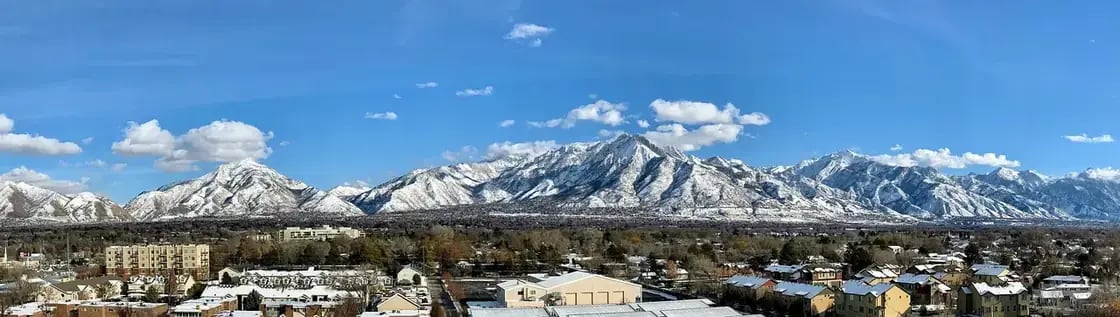

If you're considering a move to Utah, the Provo vs. Salt Lake City question comes up fast. They're only 45 miles apart on I-15, share the same mountain backdrop, and are connected by FrontRunner commuter rail — but they feel like different worlds in many ways. Salt Lake is a mid-size city with urban energy, cultural diversity, and a growing national profile. Provo is a smaller city with a university-town identity, a family-oriented culture, and mountain access that's hard to beat.
Neither is objectively "better." The right choice depends on what you're optimizing for. This guide compares the two across the factors that matter when choosing where to live.
Cost of Living
Housing
This is where the difference hits hardest.
| Metric | Provo | Salt Lake City |
|---|---|---|
| Typical home value | Lower — see our 2026 market analysis for the range and why estimates differ | Higher |
| Median rent, 1BR (ACS 2024) | $998/mo | $1,296/mo |
| Median rent, 2BR (ACS 2024) | $1,233/mo | $1,674/mo |
Provo is meaningfully cheaper for housing, especially for renters. The Census medians above cover all existing leases with utilities; current asking rents run higher in both cities, but the gap points the same way. The gap is wider still for homebuyers, though the size of it depends entirely on which estimate you use — which is exactly why we point at the method rather than a dollar figure.
Everything Else
Beyond housing, costs are similar. Groceries, gas, and utilities are comparable across the Wasatch Front. Salt Lake has a slight edge in dining variety and competition (which can mean better deals). Overall, Provo's cost of living is lower than Salt Lake City's, driven primarily by housing.
Job Market
Salt Lake City
The clear winner for career opportunities. Salt Lake's economy is diversified across tech ("Silicon Slopes" stretches from Lehi to downtown SLC), healthcare (Intermountain Health, University of Utah Health), finance (Goldman Sachs has a major office), and state government. The job market is deeper, the salaries tend to be higher, and there's more variety across industries.
Provo
Provo's economy is increasingly tech-driven, with companies like Qualtrics, Vivint, and a growing startup ecosystem based along the I-15 corridor between Provo and Lehi. BYU is a major employer. The job market is strong but narrower — tech, education, and healthcare dominate. Many Provo residents commute to the Lehi/Draper/SLC tech corridor for work.
The commute factor: If your job is in Salt Lake, you can live in Provo and commute via FrontRunner (about 70 minutes) or I-15 (45–75 minutes depending on traffic). Many people do this, especially families who want Provo's lower housing costs and family-oriented environment.
Culture & Lifestyle
This is where the two cities diverge most sharply.
Salt Lake City
Salt Lake has evolved dramatically over the past decade into a cosmopolitan city. The dining scene is diverse and sophisticated — from Ethiopian and Vietnamese to craft cocktail bars and James Beard-recognized restaurants. The city has a growing arts scene, professional sports (Jazz, RSL, Utah Mammoth), a vibrant LGBTQ+ community, and neighborhoods with distinct personalities (9th & 9th, Sugar House, The Avenues, downtown). The population is far more religiously mixed than Utah County's.
Provo
Provo is a college town centered around BYU, with a strong LDS cultural identity. It's family-oriented, community-focused, and socially conservative relative to Salt Lake. The dining and nightlife scene is growing but significantly smaller. Downtown Provo's Center Street has genuine character, and the food scene has matured, but it's still a fraction of what Salt Lake offers.
The honest take: If you value nightlife, cultural diversity, and big-city amenities, Salt Lake is the clear choice. If you value a tight-knit community, a family-friendly environment, and don't need a bustling urban scene, Provo delivers.
Outdoor Access
Both cities offer outstanding outdoor access — this is Utah, after all — but the experience is slightly different.
Provo Advantages
Provo sits directly at the base of the mountains with trailheads literally minutes from downtown. Rock Canyon, Y Mountain, and Provo Canyon are all within a 10-minute drive. Sundance is 25 minutes away. The outdoor access feels more immediate and less competitive than in Salt Lake, where popular trailheads (like Millcreek Canyon and Big Cottonwood) can be parking nightmares on weekends.
Utah Lake adds a water-recreation dimension that Salt Lake City doesn't have in the same way (the Great Salt Lake, while iconic, isn't a recreational lake in the traditional sense).
Salt Lake City Advantages
Salt Lake's access to skiing is unmatched. Four world-class ski resorts — Snowbird, Alta, Brighton, and Solitude — are within 30–45 minutes of downtown. Park City's resorts are about an hour. If skiing is central to your lifestyle, Salt Lake is the better base.
Salt Lake also has excellent hiking (the Wasatch range is right there), city cycling infrastructure, and access to the Bonneville Shoreline Trail network.
Verdict: Provo wins for immediate, uncrowded trail access and summer recreation. Salt Lake wins for skiing proximity and trail variety.
For Families
Provo has a strong reputation as a family city. The schools in the Alpine and Provo districts are well regarded, and serious violent crime is rare. The community is oriented around children and family life — parks, recreation programs, and family-friendly events are abundant. The LDS cultural infrastructure (wards, youth programs, family activities) provides a built-in social network for families who are part of the church.
Salt Lake is also a solid family city, with excellent schools in certain neighborhoods (the east side, Millcreek, Cottonwood Heights), but it's a bigger city with more variation in neighborhood quality and more of the issues that come with urban density.
For young families on a budget: Provo's lower housing costs mean you can afford more space, a better neighborhood, and a shorter commute than you'd get in Salt Lake at the same price point.
For Young Professionals
Salt Lake is the stronger choice for young professionals who value social life, career networking, dating variety, and urban amenities. The city has a larger, more diverse population of 20- and 30-somethings, more industries to work in, and more to do on a Friday night.
Provo works for young professionals who are connected to BYU, work in the local tech scene, or prefer a quieter lifestyle. The social scene is more limited, and the dating pool is heavily shaped by BYU's culture. That said, Provo is significantly more affordable, and the quality of life — mountain access, short commutes, low crime — is high.
For Students
BYU or UVU students: Provo is your home base. Both campuses are here, the housing market caters to students, and the community infrastructure supports student life.
University of Utah students: You'll be in Salt Lake. The U of U campus sits on the east bench of Salt Lake City with excellent views and direct access to the mountains.
Choosing between schools? That's a bigger decision than just location, but if lifestyle is a factor: U of U offers a traditional university experience in an urban setting with more social diversity. BYU offers a faith-centered academic experience in a smaller, more community-oriented city.
The Bottom Line
| Factor | Provo | Salt Lake City |
|---|---|---|
| Cost of living | Lower, mainly housing | Higher |
| Job market | Good, narrower | Excellent, diverse |
| Outdoor access | Immediate, uncrowded | World-class skiing, more variety |
| Culture/nightlife | Limited but growing | Vibrant and diverse |
| Family-friendly | Excellent | Good (varies by neighborhood) |
| Diversity | Lower | Higher |
| Commute | Short within city | Moderate (variable by neighborhood) |
| Young professional scene | Smaller | Larger and more varied |
Choose Provo if: You want lower costs, a family-oriented community, immediate mountain access, and you don't need big-city amenities.
Choose Salt Lake if: You want career variety, cultural diversity, nightlife, skiing access, and a more urban lifestyle.
The hybrid option: Many people live in Provo and commute to Salt Lake for work, getting Provo's cost of living and community with access to Salt Lake's job market. The FrontRunner makes this viable without a car.
Comparing two cities whose statistics are not directly comparable
Everything above is a fair comparison of two places. This section is the caveat that keeps it honest, because a great many published Provo-versus-Salt-Lake comparisons put two numbers side by side that are not measuring the same thing.
The age structures are not close. Provo's median age is among the lowest for any American city of its size; Salt Lake City's sits far nearer the national figure. Almost every per-capita and per-household statistic is sensitive to age structure — income, poverty, household size, commute mode, health measures, even restaurant spending. When two cities differ this sharply on age, a single-number comparison of anything downstream of age is comparing the age gap as much as the thing being measured.
A large share of Provo's population is not in households. The Census classifies people not living in a house, apartment, mobile home or rented rooms as living in group quarters, which includes college dormitories and off-campus housing built specifically for students with individual leases. Provo's share in that category is large; Salt Lake City's is much smaller. Any per-household statistic is computed over the household population only, so the same measure covers a meaningfully different fraction of each city's residents.
Poverty is the comparison most likely to mislead. American Community Survey poverty estimates exclude people living in dormitories but include students living off campus. In Provo that pulls the measured rate up substantially; in Salt Lake City the same mechanism has a far smaller effect. Setting the two rates beside each other produces a difference that is largely an artifact of one city having a very large undergraduate population.
City limits and metro areas are different units, and comparisons mix them constantly. Provo city and the Provo–Orem–Lehi metropolitan area describe very different populations, and Salt Lake City is likewise a modest share of its own metro. Comparing city to city and metro to metro can yield opposite answers on job market breadth, cost, and diversity. Check which unit a statistic uses before trusting it; published comparisons frequently take the city figure for one and the metro figure for the other without saying so.
Cost-of-living indexes are constructed, not observed. Each publisher chooses its own basket of goods and its own weights, so two reputable indexes can rank the same pair of cities differently and both be defensible. Use them for direction rather than magnitude, and see our cost of living in Provo guide for the components that move a household budget here.
And every estimate carries a margin of error that widens as geography and subgroup shrink. Two figures that differ by a couple of percentage points may not differ at all.
A workable rule. Compare like with like: the same geographic unit, the same source, the same year. Prefer figures about the thing you care about over composite scores built by someone else's weighting. And where a statistic is heavily shaped by age structure, which in this pairing is most of them, treat it as a starting question rather than an answer. The comparison above holds up because it rests mostly on things that are not distorted this way — commute times, industry mix, what is within a half-hour drive, and what a given evening looks like in each city.
Two more comparisons that break, and why
Metro definitions are revised, so time series quietly reset. Metropolitan statistical areas are delineated by the federal Office of Management and Budget and updated periodically as commuting patterns change. Boundaries get redrawn, counties move between metros, and official names change — the Provo metro is now styled as Provo–Orem–Lehi. When that happens, a chart appearing to show one continuous metro over twenty years may be splicing together areas that covered different ground. If a comparison spans a decade or more, check whether the geography held still. Frequently it did not.
Crime statistics are the least comparable numbers people compare most confidently. Two structural problems stack here. First, reported crime depends on reporting: agencies differ in how offenses are classified and recorded, and the FBI's transition from its older summary system to the incident-based NIBRS standard left several years in which agency participation was uneven, so national and city-level series from that period have real gaps. Second, and more relevant to this pairing, a rate is a ratio — and the denominator is a resident population that, in Provo's case, includes a large student population and, in the case of any downtown, excludes the daytime population that commutes in. A city whose daytime population greatly exceeds its residential one will show a higher rate per resident for offenses committed against visitors, workers and property rather than against residents. Comparing Provo's and Salt Lake City's rates without accounting for that compares two different denominators.
Our is Provo safe guide works through what the local figures do and do not support.
The general principle behind both examples, and behind this whole section, is worth stating once: a number is a measurement of a defined thing, and comparisons fail when the definitions differ rather than when the arithmetic does. Almost every misleading Provo-versus-Salt-Lake claim survives scrutiny of its math and falls apart on what it counted.
Income figures need the same care. Median household income and per capita income diverge sharply where household composition differs, and these two cities differ a great deal. A city with larger family households and a single earner can post a healthy household median and a modest per capita figure; a city with many small or shared households can invert that. Neither statistic is superior — they answer different questions — but quoting one city's household median against the other's, without noting that the households themselves are not comparable in size or composition, produces a difference that is partly just arithmetic about who lives together.
Growth-rate comparisons deserve one final flag. Percentage growth computed off a smaller base overstates the practical difference, and Utah County's metro has been growing from a smaller starting point than Salt Lake's. A headline that one area is growing several times faster than another can be entirely accurate and still describe a smaller absolute number of additional people. When growth is the thing you care about — for traffic, school crowding, or housing supply — ask for the absolute figures alongside the percentages, because those are what you will experience.
Related Guides
- Provo vs Logan: Choosing Between Utah's Two College Valleys
- Moving to Provo: The Ultimate Guide
- Provo Neighborhoods Guide
- Buying a Home in Provo
- Day Trips from Provo
- Provo vs Orem
- Provo Population & City Facts (2026): Who Actually Lives Here
- Retiring in Utah Valley: Taxes, Property Relief, Healthcare and What Nobody Mentions
- PVU or SLC: Which Airport Should You Fly From?
- Lehi vs Provo
- Salt Lake City from Provo: The FrontRunner Day Trip
Last updated: April 2026. Cost of living data is approximate and based on current market conditions. Always verify current pricing for your specific situation.
Frequently Asked Questions
Should I live in Provo or Salt Lake City?
How far is Provo from Salt Lake City?
Is Provo more affordable than Salt Lake City?
Can I compare Provo and Salt Lake City poverty rates directly?
Why is Provo's median age so much lower than Salt Lake City's?
Should I compare the cities or the metro areas?
Are cost-of-living index comparisons between the two cities reliable?
Which comparisons between Provo and Salt Lake are trustworthy?
Sources
The facts in this guide were checked against these sources. Hours, fees and rules change, so confirm anything time-sensitive with the source before you go. How we make Provo.com.
- ACS 1-Year Estimates 2024, Table B25031: Median Gross Rent by Bedrooms — Provo and Salt Lake City (via USAFacts Government Data Connector, accessed 2026-10-12), U.S. Census Bureau. Checked October 12, 2026.
- Utah Transit Authority: FrontRunner, Utah Transit Authority. Checked October 12, 2026.