Upcoming dates

Ask around Orem about "the farmers market" and everyone knows which one you mean: the Sunset Farmers Market, which fills Orem City Center Park every Wednesday evening from May through October. It is the valley's big weeknight market — the operator describes around 200 small local businesses participating each week — and because it runs in the evening instead of Saturday morning, it occupies a completely different slot in your week than Provo's market does. Less "weekend errand," more "dinner plans."
This is the evergreen guide: hours, parking, what is worth buying, the food-truck situation, the nutrition programs that most eligible households never claim, and the one sign at the market that tells you something about your food that nobody explains.
The Basics
When: Wednesdays, May through October. The operator's own Orem page states the day and the season but does not print a clock time; listings and the market's own event entries consistently put it at 5:00 to 9:00 p.m. for most of the season, with October evenings ending earlier — around 8:00 p.m. as the light goes. Treat the October hour as the one to double-check.
⚠ The operator contradicts itself on the season, and we are not going to resolve it for them. The Orem market page says May through October. The company's own homepage describes its markets as running July through October. Both are live on the same site. The Orem page is the more specific of the two and matches every listing and the market's own posted schedule, so that is what this guide follows — but if you are planning around the shoulder weeks in May or June, check before driving over.
Where: Orem City Center Park, on Center Street, the big park just east of State Street, next to the Orem City Center campus. Roughly a 10-minute drive from either BYU or UVU.
Cost: Free admission, free parking.
Skipped weeks happen. The schedule shifts around city events and weather. If you are making a special trip, check the operator's site that afternoon.
You Can See Who Is Coming Before You Go
Here is a useful feature almost no market guide mentions: the operator publishes a vendor schedule for each individual Wednesday, broken out by category, with farms listed by name. Growers that appear on recent midsummer lineups include Black Bear Orchards, Bear Country Farms, Hatfield's Farm, Hobbled Farms, Crofter Market, Hubbard Road, Gabby's Greenhouse, DP Wildflower Honey and Escobedo Lavender.
If you are driving in for something specific — a case of peaches, a particular honey, lavender for a wedding — check that week's list rather than hoping. Vendor rosters at outdoor markets are week-to-week; a grower who sold out on Sunday does not always come on Wednesday.
What to Buy, and When
The vendor mix rotates, but the reliable categories:
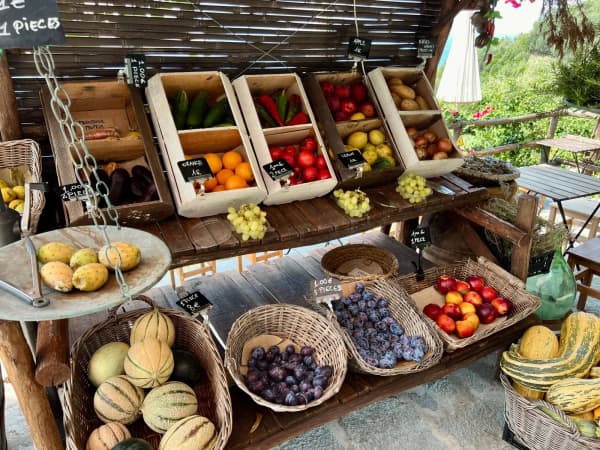
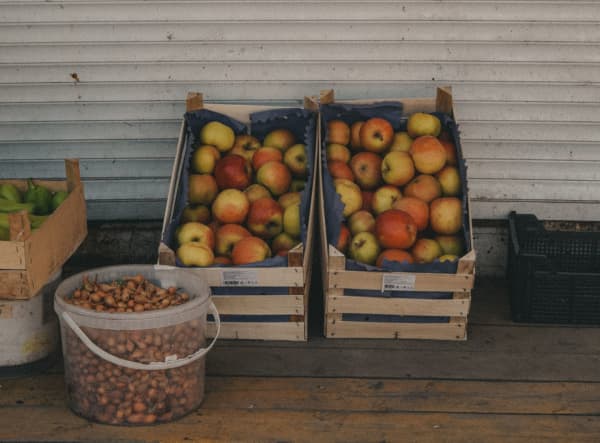
Produce. Fruits, vegetables and herbs, much of it from growers within an hour of Orem. Early season leans greens, starts and flowers; by late July you are into the good stuff — corn, tomatoes, stone fruit — and September brings the apple-and-squash turn. Utah County peaches in August are the single best reason to show up with cash.
Pantry staples. Eggs, honey, milk, meat, jams and baked goods from small local producers. These are the booths regulars build a weekly habit around.
Flowers and plants. Particularly strong May through July. One of the better cut-flower markets in the valley, and lavender growers turn up in midsummer.
Handmade goods. Soap, candles, jewelry, art, clothing. The maker share here is bigger than at most produce-first markets, which is part of why it works as an evening stroll even if your fridge is full.
The Sign in Front of the Booth Means Something
This is the thing to know about buying food from a stranger in a park in Utah, and no competing guide explains it.
Utah runs two entirely separate legal pathways for food made in a home kitchen, and a vendor has to pick one. They are mutually exclusive — you cannot operate under both at the same time.
Path one is the Cottage Food Production program, administered by the Utah Department of Agriculture and Food. It requires registration, a home-kitchen inspection and a food handler's permit, and it limits you to shelf-stable, non-potentially-hazardous items: baked goods, jams and jellies, honey, dried fruit, nuts, candy, dried herbs, roasted coffee, vinegar and the like. In exchange, a registered producer can sell in more places — farmers markets, events, and retail stores.
Path two is the Home Consumption and Homemade Food Act, Utah's "food freedom" law. It requires no registration, no inspection and no sales cap — Utah and Wyoming are routinely ranked the two most permissive home-kitchen frameworks in the country. The trade-off is that sales must be direct and in person to an informed final consumer, and the product range excludes raw milk and most meat.
The visible difference on market day is a sign. Historically, food sold under the homemade-food path had to be displayed in a separately marked section carrying language to the effect that the items in that section are homemade and have not been certified, licensed, regulated or inspected by state or local authorities. That is not a warning that the food is bad. It is a disclosure that you are buying from a kitchen the state has never walked into, which is precisely what the law was written to permit.
⚠ This changed in 2026 and the change is recent enough to verify rather than assume. Reporting on the 2026 legislative updates describes two shifts: the blanket entrance signage previously required at direct-to-sale farmers markets was repealed, with separation and signage now applying only where uninspected vendors share space with a regular market; and a contracted "designated representative" may now sell, deliver and store a producer's homemade goods on their behalf. A separate change reported to take effect July 1, 2026 exempts food sold by a "home cook" — someone preparing food exclusively in a private, noncommercial home kitchen — from Utah sales tax, with guidance still pending. If you are a vendor rather than a shopper, confirm all of this with UDAF directly before changing how you operate.
For a shopper, the practical version is short: ask. A producer working under either path will tell you which one, and most are proud of the answer.
The Food-Truck Dinner Play
The thing that makes the Orem market different is that it is as much a food-truck night as a farmers market. The operator brands the Wednesday lineup "Food Fest." In practice you can treat Wednesday as a no-cook dinner night — arrive at 5:30, eat from a truck on the grass while music plays, then shop the produce rows on the way out.
Two details that do not appear in listings: the live music is largely buskers who apply through the market rather than a booked lineup, so the acts rotate — and the operator has run a free yoga class from 7 to 8 p.m. at the market. Confirm the yoga on the week's schedule before you carry a mat across the park.
For students, this is a workable grocery run: ten minutes from campus, dinner and produce in one stop, and truck pricing competitive with chain takeout.
Timing Your Visit
- 5:00–6:00 p.m. — best produce selection, shortest truck lines, hottest part of the evening. Shop first, eat second.
- 6:00–7:30 p.m. — peak crowd. Music is going, truck lines are longest, the park is full. The market at its most fun and least efficient.
- 7:30 to close — cooler, calmer, golden-hour pleasant. Some produce is picked over, but vendors are likelier to deal and parking is easy.
SNAP, Double Up, and Two Programs Almost Nobody Claims
This section is the reason to read this page rather than a listing, because the numbers that circulate about Utah's produce match are inconsistent and the correction matters if you are budgeting.
The mechanics first. Bring your SNAP EBT Horizon card to the market information booth before you shop. Tell the attendant how much you want to spend; they swipe the card and hand you wooden tokens worth one dollar each, which spend like cash with vendors. A detail the operator states and nobody repeats: you do not have to use the tokens that day. They keep. If you load more than you spend, bring the rest back next Wednesday.
Double Up Food Bucks is the match, and the ceiling is the number that matters. With Double Up Food Bucks you get free Utah-grown fruits and vegetables on top of your Horizon card spending, up to a cap per market day. Ask at the booth for this season's cap.
⚠ Published figures for the match vary from source to source, terms are funded year to year, and caps vary by market. So the durable advice is the structural one: the match is real, it is capped, and the cap is what you should ask about at the booth before you decide how much to load.
The match is produce-only. Your base SNAP tokens buy the full range of eligible groceries at the market — eggs, meat, dairy, bread. The Double Up portion is restricted to fresh fruits and vegetables. This is the single most common point of confusion at the booth and it changes how you should split a shopping trip: spend the matched dollars on produce, save your base benefit for the protein and pantry booths.
Two programs the repo has never mentioned and most eligible people have never heard of:
- The Utah Senior Farmers Market Nutrition Program. A produce incentive offering $50 to qualifying seniors to spend at authorized farmers markets. Vouchers cover fresh fruits, vegetables, herbs — and honey, which is unusual and worth knowing at a market with several honey producers.
- Utah Produce Rx. This one is surprising: it is a fruit-and-vegetable prescription program run through healthcare settings. Eligible patients are screened and enrolled during a regular clinic visit, not at the market, and receive credit to spend at participating farmers markets and local retailers. If you qualify, the enrollment happens at your doctor's office — which is exactly why almost nobody finds it by searching for farmers markets.
Eligibility, funding and participating locations for all three change year to year. Ask at the information booth, or start with the Utah Department of Health and Human Services community food programs.
Getting There
The park sits on Center Street just east of State Street, which means the approach from I-15 is straightforward and the approach from BYU is a straight run up State. Parking is free in the park lots and on surrounding streets, and the closest spaces fill in the first hour or two on a nice evening. Arriving right at opening or after about 7:30 p.m. is the easy window.
City Center Park is a good venue for this: shaded, flat, stroller-friendly paths, and an all-abilities playground, which is why the market works for families in a way that a parking-lot market does not. Cyclists have had a free bike valet available in past seasons — worth checking the week's schedule if you would rather not lock up.
How It Compares to the Other Markets
- Provo Farmers Market — Saturdays, 9 a.m.–2 p.m. into late September and 10 a.m.–2 p.m. through October, Pioneer Park. More compact, stronger pure-produce focus, and the classic Saturday-morning-plus-Center-Street-brunch routine. If you want the biggest produce haul of the week, Provo Saturday is still the move.
- Orem Sunset Farmers Market — the biggest of the valley's weekly markets by participating vendor count, per the operator, and the only major one that works on a weeknight. Best for dinner-plus-shopping, makers, and anyone whose Saturdays are spoken for.
- Springville Sunset Farmers Market — run by the same operator, and handy for south-county residents.
The structural fact worth knowing: "the Orem farmers market" is one of four markets run by a single company. Sunset Farmers Markets was started in 2018 by Kelly and Jess Carter to connect local growers and food artisans with Utah Valley communities, and it now operates markets in Orem, Springville, Lindon and Draper — plus market operations at the Utah County Fair and events at University Place. If Wednesday does not work, there is very likely a Sunset market on a night that does, and the vendor rosters overlap, so a grower you liked in Orem may well be somewhere else later in the week.
Good to Know
- Cash and cards: most vendors take both; a few small producers are cash-only. An ATM run beforehand never hurts.
- Dogs: leashed dogs are welcome, and City Center Park has the room for it. Keep them clear of truck lines and produce tables.
- Weather: outdoors and mostly rain-or-shine, but severe-weather evenings can shorten or cancel it.
- Follow the market directly: the operator posts weekly lineups and changes to social media faster than to its own schedule page.
If you are building a full Orem evening around it, University Place is five minutes away for anything the market did not cover, and our Living in Orem guide covers the rest of the city. Students working a tight grocery budget should also read our student meal prep guide, which covers how to build a week around a market haul. For everything else on the calendar, browse Utah Valley events.
Related Guides
- Utah Valley Farmers Markets, by Day of the Week
- Farm Stands, CSAs and Local Produce in Utah County
- Taste of Orem: how the ticket sheets work and what twenty tickets buys
Frequently Asked Questions
When is the Orem farmers market?
Where do I park for the Orem farmers market?
What can I buy at the Orem farmers market?
Does the Orem farmers market take SNAP?
Is there a produce program for seniors in Utah?
What does the homemade-food sign at a Utah farmers market mean?
Is the Orem farmers market dog friendly?
How does the Orem market compare to the Provo farmers market?
Sources
The facts in this guide were checked against these sources. Hours, fees and rules change, so confirm anything time-sensitive with the source before you go. How we make Provo.com.
- Senior Farmers Market Nutrition Program, Utahns Against Hunger. Checked October 12, 2026.
- Orem's Sunset Farmers Market 2026, KSL.com Events. Checked October 12, 2026.
- Utah County farmers markets near close, The Daily Universe (BYU). Checked October 12, 2026.