
More on Orem: every guide we have published there, in one place.
Every valley has the place where everyone ends up — the default answer to "where should we meet?" and "what do we do with the kids today?" In Utah Valley, that place is University Place: the property at 575 East University Parkway in Orem that used to be University Mall and has spent the past decade becoming something considerably more interesting than a mall.
Malls across America are dying — Provo has watched its own struggle through the Towne Centre's slow-motion redevelopment saga. University Place is the counter-example: the same-era mall a few miles north that reinvented itself early, aggressively, and mostly successfully. Owner Woodbury Corporation — the century-old, family-run Utah developer that built the mall in the first place — has poured a $500 million redevelopment into the property, wrapping the surviving indoor shopping center in apartments, offices, a hotel, restaurants, and a park with its own events calendar. The result is less "mall" than "small downtown that happens to contain a mall."
Here's the complete picture: what's there, how locals use it, and the quirks (looking at you, Sunday hours) that first-timers should know.
A Little History, Because It Explains the Place
University Mall was for decades the retail center of Utah County. Then came the standard American mall story, in fast-forward: JCPenney decamped to the new Provo Towne Centre in 1998; Nordstrom came in 2002 and left in 2012; Macy's closed in 2019 and its building was demolished months later.
The difference is what Woodbury did next. Instead of managing decline, it tore into the property: the Macy's corpse became a brand-new full-line Dillard's. A former anchor pad became RC Willey. Nine stories of parking and offices rose on the west side. Hundreds of apartments came in along the edges. And in the middle, where malls usually put more parking, Woodbury built a two-acre park.
That's why the place works when so many peers don't: it stopped betting everything on department stores fifteen years before most malls did.
Who Paid for the Rebuild, and How
The transformation described above did not happen on retail rent alone. It happened inside a community development project area, and the arrangement is unusual enough to be worth understanding — partly because it explains why the property could absorb a decade of demolition and construction, and partly because it is one of the clearest working examples of a financing tool used all over Utah Valley.
The tool is called tax increment financing. Utah authorizes cities and counties to create a community reinvestment agency under Title 17C of the state code — the same bodies most people still call redevelopment agencies, or RDAs. When an agency draws a project area, the property tax collected there is frozen at its existing value for accounting purposes. Everything above that baseline, generated by whatever new development follows, is the increment. Instead of flowing to the county, the school district, the water district and the city, the increment is redirected for a fixed period to pay for the development that created it. Utah County's auditor, which administers the payments, describes it in exactly those terms.
Orem's version is called the University Place Community Development Area. Under its incentive agreement, much of the increment from the area goes toward the infrastructure debt behind the redevelopment. The agreements are public documents, and the split is worth reading there rather than secondhand.
What that buys, and what it costs. The honest way to describe it is as a bet. Structured parking, relocated utilities, new internal streets and a two-acre park on land that could have held cars are exactly the "extraordinary costs" the statute contemplates — the things that make a mall block into a walkable district and that no tenant's rent will pay for on its own. The counter-argument is equally real: for the life of the agreement, growth in taxable value on one of the most valuable properties in Utah County is largely unavailable to the school district and the county. Reasonable people in Orem have argued both sides at public hearings, and the agreements are public documents.
The rules changed partway through this story. Utah recodified the statute, retiring the old "community development and renewal agency" language in favor of community reinvestment agencies; Utah Code 17C-1-102 still defines an "agency" to include a body created as a redevelopment agency or a community development and renewal agency under previous law, which is why all three names remain in circulation for the same thing. The bigger practical change was procedural. Under Utah Code 17C-2-204 an urban renewal project area budget requires the consent of a taxing entity committee — a standing body on which the county, the school district and the other levying entities vote together before an agency may receive any increment. For newer community reinvestment areas that committee was replaced by interlocal agreements negotiated with each taxing entity individually. Older project areas kept their committees, which is why two project areas a few miles apart can operate under visibly different rules.
Project areas expire, and that is the point. A tax increment arrangement is a term, not a permanent condition. When the collection period ends, the increment stops being redirected and the full taxable value of the property flows to the county, the school district, the water district and the city at the ordinary rates — on a tax base far larger than the one that existed when the area was drawn. That is the whole theory of the tool, and as older project areas expire, their increment returns to the ordinary tax rolls. Whether the University Place bet pays out the same way is a question with a date on it, and the answer will show up in Orem's budget rather than in any storefront.
How to check any of this yourself. Project area plans, budgets and annual reports are public. Orem's are handled through the city's redevelopment agency, and Utah County's auditor publishes a statewide agency database alongside the county's own redevelopment page. If you want to know whether a specific parcel — a house, a storefront, an apartment building — sits inside a project area anywhere in the valley, that is the place to start rather than a real-estate listing.
The Shopping: Anchors, the 150-Store Middle, and the Outparcels
The anchors. Dillard's (fashion and cosmetics, the west side, the valley's only full-line location), RC Willey (the furniture-and-electronics giant), and Al's Sporting Goods (the Logan-born outdoor retailer, in the space that was once Sports Authority). Between them they cover the department-store bases the valley's other centers no longer can.
The middle. More than 150 stores ring the indoor concourses — the national roster includes H&M, Lululemon, Sephora, Gap, Vans, Pandora, Cotton On, Buckle, and Zumiez, alongside a healthy rotation of Utah-born boutiques (women's fashion labels like Bohme started or scaled here) and, in recent years, a wave of online brands opening their first physical storefronts. The mix skews noticeably younger and more fashion-forward than the mall's reputation suggests — this is where the valley's enormous student population shops.
The outparcels are half the story. Costco and Trader Joe's (the latter drew opening-day lines in 2018 as one of Utah's few locations) sit on the property's edge, which means University Place doubles as many families' errand hub. The Cinemark theater on the northeast corner handles movie nights. This is worth understanding as a visitor: locals may "go to University Place" three times a week without ever entering the indoor mall.
The Food: From Food Court to Restaurant Row
University Place quietly hosts one of the densest restaurant clusters in the county. The headliner is The Cheesecake Factory — whose arrival was front-page local news; we covered the opening — joined by P.F. Chang's, Texas Roadhouse, Tucanos Brazilian Grill, and Carrabba's, plus the quicker tier (Chick-fil-A, Chipotle, and the indoor food court) for shopping-day refueling.
Two local notes. First, Los Hermanos, the beloved Provo-founded Mexican restaurant, relocated here from its longtime downtown home — a small local heartbreak turned University Place win. Second, if you're building a bigger food day around Orem, our best restaurants in Orem guide covers what's beyond the property line, and Best Food Near UVU handles the campus corridor five minutes west.
The Orchard: The Park That Changed the Property's Personality
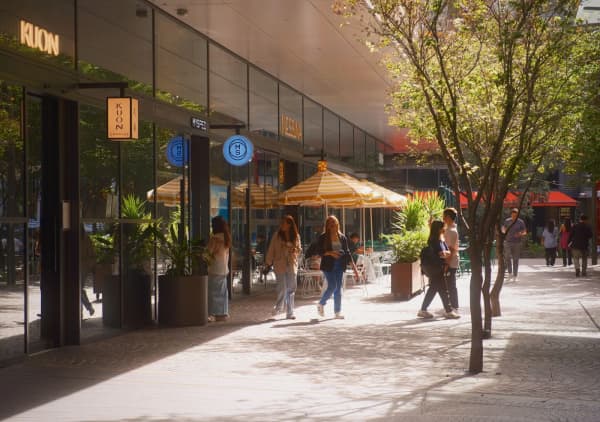
The single smartest move of the redevelopment is The Orchard — a two-acre public green at the heart of the property, programmed year-round: summer concert series, seasonal festivals, family movie nights on the lawn, and holiday lights in winter. On a warm evening it functions as Orem's de facto town square, full of families who came for nothing in particular. Each spring The Orchard also hosts the free Orem Asian Festival.
For visitors, The Orchard is the reason University Place earns a slot on a leisure itinerary rather than just an errand run — check the events calendar on the University Place site before you go, because a free concert can turn a shopping stop into the evening's plan. (It also pairs well with the valley's other outdoor-entertainment staples — the SCERA Shell's summer season is five minutes south, and our outdoor movie nights roundup maps the whole summer circuit.)
The Rest of the 120 Acres: Live, Work, Stay
The redevelopment's less-visible layers matter to visitors more than you'd think:
- Apartments ring the property, which is why the place hums on weeknights in a way dead malls never do. (House-hunting in the area? Our Orem neighborhoods guide puts the location in context.)
- A nine-story office tower — among the tallest buildings in Orem — anchors the west side above structured parking.
- The Courtyard by Marriott Orem University Place puts a hotel directly on the property — walk out of the lobby into 150 stores and a dozen restaurants. For families, it's one of the most practical bases in the valley, and it earns its slot in our where to stay in Provo guide.
More phases remain on the master plan — Woodbury has long planned a permanent home for Orem's Hale Center Theater on the property, among other additions — so expect construction fencing somewhere on the acreage more or less permanently. That's the price of being the mall that refused to die.
How It Compares: The Valley's Four Shopping Centers
Utah Valley has four major retail destinations, and visitors mix them up constantly. Here's the honest positioning:
University Place (Orem) — the biggest and most complete: department-store anchors, the deepest national-brand roster, the restaurant row, the park, the hotel. If you have one shopping stop in the valley, it's this one.
The Shops at Riverwoods (north Provo) — the boutique counterpoint: an open-air village near the mouth of Provo Canyon with local shops, restaurants, and a strong events calendar (summer concerts, holiday lights). Smaller, prettier, more local — the date-night shopping center, and home to consignment gems like Cozy Nook Treasures.
Provo Towne Centre (south Provo) — the cautionary tale mid-transformation: the 1998 mall that lost anchors and is now slated for a massive mixed-use redevelopment. Target, JCPenney, and the Cinemark still operate, but go for errands, not a shopping day.
Outlets at Traverse Mountain (Lehi) — the discount play, 25 minutes north at the county line: outlet stores for the brand-name bargain hunt. Worth the drive only if outlet shopping is specifically the mission.
The pattern worth noticing: the two centers that thrived (University Place and Riverwoods) both stopped being just malls years ago — parks, events, apartments, restaurants. The one that didn't is being rebuilt into exactly that. Retail in this valley survives by becoming a place to be, not just a place to buy.
Practical Notes for a First Visit
- Address & layout: 575 E University Parkway, Orem — the full property fills the block between State Street and 800 East. The indoor mall runs east–west through the middle.
- Hours: indoor shops generally run Monday–Saturday, 10 a.m.–9 p.m., and the historically firm Sunday closure — a Utah Valley signature that surprised out-of-state visitors for decades — has finally broken: University Place now opens Sunday afternoons (posted as 12–6 p.m.), making it the valley's main Sunday shopping option. Individual tenants and outparcels (Costco, Trader Joe's, Cinemark, and several restaurants) still keep their own schedules, so check a specific store before a special trip. Our what's open on Sunday guide and valley shopping guide both track this.
- Parking: free, abundant, with a west-side structure by Dillard's. Northeast entrances are fastest for the food court and movies.
- Getting there without a car: the UVX bus rapid-transit line stops along University Parkway between the two campuses — free for BYU and UVU students with ID — making this the easiest car-free shopping trip in the county. (Details in our UVU guide.)
- Time budget: an errand run is an hour; shopping plus lunch is an afternoon; add a movie or an Orchard event and it's a full family day.
How to Move Through It Without Getting Lost
The single most common complaint about University Place is not the shopping — it is that first-time visitors cannot find anything. That is a consequence of the rebuild rather than bad signage. The property is now two different things wearing one name, and knowing which one you are in solves most of it.
The indoor mall is the original mall building. It runs east–west through the center of the block, it is climate-controlled, and it holds most of the small-format national tenants plus the food court. If you picture a mall, this is the mall. Dillard's anchors the west end near the parking structure; the concourse walks in a fairly simple line, and it is the part of the property where wayfinding works the way you expect.
Everything around it is an outdoor district. The Orchard, the restaurant frontages, the office and residential buildings and the outparcels are streets and sidewalks, not corridors, and they do not connect to the indoor concourse in an intuitive loop. Costco, Trader Joe's and the cinema sit on the perimeter with their own entrances and their own parking, and walking to them from inside the mall is a genuine outdoor walk rather than a stroll past three more stores.
So park for your errand, not for the property. This is the practical version of everything above. Northeast entrances put you closest to the food court and the movies. The west structure by Dillard's is the right call for indoor shopping and the best option in bad weather. If your trip is Costco or Trader Joe's, park at that store and treat the rest of the block as a separate destination — the distances are longer than the map suggests, and the drive between two sides of the same address is often faster than the walk.
Budget extra time on a first visit regardless. Locals navigate by landmark rather than by sign, which is why directions from a friend tend to reference Dillard's or the Orchard rather than a store number. Give yourself fifteen minutes of orientation the first time and the property stops being confusing permanently.
The Bottom Line
University Place is what a 1970s mall looks like when its owner spends fifty years refusing to let it become a cautionary tale. It isn't glamorous, and parts of the indoor concourse still feel like the mall your parents knew — but as a one-stop answer for shopping, dinner, a movie, and a free concert on the lawn, nothing else in Utah Valley touches it. Pair it with the thrift and vintage crawl happening in the scrappier storefronts of downtown Provo and old-town Orem, and you've got the valley's full retail spectrum in one day.
The Orchard is lit for the season each winter and is free to wander. Our Christmas lights map puts it next to the rest of the valley's displays, including which ones charge admission.
Related Guides
- Bookstores in Provo & Orem: Where to Buy Used, Rare, New and Textbooks in Utah Valley
- Antique Shops in Utah Valley: The Malls, the Book Rooms, and What This County Actually Stocks
- The Native Nations Festival at University Place
Frequently Asked Questions
What stores are at University Place in Orem?
Is University Place the same as University Mall?
Is University Place open on Sundays?
What is The Orchard at University Place?
Where do you park at University Place?
Did taxpayers pay for the University Place redevelopment?
Why did University Place survive when other Utah malls did not?
Is University Place in Provo or Orem?
Sources
The facts in this guide were checked against these sources. Hours, fees and rules change, so confirm anything time-sensitive with the source before you go. How we make Provo.com.
- Utah Code 17C-1-102: Definitions (effective 7/1/2026), Utah State Legislature. Checked October 12, 2026.
- University Place, University Place (Woodbury Corporation). Checked October 12, 2026.