Upcoming dates

The Provo Farmers Market has been a Saturday morning tradition since 2002, and it has grown into one of the best community gatherings in Utah Valley. Every Saturday from early June through the end of October it fills Pioneer Park with growers, bakers, makers, food vendors and live music.
It is also a market with more structure behind it than most visitors realize — a sourcing radius, a matched food-assistance program, an accessibility plan, rules about who may busk, and a start time that changes in October. Almost none of that appears in the listings, and two pieces of it will change how your visit goes.
The basics, with the part everyone gets wrong
Where: Pioneer Park, 500 West Center Street, Provo.
When: Saturdays, from the opening weekend in early June through the last Saturday in October. In 2026 that is 6 June to 31 October.
Time — and this is the one to write down:
- 9 a.m. to 2 p.m. from the June opening through late September
- 10 a.m. to 2 p.m. for the October Saturdays
The October shift is the single most useful fact on this page. Practically every listing, calendar and aggregator prints a flat 9-to-2 for the whole season, and the standard advice — including ours, until this update — is to arrive early for the best selection. Follow that in October and you spend an hour standing in a park in the cold before anything opens. Late October mornings in Provo are frequently at or below freezing.
Cost: free to attend. Bring cash. Many vendors take cards, and the market runs a token system for SNAP, but cash is still the smoothest way through a busy stall.
Who runs it: the market states plainly that it is an independent non-profit run by a citizen-led board, not a Provo City program. The city is the venue partner. That is worth knowing when you are hunting for current information — it lives on the market's own channels, not the city's events calendar.
⚠ One trap worth naming, because it catches people every summer. There is a Pioneer Park in Provo and there is a Pioneer Park in Salt Lake City, and they both host well-known events. If you are following a link from a statewide listing to something "at Pioneer Park," check which city it means before you drive.
Produce does not arrive when the market does
This is the second correction, and it comes straight from the market's own answer to the question.
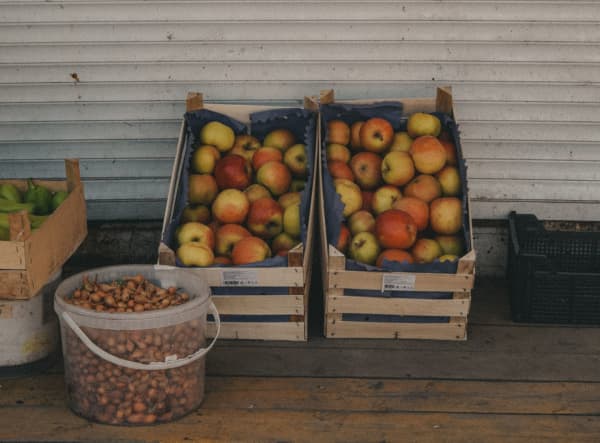
In northern Utah, produce is normally ready to be picked and sold in July. The market's own guidance is that from July onward farmers are present for the remainder of the season, with produce available right up to the final day. Before that, the June weeks are real market days — bakers, makers, prepared food, early greens, transplants and starts — but they are not the loaded produce tables the photographs promise.
So the season has two halves, and they suit different visitors:
- June is the social opening. Go for the atmosphere, the food, the crafts and the first greens. Do not go expecting to fill a shopping bag with fruit.
- July through October is the produce market. This is when the stone fruit, tomatoes, corn, peppers, melons and squash show up, and when a market trip can replace part of a grocery shop.
The high point in Utah Valley is roughly late July through September, which is peach and tomato season. If you only make it to the market twice a year, make it twice in that window.
What you will find
Produce, and the 250-mile rule
There is a defined standard behind the word "local" here. Agricultural products sold at the market must be produced within 250 miles of Provo, and the market says most come from far closer — along the Wasatch Front and within Utah Valley.
That radius is worth understanding rather than skimming. It is wide enough to include growing regions Utah Valley does not have, which is why you will sometimes see fruit at the market that nobody grows in this county. It is also a genuine rule with a boundary, which is more than most markets publish.
Home growers are welcome as vendors. The market states that local farmers are its top priority and invites people with produce to sell to get in touch — so some of what you buy comes from a large operation and some comes from someone's excellent back garden.
Baked goods, honey and preserves
Consistently one of the strongest categories here. Fresh bread, pastries, pies and cookies from local bakers, plus Utah Valley's substantial beekeeping scene showing up as raw local honey. Jams, salsas, pickles and small-batch preserves round it out.
This is also the part of the market that is worth it in June, before the produce arrives.
Prepared food
Hot food vendors and food trucks turn the market from a shopping trip into a morning. This is the reason to arrive hungry rather than after breakfast.
Artisans, makers and youth vendors
Handmade soap, candles, jewelry, pottery, woodwork and prints. Quality varies from serious professional work to weekend hobbyist, and browsing with an open mind is the right approach.
The market also runs a youth vendor program, split into two age bands for younger and older children, at a smaller and discounted booth size. One rule is worth knowing if your child wants to take part: youth vendors are no longer permitted to sell edible products — the spaces are reserved for young artisans and makers rather than bake sales.
Music, and the rules behind it
Live music runs through the market hours, and the market actively recruits local performers. Separately, busking is permitted under specific conditions: buskers must be soloists, must set up only in designated busking areas, and may not use amplification or percussion. Musicians, face painters, cartoonists, caricature artists and balloon sculptors all count, and they work for tips.
That combination — booked acts plus regulated buskers — is why the soundscape here stays acoustic and conversational rather than turning into competing PA systems.
Parking, and the request the market makes
This is the section that changed most in this update, because the standard advice was pointing readers at the one place they are asked not to go.
There is free parking around Pioneer Park and through downtown Provo, and the market publishes its own parking map showing where. But two constraints come with it:
- Parking in residential permit areas is prohibited.
- The market explicitly asks visitors to avoid parking in the adjacent neighborhood, as a matter of being good neighbors to the people who live beside a weekly event.
Generic advice to "grab a space on the side streets around 500 West and Center" runs directly into both. Use the downtown lots and streets rather than the residential blocks, and read the permit signage before you leave the car.
The market's own recommendation is to walk or ride a bike, and in downtown Provo that is not a throwaway line — the market sits inside the most walkable part of the city, and a bike removes the whole problem. Our downtown Provo neighborhood guide covers what is within walking distance.
SNAP, Double Up Food Bucks, and how the tokens work
The market participates in Double Up Food Bucks, Utah's SNAP-matching program for farmers markets, and the mechanics are worth understanding before you get to the booth rather than at it.
- Anyone receiving SNAP qualifies automatically. There is no separate application at the market.
- Spending on fresh produce is matched, up to a cap per market day.
- The two token types are not interchangeable. SNAP tokens can be spent on any SNAP-eligible food — eggs, cheese, meat, bread and so on. Double Up tokens are restricted to unprocessed, locally grown fruits and vegetables.
⚠ A note on the numbers, because they are inconsistent across sources. Published descriptions of the Utah program's matching rate and cap disagree with one another depending on which organization is describing it and when. The market's own materials describe a match on produce spending with a per-market-day ceiling. Treat the structure as reliable and confirm the current figure at the market's information booth, which is where the tokens are issued anyway.
For the wider picture of eating well on a tight budget in Provo, our student meal prep guide and cheap eats guide cover the rest of the map.
Accessibility — the service nobody publicises
This is the best-kept practical secret at the market, and it deserves to be stated plainly.
Booths on the inside of the sidewalk are set back several feet so that queues do not block the pedestrian route — a layout the market says has been in place for most of its history at Pioneer Park. Because the grass and gravel between booths is not an accessible surface throughout, the market operates a reasonable-accommodation plan instead:
- Between 10 a.m. and 1 p.m., a customer with a mobility impairment can request a personal shopping assistant from market staff.
- The staff member photographs products at the booths you are interested in and shows them to you on a tablet.
- If you want a closer look, staff arrange for the vendor to bring a sample out to the sidewalk and help with the transaction.
- The service covers one trip through the market per week, and availability is signposted at the welcome booth.
It is a thoughtful piece of design and it appears in essentially no third-party listing of the market.
Dogs, kids and the rest of the park
Dogs are welcome on a six-foot leash, kept away from produce, plants and other food products, with the obvious expectation that you clean up after them. Plenty of farmers markets ban dogs outright, so this is a real point in Provo's favor — and it lines up with Provo City's wider parks rules, which require leashes in all city parks. Our dog parks and pet life guide covers where the leash comes off, which is a much shorter list than people assume.
Pioneer Park is a good park independent of the market, with newer playground equipment and a splash pad, which is what makes this workable with small children — they can run while you shop. Our best parks guide has the detail.
There is a lost and found, at the market's main booth by the playground. Worth knowing before you spend twenty minutes retracing your steps.
The market is where Utah Valley's food businesses start
This is the part of the Provo Farmers Market that nobody outside the vendor community talks about, and it is the strongest argument for taking it seriously.
A Saturday stall is the cheapest storefront in Utah Valley. No lease, no build-out, no staff beyond yourself, and a guaranteed few hundred customers walking past a table. For a food business with an idea and no capital, the market is a proving ground — and several of the county's now-established names came through it.
Waffle Love worked markets before it had restaurants. The Provo-born business that became a multi-state chain started in the format the market exists to support, and our food trucks guide traces that route in full. Ambrosial Bakery, Provo's dedicated gluten-free bakery, spent six seasons at this market before its storefront opened — six years of Saturdays turning into a lease.
Why that matters if you are only a customer: it changes what you are looking at. Half the tables here are hobby and half are a business in its first or second year, and the difference is often visible in the branding and the consistency. If you find something excellent at a market stall in Provo, there is a decent chance you are early to something that ends up with a door and a sign.
And if you want to be on the other side of the table, the market takes applications from growers, makers, prepared-food vendors and non-profits, with a separate and cheaper category for youth. The application runs through the market's own site.
How to do it
On a first visit, walk the whole market before buying anything. Get the shape of it, see who has what, then loop back. The market is compact enough that this costs you ten minutes and saves you from buying the first version of something you find better two rows on.
Go early in summer, and check the clock in October. Between June and late September the 9 a.m. opening is the best-selection hour. In October the doors open at ten and there is nothing to be early for.
Bring bags and a cooler. Reusable bags for everything, and a cooler in the car for anything that needs to survive a warm drive home — which in August is most of it.
Eat there. The prepared-food vendors are half the point. A breakfast burrito, a patch of grass and a busker is a better Saturday morning than most restaurant brunches in the city, and it costs less.
Treat it as a supplement, not a full shop. The produce vendor count is smaller than the craft and food-truck count, which is normal for markets this size. Go for the things that are better here — stone fruit in late summer, tomatoes, eggs, bread, honey — and do the rest at the grocery store.
The other markets in the valley
If Saturday mornings do not work, the valley has a market most days of the week:
Orem Sunset Farmers Market — Wednesday evenings at Orem City Center Park, the largest of the local markets by participating vendor count and heavy on food trucks. It works as a dinner-plus-shopping outing rather than a weekend errand, and our full Orem guide covers the season and the operator's own inconsistencies about it.
Springville Sunset Farmers Market — Monday evenings at the Springville Civic Center. The smallest of the three and worth the trip if you live in south Utah County.
Spanish Fork and American Fork both run their own summer markets with a more rural feel and a stronger agricultural lean.
⚠ And the October pattern is not a Provo quirk — it is daylight, and it shows up at both ends. Provo's Saturday market opens an hour later in October. Orem's Wednesday evening market closes an hour earlier, ending around 8 p.m. rather than 9. Sunset in Provo runs from roughly 8 p.m. in late August to well before 7 p.m. by late October, so an evening market that ran to nine would be trading two hours after dark and a morning market that opened at nine would be setting up in the cold. Every aggregator prints the summer hours year-round for both. In October, check the clock for whichever market you are heading to.
Because several of the valley's evening markets are run by one operator across multiple cities, a grower you liked on Wednesday in Orem may well turn up on Monday in Springville. Provo's Saturday market is the independent one, and it is the produce-forward one.
Related Guides
- Orem Farmers Market Guide
- Best Grocery Stores in Provo
- Free Things to Do in Provo
- Downtown Provo Neighborhood Guide
- Best Parks in Provo
- Summer Activities in Provo
- Best Date Ideas in Provo
- U-Pick Orchards in Santaquin and Payson
- Utah Valley Farmers Markets, by Day of the Week
- Farm Stands, CSAs and Local Produce in Utah County
Last updated: August 2026. Market dates, hours and vendor rosters change between seasons — the market's own site and social channels are the current source.
Frequently Asked Questions
When is the Provo Farmers Market?
When does actual produce show up at the market?
Where do you park for the Provo Farmers Market?
Can you use SNAP at the Provo Farmers Market?
Is the Provo Farmers Market run by Provo City?
How local is the produce, really?
Can you bring a dog to the Provo Farmers Market?
Is the market accessible if you have limited mobility?