
BYU football Saturdays are unlike any other game day in college football. The atmosphere at LaVell Edwards Stadium is electric, the fans are passionate (and famously polite), and the Wasatch Mountains provide the most dramatic backdrop in the sport. Whether you're a lifelong Cougar fan, a visiting supporter, or a first-timer who just wants to experience a college football Saturday, this guide covers everything you need to know.
The Stadium
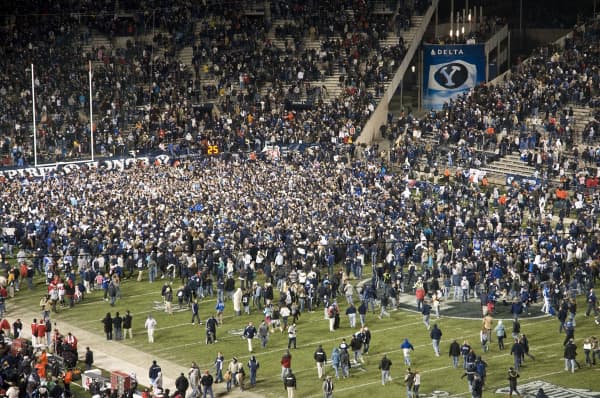
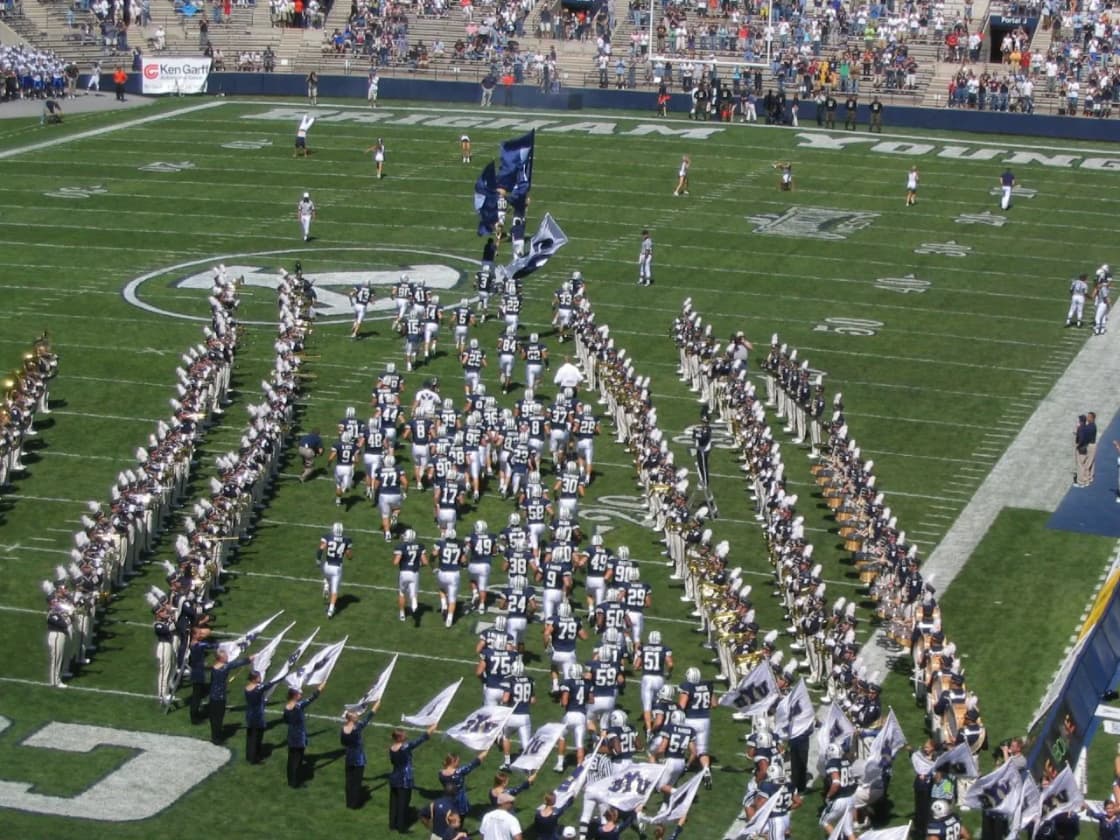
LaVell Edwards Stadium seats 62,073 and sits at the north end of BYU's campus. It is a single-tier box bowl with no upper deck, which is exactly why the view works: from the east side you are looking straight out at the Wasatch Front, with Y Mountain standing over the south end. It is one of the few stadiums in America where the scenery competes with the game for your attention.
The stadium is named after legendary coach LaVell Edwards, who led BYU to its 1984 national championship and 257 career wins. BYU joined the Big 12 Conference in 2023, which means the schedule now includes major conference opponents in addition to traditional rivalries.
For the building itself — how it grew from an orchard, the no-bag rule that catches visiting fans out, the attendance record that can no longer be broken, and what the weather does across a season at 4,500 feet — see the full LaVell Edwards Stadium guide.
Getting Tickets
Season tickets are the most affordable option for locals who plan to attend multiple games. Single-game tickets are available through BYU's ticket office and secondary markets. Pricing varies significantly by opponent — Big 12 conference games and rivalry matchups (Utah, Utah State) command premium prices, while non-conference games against smaller programs are more affordable.
Student tickets are available at a significant discount for enrolled BYU students. The student section (south end zone) is loud, standing-room energy — the best atmosphere in the stadium.
Visiting fans: Tickets for visiting team sections are available through the visiting school's ticket office or secondary markets. BYU's fan base is welcoming to visitors — you won't face hostility, even in opposing colors.
Parking & Getting There
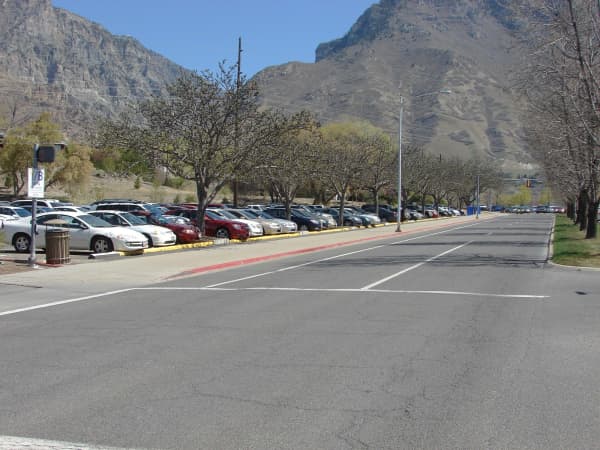
Parking near LaVell Edwards Stadium is limited and fills early. The short version is below; our full parking and game-day traffic guide covers the free lots, the tailgate-lot rules, RV and disability parking, and how to get out afterward.
BYU lots: Several campus parking lots open for paid game-day parking; BYU posts current prices with its parking map. These fill 2–3 hours before kickoff for popular games. Arrive early.
Street parking: Free street parking is available in surrounding neighborhoods but fills up fast and may require a 15–20 minute walk. Respect residential parking restrictions.
Ride transit: UVX buses stop near campus. Fares apply unless you are a BYU or UVU student or staff member with ID, so check rideuta.com for fares and any game-day service changes.
Walk from downtown: If you're staying at a downtown hotel or eating on Center Street before the game, the walk to the stadium is about 15–20 minutes. It's pleasant and avoids all parking hassles — and it is the move we recommend to visiting fans flying in.
Ride-share: Uber and Lyft operate in Provo but can have limited availability and surge pricing after games. Set a pickup point away from the stadium for faster service.
Tailgating & Pregame
BYU tailgating has its own character — family-friendly, food-focused, and enthusiastic without the alcohol-fueled intensity of some other programs (BYU is a dry campus).
Cougar Canyon: The official pregame gathering area next to the stadium. Live music, food vendors, sponsor activations, and fan activities set up several hours before kickoff. It's the central hub for the pregame experience.
Independent tailgating: Fans set up in parking lots and grassy areas near the stadium. Grills, coolers, lawn games, and team gear are the standard setup. The atmosphere is social and welcoming — introducing yourself to neighboring tailgaters is encouraged.
Pregame meal: Many fans eat on Center Street before the game — the restaurants are a 15-minute walk from the stadium. Station 22 on Center Street and Black Sheep, a block up University Avenue, are the popular downtown pregame spots. Brick Oven is the other fixture and is closer in, at 800 North rather than downtown. Or grab a J Dawgs hot dog near campus for a quick, cheap option.
Game Day Food
Inside the stadium: Standard concession fare — hot dogs, nachos, popcorn, sodas, and the usual lineup. BYU Creamery products (including the famous chocolate milk) are available at concession stands.
Near the stadium: J Dawgs (gourmet hot dogs), food trucks that set up near Cougar Canyon, and several fast-casual options along University Avenue near campus.
After the game: downtown restaurants fill up fast after a game. Make a reservation if you're planning a postgame dinner. Station 22 is on Center Street; Communal is a block up at 102 N University Avenue; Brick Oven (root beer and pizza) is neither, sitting on 800 North closer to campus. Alternatively, grab food near campus before the postgame traffic clears.
The Fan Experience
What Makes BYU Unique
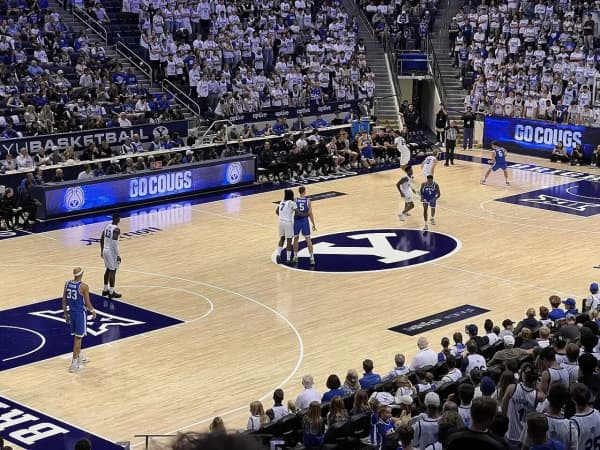
BYU has one of the most distinctive fan cultures in college football. The crowd is passionate and knowledgeable but famously clean — no profanity, no alcohol in the stadium, and a genuine politeness toward visiting fans that surprises first-timers. This doesn't mean the atmosphere is tame — when 62,000 fans are engaged in a close game against a conference rival, LaVell Edwards Stadium gets loud.
The Cosmo the Cougar mascot is one of the best in college sports — known for acrobatic stunts, crowd interactions, and genuine entertainment value.
Traditions to Know
The fight song: "Rise and Shout, the Cougars are out" plays after every BYU score. Learn the first verse to fit in.
The wave: Happens in the student section and sweeps through the stadium. Participate.
White-outs and blue-outs: For major games, BYU occasionally calls for all fans to wear a specific color. Check BYU Athletics social media before the game for any dress code requests.
Where to Stay
If you're visiting from out of town, book accommodation well in advance for football weekends — Provo's hotel inventory is limited and fills up quickly. For the full zone-by-zone picture, see our where to stay in Provo guide — and for the specific hotels that let you walk home from the stadium, our hotels near BYU guide maps the walkable pocket.
Best options near campus: Best Western Plus Provo University Inn (walking distance), SpringHill Suites by Marriott Provo, Days Inn Provo.
Downtown: Provo Marriott, Hyatt Place Provo — walking distance to both Center Street restaurants and the stadium.
Budget option: Hotels in Orem (10 minutes north) are often cheaper and available when Provo is sold out.
For full hotel recommendations, see our Parent's Guide to Visiting Provo.
Beyond the Game
A BYU football Saturday is a great excuse to explore Provo. Arrive Friday evening for a Center Street dinner. Saturday morning, hike the Y (you'll see it lit up during night games) or walk the campus. Attend the game in the afternoon or evening. Sunday, drive up Provo Canyon to Bridal Veil Falls or Sundance before heading home.
Kickoff Time Is the Variable That Changes Everything Else
Conference television partners set kickoff windows, and they are frequently confirmed only a couple of weeks before the game. That single number reshapes a Saturday more than any other decision on this page, so build the day around it rather than around a fixed routine. It matters most on 31 October 2026, when the kickoff window decides whether the stadium empties before or into Halloween trick-or-treat hours.
A morning kickoff compresses everything. Lots that would normally fill three hours out fill before most people have eaten. Tailgating turns into breakfast, downtown restaurants have barely opened, and the walk in from Center Street is at its most reliable because traffic has not built yet. The compensation is real: a morning game is the only kickoff that leaves the rest of the day open, which is why it is the one worth pairing with the canyon rather than with a postgame dinner.
An afternoon kickoff is the default and the most congested. Parking pressure, tailgate volume and postgame restaurant demand all peak on the same clock. If you are driving and you want a campus lot, the arrival window that works is earlier than it sounds — the lots do not fill gradually, they fill in a rush once the tailgate crowd commits.
An evening kickoff is the one visitors underestimate. Provo sits at roughly 4,500 feet in a dry valley, and the temperature drop between kickoff and the fourth quarter is routinely large enough to matter even in September. A stadium that felt warm in shirtsleeves at the start can be cold by the end. Bring the layer you think you will not need. The tradeoff is the best version of the view: the Y is lit for night games, and the mountains hold light long after the field is under stadium lighting.
The corollary nobody plans for: a late kickoff pushes dinner past the point where downtown can absorb a stadium's worth of people at once. Either eat before, or accept that the postgame wait is part of the evening.
Bringing Kids to a Game
The family-friendly reputation is accurate rather than aspirational, and it is one of the few college football environments where bringing young children is straightforward. A few practical notes make it work better.
Cougar Canyon is the part small children remember. The pregame area carries the activities, the music and the space to move around, and it does that job hours before anyone has to sit still. For a family with young kids, arriving early for the pregame and treating the game itself as the second half of the outing usually beats arriving at kickoff.
Seat position matters more than seat price. The stadium is a single-tier bowl, so there is no bad-sightline upper deck to avoid — but there is sun. On an afternoon game the west side spends longer in shade, and with small children that is a bigger comfort variable than the yard line.
Volume is manageable but not quiet. The student section in the south end zone is the loudest part of the building. Families who want the atmosphere without the peak volume do better toward the sidelines.
Plan the exit before you need it. Leaving with a tired child during the fourth quarter of a close game is a slow experience. Deciding in advance which gate you will use, and being willing to go a few minutes early, turns the hardest part of the day into a non-event.
If You Are Only in Town for the Weekend
Visiting fans routinely plan a Friday-to-Sunday trip and discover on the last morning that Provo runs on a different rhythm than the city they flew in from.
Sunday is the constraint. A significant share of restaurants close, and — the detail that catches people out — FrontRunner and UVX do not run on Sundays. If your plan was to take the train back toward Salt Lake City or reach the airport by transit on Sunday morning, that plan does not work; you need a car, a ride-share or an airport shuttle booked ahead. Our guide to getting between Provo and the Salt Lake City airport covers the options that do run.
Saturday morning is the underused window. Before an afternoon kickoff there is time for a walk on campus or a hike partway up the Y, and both are better in the morning than in the afternoon heat. Trying to do either after a game is a worse experience in every respect.
Friday night is when downtown is easiest. Center Street on a Friday before a home game is busy but navigable. The same restaurants immediately after Saturday's game are not, which is the argument for putting your one proper sit-down meal on Friday and treating Saturday's food as part of the game-day experience rather than a separate event.
What First-Timers Get Wrong
Underestimating the walk-in option. Visitors default to driving because that is what they do at home, then spend the difference in the parking queue. From a downtown hotel the walk is on the order of fifteen to twenty minutes and it removes the single most stressful part of the day at both ends.
Assuming a dry campus means a subdued crowd. It does not. The absence of alcohol changes the character of the crowd, not its volume, and a close conference game in a full house is loud by any standard.
Treating the altitude as a talking point rather than a planning input. Sun exposure is stronger and the air is drier than most visitors are used to. Water and sunscreen are not optional extras at an afternoon game, and they are far easier to bring than to buy once you are inside.
Booking a room late. Provo's hotel inventory is limited relative to a 62,000-seat stadium, and a football weekend is one of the few times that arithmetic becomes obvious. The rooms that go first are the walkable ones.
The Airspace Over the Stadium Closes on Game Day, and Almost Nobody Knows It
If you were planning to fly a drone over LaVell Edwards Stadium to get the shot everyone wants, stop. It is prohibited, the prohibition is federal, and it applies automatically without anyone posting a sign.
The instrument is FDC NOTAM 4/3621, issued under 14 C.F.R. § 99.7, the FAA's special security instructions authority. It is what pilots call a blanket NOTAM: it does not name a stadium or a date, it describes a category of event and then applies itself wherever and whenever that category occurs. The terms are these. All aircraft operations — expressly including parachute jumping, unmanned aircraft and remote-controlled aircraft — are prohibited within a 3 nautical mile radius, up to and including 3,000 feet AGL, of any stadium with a seating capacity of 30,000 or more during a regular or post-season Major League Baseball game, an NFL game, or an NCAA Division I football game. It runs from one hour before the scheduled start until one hour after the event ends.
Every element of that fits this building. LaVell Edwards Stadium's 62,073 seats clear the 30,000 threshold twice over, and BYU football is Division I. So on every home Saturday, a cylinder of restricted airspace three nautical miles across sits over campus for the length of the game plus two hours, and it disappears again afterwards. That last point is the one people get wrong in both directions: the restriction is tied to the event, not to the stadium. There is no standing prohibition over an empty stadium on a Tuesday in March.
Three practical consequences follow.
A Part 107 certificate does not help you. Being a licensed commercial remote pilot confers no right to operate inside an active stadium TFR. The relief that exists is an FAA airspace waiver issued through the Airspace Access Program, and it is granted for operational purposes of the event itself and for the broadcast rights holder — not for a fan with a good camera. This is worth stressing because the assumption that certification equals access is exactly the mistake that gets people into trouble.
The penalties are not aviation-administrative. The NOTAM language invokes 49 U.S.C. § 40103(b) to classify the airspace as national defense airspace, and warns that knowing or willful violation may carry criminal penalties under 49 U.S.C. § 46307, with interception, detention and interview by law enforcement as the near-term consequence. A drone over a full stadium is treated as a security matter and it is treated that way immediately.
Finding the restriction is hard, which is not an excuse. The blanket NOTAM contains no locations and no times — it is, as one pilots' association put it, a notice that a restriction might exist. Kickoff times for BYU are set by television partners and often confirmed only a couple of weeks out, which means the start of the restricted window frequently is not knowable far in advance either. If you fly anything at all, the workable approach is to treat every home game day as closed airspace over campus and plan around it, rather than trying to compute the edges.
For everyone not flying anything, there is still something useful here: it explains the pregame flyovers. Those aircraft are operating under an approved waiver, which is why a formation can pass over a stadium that a hobbyist may not put a 249-gram quadcopter anywhere near.
Related Guides
-
BYU Football 2026: The Complete Schedule, Home Games, and Season Preview
-
High School Football in Utah County: Rivalries and Friday Nights
-
BYU Student Sports Tickets: The ROC Pass Explained Last updated: April 2026. Game schedules, ticket prices, and policies change annually. Check BYUCougars.com for current season information.
Frequently Asked Questions
How do I get tickets to a BYU football game?
What is tailgating like at BYU?
Where should I eat before a BYU football game?
What is the BYU football atmosphere like?
What time do BYU football games start?
Is a BYU football game good for young kids?
Can I get to Provo by train on a Sunday after a Saturday game?
How cold does LaVell Edwards Stadium get for a night game?
Sources
The facts in this guide were checked against these sources. Hours, fees and rules change, so confirm anything time-sensitive with the source before you go. How we make Provo.com.
- FDC 4/3621 Special Security Notice: Sporting Events, Federal Aviation Administration (FAASafety.gov). Checked October 12, 2026.
- Utah Transit Authority: FrontRunner, Utah Transit Authority. Checked October 12, 2026.
- Football Facilities, BYU Athletics (byucougars.com). Checked October 12, 2026.
- BYU Hall of Fame: Head Coach LaVell Edwards, BYU Athletics (byucougars.com). Checked October 12, 2026.
- Airport Travel, Utah Transit Authority. Checked October 12, 2026.