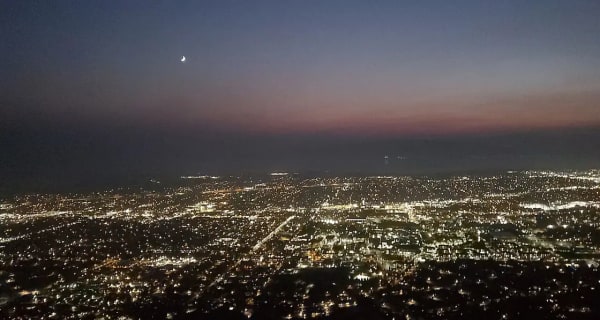

Provo's own sky is not dark. The valley light dome washes out everything faint, and no amount of driving to the edge of town fixes that. What makes this a good base for stargazing is geography: within forty minutes you can be in a canyon, within an hour and a quarter you can be above 10,000 feet in the Uintas, and — the part almost every guide to this subject misses, including earlier versions of this one — within forty minutes you can be at a certified International Dark Sky Place.
The certified site nobody mentions
Timpanogos Cave National Monument
Distance: about 40 minutes · American Fork Canyon
In September 2020, Timpanogos Cave National Monument was certified by the International Dark-Sky Association as an Urban Night Sky Place. It was the first unit of the National Park Service anywhere in the world to receive that designation.
Earlier versions of this page told readers that Capitol Reef, nearly three hours south, was the closest certified park. That was wrong by a factor of four, and it was wrong while this site's own guide to Timpanogos Cave sat one click away.
Be precise about what the certification means, because the category is the interesting part. Urban Night Sky Place is not the same designation as a Dark Sky Park. It was created specifically for protected sites near or surrounded by significant artificial light, to recognize places that actively promote an authentic night-time experience anyway — through lighting design, public education and outreach — rather than places blessed with pristine skies. The monument sits on the Wasatch Front with the whole valley glowing to the west.
So the honest framing is this: it is the closest certified site to Provo, not the darkest. The certification is a statement about stewardship and public programming, not a promise of a black sky. That is exactly why it is useful — it is close enough to go on a weeknight.
The programming is the real draw. The monument runs night sky programs in American Fork Canyon during the summer months, in partnership with the Uinta-Wasatch-Cache National Forest and local astronomy groups. These are the sort of ranger-and-volunteer evenings where telescopes are already set up and someone is there to point things out — a far better first experience than standing in a lay-by wondering which smudge is Andromeda. Schedules are published by the monument and change year to year, so check before planning around one.
⚠ Practical constraints on the canyon. American Fork Canyon is a designated recreation fee area: driving through is free, but a vehicle parked at a developed site needs a recreation pass on display, with interagency passes honored. A stargazing stop at an undeveloped gravel turnout is not what the fee is for — but read the closure order below before assuming a pullout is fair game. A Forest Service closure order restricts camping and campfires within a quarter mile of the SR-92 corridor, the North Fork road and Forest Road 010, so the pull-outs along that stretch are not places to spend the night. And the Alpine Loop is a seasonal road — generally open late May to late October, snow-dependent at both ends — with a vehicle length restriction on SR-92 that rules out longer rigs entirely. Our Alpine Loop guide covers the road itself.
Free telescopes, in Provo, on campus
The second thing almost no local stargazing guide mentions is that you can look through a research-grade telescope in Provo, for free, without owning anything.
BYU's Royden G. Derrick Planetarium sits on the fourth floor of the Eyring Science Center and runs public shows. The published pattern is Monday evenings and Friday evenings, with Monday shows given as professional presentations and Friday shows run by the BYU Astronomical Society. Reservations are not taken — you turn up. Afterwards, weather permitting, the rooftop observation deck opens with telescopes set up for the public.
That deck is part of the Orson Pratt Observatory, named for an early apostle of the Church of Jesus Christ of Latter-day Saints who was also a serious mathematician and astronomer. BYU runs telescopes in the campus dome and on the observation deck, with additional instruments brought out on public nights.
⚠ The catch is seasonal and it is annoying. Neither the Monday nor the Friday public shows run during Summer Term; both resume in September. Peak Milky Way season in Utah is June through September. So the months when you most want to be looking up are precisely the months when the public program pauses. Plan a campus night for the academic year and a canyon night for summer.
Show titles and times change by semester, so treat the pattern above as the shape and the planetarium's own current schedule as the authority.
And one thing not to do. BYU also operates the West Mountain Observatory, a research facility at about 6,600 feet with three telescopes, reached by about an hour's drive that ends in roughly five and a half miles of rough gravel road. The mountain is visible from campus, which is exactly why people try. BYU states plainly that it does not provide tours of that facility. It is a working research site, not a viewpoint. Do not drive up expecting access.
Driving out: the nearby spots
Kyhv Peak Road
Distance: 20 minutes · Darkness: moderate — the valley dome is still with you
The most accessible dark-ish sky from Provo. Climbing the road above Provo Canyon lifts you over the worst of the valley glare, and the overlook areas give open sky and a genuine improvement on viewing from town. Major constellations, planets and the brighter structure of the Milky Way all read well here.
⚠ It is a seasonal road, and this guide previously failed to say so. The gate typically closes around the beginning of November and reopens around the beginning of May, with both ends weather-dependent. For roughly half the year the drive-up overlook is not reachable. The road is also paved for only part of its length before turning to dirt.
Two naming notes: the peak and the road were officially renamed from Squaw Peak in 2022, so maps and signs carry both, and the overlook is a different feature from the summit — most people who say Squaw Peak mean the overlook.
Nebo Loop Scenic Byway
Distance: 40 minutes · Darkness: good
South through Payson Canyon and up onto the Nebo Loop, the valley light dome falls away behind you and the elevation — 7,000 to 9,000 feet along much of it — puts you above haze. Pull-outs give open sky in most directions. Also a seasonal road; the loop closes in winter.
Mirror Lake Highway
Distance: about 75 minutes · Darkness: excellent
The Uintas are the nearest dark sky to Provo. Alpine meadows above 10,000 feet, minimal light pollution in most directions, and the conditions that make Milky Way photography work rather than merely be attempted. Best paired with a camping trip — see our camping guide — and note that the highway is seasonal and carries its own recreation fee.
Utah's dark sky parks, for the long trip
Utah has a long list of certified International Dark Sky Places. The certified list grows, so treat any specific count you read — here or anywhere — as a snapshot rather than a fact.
The southern parks are a different experience from anything within an hour of Provo:
Capitol Reef National Park — under three hours, and the closest of the southern parks. Ranger astronomy programs in summer.
Goblin Valley State Park — around three and a half hours. Rock formations that photograph extraordinarily well under a star field.
Bryce Canyon National Park — around four hours. Among the darkest measured skies in the national park system, with an annual astronomy festival, and the hoodoo-and-Milky-Way image that sells the whole idea.
Moab — Arches, Canyonlands and Dead Horse Point all sit in the same dark corner of the state, and our Moab guide covers the trip.
How to read a dark sky map
Two scales do most of the work and knowing them makes every other decision easier.
The Bortle scale runs from 1 to 9 and describes what you can see. Class 1 is a pristine sky where the Milky Way casts shadows; class 9 is an inner-city sky with a handful of stars. Provo sits at the bright end. The canyons above it move you a couple of classes; the Uintas and southern Utah move you several. The practical point is that the scale is not linear in effort — the first hour of driving buys far more than the third.
Light pollution maps show the glow itself rather than what you can see, and the useful trick is to look not at where you are standing but at which direction is dark. From most spots near Provo the valley is to your west, so the good viewing is east and south. That is why a canyon works so well: the terrain physically blocks the city.
A local wrinkle worth knowing. Utah Valley's winter temperature inversions trap particulates in the valley — and the same layer scatters city light back down, which is why the sky glow looks worse on an inversion night. Our Provo weather guide explains the inversion mechanism. In late summer the equivalent problem is wildfire smoke, which flattens contrast even when the forecast says clear.
Timing it properly
Moon phase is the single biggest variable and the one beginners most often ignore. Plan within a few days of new moon. A full moon is bright enough to cast shadows and will erase everything faint. If you are stuck with a bright moon, go anyway and look at the moon — through binoculars it is spectacular, and the terminator line where light meets shadow is where the craters show relief.
Astronomical twilight is the real start of darkness, roughly ninety minutes after sunset at this latitude in summer, and later than most people expect. Arriving at sunset means an hour of waiting; arriving after full dark means driving mountain roads in the dark. Split the difference and arrive during twilight, which also lets you set up while you can still see.
Give your eyes the twenty minutes. Full dark adaptation takes twenty to thirty minutes and a single glance at a bright phone screen resets it. Use a red light, or your phone's red-tint accessibility mode, and warn everyone in the group before you go.
What to look at
Arriving under a dark sky with no plan is how people conclude that stargazing is overrated. A short list of targets changes the evening entirely.
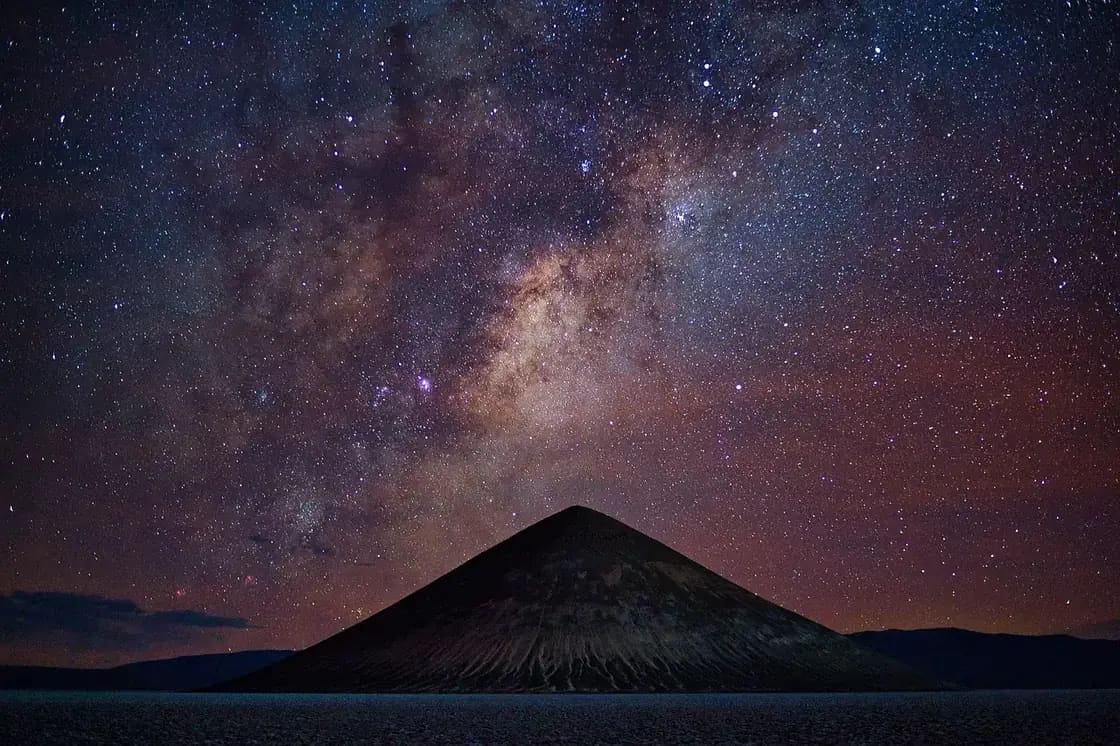
Summer, roughly June to September. The Milky Way core — the dense, textured part toward the galactic center — sits low in the southern sky and is the single most impressive naked-eye sight available here. Above it, the Summer Triangle of Vega, Deneb and Altair is unmissable and makes a good anchor for finding everything else. In binoculars, the globular cluster in Hercules resolves into a fuzzy ball of tens of thousands of stars, and the star clouds around Sagittarius break into structure.
Autumn. The Andromeda galaxy climbs high and is visible to the naked eye from a dark site as an elongated smudge — the furthest thing most people will ever see unaided, and worth pausing on for that reason alone.
Winter. The Milky Way core is gone but the sky is at its sharpest, because cold air holds less moisture and the inversion sits below you if you have driven up out of it. Orion dominates, and the Orion Nebula below the belt shows as a distinct gray cloud even in binoculars. The Pleiades are better in binoculars than in most telescopes, because a telescope's field of view is too narrow to hold them.
Meteor showers. Two are worth planning a night around. The Perseids peak in mid-August — generally around the 11th to 13th, though the exact peak shifts year to year — and are the best of the year here because the nights are warm enough to lie out comfortably. The Geminids in mid-December are arguably richer but require serious cold-weather kit. For either, the technique is the opposite of normal observing: no optics at all, lie flat, look up rather than at the radiant, and give it at least an hour.
And the thing that will confuse you. A neat line of evenly spaced points of light tracking silently across the sky is a train of recently launched satellites, not aircraft and not anything unexplained. They are now a common sight and they are the single most-reported "UFO" in Utah skies. Individual satellites crossing the field of view are constant at this point, particularly in the hour after dusk.
Astrophotography, briefly
Modern phones do more than people expect, and a basic camera on a tripod does a great deal more.
A phone in night mode, propped steady on a rock or a small tripod, will record the Milky Way from a dark site. It will not do it handheld. The single biggest improvement is simply not touching the phone during the exposure — use the timer.
A camera wants three things: a wide lens, a fast aperture, and a tripod. The rough guide for exposure length before stars begin to trail is to divide roughly 500 by the focal length in millimeters — about twenty seconds on a 24mm lens, about fifteen on a 35mm. Beyond that the stars smear because the Earth is turning. Push the ISO higher than feels comfortable; noise is fixable and an underexposed night shot is not.
Compose with something in the frame. A ridge line, a tree, a road — a photograph of only sky is a photograph of nothing in particular. Our photography spots guide covers foregrounds worth driving to.
Focus is the thing that ruins most attempts. Autofocus will hunt and fail in the dark. Switch to manual, use live view zoomed all the way in on the brightest star, and adjust until it is the smallest possible point. Then tape the focus ring and do not touch it.
What to bring
Warmth, first and by a distance. Elevation plus clear skies plus night equals cold, even in July — clear air radiates heat away fast, which is the same reason the viewing is good. A jacket, hat, gloves and something to sit on will extend a session by hours. Most stargazing trips end early because someone got cold, not because the sky disappointed.
Binoculars before a telescope. A 7x50 or 10x50 pair shows star clusters, nebulae, the four Galilean moons of Jupiter and detailed lunar craters, costs a fraction of a telescope, needs no setup and travels in a coat pocket. Almost everyone who buys a cheap telescope first regrets it.
A star app, used sparingly and in night mode, turns a confusing sky into a map. Point it up and it names what you are looking at.
A thermos and a blanket, which sound trivial and are the difference between an hour and three.
Tell someone where you are going. Canyon roads have no phone signal in long stretches, seasonal gates close behind you, and a stargazing trip is by definition one you take in the dark.
Related Guides
-
Advertisement
-
Shooting Ranges in Utah Valley: Where the Public Can Actually Shoot, and What to Bring
-
Skate Parks in Utah Valley: Fort Utah, Orem, and Where Else to Actually Skate
-
Goblin Valley and the San Rafael Swell from Provo Last updated: August 2026. The Timpanogos Cave dark sky certification and the BYU planetarium public-show pattern were verified this update against the certifying body's and BYU's own pages; the "Capitol Reef is the closest certified park" claim in earlier versions was corrected here. Program schedules, road gates and fees change every season — confirm before you drive.
Frequently Asked Questions
What is the closest certified dark sky place to Provo?
Is Timpanogos Cave as dark as a national park in southern Utah?
Can you look through a telescope for free in Provo?
Can you see the Milky Way from Provo?
When is the best time of year and night for stargazing near Provo?
Is Kyhv Peak Road open at night and in winter?
Do I need a permit or a fee to stargaze in American Fork Canyon?
What equipment do I need to start stargazing?
Sources
The facts in this guide were checked against these sources. Hours, fees and rules change, so confirm anything time-sensitive with the source before you go. How we make Provo.com.
- Timpanogos Cave National Monument Certified by International Dark-Sky Association as Urban Night Sky Place, National Park Service. Checked October 12, 2026.
- BYU Royden G. Derrick Planetarium: Public Shows, BYU Royden G. Derrick Planetarium. Checked October 12, 2026.
- About the Observatory, BYU West Mountain Observatory. Checked October 12, 2026.
- Timpanogos Cave National Monument Urban Night Sky Place, DarkSky International. Checked October 12, 2026.