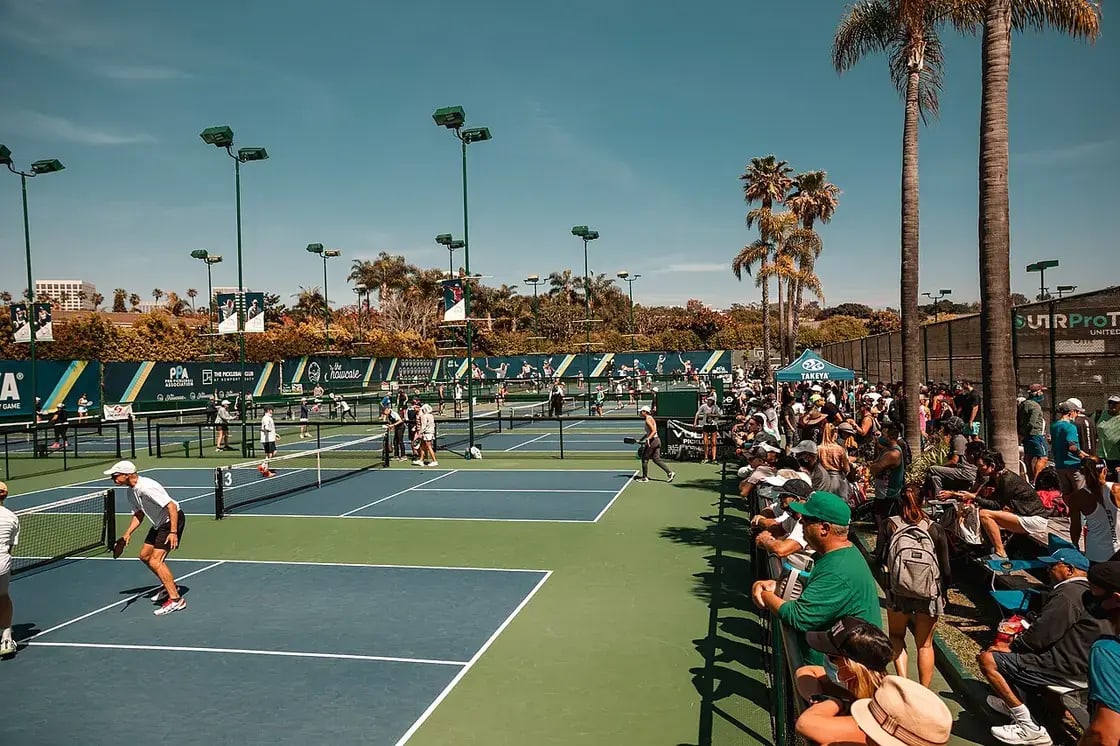

Utah County has quietly assembled a deep bench of public pickleball courts — more than two dozen dedicated locations from Alpine down to Santaquin, most of them free — and the biggest addition of all, a 45-court complex at Epic Sports Park, is under construction right now.
This guide maps all of it: where to play today, what's free versus membership, where the lights are (August evenings, you're welcome), the indoor options that keep the season alive through January, and how to find games. Court counts below come from the Utah Valley Convention and Visitors Bureau's county-wide directory (updated February 2026) plus the cities' own recreation pages; small facilities change, so treat any single court count as a snapshot and the addresses as the reliable part.
Provo courts
Provo proper is — surprisingly, for now — the thinnest slice of the county map. That changes dramatically when Epic's complex opens, but today:
Rotary Park — 8 dedicated outdoor courts · Free · Restrooms and water · 1460 N 1500 W The city's free pickleball hub, on the northwest side. Eight courts is enough that a summer evening usually resolves into a natural rotation rather than a standoff.
Provo Recreation Center — 8 dedicated outdoor courts · Members · Lights · 320 W 500 N The only lighted dedicated courts in Provo, attached to the Rec Center. The CVB lists these as membership-required; if you're not a member, ask the front desk about access options before making the trip. The Rec Center also programs indoor court time in its gyms on a rotating schedule — worth a call in winter.
Coming: Epic Sports Park, 45 courts. The headline of Provo pickleball's future. Still in design and construction as part of Epic's Phase 2, no opening date announced, operating plans not final — the city's stated goal is a blend of tournaments, reservations, and drop-in play. When it opens, it will be a major regional complex. Full context in our Epic guide.
Orem courts
Orem is the valley's real pickleball town, with both the best free spread and the county's structured-play scene:
Sharon Park — 6 dedicated outdoor courts · Free · Lights · Restrooms and water · 600 N 300 E Central, lit, and busy — the default answer to "where should we play in Orem tonight?"
Bonneville Park — 4 dedicated courts + 1 tennis court · Free · Lights · Restrooms and water · 1450 N 800 W Northwest Orem's option, with lights.
Orem Community Tennis Courts — 9 dedicated pickleball courts · Free · Lights · Restrooms · 165 600 W Despite the name, this complex carries nine dedicated pickleball courts — the largest free lit block in the county's core.
Cherry Hill Park — 2 dedicated courts · Free · Restrooms and water · 250 E 1650 S Small and neighborhood-scaled; your best odds of an empty court on a Saturday morning.
Hillcrest Park — 635 E 1400 S · Courts open 7 a.m.–10 p.m. This is Orem Recreation's home base for organized pickleball — adult leagues on weeknights, beginner clinics, and regular bracketed tournaments (team entries typically run about $40–$44, with prizes for the top three). If you want structure instead of open play, this is the valley's front door; details and registration live at Orem Recreation's pickleball page.
Club Pickleball USA — Indoor courts · memberships and open play · closed Sundays · 1330 Sandhill Rd The indoor option on the Provo–Orem line: climate control, lights, food, and bookable court time.
North county: Lindon, Pleasant Grove, American Fork, Alpine
- Creekside Park, Lindon — 2 courts, free, lights · 100 S 600 W
- Hollow Park, Lindon — 4 courts, free, lights · 300 E 400 N
- Pleasant Grove Recreation Center — 8 dedicated outdoor courts, free, lights · 315 S Locust Ave
- Harvey Park, Pleasant Grove — 6 courts, free, lights · 4301 Harvey Blvd
- Discovery (Manila) Park, Pleasant Grove — 2 courts, free · 1511 N 100 E
- Art Dye Park, American Fork — 12 courts, free · 1000 N 550 E — one of the county's biggest free blocks
- Burgess Park, Alpine — 4 courts, free · Parkway S
- Suncrest Park (top of Traverse Ridge) — 2 courts, free · 15343 S Traverse Ridge Rd
Northwest county: Lehi, Saratoga Springs, Eagle Mountain
- Viewpoint Middle School, Lehi — 6 courts, free, lights · 211 W Traverse Terrace Dr
- Watercress Park, Lehi — 2 courts (plus a tennis court), free · 1500 S Center St
- Spring Creek Park, Lehi — 3 courts, free · 2096 S Bullrush Pkwy
- Olympic Park, Lehi — 3 courts, free · 2700 W Parkside Dr
- Patriot Park, Saratoga Springs — 8 courts, free, lights · 444 E 400 S
- Brandon Park, Eagle Mountain — 8 courts, free, lights · 4623 N Brandon Park Dr
- Cory Wride Memorial Park, Eagle Mountain — 14 courts, free, lights · 5806 Pony Express Pkwy — the county's largest free outdoor block
South county: Springville, Mapleton, Spanish Fork, Payson, Santaquin
- SunPro Tennis and Pickleball Club, Springville — indoor courts, membership, trainers and lessons · 2069 W 1150 N — the county's biggest indoor facility
- Ira Allan Park, Mapleton — 14 courts, free · 1728 S 800 W
- Mapleton Grove Park — 2 courts, free, lights · 126 S Doubleday St
- Spanish Fork Sports Park — 16 courts, free, lights · 295 Volunteer Dr — the south county's free flagship
- Memorial Park, Payson — 6 courts, free · 285 S 200 E
- Harvest View Sports Complex, Santaquin — 8 courts, free · 1270 Summit Ridge Pkwy
Free vs. paid, lights, and winter: the quick strategy
If you want free + lights (summer evenings): Sharon Park, the Orem Community Tennis Courts, Spanish Fork Sports Park, Cory Wride Memorial, Patriot Park, and Harvey Park are the workhorses.
If you want the best odds of an open court: go small (Cherry Hill, Mapleton Grove, Watercress) or go big enough that rotation absorbs the crowd (Art Dye, Ira Allan, Cory Wride, Spanish Fork).
When it snows: Club Pickleball USA (hourly, no membership needed) and SunPro (membership) are the dedicated indoor answers, with rec-center gym blocks — Provo, Orem, Pleasant Grove — as the budget option. Indoor gym schedules rotate seasonally, so verify before driving.
Finding games: PlayTime Scheduler's Utah County – Provo/Orem region is the valley's de facto open-play bulletin board, and Orem Rec's Hillcrest leagues are the structured path. Local open-play etiquette is standard: paddles in the rack hold your place, winners split or rotate off depending on the crowd, and games run to 11, win by two.
Never played? Your first game, minus the awkward part
Pickleball's entire appeal is that the learning curve is a ramp, not a wall. What to know before your first trip to Rotary or Sharon Park:
Gear: A starter paddle runs $20–$50 at any sporting-goods store (Al's Sporting Goods at University Place stocks a wall of them), and outdoor balls are a few dollars. Court shoes beat running shoes — the game is lateral. That's the entire equipment list.
The rules in one paragraph: Games go to 11, win by two. You serve underhand, diagonally, from behind the baseline, and the ball must bounce once on each side before anyone can volley (the "two-bounce rule"). The 7-foot zone at the net is the kitchen — you can't hit a volley while standing in it. Only the serving side scores. Everything else you'll absorb in a game and a half.
Open-play culture: Stack your paddle in the holder or along the fence to claim the next game, rotate off graciously, and say yes when a foursome one player short waves you in — that wave is how basically everyone in this valley got started. Weekday mornings skew retiree-friendly and patient with beginners; summer evenings under the lights skew younger and faster. Pick your on-ramp accordingly.
Leveling up: Orem Rec's beginner clinics at Hillcrest are the cheapest instruction in the county, Club Pickleball USA and SunPro both offer lessons and trainers, and PlayTime Scheduler sessions usually list a skill rating so you can find your bracket.
Why this valley is built for pickleball
The demographics write the story themselves. Pickleball is the country's fastest-growing sport, it thrives on cheap social evenings, and Utah Valley is a place with tens of thousands of students, young families everywhere, and a date-night economy that has always rewarded activities under ten dollars — the same forces behind our soda shops and board-game cafés. Free courts with lights are effectively the perfect Provo-Orem social infrastructure, and the cities have clearly noticed: nearly every park on this list added its courts within the last several years, and the biggest complex of all is still coming.
When Epic's 45 courts open, Utah Valley won't just have places to play — it will have a legitimate claim as a tournament destination for the sport. Until then, there's a free court with your name on it in basically every direction.
Round out the active life: the best gyms in Provo, the best parks, and Epic Sports Park's complete guide for everything else on the west side.
Why the courts keep appearing
The growth in public pickleball capacity across Utah Valley is not simply a matter of cities responding to a trend. There is a specific funding mechanism behind most of it, and knowing how it works explains both why courts arrive and why they are sometimes not maintained as well as players would like.
Utah cities and counties may charge impact fees — one-time charges on new development, authorized by the Impact Fees Act at Title 11, Chapter 36a of the Utah Code. The logic is that new rooftops bring new residents who use parks, and the cost of expanding the park system to serve them should fall on the development that created the demand rather than on existing residents' property taxes. In a valley adding housing as fast as this one, park impact fee revenue is substantial.
The Act constrains that money tightly, and the constraints are what shape the courts you play on.
A city has to do the arithmetic first. Before imposing a fee, a local government must adopt an impact fee facilities plan identifying the existing level of service, establishing a proposed level of service, identifying excess capacity, quantifying the demand new development places on facilities, and setting out how it will meet that demand. A separate impact fee analysis then supports the amount charged. Small entities are partially exempted — a subdivision under 5,000 population collecting under $250,000 a year need not prepare the full plan, though its fees must still rest on a reasonable basis.
Impact fees maintain a standard; they cannot raise one. This is the provision that surprises people. A proposed level of service may equal or diminish the existing level of service — it may exceed it only where the improvement above the current standard is funded independently of impact fees. Newcomers can be charged to keep the park system as good as it currently is per resident. They cannot be charged to make it better for everyone.
The money is earmarked by category. Park impact fees must be spent on parks; road impact fees on roads. Revenue collected for one facility type cannot subsidize another.
Capital only, never operations. Fees fund permanent facilities with a life expectancy exceeding ten years. They cannot pay for maintenance, staffing, utilities, or resurfacing.
And there is a clock. Impact fees must be spent or encumbered within six years of the day each fee is paid, with refund provisions if they are not. A city sitting on park impact fee revenue faces a deadline.
What that means for players
Read the list above as a design brief and the courts explain themselves.
Construction is cheap against the level-of-service math. Pickleball courts deliver a lot of countable capacity per dollar and per acre — several courts fit in one tennis footprint. For a city that must demonstrate it is maintaining service levels against a rising population, they are an efficient way to do it.
The six-year clock rewards shovel-ready projects. Courts can be designed, bid and built inside that window comfortably, which is not true of every park project competing for the same fund.
Building is funded; upkeep is not. The single most common complaint about public courts anywhere — cracked surfaces, sagging nets, faded lines, no lights — traces directly to the split. The fee that built the court is legally barred from maintaining it. Maintenance competes in the general fund against every other municipal need, and it competes annually, forever, while the construction money arrived once and had to be spent.
That is also why the practical route to a better local court is usually not "ask the city to build more." It is to raise maintenance in the budget process, which is a different ask made to a different pot of money at a different time of year. Our guide to following the Provo City Council covers how to find and speak at those meetings.
Two adjacent mechanisms are worth not confusing with this one. Several Utah County communities fund arts and recreation programming through a local RAP tax — a small sales tax, entirely separate from impact fees, covered in our guide to small-city celebrations in Utah County. And ongoing operations at municipal facilities are largely general fund and user fees, which is the model behind the Provo Recreation Center.
How to see the decision before it is made
Impact fee decisions are unusually open to the public, and almost nobody uses the access.
The Impact Fees Act builds notice into every stage. A local government must give notice before adopting or amending an impact fee facilities plan, separate notice that it is preparing an impact fee analysis, and further notice of its intent to adopt the fee itself, with a hearing. The plan and the analysis are public documents, and because they must identify the existing level of service and the proposed one, they state in writing how much park capacity per resident the city intends to maintain — which is the number that determines whether more courts get built.
The Act also requires local governments to account for the fees they collect, and provides for refunds where money is not spent or encumbered in time. And it sets out a route to challenge a fee, with time limits, plus mediation and arbitration procedures; the state's Office of the Property Rights Ombudsman publishes plain-language guidance on how impact fees are supposed to work.
The practical point for a player: the moment to influence court supply is when the facilities plan is out for comment, not after the budget is set. That document is where a city writes down what it is planning to build.
Related Guides
- EPIC Sports Park Opens for Free Drop-In Play Through Mid-October
- The Provo Recreation Center: What's Inside, What It Costs, and What Nobody Tells You First
- Bowling in Provo & Orem: Every Lane in Utah Valley, Ranked by What You Actually Want
- Provo Beach: The Indoor Surf Park at Riverwoods, and How to Do It Without Overspending
- Team-Building and Corporate Activities in Utah Valley
Frequently Asked Questions
Where can I play pickleball for free in Provo?
Where are the pickleball courts in Orem?
Where can I play pickleball indoors in Utah Valley during winter?
How many pickleball courts are coming to Epic Sports Park?
How do I find people to play pickleball with in Utah Valley?
Who pays for new pickleball courts in Utah Valley?
Why are public pickleball courts often poorly maintained?
Can impact fees be used to improve a city's parks beyond current standards?
Sources
The facts in this guide were checked against these sources. Hours, fees and rules change, so confirm anything time-sensitive with the source before you go. How we make Provo.com.
- Epic Sports Park opening release (Sept 19, 2024), Provo City. Checked October 12, 2026.
- Epic Sports Park FAQs, Provo City. Checked October 12, 2026.
- Club Pickleball USA. Checked October 12, 2026.