
More on Eagle Mountain: every guide we have published there, in one place.
A little over a decade ago, Eagle Mountain was a remote stretch of the Cedar Valley with a few hundred residents and a lot of open sky. Today it's one of the fastest-growing cities in Utah and an unlikely magnet for some of the biggest names in technology — Meta, Google, and Tyson Foods have all planted major facilities here, even as the city holds onto its Pony Express heritage, big lots, and rural character.
If you're thinking about moving here, you're looking at one of the best space-and-affordability values in Utah Valley — with a genuinely different lifestyle than the more urban cities to the east. This guide covers what it's actually like to live in Eagle Mountain — the housing, the data-center boom, the schools, the long commute, and the western, outdoorsy culture — from people who know the area well.
The short version
Eagle Mountain sprawls across the Cedar Valley on the far western edge of Utah County, at the base of the Lake Mountains. It's one of the largest cities in the state by land area, which is exactly why it can offer what the rest of the valley increasingly can't: space. Its population went from about 21,000 in 2010 to 43,623 in 2020, and has since climbed toward and past 60,000.
What draws people:
- Affordability and space — bigger lots, larger homes for the money, and neighborhoods where some properties allow animals and gardens.
- A western, outdoor lifestyle — the Pony Express Trail, an extensive trail network, a dark-sky ordinance for stargazing, and room to ride ATVs and horses.
- Major employers and tax revenue — Meta's billion-dollar data center, a Tyson Foods plant, Google's land for a future campus, and more data-center development on the way.
- A strong community feel — anchored by Pony Express Days, a beloved annual rodeo-and-festival tradition.
What to weigh:
- Location. Eagle Mountain is the most remote of the fast-growing valley cities — commutes to I-15 and job centers are longer.
- Limited retail and dining. Day-to-day shopping and restaurant options are still thin compared to Lehi or Orem (residents joke about the lone gas station of the early days).
- Growth and traffic. Even out here, rapid growth means the main roads — Pony Express Parkway, SR-73 — get busy at peak times.
From bankruptcy auction to boomtown
Eagle Mountain's origins are unusual. In 1994, a group of investors bought roughly 8,000 acres in the Cedar Valley at a bankruptcy auction. The community was incorporated in December 1996 and became a city in 2001, starting from just a few hundred residents. For years it was best known as a remote, affordable place to buy a lot of house and land far from the bustle of the Wasatch Front.
The land it sits on — vast, open, and at the base of the mountains — has shaped everything about it. It's why Eagle Mountain can be both a fast-growing residential community and a hub for enormous industrial projects like data centers, and why the city's identity leans rural and western even as its population multiplies.
The data-center boom
The most surprising thing about Eagle Mountain is its emergence as a technology-infrastructure hub. The same qualities that make it appealing to homebuyers — abundant, affordable land — make it attractive to data-center developers who need space near power and fiber.
Meta (Facebook) built a major data center here, a $1 billion-plus investment that it later expanded. Google purchased land for a potential future campus, with a written commitment to invest well over $1 billion in the area. Tyson Foods built a meat-processing plant. And developers like Tract have acquired hundreds of additional acres to prepare even more data-center sites. The one real constraint has been power: demand has outpaced what the regional utility can supply, which has slowed some projects and prompted the city to explore new energy solutions.
For residents, this matters in a concrete way: large commercial and industrial facilities generate significant tax revenue that helps fund city services and can offset the property-tax burden on homeowners — a meaningful benefit in a city building out so much new infrastructure.
If you're weighing Eagle Mountain against other cities, it helps to see current prices and inventory side by side. You can browse what's on the market across Utah Valley — homes for sale, rentals, and student housing — in our real estate marketplace, and if you're moving from outside the area, our moving to Provo guide covers the practical side of relocating to the valley.
Housing in Eagle Mountain
Eagle Mountain's calling card is value. Because it has so much developable land, it has consistently offered more home and more lot for the money than the more central cities of Utah County — a big reason families have flocked here. The housing stock is overwhelmingly new, almost all of it built in the last 20 years.
The city has distinct areas with different feels: established family neighborhoods and golf-course and equestrian properties in The Ranches; more affordable starter homes around the original City Center; newer planned developments like Eagle Park; higher-end homes with mountain views in areas like SilverLake; and a more rural, large-lot character in parts of the Cedar Valley, where there's room for animals and open space. That variety means buyers can dial in the trade-off between price, space, and amenities that fits their priorities.
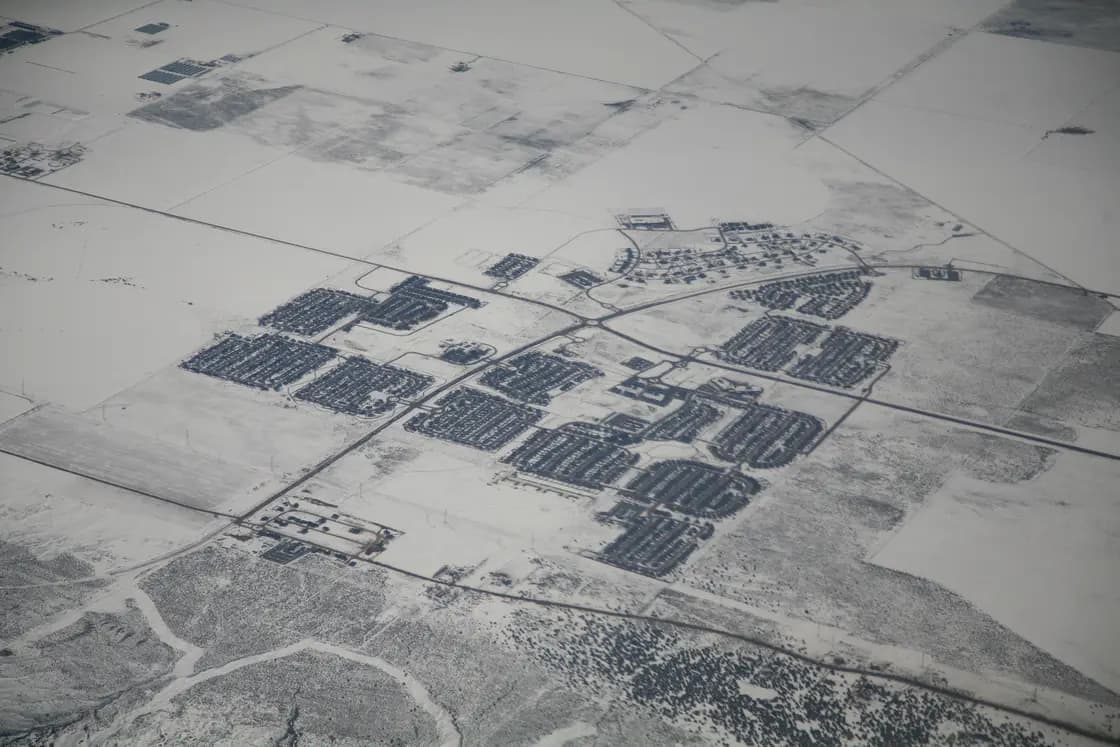
Two structural facts shape the search here more than anything the market is doing in a given year. The first is geography. Eagle Mountain covers an enormous footprint, and its developed pods are separated by real stretches of open ground rather than running continuously into one another. Where you land inside the city changes your drive to a grocery store, to a school, and to the main connector out toward Lehi — sometimes by more than the difference between two neighboring cities elsewhere in the valley.
The second is schools. Eagle Mountain leaves the Alpine School District along with Saratoga Springs, Cedar Fort and Fairfield to form the new Lake Mountain School District, which becomes operational on July 1, 2027. For anyone buying with young children, that transition — not the current boundary map — is the thing to ask about.
Because nearly the whole city was built inside the last two decades, there is very little genuinely old housing stock here, and most master-planned neighborhoods carry an HOA with design and landscaping standards. Buyers arriving from established parts of the valley are usually trading architectural variety and mature trees for newer systems and a bigger lot.
Getting around: the trade-off of the far west side
There's no way around it: Eagle Mountain is the most remote of the fast-growing valley cities. It sits at the western base of the Lake Mountains, roughly 30 miles from Provo and 40 miles from Salt Lake City. Most commuters use Pony Express Parkway and SR-73 (the Cory Wride Highway) to reach Lehi, I-15, and the Silicon Slopes job centers to the northeast.
That distance is the central trade-off of living here: you get more house and land, but you pay for it in drive time, and rapid growth has added congestion to the main connectors. State and regional road investment in northwest Utah County — including improvements tied to SR-73 and the broader corridor — is gradually improving those connections, but if a short commute is your top priority, Eagle Mountain may not be your city. If space and affordability matter more, the drive is often a price people are happy to pay.
Schools
Eagle Mountain is currently served by the Alpine School District, but a major change is coming. Utah County voters approved splitting Alpine into three smaller districts, and Eagle Mountain — together with Saratoga Springs, Cedar Fort, and Fairfield — will become part of the new Lake Mountain School District — the name was made permanent in late 2025 — which officially assumes operations on July 1, 2027, making 2027–28 the first school year under the new district.
Students here currently attend schools including Cedar Valley and Westlake high schools, both of which have been running over capacity due to the area's explosive growth. To relieve the crowding, the district broke ground in 2025 on a new high school in neighboring Saratoga Springs, set to open around 2028. For families, the takeaway is that schools out here are part of a system being actively reorganized and expanded. Because boundaries shift quickly in a fast-growing area, confirm current school assignments directly with the district when choosing a home.
Things to do
Eagle Mountain wears its heritage proudly: the historic Pony Express Trail runs through the city, and the Pony Express Days festival each summer — a multi-day celebration with a PRCA rodeo (a repeat "Rodeo of the Year" in its circuit), carnival, concerts, and fireworks — is the unofficial kickoff to the season and a true community tradition. Our guide to things to do in Eagle Mountain rounds up the festival, Cory Wride Memorial Park, dark-sky stargazing, and the trails in detail.
Eating is its own subject here, and a surprising amount of the best of it runs out of food trucks rather than storefronts — our guide to restaurants in Eagle Mountain covers where they park.
Day to day, the appeal is the outdoors. The city has an extensive network of hiking and mountain-bike trails, including the paved Pony Express Parkway Trail that links neighborhoods to parks; a dark-sky ordinance that makes for excellent stargazing; parks, a skate park, and golf; and easy access to open land for ATVs, horses, and birdwatching. Utah Lake and the canyons are a drive away for boating, skiing, and bigger adventures. For ideas just beyond Eagle Mountain's borders, browse our guides to things to do in Utah Valley and keep an eye on the Provo.com events calendar for concerts, markets, and festivals happening nearby.
Who actually provides your utilities
Eagle Mountain is served by Rocky Mountain Power, which places it with the western and northern Utah County cities rather than with the municipal-power towns down the valley.
The comparison worth drawing is with Lehi, the city most Eagle Mountain commuters drive through. Lehi owns Lehi City Power and picks its own generation projects through the UAMPS cooperative; Eagle Mountain buys from a regulated investor-owned utility, with rate questions settled at the Public Service Commission rather than at a council meeting. For a household the monthly experience is similar. For anyone who cares where the decisions are made, it is a real difference — and one that rarely appears in a relocation comparison.
Natural gas is Enbridge Gas Utah, the utility formerly known as Questar and then Dominion Energy Utah. Eagle Mountain is not a UTOPIA Fiber city, and given the city's geography — a very large land area with development in distinct pockets — internet availability varies more by subdivision here than in most of the valley. Check the specific address rather than the city.
Water deserves particular attention in the Cedar Valley. Across Utah Valley, properties are commonly served by two systems, treated culinary water indoors and untreated secondary water for outdoor irrigation, and Utah's statewide metering law now requires every pressurized secondary connection in the state to be metered by January 1, 2030, with a statutory cap on how fast rates may rise to pay for the metering. In a west-side city built largely from new development on dry ground, the secondary picture is designed in rather than inherited from irrigation companies, which makes it a question to ask about your specific development. Our guide to secondary water and water shares covers the statute and the buyer's checklist.
Who responds when you call 911
Eagle Mountain does not run its own police department. The Utah County Sheriff's Office does, and it has since the city incorporated in 1996.
The arrangement is substantial rather than nominal. The Sheriff's Office staffs a dedicated Eagle Mountain division of more than thirty sworn personnel providing round-the-clock coverage, with a chief deputy, a lieutenant, sergeants, detectives, patrol deputies and school resource officers, supported by a full-time office specialist, a full-time victim advocate and part-time community safety instructors. The city does operate its own fire department, so unlike Vineyard — which contracts both police and fire — Eagle Mountain splits the two.
This is one of the clearest contrasts in the valley. Saratoga Springs, immediately across the Cedar Valley, runs its own police department with its own chief. Two neighboring cities in the same corner of the county have answered the same question differently, and if you are choosing between them it is a fair thing to weigh. A city department reports to the city council. A contract division reports to an elected county sheriff and is renegotiated on a contract cycle.
What the contract buys is depth without the overhead: Metro SWAT, K-9 teams, the investigations division, accident investigation, search and rescue and emergency services are all county units serving Eagle Mountain without the city funding any of them outright. That matters in a community with the demographic profile Eagle Mountain has — a very young population, a great many children, and rapid growth — which the Sheriff's Office addresses through community programs rather than patrol alone.
The honest counterweight is accountability distance. When residents want to change how their city is policed, the decision runs through a contract negotiation and a county elected official rather than solely through their own council. For how those decisions get made locally, see who decides what in Utah Valley.
Who Eagle Mountain is right for
Eagle Mountain tends to be a strong fit if you want maximum space and value, you love an outdoor, western lifestyle, and you're willing to trade a longer commute for a bigger home, a bigger lot, and dark, star-filled skies. Families priced out of the central valley, outdoor enthusiasts, and people who want room for animals or hobbies do especially well here.
It's less of a fit if you need short commutes, lots of nearby restaurants and shopping, or an established urban feel — Eagle Mountain is, by design, the quieter and more rural end of Utah County, and conveniences are still catching up to the population.
If you're a BYU or UVU student, Eagle Mountain is one of the farther cities from both campuses, so it's much more of a family-and-homeowner community than a student hub. For most students, something closer to campus will make more sense — browse current student housing options to compare.
The bottom line
Eagle Mountain is one of Utah's great space-and-value plays — a fast-growing, family-friendly city that hangs onto its Pony Express roots and big-sky character even as Meta, Google, and Tyson reshape its economy. It rewards people who want more home, more land, and a quieter, outdoorsy life, and who don't mind a longer drive to get it. If that's you, it's one of the most distinctive addresses in Utah Valley.
When you're ready to take the next step, start with current listings in our real estate marketplace, and if you're relocating from out of state, our complete moving guide walks through everything from utilities to neighborhoods across Provo, Orem, and the surrounding cities.
Related Guides
- Eagle Mountain Neighborhoods Guide: Where to Live — area by area, and what the names actually mean
- Living in American Fork, Utah (2026): The Complete Guide
- Cedar Fort & Fairfield: Camp Floyd and Utah County's West Desert Edge
- Living in Mapleton, Utah (2026): The Complete Guide
- Living in Payson, Utah (2026): The Complete Guide
- Living in Salem, Utah (2026): The Complete Guide
- Lake Mountain School District: The West Side Gets Its Own Schools
- Which School District Am I In? Utah County Before and After the Alpine Split
- Who Decides What in Utah Valley — the bodies governing the county's largest city by area
- Saratoga Springs vs. Eagle Mountain: The Two Fastest-Growing Cities in Utah, Compared for People Deciding Between Them
- Every Rec Center in Utah Valley, Compared: Provo, Orem, Lehi, American Fork, Pleasant Grove, Springville and Spanish Fork
Frequently Asked Questions
Is Eagle Mountain, Utah a good place to live?
How fast is Eagle Mountain growing?
Why are there so many data centers in Eagle Mountain?
What school district is Eagle Mountain in?
What is the commute like from Eagle Mountain?
What is there to do in Eagle Mountain?
Does Eagle Mountain have its own police department?
Who supplies electricity in Eagle Mountain?