
The Y Mountain Trail is the most iconic hike in Provo — a short, steep climb to the massive white letter "Y" painted on the mountainside above BYU's campus. It's a rite of passage for every BYU student, a popular fitness challenge for locals, and one of the best viewpoints in Utah Valley. The hike is straightforward: follow the switchbacks up, enjoy the panoramic view from the Y, and come back down.
What makes this hike special isn't difficulty or distance — it's the payoff. The view from the Y encompasses the entire Utah Valley, from Utah Lake to the surrounding peaks, with BYU's campus directly below. At sunrise, it's one of the most beautiful sights in the state.
Trail Details
| Detail | Info |
|---|---|
| Distance | About 1.1 miles each way; published round trips run 2.2–2.4 miles depending on whether the measurement stops at the base or the top of the Y |
| Elevation gain | 1,100 feet |
| Difficulty | Moderate to strenuous |
| Time | 1.5–2 hours round trip |
| Trailhead | End of E 820 N, Provo |
| Parking | Small lot at trailhead (fills fast) |
| Dogs | Allowed on leash |
| Fee | Free |
| Restrooms | Portable restroom at trailhead |
What to Expect
The Climb
The trail is essentially a series of switchbacks that climb relentlessly from the trailhead to the Y. There's no flat warm-up section — you're climbing from the first step. The switchbacks are well-maintained with a mix of packed dirt, gravel, and some rocky sections. The trail is wide enough for two people side-by-side on most sections.
The steepest sections are in the middle of the hike, where the switchbacks tighten. If you're not used to hiking at elevation (the trailhead starts around 5,200 feet), you'll feel it. The altitude, the relentless uphill grade, and the lack of shade combine to make this a genuine workout despite the short distance.
The Y
The Y itself is a concrete block letter, about 380 feet long by BYU Magazine's count, built on the mountainside by BYU students in 1906 and maintained by the university ever since. When you reach it, you'll find a flat area at the base of the letter where most hikers rest, take photos, and enjoy the view.
The view is the reward. On a clear day, you can see the entire Utah Valley — Utah Lake to the west, Mount Timpanogos to the north, the Provo River corridor below, and the sprawl of Provo, Orem, and the surrounding cities stretching across the valley floor. It's a 360-degree panorama that consistently impresses even people who hike regularly.
Beyond the Y
What most people don't know: the trail continues past the Y. Above the Y, the Forest Service's Slide Canyon Trail #062 narrows to singletrack and runs 3.4 miles to the Slate Canyon trail, then 1.1 miles more to Kyhv Peak (Squaw Peak) Road. The terrain gets rougher, the crowds disappear almost entirely, and the scenery shifts from valley views to mountain forest. If you want a longer adventure and some solitude, this is an excellent option. Just be prepared with more water and appropriate gear — this isn't maintained to the same standard as the main Y trail.
When to Go
Best Times of Day
Sunrise is the best time to hike the Y. The light on the valley is extraordinary — warm golds and pinks spreading across the lake and mountains — and the trail is nearly empty. You'll need a headlamp for the first portion if you start in true pre-dawn darkness. The effort is worth it.
Early morning (6–8 AM) is the practical sweet spot. Cooler temperatures, fewer crowds, and good light for the view. This is when most regulars go.
Late afternoon works in fall and spring when temperatures are manageable. The light is nice for photos of the valley, and you can catch sunset from the top if you time it right.
Avoid midday in summer. The trail has zero shade. Summer afternoon temperatures regularly hit 90°F+ in Provo, and the south-facing slope amplifies the heat. Hiking the Y at noon in July is miserable and dangerous without enough water.
Best Seasons
Spring (March–May) and fall (September–November) are the best seasons. Moderate temperatures, manageable sun, and beautiful light. Spring wildflowers occasionally appear on the lower sections.
Summer (June–August) is fine if you go early. Before 8 AM, the heat is manageable. After that, it gets brutal.
Winter (December–February) is doable but requires caution. Snow and ice accumulate on the trail, especially on north-facing switchbacks. Microspikes or traction devices are strongly recommended. The views of a snow-covered valley are striking.
What to Bring
Water: Bring at least 1 liter, more in summer. There's no water source on the trail and no shade. Dehydration on this hike is common and preventable.
Sun protection: Sunscreen, sunglasses, and a hat. The trail faces south and there is no shade at any point.
Shoes: Trail shoes or hiking boots are ideal. Running shoes work but the rocky sections will punish anything with thin soles.
Headlamp: If you're doing a sunrise hike, you'll need one for the pre-dawn start.
Layers: Mornings can be cold, especially in spring and fall, even though you'll warm up quickly on the climb. A light layer you can tie around your waist is smart.
Phone/camera: The views are worth capturing. Just don't rely on your phone for a flashlight — bring a headlamp separately.
Parking and Access
The trailhead is at the end of E 820 N in Provo, on the east side of campus. There's a small parking lot that fills quickly, especially on weekend mornings and during peak seasons. If the lot is full, street parking along the approach road is available but limited.
Game day warning: On BYU football Saturdays, the area around the trailhead is significantly more congested. Plan accordingly or go early.
Alternative access: You can also reach the trailhead via the Bonneville Shoreline Trail, which runs along the foothills and connects to the Y trail. This adds distance but avoids the parking situation.
Fitness Level & Difficulty
The Y trail is often described as "moderate," but that's misleading if you're not an active hiker. Roughly a thousand feet of gain in roughly a mile is an average grade close to eighteen percent, with no flat recovery — steeper than most casual hikers expect, and the grade is the number that describes the effort rather than the distance. If you exercise regularly and can climb stairs without getting winded, you'll be fine. If you're sedentary, start with something easier (like the Provo River Parkway) and work up to it.
That said, thousands of people of all ages and fitness levels hike the Y every week. Go at your own pace, take breaks when you need them, and don't feel pressured by the runners flying past you. The view is the same whether you get there in 30 minutes or 90.
For BYU students: Hiking the Y is a rite of passage, and peer pressure to race up is real. There's no prize for being first. Enjoy the hike.
Safety
Stay on the trail. Cutting switchbacks causes erosion and is dangerous on the steep slopes.
Don't hike alone at night unless you're experienced and have proper lighting.
Tell someone your plans. Even on a popular trail like this, it's good practice to let someone know when you're heading out and when you expect to be back.
Watch for rattlesnakes in warm months. They're present but uncommon. Stay on the trail and watch where you step and put your hands.
Lightning: If thunderstorms are building, do not be on the exposed slope above the Y. Get down quickly. Summer afternoon storms are common in Utah.
Who Owns Y Mountain, and Why It Took an Act of Congress
The trail is the most-walked path in Utah Valley and, for most of its history, the university whose initial sits on the hillside did not own the ground under it. Sorting that out took twenty-six months, a congressional subcommittee hearing, and a defense spending bill.
The letter came first, in 1906. BYU President George H. Brimhall commissioned Ernest D. Partridge and three students to lay out three letters on the slope — a B, a Y and a U, reading down the mountain. Hundreds of students and faculty formed a bucket brigade and passed lime, sand and rock up the slope by hand. The work was hard enough that when the day ended only the Y had been finished, and the plan for the other two letters was quietly abandoned. BYU Magazine puts it at about 380 feet long, which is most of the reason it reads clearly from the far side of the valley.
The land underneath became federal in the 1930s. BYU says the ground had belonged to Jesse Knight, a university benefactor, before it passed to the federal government.
That produced split ownership: BYU held the trailhead and the bottom of the trail, and the Forest Service held everything above it, including the ground beneath the Y itself. Contemporaneous accounts disagree about exactly how much BYU held — the university's own spokesman described it as the first third of the land along the trail, other reporting described the trailhead and the first two switchbacks, and elsewhere it was put at the lower 40 acres. We record the disagreement rather than pick the tidiest version, because all three descriptions circulated at the same time from people close to the transaction.
The practical consequence was procedural and limiting: BYU maintained the trail but had to go through a Forest Service permitting process to do maintenance and improvements on land it did not own.
Fixing it required Congress, because federal land cannot simply be sold to a willing buyer. Representative Jason Chaffetz introduced a bill in 2012 — the Y Mountain Access Enhancement Act — allowing BYU to buy the parcel at fair market value. Provo Mayor John Curtis testified before the House Subcommittee on National Parks, Forests and Public Lands on June 28, 2012 in support, arguing that BYU ownership would bring consistent, predictable management. The conveyance requirement finally passed in December 2014, folded into the National Defense Authorization Act, with Rep. Jason Chaffetz and Sen. Orrin Hatch as sponsors and help from Sen. Harry Reid.
The deal closed and the deed was recorded, and BYU announced the completed purchase in 2016: approximately 81 acres, covering the full trail and the block Y. The earlier bill and the 2014 coverage describe 80 acres and the final announcement says roughly 81; both figures are in circulation and the difference is almost certainly survey rather than substance.
What changed afterward, and what did not. BYU said access would not change and the trail would stay open, and it has. What followed was maintenance the old permitting process had made cumbersome: erosion repair on the worst pitches, signs at the bends marking progress and noting local wildlife, work on the parking area and trailhead, and permanent lighting installed on the Y. That last one is why lighting the Y for Homecoming or commencement is now a switch rather than an expedition to hang bulbs by hand.
What "open to the public" means when the owner is private. This is the part worth understanding before you go, and it is the reason this section exists at all. The Y Mountain Trail is not public land you have a right to enter. It is private property. The federal conveyance directed BYU to keep allowing the same reasonable public access to the trailhead, the trail and the Y as before, and BYU said access would not change. Within that, the day-to-day terms, such as dogs, drones, group sizes, event use and closures for weather, fire risk or trail work, are BYU's to make and to change, and they are not the Forest Service rules that apply on the national forest land higher up the ridge and on either side.
In practice this rarely bites anyone, because the university has kept the trail generously open for a decade. But it means the right question before an unusual plan — a large group, a dog, a drone, a sunrise start, a commercial shoot — is what does the landowner currently allow, and the answer lives on BYU's own posted rules rather than in general national-forest norms. For the contrast, Kyhv Peak a few miles north sits on national forest land and runs by an entirely different rulebook.
Why erosion is the whole story
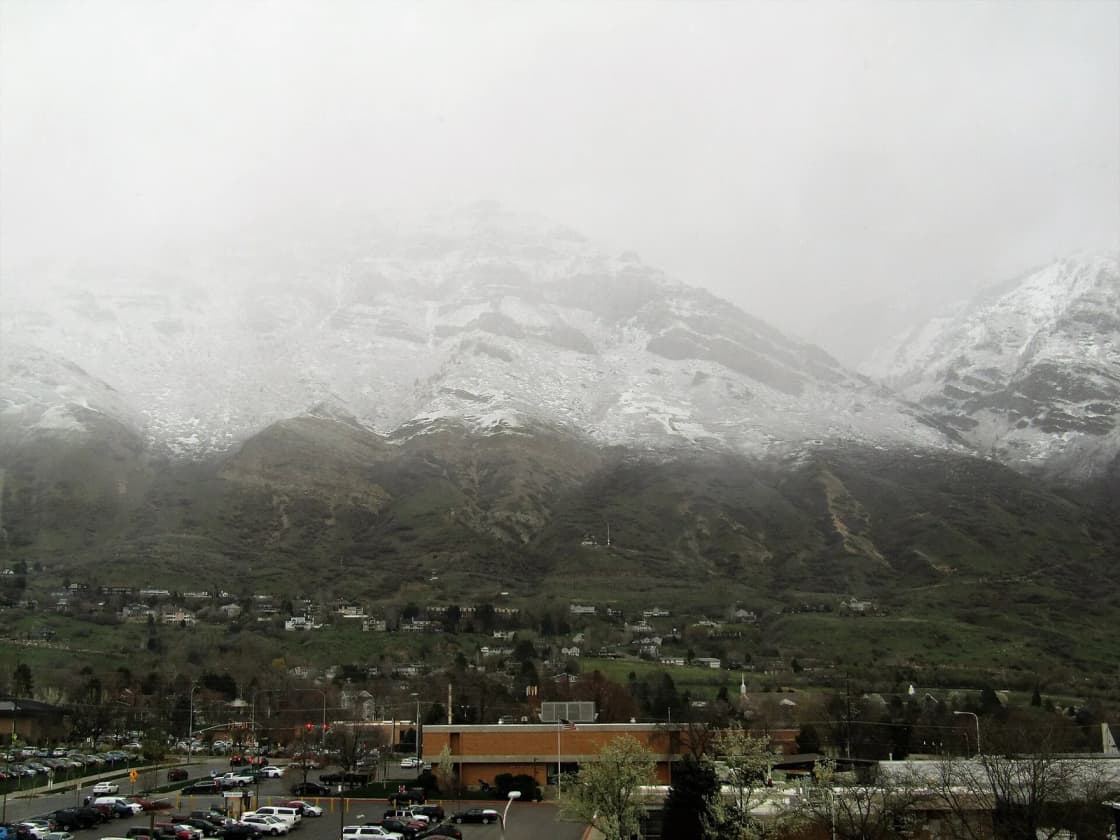
The Provo bench sits directly beneath steep, dry, sparsely vegetated slopes, and the mountain's default behavior is to move downhill — in spring melt, in summer thunderstorms, and in the debris flows that periodically remind valley cities why the foothills are managed at all. It also explains why the trail was so heavily engineered after 2016. Erosion is not a historical problem here that was solved; it is an ongoing condition, and a path carrying this many boots on a slope this steep and this dry needs constant attention to keep the tread from becoming a watercourse. When you notice the reinforced switchbacks and the drainage cuts, you are looking at that work.
The practical version for a hiker is simple: stay on the tread and off the shortcuts between switchbacks. Cutting a corner on this slope does not just widen a path — it starts a channel, and the channel is what the whole management history of this hillside has been about.
Related Guides
-
Complete Provo Hiking Guide — 15 trails ranked by difficulty
-
Provo Peak: The Mountain Behind the Y, and Why the Road Is the Hard Part
-
Lesser-Known Hikes Near Provo: Six Trails Past the Famous Five (2026)
-
Utah Valley Hike Finder — filter every trail by difficulty, length, season, dogs and fees Last updated: April 2026. Trail conditions change with weather and season. Always bring enough water and check conditions before hiking.
Frequently Asked Questions
How hard is the Y Mountain hike in Provo?
How long does it take to hike the Y?
Can I hike past the Y on Y Mountain?
What is the Y on Y Mountain?
Who owns Y Mountain and the Y?
Why did BYU need an act of Congress to buy Y Mountain?
Is the Y Mountain Trail public land?
When was the Y built and how big is it?
Sources
The facts in this guide were checked against these sources. Hours, fees and rules change, so confirm anything time-sensitive with the source before you go. How we make Provo.com.
- Trails | Provo, UT, Provo City Parks and Recreation. Checked October 12, 2026.
- Slide Canyon Trail #062, USDA Forest Service, Uinta-Wasatch-Cache National Forest. Checked October 12, 2026.
- Testimony of Provo Mayor John Curtis on H.R. 4484 (June 28, 2012), House Committee on Natural Resources. Checked October 12, 2026.
- Upper Y Mountain Trail and Y Conveyance Act (S. 28, 113th Congress) - CRS bill summary, Congressional Research Service via GovInfo. Checked October 12, 2026.
- BYU announces final purchase and acquisition of Y Mountain Trail land, BYU News. Checked October 12, 2026.
- An Ode to the Y, BYU Magazine. Checked October 12, 2026.
- AllTrails: Top of the Y, AllTrails. Checked October 12, 2026.