
The Provo River Parkway is the most-used piece of outdoor infrastructure in Utah Valley, and it is unusual: fifteen continuous paved miles that start on the shore of Utah Lake, run through the middle of a city of 115,000 people, and finish in a mountain canyon at the foot of a 607-foot waterfall. You can commute on it, race on it, push a stroller on it, or ride it as a legitimate scenic route.
It is also, in 2026, a trail with three separate construction stories attached to it, an unbuilt extension at its top end, and a rail-trail history most of the people using it have never heard.
Trail overview
- Length: about 15 miles (published as 15 to 15.2)
- Ends: Utah Lake State Park (west) to Vivian Park, Provo Canyon (east)
- Surface: asphalt the entire way
- Elevation gain: roughly 750 to 850 feet end to end, almost all in the canyon
- Category: rail-trail, in part
- Uses: walking, running, cycling, inline skating, horseback riding in places
- Motor vehicles: prohibited
- Dogs: on leash
The route, section by section
The Parkway is really three trails wearing one name, and knowing which one you want saves a lot of driving.
Utah Lake to downtown Provo (the flat end)
From Utah Lake State Park the trail follows the river north and east through parks and residential Provo. This is the flattest, widest-feeling and least dramatic section, and it is the right choice for young children, strollers, wheelchairs and anyone who wants distance without climbing. It passes Fort Utah Park and Paul Ream Wilderness Park. Paul Ream has parking; Fort Utah's main lot has been closed for the All-Wheels Park rebuild, so check the city for current parking there.
This end of the trail is changing. The Provo River Delta Restoration Project rebuilt the river's mouth into Utah Lake and added an entirely new trail network — Skipper Bay, the observation tower, the old channel — reached from Delta Gateway Park on Lakeshore Drive. As part of that project, Utah County plans to repave the Parkway from Lakeshore Drive down to Utah Lake State Park once the delta's new boat ramps and fishing platforms are finished, which the project put at around mid-summer 2026. Expect the west end to be better than the maps suggest, and to have been briefly worse while the paving happens.
Downtown to the canyon mouth (the city section)
Through the middle of Provo and into Orem, the trail negotiates streets, crosses under and over roads, and runs alongside University Avenue toward the mouth of Provo Canyon. This is the section with surface street crossings and narrow underpasses, and it is the least pleasant part to ride quickly. It is also the most useful part, because it is what makes the Parkway a commuting route rather than a recreation loop.
Occasional closures happen here; an undercrossing near Geneva Road has been intermittently affected. If you are riding end to end, budget for a detour and follow signed alternatives rather than improvising through traffic.
Provo Canyon: the canyon mouth to Vivian Park (the good bit)
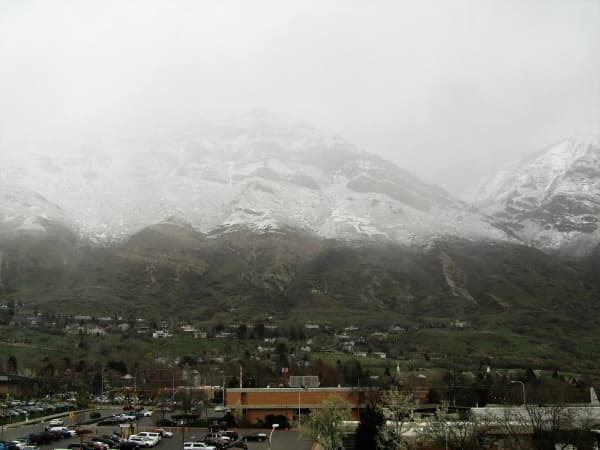
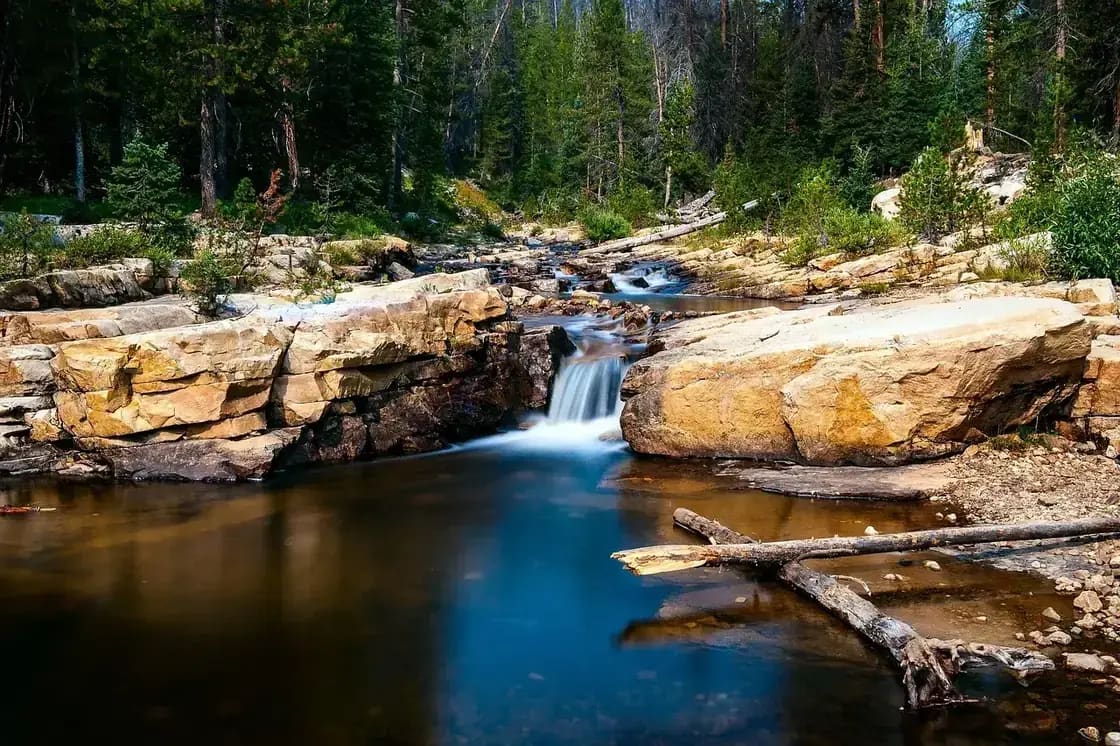
At Orem's 800 North the trail leaves the city and turns up the canyon, and everything changes. The pavement opens up, road crossings nearly vanish, the river runs beside you, and the canyon walls close in. This is the seven-mile stretch people mean when they talk about the Parkway.
It passes Nunn's Park, Canyon Glen, Bridal Veil Falls, Mount Timpanogos Park and finishes at Vivian Park. The grade is steady and gentle enough that the climb barely registers on the way up and delivers a long, easy descent coming back.
The rail-trail nobody mentions
The reason a canyon this steep has a wide, gently graded paved path running up it is not that somebody bulldozed one. It is a railroad grade.
The canyon corridor was a rail line before it was a trail, and the Heber Valley Railroad still stops at Vivian Park at the top. Where the tracks came out, the corridor became trail — which is why the canyon section is wide, why its gradient is so consistent, and why it hugs the river rather than the highway.
The railroad still exists at the far end. It runs today as the Heber Valley Railroad out of Heber City; it just does not come down the canyon any more. Our guide to Heber Valley and Midway covers what it does now.
Why the parking lot is called Nunn's Park
Ride the canyon section and you pass a pipeline, a diversion, a couple of severe-looking industrial structures and a parking lot named after somebody. They are all one story, and it is a bigger one than the canyon lets on.
In 1897, about four and a half miles up Provo Canyon, the Telluride Power Company and Lucien L. Nunn started generating hydroelectric power at what became known as Nunn's Station. According to the Central Utah Water Conservancy District, it was the first high-voltage, long-distance alternating-current transmission system in the world — and it sent its power 32 miles across the mountains to the mining town of Mercur, in Tooele County. Nunn had earlier persuaded George Westinghouse to develop the alternating-current system that made it possible.
Demand outran the station almost immediately. Nunn moved the operation down to the mouth of the canyon, where a greater drop meant more pressure on the turbines. The new generating station was designed by Fay Devaux "Fred" Olmsted, a Michigan-trained engineer, along with a twelve-foot-square wooden flume that hugged the canyon wall and carried river water to a cement box more than 300 feet above the powerhouse. Olmsted died of tuberculosis before it was finished, and the plant was named after him.
The Olmsted Power Plant opened in 1904 and ran for 111 years. It housed the Telluride Institute, one of only two original electrical-engineering training programs in the United States, where students lived on the upper floors. The powerhouse is listed on the National Register of Historic Places. A replacement plant, a roughly $42 million partnership between the Bureau of Reclamation, the Department of the Interior and the Central Utah Water Conservancy District, began generating in 2018 beside the original, which was slated to become a museum. For a number of years before Orem built Mt. Timpanogos Park, the Timpanogos Storytelling Festival was held on the Olmsted grounds.
So: the diversion you ride past feeds a plant that has been making electricity since before Utah had paved canyon roads, and the parking lot most visitors use for Bridal Veil Falls is named for the man who ran the first long-distance AC transmission line on earth. A roadside marker titled Let There Be Light stands near the canyon mouth, and the Parkway is one of the ways to reach it.
The Bridal Veil bottleneck, and the work fixing it
The single most congested point on fifteen miles of trail is the base of Bridal Veil Falls, and there is a specific reason for it.
An avalanche in January 2023 buried the base of the falls, pushed snow onto US-189 and destroyed the wide footbridge that had served as the natural gathering point. What replaced it was a narrow, makeshift bridge — so a regional cycling corridor and the busiest pedestrian attraction in the canyon now share one pinch point. Bike-and-pedestrian conflicts here are routine, not occasional.
Utah County's $7 million reconstruction of the Bridal Veil area, which began in September 2025, is designed to fix that geometry: separated bike and pedestrian paths, a rebuilt trail at the base, a park and pavilion on the opposite bank, and expanded parking.
For trail users the important detail is the second phase. Phase 2, scheduled from July 2026, reroutes bike traffic across the river around the work zone and closes the trail at the base of the falls for reconstruction. Completion dates in circulation disagree — the county's spokesman described late summer or early fall 2027, matching a two-year framing from a September 2025 start, while at least one outlet printed October 2026. Check Utah County's current notice before planning a through-ride. Our Bridal Veil Falls guide has the full picture.
The extension that hasn't been built
Ride to Vivian Park and the pavement simply stops, four miles short of Deer Creek Reservoir. That is not an oversight.
An extension from Vivian Park to Deer Creek Dam has been planned. UDOT's own project materials are unusually candid about why it is hard: the alignment has to thread between the highway, the river, the railroad and steep canyon walls, across slopes with existing geological instability. Building a trail there means retaining walls, not paving.
That is worth knowing before you plan around it, because the completed extension appears on aspirational maps and in older write-ups as though it exists. It does not. Vivian Park is the end of the pavement, and has been for a long time.
Best access points
West to east:
- Utah Lake State Park — the west terminus. Entrance fee; full facilities.
- Delta Gateway Park (311 N Lakeshore Drive) — Provo's newest park and the gateway to the delta trail network.
- Fort Utah Park (200 N Geneva Road) — west Provo, good flat-riding start, but the main lot has been closed for the All-Wheels Park rebuild. Check the city for current parking, or start at Utah Lake State Park or Paul Ream meanwhile.
- Paul Ream Wilderness Park (1600 W 500 N) — quiet, shaded, central.
- Canyon View Park / Interchange Park area (800 North) — the standard start for a canyon ride, at the canyon mouth in Orem.
- Nunn's Park — first major canyon parking, and the access point for Bridal Veil and for winter ice climbing.
- Canyon Glen Park (1501 E Provo Canyon Road) — picnic pavilions, restrooms, and the dirt-trail connections.
- Mount Timpanogos Park — upper canyon, picnic sites.
- Vivian Park — the east terminus, and the takeout for river tubing in summer.
Most canyon parks have restrooms, water and picnic tables in season. City-side parks vary.
Naming the river correctly
This trips up visitors and even some local write-ups, and getting it wrong makes fishing and rafting advice useless.
The Provo River is described in three named stretches:
- Upper Provo — above Jordanelle Reservoir, in the Uintas.
- Middle Provo — between Jordanelle Dam and Deer Creek Reservoir, through Heber Valley. This is the blue-ribbon tailwater fishery.
- Lower Provo — below Deer Creek Dam, through Provo Canyon and down to Utah Lake.
The water running beside the Parkway is the Lower Provo, not the Middle Provo. If a source tells you the Parkway follows the Middle Provo, it is describing a river forty minutes away over a mountain pass.
How to use it
Walking and running
The city section is the practical everyday choice, and it is what makes the Parkway function as neighborhood infrastructure. For a scenic run, park at the canyon mouth and go up: the grade is honest, the turnaround is obvious, and the return is downhill. Our running routes guide has the loops.
Cycling
Three routes cover most of what people ride:
- Canyon mouth to Bridal Veil Falls and back — about 8 miles, the classic family ride.
- Canyon mouth to Vivian Park and back — about 14 miles, the best value for effort in the valley.
- End to end and back — roughly 30 miles, mostly for fitness rather than scenery, because of the city crossings.
Keep right, call your pass, and slow down through the Bridal Veil area. It is the one place on the trail where a fast line is antisocial.
Families
The lower half is the answer, plus the delta trails at the west end. The canyon is beautiful but carries the fastest cyclists on the corridor.
Connections
The Parkway is part of the Golden Spoke, a regional network of paved trails. Locally it meets the Murdock Canal Trail and the University Parkway side path, and in the canyon it touches dirt: the Great Western Trail and the north Provo Canyon section of the Bonneville Shoreline Trail leave from near Canyon Glen. Those are not beginner connections and are covered in our mountain biking guide.
Season by season
Spring is loud and green, with the river at runoff volume. Expect debris on the pavement after storms and a cold canyon microclimate in the mornings.
Summer is peak use. The canyon is shaded for much of the day and noticeably cooler than the valley floor, which is why the Parkway is the default summer exercise route. Go early. Our summer activities guide covers the rest.
Fall is the best time to ride it. The maples turn in the canyon, the light gets long, and the crowds thin after Labor Day.
Winter is the section most people write off and should not. The city stretch is generally cleared and rideable. The canyon section is not plowed, but foot traffic compacts it, and with microspikes it is a fine winter walk. The falls freeze. Avalanche paths cross the canyon — the 2023 slide reached the highway and the trail — so check conditions after storm cycles rather than assuming a paved trail is a safe trail.
Safety and etiquette
- This is a shared corridor, not a bike path. The single biggest conflict is speed differential at the Bridal Veil pinch point.
- Announce passes. "On your left" prevents most of the collisions that happen here.
- Leashes short. A retractable lead across a 16-foot trail is a tripwire.
- Lights after dusk. Sections of the canyon are dark and the trail is unlit.
- Do not enter the river casually. The Lower Provo runs cold and pushy in spring; the tubing season below Vivian Park is a supervised, seasonal activity with outfitters, not an improvisation.
- Check current closures. Between the Bridal Veil rebuild and the delta repaving, two ends of this trail are moving targets in 2026.
Who is responsible if you get hurt on it
A paved municipal trail feels like the sort of place where somebody is obviously in charge of your safety. Legally, it is closer to the mountain than to the sidewalk outside a shop, and the statute that does that is worth knowing before you assume otherwise.
Utah Code § 57-14-201 provides that an owner of land owes no duty of care to keep the land safe for a person entering for a recreational purpose, and no duty to warn of a dangerous condition, use, structure or activity on it. Utah Code § 57-14-101 states the chapter's purpose as limiting the liability of public and private landowners — cities included. Utah Code § 57-14-102 defines "owner" to include the possessor of any interest in the land, public or private, including a lessee or a person in control of it, and defines "land" to include roads, railway corridors, water courses, private ways, and structures attached to the realty. A rail-trail through a canyon is squarely inside that definition.
The provision written for exactly this kind of trail
Most of the chapter reads as though it were drafted with wild country in mind, and for decades that ambiguity was litigated. Utah Code § 57-14-401 closed it. That section provides that a person may not make a claim against or recover from an owner of any land — including land in developed or improved, urban or semi-rural areas opened to the general public without charge, such as a lake, pond, park, trail, waterway, or other recreation site — for personal injury or property damage caused directly or indirectly by participating in an activity with a recreational purpose there.
Trail is named. Park is named. Urban and developed are named. The Parkway is the paradigm case.
The activities are named too. Utah Code § 57-14-102 lists, among recreational purposes, walking, running, jogging, bike riding, in-line skating, roller skating and equestrian activity — essentially the entire user population of this corridor on a Saturday morning.
Utah Code § 57-14-203 extends the same treatment to land leased to the state or a subdivision of the state for recreational purposes unless a written agreement says otherwise, which matters on a trail that crosses several ownerships between Utah Lake and Vivian Park without announcing it.
The three limits
It stops at the tollbooth. Utah Code § 57-14-202 conditions the protection on use permitted without charge, and Utah Code § 57-14-204 removes it where the owner charges to enter or use the land. The trail is free; the paid facilities strung along it are on a different footing.
It never covered deliberate harm. The same section preserves liability for willful or malicious failure to guard or warn against a dangerous condition and for deliberate injury.
It does not cover you. Utah Code § 57-14-401 says in its own second subsection that nothing in it relieves a participant of an obligation they would otherwise have to exercise due care, or of the consequences of failing to — and Utah Code § 57-14-205 says the same for the rest of the chapter. That is the legal backstop under every piece of etiquette in the section above. A cyclist who overtakes at speed on a blind curve is not protected by anything here; the immunity runs to the landowner, not to the fast rider.
Where a claim does survive, Utah Code § 57-14-501 caps noneconomic damages against a landowner at four hundred and fifty thousand dollars for actions arising on or after 14 May 2019, excluding punitive damages and wrongful-death claims.
The practical reading is simple. Nobody is inspecting this trail for your benefit, the frost heave near the river is nobody's liability, and the person most responsible for how your ride goes is you.
Related guides
- Old Provo Channel status: ramps open, piers fenced, paving pending — the lake-end work as of September 2026
- Bridal Veil Falls: Complete Visitor Guide
- Utah Lake: The Complete Guide
- Murdock Canal Trail
- Running Routes in Provo
- Mountain Biking in Provo
- Best Parks in Provo
- The Provo River Delta's Last Construction Summer: What's Finishing, What's Detoured
- Y Mountain Trail: The Complete Hiking Guide (2026)
- Utah Valley Hike Finder — filter every trail by difficulty, length, season, dogs and fees
- Bike Commuting in Provo
- Vivian Park and Nunn's Park — the canyon's two day-use stops
- Every Paved Trail in Utah Valley: Provo River Parkway to Murdock to the Jordan River, and How They Connect
- Things to Do in Utah Valley With Your Dog
Frequently Asked Questions
How long is the Provo River Parkway?
Where does the Provo River Parkway start and end?
Can I bike the Provo River Parkway?
Is the Provo River Parkway paved the whole way?
Is the trail good for strollers and wheelchairs?
Why does the trail stop at Vivian Park instead of continuing to Deer Creek?
Are dogs allowed on the Provo River Parkway?
Does the Parkway connect to other trails?
Sources
The facts in this guide were checked against these sources. Hours, fees and rules change, so confirm anything time-sensitive with the source before you go. How we make Provo.com.
- Olmsted Hydroelectric Power Plant, Central Utah Water Conservancy District. Checked October 12, 2026.
- $7 Million Reconstruction Project at Bridal Veil Falls to Begin After Labor Day; Parking and Access Will Be Modified for Two Years of Construction, Utah County Government. Checked October 12, 2026.
- 2020 Census Redistricting Data (P1): Provo city, Utah, U.S. Census Bureau (via USAFacts Government Data Connector). Checked October 12, 2026.
- Parks | Utah County Public Works, Utah County. Checked October 12, 2026.
- The Legend and History of Bridal Veil Falls, Intermountain Histories (Charles Redd Center for Western Studies, BYU). Checked October 12, 2026.
- Provo River Parkway, AllTrails. Checked October 12, 2026.
- Bridal Veil Falls $7M reconstruction project begins, expected to take 2 years, KJZZ. Checked October 12, 2026.