Provo is one of the most religiously distinctive cities of its size in America, and if you're moving here — for a job, for school, for family — understanding its faith landscape is useful, whatever you believe. This guide is written for every kind of newcomer: the Latter-day Saint wondering how to find their new ward, the Catholic or Episcopalian or Muslim family wondering where their community gathers, and the newcomer of no particular faith who just wants to understand the rhythms of their new town.
Our approach here is simple: we describe, we don't advocate. Every congregation named below was verified as active when this guide was written, but service times and clergy change — always check a community's own website or phone line before your first visit.
The Lay of the Land
The Church of Jesus Christ of Latter-day Saints is the defining institution of Utah Valley life. A strong majority of residents are members, Brigham Young University — the Church's flagship university — anchors the city, and the Missionary Training Center north of campus sends missionaries around the world every week. That shapes daily rhythms in ways newcomers notice fast: Sundays are quiet, many businesses close, and the social calendar often runs through congregations.
At the same time, the valley is more religiously varied than its reputation suggests — and growing more so as the tech industry and two large universities keep drawing people from everywhere. Downtown Provo has held non-LDS congregations continuously since the 1890s, and today's valley includes Catholic, Episcopal, mainline and evangelical Protestant, Adventist, Muslim, and Jewish communities, plus an active interfaith network.
The Church of Jesus Christ of Latter-day Saints
If you're a Latter-day Saint moving in, your first question — "what ward am I in?" — takes about two minutes to answer: the Church's meetinghouse locator at churchofjesuschrist.org maps any address to its ward and meeting time. Our guide to finding your ward walks through it, BYU housing exception included. Records transfer through your previous ward or via the Church's tools, and in Provo you can expect a visit from ministering neighbors quickly; the machinery of welcome here is well-oiled.
If you're not a member, three things are worth knowing. First, ward boundaries organize neighborhoods, not just congregations — ward activities, picnics, and service projects are frequently open to everyone on the street, and accepting an invitation or two is one of the fastest ways to meet your neighbors. Second, anyone may attend Sunday services; the main weekly service (sacrament meeting) is about an hour, visitors are common, and nobody checks credentials at the door. Our guide to visiting a church in Provo covers the practical side of that — how to find a meetinghouse and its start time, what happens in the hour, and what to wear. Third, students have their own system: single adults 18–35 are typically organized into Young Single Adult wards, which is a load-bearing feature of BYU and UVU social life.
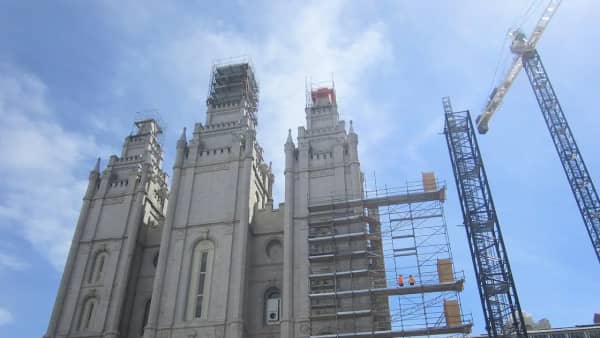
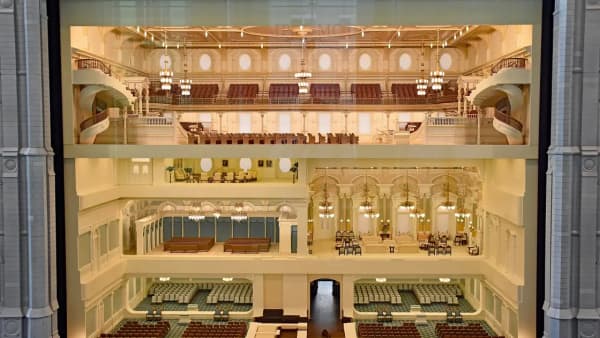
The valley is also home to six operating temples of the Church — which work differently from meetinghouses. Temples are open only to members holding a current recommend, but their grounds are open to everyone and are beautiful places to walk. The Provo City Center Temple downtown is the local landmark; our temple guide for out-of-town guests explains the meetinghouse/temple distinction in full and lists all six.
Catholic: St. Francis of Assisi
The Catholic parish serving Provo is St. Francis of Assisi Catholic Church at 65 East 500 North in Orem, one with deeper local roots than most people guess: the parish had a church in Provo by the 1920s before it moved to Orem. It's a fully bilingual parish, with daily and weekend Masses in both English and Spanish, an active Knights of Columbus council, and religious education programs. Check oremstfrancis.org for current Mass and confession times.
Episcopal: St. Mary's
St. Mary's Episcopal Church sits at 50 West 200 North in downtown Provo — you'll know it by the red door and stained glass. It's a small, warm congregation with an explicitly open welcome: the parish states that all visitors are welcome regardless of race, religion, gender, disability, or sexual orientation, in keeping with the Episcopal Church's broader commitments. For newcomers looking for liturgical worship in a come-as-you-are congregation, this is downtown Provo's address for it.
United Church of Christ: Provo Community Congregational
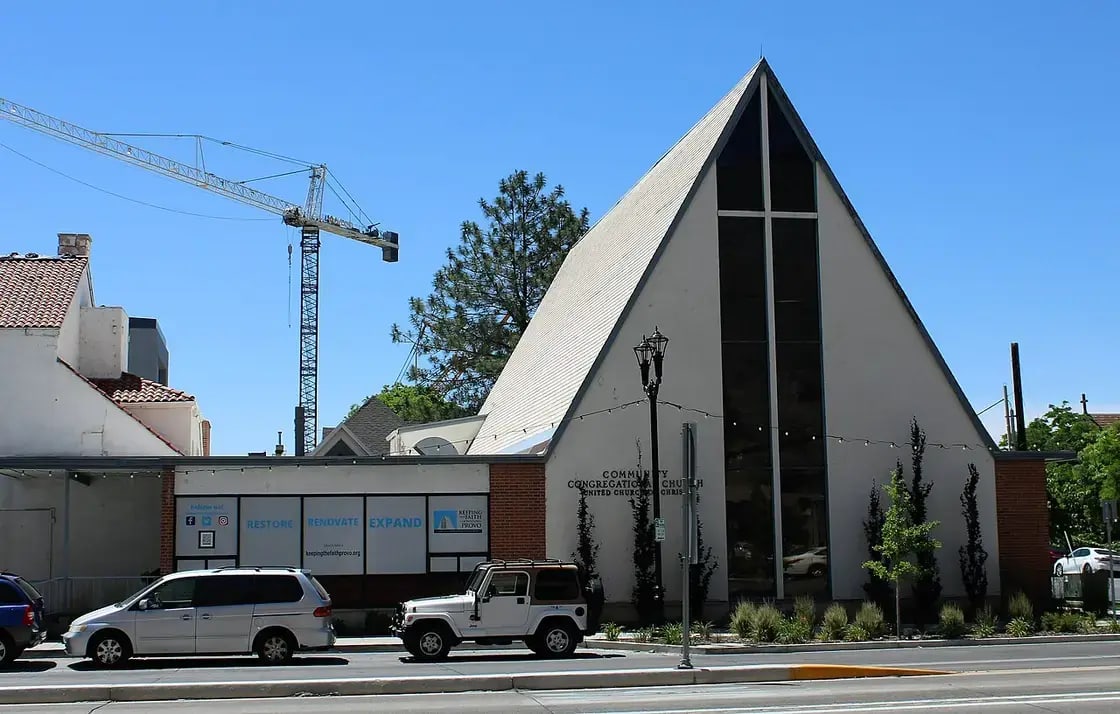
A block away at 175 North University Avenue stands one of the most historically significant buildings in downtown Provo: the Provo Community Congregational United Church of Christ. The congregation dates to 1891, and the "Community" in the name is earned — after the 1919 national merger of the Methodist Episcopal and Congregational churches, the Provo church took the Community name and served members of several mainline denominations, including American Baptists, Methodists and Presbyterians. Over the decades it housed Provo's first free kindergarten, the city's first Girl Scout troop, one of the Intermountain West's first Boy Scout troops, and Provo's first Alcoholics Anonymous meetings. Today it's an Open and Affirming UCC congregation — the denomination's designation for congregations that explicitly welcome LGBTQ members — worshiping in a landmark Spanish Colonial Revival building that still anchors the corner. Sunday services are late morning; confirm the current time at provocommunityucc.org.
Evangelical, Baptist & Other Christian Congregations
Beyond the historic downtown churches, Provo has a range of evangelical, Baptist, and non-denominational congregations — including Provo Bible Church, the non-denominational City on a Hill (which also runs community outreach and a food pantry), and the Provo Seventh-day Adventist Church at 255 South 700 East, which worships on Saturdays. This is the most fluid layer of the valley's church landscape — congregations plant, move, and merge — so treat any list as a starting point and confirm locations and service times directly.
Islam: The Utah Valley Islamic Center
The valley's Muslim community gathers at the Utah Valley Islamic Center at 352 East 900 South in Orem, which serves Utah County for daily and Friday (Jumu'ah) prayers and community events. Prayer times shift through the year; check uvislam.com for the current schedule.
Jewish Life in and near the Valley
Utah County's Jewish community is small but present. Chabad of Utah County, based in Lehi at the north end of the valley, offers holiday celebrations, classes, and community gatherings (jewishutahcounty.com). Utah's larger Jewish institutions are in Salt Lake City, about 45 minutes north — including Congregation Kol Ami, which serves both Reform and Conservative traditions — and Hillel for Utah connects Jewish students from colleges statewide, including BYU and UVU, to the broader Utah Jewish community.
The Interfaith Layer
The Utah Valley Interfaith Association brings the valley's traditions into the same room, hosting dialogue events and shared observances through the year — a good first stop if you want to meet people across communities or find a tradition not listed here. And whatever your faith or none, the valley's service network welcomes all hands: Community Action Services and Food Bank, United Way of Utah County, and Habitat for Humanity of Utah County all run volunteer programs year-round, many staffed shoulder-to-shoulder by congregations of every kind. Our Faith & Community hub lists more.
A Note on Temples
The six operating temples in Utah County are the most visible religious buildings in the valley, and they work differently from the meetinghouses described above — they aren't used for weekly worship, and entry to a dedicated temple is limited to Church members holding a current recommend. The grounds, however, are open to everyone. Our guide to visiting Utah Valley's temples covers who can go where, how public open houses work, and what the Provo Rock Canyon reconstruction means for visitors.
How to Actually Visit a Congregation Here for the First Time
Utah Valley is unusually easy to visit religiously and unusually easy to misread, and a few practical notes save newcomers a lot of guesswork.
Check the schedule directly, every time. Shared buildings are common among the smaller congregations, which means service times are set by a rota rather than by tradition, and they move. A congregation's own page or a phone call is reliable; a third-party directory listing frequently is not. This is the single most common reason a first visit fails.
Expect to be noticed, and expect that to be friendly. Congregations outside the dominant faith here are small enough that a new face registers immediately. Most treat that as an opportunity rather than an intrusion, and the welcome is often warmer and more immediate than a visitor from a large city is used to. If you would rather observe quietly first, sitting near the back and arriving a few minutes late is a perfectly normal way to do it.
Dress is generally modest, and generally less formal than you expect. Across most of the valley's congregations, the practical answer is smart-casual and covered, and almost nobody will comment either way. Where a specific expectation exists — head covering, removing shoes — it is usually stated on the congregation's own materials, and asking in advance is welcomed rather than awkward.
Sunday is not the only answer. Friday prayers at the Islamic center, Saturday observance in Jewish community life, and midweek gatherings across several Christian congregations all mean the busiest and most representative time for a given community may not be Sunday morning at all. Ask what the main gathering is rather than assuming.
Children are usually accommodated, but ask how. Practice varies more than newcomers expect: some congregations here run a full simultaneous children's program, some keep families together throughout, and some have a cry room or a foyer with a speaker. In a congregation meeting in leased commercial space, the answer is often shaped by what the building physically allows rather than by preference. One question in advance avoids an uncomfortable hour.
The interfaith layer is a genuine shortcut. If you are new and unsure where to start, the valley's interfaith activity — described above — is the most efficient way to meet several communities at once without committing to any of them, and the people involved are used to exactly that question.
Why a Small Congregation Here Meets in a Storefront
If you visit the smaller congregations in this valley, a pattern becomes obvious quickly: a great many of them meet somewhere that was not built to be a place of worship. A leased suite in an office park. A converted retail unit. A school gym on Sunday morning. A shared building with another congregation on a different schedule.
That is mostly economics, and partly law. Building a purpose-built house of worship requires land, capital and a congregation large enough to service the debt, and most minority-faith and start-up congregations in Utah Valley have none of the three at the outset. So they lease. And leasing puts them straight into a zoning question that a large, established denomination rarely has to think about: is a religious assembly permitted in this zone, and on what terms?
The federal law that governs this is RLUIPA. The Religious Land Use and Institutionalized Persons Act, passed unanimously by Congress and signed by President Clinton on September 22, 2000, is a civil rights statute protecting religious assemblies from discriminatory or unduly burdensome land use regulation. Congress enacted it after hearings found that houses of worship — particularly those of minority religions and start-up churches — were disproportionately affected by local land use decisions, and that religious institutions as a class were treated worse than comparable secular ones.
Four things it prohibits. A land use regulation may not impose a substantial burden on religious exercise unless the government shows the restriction is the least restrictive means of furthering a compelling governmental interest. Beyond that, zoning and landmarking laws may not treat a religious assembly on less than equal terms than a nonreligious assembly, may not discriminate on the basis of religion or denomination, and may not totally exclude religious assemblies from a jurisdiction or unreasonably limit them within it.
The equal-terms provision is the one that matters most in practice, and the textbook example is close to what happens here. If a zoning district permits theaters, fraternal lodges, meeting halls and other places where people gather for secular purposes, but permits a house of worship only by individual approval or not at all, that is precisely the disparity the provision was written for. A mere inconvenience is not enough — the burden must be substantial — but once it is shown, a city has to produce a compelling reason, not merely a reasonable one.
What this means for someone looking for a congregation. Do not read a modest meeting place as a sign of a marginal or temporary community. Several of the valley's most established minority-faith congregations spent years in leased space before building, and some have chosen to stay. The address tells you about the property market and the zoning map. It tells you very little about the congregation.
Practical Notes for Newcomers
Sundays really are different here. Most locals plan errands for Saturday. Plenty is open on Sunday — our restaurants open on Sunday guide is one of our most-used pages for a reason — but the pace changes, and twice a year the Church's General Conference weekend changes it further.
Visiting is normal. Every community above receives visitors regularly. Dress on the nicer side of casual, arrive a few minutes early, and if you're unsure of etiquette — head coverings, standing and sitting, communion practices — a quick email or call ahead is always welcomed. Nobody in this valley is surprised by a newcomer checking out a congregation.
What a first LDS visit looks like, since it's the one most newcomers here end up making: the main Sunday service, called sacrament meeting, runs about an hour and consists of congregational hymns, the passing of the sacrament (bread and water, which visitors may simply pass along), and short sermons given by ordinary members of the congregation rather than professional clergy — the speakers rotate week to week. It's followed by a second hour of classes on alternating schedules. Children stay with families in the main meeting, so a certain amount of cheerful pew noise is completely normal. Nobody will single you out, though sitting near the back guarantees it.
Students have extra infrastructure. BYU is owned and operated by the Church, so religious life is woven into the university itself; for students elsewhere, the Church operates institutes of religion adjacent to college campuses — including near UVU — offering classes and a social hub for young adults. Non-LDS students looking for their own communities will find the downtown congregations above within a short drive of both campuses, and several run programs aimed at students; ask when you reach out.
Things change; verify. Service times, clergy, and even buildings move. We verified every congregation in this guide as active as of July 2026, and we'll keep it current — but the community's own website is always the final word.
Know a congregation we should add, or spot something that's changed? Tell us at contact@provo.com — this guide only works if it stays accurate.
Frequently Asked Questions
Do I have to be a member of The Church of Jesus Christ of Latter-day Saints to attend a service?
Are there non-LDS churches in Provo?
Is there a Catholic church in Provo?
Is there a mosque or synagogue in Utah Valley?
What is a ward, and how do ward boundaries work?
Why do so many smaller congregations in Utah Valley meet in offices or storefronts?
Can a city in Utah stop a church or mosque from opening in a particular location?
Is it hard to find a non-LDS congregation in Provo?
Sources
The facts in this guide were checked against these sources. Hours, fees and rules change, so confirm anything time-sensitive with the source before you go. How we make Provo.com.
- St. Francis of Assisi Catholic Church. Checked October 12, 2026.
- Utah Valley Islamic Center. Checked October 12, 2026.
- Utah State Historic Preservation Office (NRHP nomination). Checked October 12, 2026.
- Provo City Library. Checked October 12, 2026.
- U.S. Department of Justice. Checked October 12, 2026.
- The Church of Jesus Christ of Latter-day Saints. Checked October 12, 2026.