
Plenty of people end up in a Provo church for reasons that have nothing to do with converting. A visiting parent. A curious newcomer who has just moved into the most Latter-day Saint city in America and wants to understand the place. Someone in town for Education Week or a graduation. A student from a different tradition looking for the congregation that fits. A researcher, a journalist, a friend who was invited and said yes.
What almost none of them can find is a straight answer to the practical questions: where do I go, what time does it start, what will happen, what do I wear, and will I stand out.
This guide answers those. It is written for a visitor of any background, including no background at all, and it takes the same line the rest of this site takes on the subject — neither defensive nor sneering, just accurate.
First, the building distinction that confuses everyone
Provo has two very different kinds of Latter-day Saint building, and mixing them up is the single most common visitor mistake.
A meetinghouse — also called a chapel or ward house — is where Sunday worship happens. There are hundreds in Utah County. They are ordinary-looking buildings, usually with a spire, a car park and a basketball court inside. Most have the words Visitors Welcome on the exterior sign. Anyone can walk in.
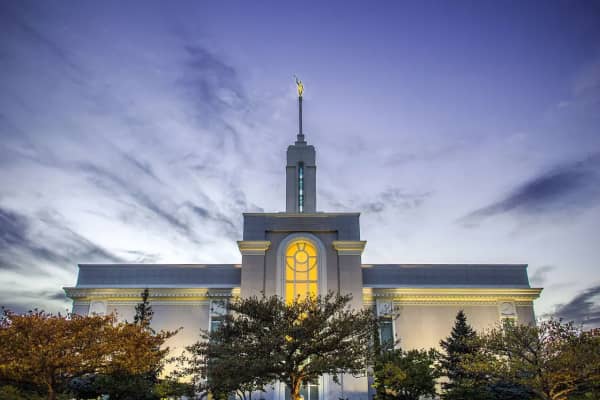
A temple is not a Sunday worship building at all. Utah County has six operating temples, including the Provo City Center Temple downtown, and they are used for specific ordinances by members holding a current recommend. They are closed to the general public — with the significant exception of open houses before a new or renovated temple is dedicated, when anyone may tour the interior. The grounds are open to everyone, always, and they are among the nicest public gardens in the valley.
If you want to attend a service, you want a meetinghouse. If you want to see a temple, we have a dedicated guide to visiting Utah Valley's temples that covers all six, the grounds, and how open houses work.
How to find a service, and its start time
This is the part no one explains, and it matters more here than almost anywhere.
Latter-day Saint congregations are called wards (large) or branches (small), and they are organized geographically — your address determines your ward, rather than you choosing one. Several wards share a single building, meeting one after another through the day. That means there is no standard Sunday start time in Provo. Start times are staggered across the morning and into the early afternoon, and they vary building by building and congregation by congregation.
The tool that solves this is the Church's own Meetinghouse Locator at maps.churchofjesuschrist.org. Enter an address and it returns the buildings nearby, the congregations meeting in each, and their Sunday start times. It is public, requires no account, and is the only reliable source — a printed time on a third-party page is very likely stale, because congregations get reorganized and reshuffled between buildings constantly in a city this dense.
Two weekends a year when nothing normal happens. Latter-day Saint congregations worldwide suspend their usual Sunday meetings for general conference, held the first weekend of April and the first weekend of October. In 2026 that is 3–4 October; the sessions are broadcast from Salt Lake City and anyone may watch. Congregations also skip normal meetings for their own stake conference weekends, which are scheduled locally and land on different dates for different congregations — the Meetinghouse Locator flags upcoming conference dates for each stake. Turn up without checking on one of those Sundays and you may find an empty car park.
What a Latter-day Saint Sunday service is actually like
The Sunday block is two hours, split into two one-hour meetings. This changed in January 2019, from a three-hour block — a lot of older writing on the internet still describes the old format, so if you read "three hours" somewhere, that page is out of date.
Hour one is sacrament meeting, and it is the part visitors attend. It is held in the chapel with the whole congregation together, and the structure is consistent worldwide:
- Opening hymn and prayer, both offered by ordinary members rather than clergy.
- Ward business — announcements, and sometimes a request for the congregation to raise a hand sustaining someone in a new role. Visitors are not expected to participate in this.
- The sacrament, which is the point of the meeting. Bread and water, blessed and passed through the congregation by teenage boys, symbolizing the body and blood of Jesus Christ. It functions much like Communion or the Lord's Supper elsewhere. This is the quietest ten minutes of the week, and the room takes it seriously. Visitors may take it or pass the tray along — both are completely normal and nobody will look.
- Talks — sermons, but delivered by assigned members of the congregation rather than a professional minister. Two or three of them, five to twenty minutes each, sometimes with a hymn or a choir number between. Quality varies enormously, which members will cheerfully tell you themselves. A teenager and a retired engineer might speak on the same morning.
- Closing hymn and prayer.
Hour two is a smaller class — Sunday School, or separate meetings for men, women, youth and children, alternating by week. Visitors are welcome to stay and equally welcome to leave after the first hour. Leaving after sacrament meeting is unremarkable and nobody will chase you.
Things that will not happen, and which surprise people from other traditions: no collection plate, ever. No altar call. No one will ask you to stand up and be introduced, though someone conducting may welcome visitors generally. No clergy in vestments — the bishop is an unpaid volunteer who has a day job. No amplified band; the music is congregational hymns with an organ or piano.
Things that will happen: people will talk to you. This is a genuinely friendly environment and a new face in a Provo ward is noticed. Expect a handshake, a "are you visiting?", possibly an invitation to something. If you would rather not be drawn in, saying "just visiting today, thanks" works perfectly well and will be respected. If you leave a name and number with someone, expect a follow-up — that is the culture, not a sales tactic, but it is real.
Children are everywhere and they are loud. A Provo chapel on a Sunday morning contains a lot of small children, and no one apologizes for the noise. If you were expecting cathedral silence, recalibrate.
What to wear
For a Latter-day Saint service, the norm is dressed-up: men in a shirt and tie, frequently a suit; women in a dress or skirt, although trousers on women are ordinary now and nobody comments. Missionaries and men passing the sacrament wear white shirts.
As a visitor, you will not be turned away, corrected, or seated differently for wearing anything. That is genuinely true and worth believing. But you will be visibly different in jeans, and most people would rather not be. Smart-casual is the comfortable floor — trousers and a collared shirt, or a dress or blouse. Nobody expects a visitor to own a suit.
Elsewhere in Provo the range is wide: some congregations are formal, several are explicitly come-as-you-are. When in doubt, a congregation's own website usually says.
The one Sunday a month that is completely different
If you attend on the first Sunday of the month, you will not get the service described above, and nobody will have warned you.
On what members call fast Sunday, the talks are replaced by an open microphone. Instead of two or three assigned speakers, members of the congregation come to the pulpit spontaneously, one after another, to say what they believe and why — a testimony meeting. There is no schedule and no list. People stand up when they feel moved to, and the meeting ends when the hour does.
It is, for a visitor, the most interesting hour in the Latter-day Saint calendar and also the most unpredictable. You may hear something genuinely moving; you may hear a seven-year-old recite something they were coached on; you may hear an unguarded personal story that would never be told from a pulpit anywhere else. Long silences between speakers are normal and are not awkward to the room.
Two practical notes. Anyone may speak, including a visitor — but there is absolutely no expectation that you will, and the overwhelming majority of visitors simply listen. And the name comes from the associated practice: members are asked to fast for two meals that day and donate the money saved as a fast offering for people in need. That is a members' practice; nothing is asked of a visitor.
One scheduling wrinkle worth knowing this year: when general conference falls on the first weekend of a month — as it does in October 2026 — fast Sunday is typically moved rather than skipped, and the replacement date is set locally. If a testimony meeting is specifically what you want to see, check with the congregation.
The missionaries you will see everywhere
You will notice them within a day of arriving: young people in pairs, on foot or on bicycles, men in white shirts and ties with black name badges reading Elder, women in modest dress badged Sister.
Provo has more of them than anywhere on earth, because the Church's flagship Missionary Training Center sits just north of the BYU campus. Tens of thousands of new missionaries pass through it every year on their way to assignments worldwide, and the MTC is one of the quiet engines of the local visitor economy — a steady stream of families flying in for drop-offs, filling hotels and restaurants in weeks that have nothing to do with football.
For a visitor, the etiquette is simple. They are happy to talk and they will not be offended if you are not. "No thank you" ends a conversation politely and completely. If you do give them your number or address, expect a follow-up — that is the job, and they are sincere about it, but decide before you hand it over rather than after.
The MTC itself is not open to the public — no tours, no drop-in visits. If you are here for a drop-off, we have a dedicated Provo MTC guide for families that walks through the day, and where to stay in Provo covers the lodging question that always comes with it.
Practical notes on the building itself
Small things that make a first visit easier:
- Enter through the front and just sit down. There is no host, no assigned seating, no ushering. Anywhere in the chapel is fine, and the back rows are the low-profile choice. Regular families do tend to occupy the same pew every week, so if someone looks momentarily confused, that is why — shuffle along and it is forgotten.
- Arrive a few minutes early. Prelude music is already playing and the room is quiet before the hour, which is easier to walk into than a service already underway.
- There is a foyer with speakers, and it is where parents take crying children. If you want to hear the meeting without being in the room, that is a completely normal place to be.
- Most meetinghouses have a nursing room for mothers, and buildings are generally step-free with accessible restrooms.
- Do not photograph or record the service. The building's other spaces are unremarkable, but the meeting itself is a worship service and cameras are out of place.
- Nothing is sold and nothing is collected. There is no bookstall, no donation box at the door, and no one will take your details unless you offer them.
A short vocabulary, so you can follow along
Latter-day Saints use a dense internal vocabulary and use it without translation, because in Provo almost everyone already speaks it. The dozen words below will carry you through a service:
- Ward — a congregation. Branch — a small one. Stake — a group of wards, roughly a diocese.
- Bishop — the unpaid volunteer who leads a ward, usually with a full-time job elsewhere. Stake president — the same, one level up.
- The sacrament — the bread and water, equivalent to Communion. Sacrament meeting — the main Sunday service.
- Elder / Sister — the titles used by full-time missionaries.
- Relief Society — the women's organization. Primary — the children's. Priesthood / Elders Quorum — the men's.
- Calling — an unpaid assignment in the congregation. Nearly everyone has one; nobody applied for it.
- Testimony — a personal statement of belief, and the substance of fast Sunday.
- General conference — the twice-yearly worldwide broadcast. Stake conference — the local equivalent.
- Investigator or, more current, friend of the Church — someone attending and learning who is not a member. If you attend twice, someone may use one of these about you. It is meant warmly.
Provo's student congregations, which are unlike anywhere else
If you attend a service near campus, you will encounter something that exists at this density nowhere else on earth.
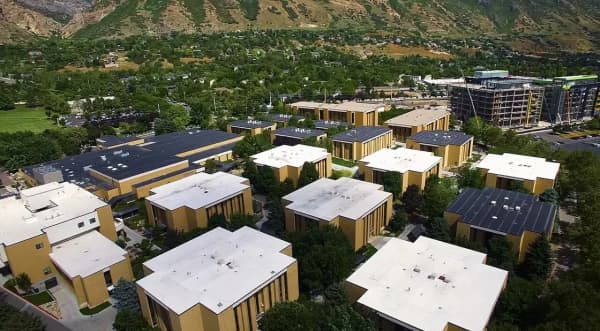
Because roughly 80,000 students live in Provo and Orem, the Church runs a parallel structure of young single adult (YSA) wards and married student wards alongside the ordinary neighborhood ones. The scale is genuinely hard to convey: as Deseret News reported in May 2025, 170 wards meet on the BYU campus itself, and the Church operates 265 congregations across 26 student stakes serving students in Provo and around it. In most of the world a single building serves one to three congregations; here, entire buildings and campus classrooms are given over to student wards meeting back to back all day.
A naming note that catches people reading older material: until 2011 these were called BYU wards and stakes, named institutionally — BYU 5th Stake and so on. In 2011 they were renamed to city-based names — Provo YSA and Provo Married Student wards and stakes — and realigned geographically. If a source refers to "BYU stakes," it is describing the pre-2011 arrangement.
What this means for a visitor is straightforward. A student ward's service follows exactly the same format described above; the congregation is simply all in its twenties, and the talks skew toward the concerns of that age. You can attend one as a visitor. What you cannot do is belong to one if you are not in the life stage it serves — these congregations are defined by student housing boundaries and marital status, not preference. A permanent resident looking for a home congregation wants the neighborhood ward covering their address, which the Meetinghouse Locator will name.
For visitors during Education Week in August, note that the student wards are at their emptiest in summer and fill sharply once the semester begins.
If you are looking for a different tradition
Provo has more religious variety than its reputation suggests, and less than a city of 115,000 elsewhere would have. Both halves of that sentence are true and worth saying plainly.
The valley has an active Catholic parish, an Episcopal congregation, a historic United Church of Christ congregation downtown, Baptist and other evangelical churches, a Muslim community center serving Utah Valley, and Jewish life in and near the valley. Several of these serve an unusually wide catchment — a single parish may cover a geography that would hold a dozen elsewhere — which means congregations are larger and further apart than you would expect, and service times are worth confirming before you drive.
Our newcomer's guide to faith communities in Provo and Utah Valley is the directory: who is where, what they offer, and how to make contact. This page is about what happens when you arrive; that one is about choosing where to arrive.
One practical note for anyone joining a minority congregation here: they tend to be tightly knit and very glad to see newcomers, precisely because they are small in this market. If you are moving to Provo from a tradition that is dominant where you came from, the adjustment is real, and finding your congregation early makes the whole move easier.
Sunday in Provo, beyond the service
Attending a service on a Sunday in Provo means running into the city's Sunday rhythm, which is unlike a normal American Sunday.
A large share of the valley closes. Not by law — by custom, in a predominantly Latter-day Saint community that keeps Sunday as a day of rest. Many restaurants, most local retail, and a good deal of everything else are simply shut. The exceptions are real but specific, and we map them in the shopping guide and the nightlife guide. If you are visiting for a Sunday service and expecting brunch afterwards, check first.
Traffic and parking around meetinghouses is a genuine thing in the hours when wards change over. Arriving ten minutes early is both polite and practical.
And if you want the other half of the local Sunday experience, the soda shop is Provo's genuinely distinctive contribution to American beverage culture, and several are open when nothing else is.
The short version
- Meetinghouse for Sunday worship. Temple for something else entirely. Do not confuse them.
- Find the time on the Meetinghouse Locator, not on a third-party page. Times are staggered and change.
- Not on general conference weekend — 3–4 October in 2026 — and not on a stake conference weekend.
- Two hours, and you may leave after one.
- Dress up a little; nobody will mind if you don't.
- No collection, no pressure to participate, and people will absolutely say hello.
Meeting times, congregation boundaries and building assignments change frequently in Utah County. Verify any specific time through the Meetinghouse Locator or the congregation directly.
Related Guides
- A Newcomer's Guide to Faith Communities in Provo & Utah Valley — who worships where
- Visiting Utah Valley's Temples — all six, and how open houses work
- How to Actually Volunteer in Utah Valley
- BYU Education Week — the August event that brings the valley its largest visitor wave
- Living in Provo — the full picture of the city
- Moving to Provo: The Complete Guide
- New to a Provo YSA Ward? The Practical Guide (2026)
- The Provo Newcomer's Guide — the printable first-month checklist this sits inside
Frequently Asked Questions
Can a non-member attend a Latter-day Saint church service in Provo?
What time does church start in Provo?
What should I wear to church in Provo?
Are there two Sundays a year when Provo churches don't meet?
How many Latter-day Saint congregations are there in Provo?
Are there non-LDS churches in Provo?
Can I visit a BYU student ward if I'm not a student?