
Six operating temples sit within roughly twenty-five miles of each other in Utah County, with a seventh under reconstruction and two more — Lehi and Spanish Fork — announced but not yet under construction. There is no comparable concentration anywhere in the world, and for anyone new to the valley — moving here for a job, visiting a student, marrying into a family, or simply curious about the buildings that keep appearing on the skyline — the obvious questions are the ones nobody quite gets around to answering.
Who can go inside? What happens if you just show up? Is it rude to take a picture? What is that enormous building in downtown Provo that used to be something else?
Here is a plain, respectful answer to all of it.
First: a temple is not a chapel
This is the distinction that clears up most of the confusion, and it's the one visitors most often miss.
The building where Latter-day Saints attend Sunday worship is a meetinghouse — locals call it a chapel or a ward building. There are hundreds of them in Utah Valley, they're architecturally unremarkable on purpose, and they are open to anyone. You can walk into a sacrament meeting on a Sunday morning without knowing a soul and be treated as a welcome guest. Our guide to faith communities in Provo covers how that system works, along with the valley's Catholic, Episcopal, Protestant, Muslim, and Jewish congregations.
A temple is a different category of building entirely. Temples aren't used for weekly worship. They're used for specific ordinances — most visibly marriage sealings, which is why you'll see wedding parties outside on almost any weekday — and once dedicated, they're reserved for members of the Church who hold a current temple recommend.
That's the part that sounds exclusionary written down and feels less so in practice, because of the second half of the rule: the grounds belong to everyone.
The grounds are open
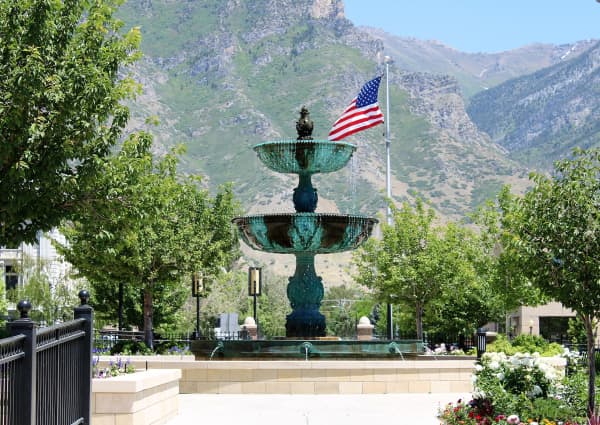
Every temple in Utah Valley sits on landscaped grounds that are open to the public, unfenced in practice, and used constantly by people with no connection to the Church. Locals walk them in the evening. Photographers use them. People sit on the benches and eat lunch.
You do not need permission, and nobody will ask you what you're doing there.
A few courtesies make you a good guest:
- There will be weddings. On any given weekday, and especially in summer, several sealings a day let out, and families gather outside for photographs. Give them room. It's their day, and the grounds are effectively their venue.
- Keep it quiet. These are contemplative spaces, and people come to them for that. Nobody minds children; it's the volume of a phone call on speaker that lands badly.
- Photograph the building freely. Exterior photography is entirely normal.
- Don't try the doors. Entry desks are staffed, and turning up without a recommend puts a volunteer in the position of turning you away, which is uncomfortable for everyone.
The one time anyone can go inside
Before a newly built or extensively renovated temple is dedicated, the Church holds a public open house — a stretch of weeks during which anyone, of any faith or none, can tour the completed interior. No ticket cost, though reservations are typically required, and the buildings are shown finished and furnished.
This is the only way for a non-member to see the inside of a temple, and it's the reason open houses draw crowds far beyond the Church's own membership.
Utah Valley just had one. The Lindon Utah Temple opened its doors to the public from mid-March through early April 2026 before being dedicated on May 3 by President Henry B. Eyring. It became the seventh temple ever dedicated in Utah County — the sixth currently in operation, since the Provo Utah Rock Canyon Temple is closed for reconstruction.
If you missed it, the next local opportunity is likely the rebuilt Provo Utah Rock Canyon Temple, and after that the announced Lehi temple — but no dates exist for either, and there's no way to predict them. The practical advice is simple: when an open house is announced within driving distance, go. They don't come around often, and once a temple is dedicated the window closes for good.
The six operating temples
Each of these is distinct enough to be worth its own visit, and they're close enough together that seeing several in an afternoon is a reasonable outing.
Provo City Center Temple — downtown Provo, at Center Street and University Avenue. The most remarkable building of the six, and the one to see first if you only see one. It was built inside the surviving shell of the Provo Tabernacle, a beloved 19th-century civic and religious hall that was gutted by fire in December 2010. Rather than demolish the ruin, the Church rebuilt it as a temple, preserving the exterior walls and the tabernacle's character, and dedicated it in March 2016. It sits on an ordinary downtown block, surrounded by restaurants and shops, which makes it the easiest of the six to visit on foot and the one most integrated into daily city life. The full story of the fire, what survived it, and the engineering that put a basement under a standing building is on our Provo Tabernacle page.
Mount Timpanogos Utah Temple — American Fork, at the north end of the valley. Dedicated in October 1996 and, for a long stretch, the workhorse of northern Utah County. Large, white granite, set against the mountain it's named for, with grounds that are among the prettiest in the valley in spring.
Payson Utah Temple — the southern anchor, dedicated in 2015. Set apart from the density of Provo and Orem, with a hillside setting and long views north up the valley. If you're driving the Nebo Loop or exploring the south end of the county, it's an easy stop.
Orem Utah Temple — dedicated in January 2024 on the west side of Orem. Its tall spire is visible from a long way off across the valley floor.
Saratoga Springs Utah Temple — dedicated August 2023, on the far northwest side of Utah Lake. Technically Utah County, though the drive from Provo takes you around the lake and it feels like a different region. Worth pairing with a trip out that direction rather than a special errand.
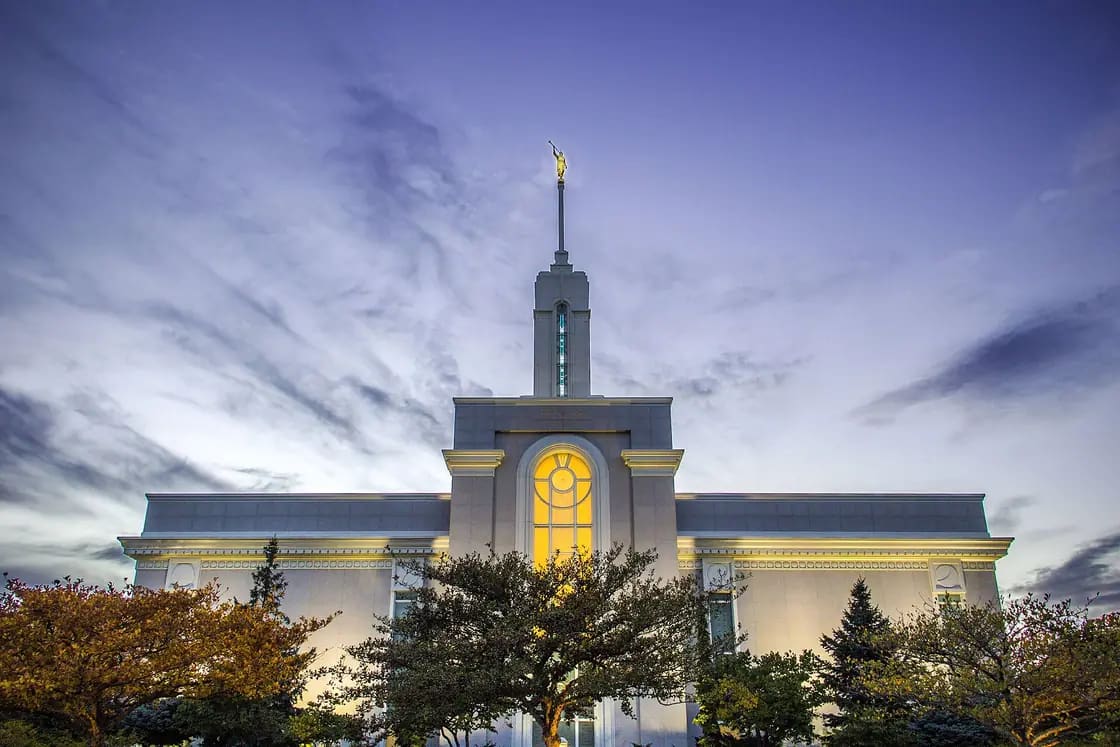
Lindon Utah Temple — the newest, dedicated May 3, 2026, at 850 East Center Street in Lindon. The design draws deliberately on local heritage — the linden flower and tree that give the city its name, and harvest-basket motifs referencing the area's agricultural history. Because it's new, the grounds are still settling in, but it's the one with the freshest story attached.
The one that isn't there anymore
If you drive up to Provo's east bench looking for the temple you remember, you'll find a construction site.
The Provo Utah Temple, dedicated in 1972 and for decades one of the busiest temples in the Church, closed on February 24, 2024. Days before it closed, the Church announced that the rebuilt temple would carry a new name — the Provo Utah Rock Canyon Temple — taken from its position at the mouth of Rock Canyon and chosen partly to distinguish it from the Provo City Center Temple two and a half miles away.
The old building was demolished. What's rising in its place is an entirely new temple on the same site, with a different exterior design. It is not a renovation in any meaningful sense.
No open house or dedication date has been announced. Anyone who tells you a specific reopening date is guessing. What is safe to say is that when the announcement comes, it will be widely publicized and the open house will be crowded.
For visitors, the practical consequence is this: the temple adjacent to the Missionary Training Center is closed, which matters if you're a family in town for a missionary drop-off and were planning to walk those grounds. Our Provo MTC guide covers that trip in detail, and the City Center Temple downtown is the natural substitute.
What happens inside, in general terms
Visitors often assume the reticence about temple interiors means something is being hidden. It's closer to the opposite — the Church publishes a good deal about what temples are for, and the reserve is about treating the ceremonies as sacred rather than secret.
In broad strokes, temples are used for ordinances — formal religious ceremonies — rather than sermons and congregational worship. The most visible is the sealing, the marriage ceremony that Latter-day Saints believe binds a couple, and their children, beyond death. That's the ceremony behind every wedding party you see on the grounds. Temples are also used for baptisms performed on behalf of deceased ancestors, which is the practical reason the Church invests so heavily in genealogical research, and for the endowment, an instructional ceremony that adult members receive for themselves and then return to perform on behalf of the dead.
That last point explains something visitors find puzzling: members attend repeatedly, sometimes weekly, for their entire lives. It isn't a one-time rite of passage. The buildings need capacity because people keep coming back.
If you want more than a paragraph, the Church's own materials describe temple purposes in some detail, and the public open house tours are built precisely to give non-members a look at the rooms and an explanation of what each is for.
How members get in
The credential is called a temple recommend — a small card, renewed every two years, issued after interviews with a member's local bishop and stake president.
The interviews cover belief and conduct: faith in Jesus Christ, honesty, adherence to the Church's health code and standards of sexual morality, tithing, and whether the member is a full participant in their congregation. They're conversations rather than examinations, but they are genuine, and members do sometimes come away without a current recommend.
Two consequences matter for visitors. First, the line isn't member versus non-member — it's recommend-holder versus everyone else, and plenty of Latter-day Saints fall on the outside of it at any given moment. Second, this is why a family attending a temple wedding can be split down the middle, with some relatives inside and some waiting outside, in a way that has nothing to do with how close anyone is to the couple.
If you're new to the valley
For a non-member moving to Utah County, the temples are the most visible edge of a religious culture that shapes a lot of daily life here — the Sunday quiet, the volume of weekday evening activity at meetinghouses, the way summer weekends fill with weddings.
The useful posture, from people who've done it: treat the buildings as civic landmarks, because functionally that's what they are. Walk the grounds. Go to an open house if one is announced. Say yes to a wedding invitation even if you'll be outside for the ceremony. None of that implies anything about your own beliefs, and locals do not read it that way.
If you only have an hour
Go to the Provo City Center Temple downtown, park once, and walk. It's the most architecturally interesting of the six by a wide margin, its history is legible from the sidewalk, and it sits inside a working downtown rather than behind a lawn on an arterial — so you can combine it with lunch, the Covey Center, or the farmers market without a second stop. Circle the building, read the exterior stonework, and note how much of the old tabernacle survived. Then, if you have another twenty minutes, drive up to the Rock Canyon site on the east bench to see the replacement rising, and you'll have covered both ends of the story in a single outing.
Practical logistics
Parking is free and on-site at all six, and generally ample except during peak wedding hours on summer Fridays and Saturdays. The City Center Temple is the exception — it's on a downtown block with a dedicated lot that fills, and street parking downtown is the fallback.
Best times to visit. Early evening is the most rewarding: the light is good, wedding traffic has thinned, and the buildings are lit after dark. Weekday mornings are the busiest for sealings. Temples are closed Sundays and Mondays, which doesn't affect walking the grounds but does mean the parking lots will be empty and the buildings dark.
Accessibility. The grounds are paved and level at most sites, with accessible parking near the entrances. Payson and Saratoga Springs sit on slopes with more grade to cover than the others.
If you've been invited to a wedding and you're not able to attend the sealing itself, that's a specific and common situation with its own etiquette — what to do during the ceremony, how the day is structured, where you'll be included. Our guide to temple weddings for out-of-town guests is written for exactly that, and it's a better answer than anything this article can give in a paragraph.
Why so many
The obvious question, for anyone driving past a fourth spire in twenty minutes, is why a county of more than 700,000 people needs six of these.
The short answer is capacity. Temples serve geographic districts, and a temple district here contains an extraordinary density of active members — enough that Mount Timpanogos and the old Provo temple were running near their limits before Payson and City Center opened. Each new temple relieves the ones around it. Announcements in Lindon and Lehi follow the same logic, tracking the population moving north into the fast-growing corridor toward Salt Lake County.
Whatever your own relationship to the faith, that's the practical explanation for the skyline. These buildings aren't monuments. They're infrastructure, in a valley that has more demand for them than anywhere else on earth.
Photography, Grounds Etiquette, and the Difference Between "Open" and "Public"
The grounds being open is the single most useful fact on this page, and it is also the one most likely to be misread. Open does not mean public in the legal sense. Temple grounds are private property that the owner has chosen to leave accessible, and the practical difference shows up in exactly the places you would expect: hours, photography, and what happens when a lot of people want the same lawn at once.
Photography is generally fine and occasionally not. Photographing the building and the grounds is normal, expected, and done constantly — these are among the most photographed structures in the state. What changes the answer is scale and intent. A phone snapshot is one thing; a tripod, lights, and a bridal party is a commercial or semi-commercial shoot, and several temples in Utah restrict or require permission for that, particularly at the sites where wedding photography volume is high enough to crowd out everyone else. There is no single valley-wide rule, which is the point: check the specific temple's own page or call the temple, and do it before you book a photographer rather than after.
The building interior is never photographable, including during an open house, and this is not a gray area. If you tour an interior during an open house you will be asked to leave cameras and phones alone inside. That restriction is uniform and it is enforced politely but completely.
Read the grounds as a place where something serious is happening nearby. Nobody will police your volume, and there is no dress code on a lawn. But the people walking past you are frequently on their way to or from something they consider among the most significant events of their lives — a wedding, a sealing, a first visit after a long absence. The etiquette that matters is proportion: keep drone flying, loud music, ball games and picnics for the many excellent parks nearby, and treat the grounds the way you would treat the garden of a cathedral you had wandered into. That standard is easy to meet and it covers every case.
Practical accessibility varies more than you would guess. These buildings were completed across a span of decades, and the older ones were designed to different expectations. Level access, parking distance from the door, seating on the grounds, and shade are different site to site, and the newest buildings are markedly better on all four. If any of that matters for someone in your group, the reliable move is to call the specific temple and ask a specific question — "how far is accessible parking from the entrance" gets a real answer, where "is it accessible" gets a yes.
Weddings are the one time a crowd appears from nowhere. On a Friday or Saturday in summer, a busy temple can cycle several wedding parties through in a morning, and the grounds fill and empty in waves. If you want the quiet version, a weekday morning is a different place entirely. If you want to see the building doing the thing it exists to do, a Saturday is exactly right — just do not expect to have the gardens to yourself.
Related Guides
-
Visiting Provo's Temples: Grounds, Schedules and Closures — the two Provo sites specifically, including what is and is not there now
-
A Newcomer's Guide to Faith Communities in Provo & Utah Valley
-
The New Provo Temple, Explained: The Rock Canyon Rebuild
Advertisement -
Family Sunday Activities in Utah Valley (the Sabbath-Keeping Version)
-
Salt Lake Temple Open House 2027: Dates, Free Tickets and Planning the Trip From Utah Valley
-
Temple Square Visitors' Center: What to See, Hours, Free Tours and Parking
Frequently Asked Questions
Can non-members visit a Latter-day Saint temple?
How many temples are there in Utah County?
What's the difference between a temple and a regular Latter-day Saint chapel?
Can you take photos at a temple?
When will the Provo Rock Canyon Temple reopen?
Do I need permission to photograph a temple from the grounds?
Are temple grounds accessible for someone with limited mobility?
Is there a quiet time to visit the grounds?
Sources
The facts in this guide were checked against these sources. Hours, fees and rules change, so confirm anything time-sensitive with the source before you go. How we make Provo.com.
- Population Estimates by Characteristics, Vintage 2023: Utah County, Utah, U.S. Census Bureau (via USAFacts Government Data Connector). Checked October 12, 2026.
- President Eyring Dedicates the Lindon Utah Temple, Newsroom, The Church of Jesus Christ of Latter-day Saints. Checked October 12, 2026.
- The Provo Temple Will Reopen as the Provo Utah Rock Canyon Temple, Newsroom, The Church of Jesus Christ of Latter-day Saints. Checked October 12, 2026.
- Provo Utah Rock Canyon Temple, The Church of Jesus Christ of Latter-day Saints. Checked October 12, 2026.
- Provo City Center Temple, The Church of Jesus Christ of Latter-day Saints. Checked October 12, 2026.
- Orem Utah Temple, The Church of Jesus Christ of Latter-day Saints. Checked October 12, 2026.
- Lehi Utah Temple, The Church of Jesus Christ of Latter-day Saints. Checked October 12, 2026.