
Every Utah Valley company profile eventually mentions a basement or a door knock. Vivint's story starts with the door knock — and runs through a $2.8 billion acquisition, more than 2 million customers, the biggest corporate name ever hung on a Utah arena, and the largest penalty the Federal Trade Commission has ever collected in a credit-reporting case.
This is an independent editorial profile. Provo.com has no business relationship with Vivint.
It Started in Pest Control, Not Alarms
The detail that explains Vivint better than any other is that its founder did not start in security. In the summer of 1992, Todd Pedersen — then a BYU student — hired about ten friends to sell pest control out of a single-wide trailer. By the end of that year the crew had grown to roughly eighty people.
That is the whole company in miniature. What Pedersen built first was not a product but a recruiting and sales machine: young men and women, mostly students, deployed in geographically concentrated teams for a single intense summer, paid on commission. When the Security Industry's own hall of fame inducted him years later, its citation said the plain version out loud — he took the sales and marketing methods he had picked up working for pest control companies and pointed them at residential alarms, an industry whose old guard initially treated the idea with contempt.
Seven years later, in 1999, Pedersen and his high-school friend Keith Nellesen founded APX Alarm Security Solutions. The two had grown up together in Idaho Falls. By published accounts the operation installed more than 900 systems in its first summer.
Everything downstream follows from that structure. The reason Utah Valley has a summer-sales economy at all, the reason a BYU sophomore can earn a year's tuition between May and August, and the reason the company's worst legal chapter took the shape it did are all the same fact wearing different clothes.
The Founding Year, and Why the Wrong One Travels
This profile says 1999, and the reason is worth stating because a different year is printed nearly everywhere.
APX Group Holdings' own Form 10-K filings state, in three consecutive years, that Todd Pedersen "founded our company in 1999." That is the company telling the Securities and Exchange Commission under penalty of perjury. Vivint's own newsroom biography of Pedersen says 1999. So does the company's own social media, so do the business databases that pull from filings, and so did the Deseret News when it covered the company in 2021.
Yet 1997 appears constantly in secondary summaries, and the mechanism is mechanical rather than mysterious: a wrong date in a summary field gets scraped, syndicated and quoted far more often than the filings that contradict it. If you find 1997, you have almost certainly found a summary field rather than a source.
We had it wrong too. Until this edition, two other pages on this site carried 1997 — a correction we made on one page in an earlier update and failed to sweep across the rest. That is the honest version of how a wrong date propagates: not malice, just a fix applied where it was noticed rather than everywhere it lived.
The founding city is unresolved, and this is a rarer problem. Secondary accounts place the founding in Lehi or in Provo, sometimes both within a single publication. We say Utah Valley and leave it there, because that is what the evidence supports.
What Vivint Actually Sells
Vivint's product is the professionally installed smart home: outdoor and doorbell cameras with on-device deterrence features, smart locks, door and window sensors, glass-break and motion detectors, smoke and carbon monoxide alarms, thermostats and lighting, all on one platform behind 24/7 professional monitoring.
The model is the opposite of the DIY approach taken by Ring or SimpliSafe. A technician designs and installs the system in your house. The equipment is bought or financed separately from the monitoring subscription, which is the structural reason the FTC case described below was about credit reports rather than about alarms — for a large share of customers, buying a Vivint system means taking out a loan.
The scale is real. As of 2026 the company reports more than 2 million customers in the United States and roughly 27 million connected devices under management. For comparison, when the FTC settled with the company in 2021, the agency's own description put the figure at more than 1.5 million across the US and Canada.
Who Has Owned It
Vivint has been through the full corporate life cycle in about a decade, which is unusual for a company that has never moved its headquarters.
- 1999–2012 — founder-owned. The company bootstrapped for most of a decade, funding growth out of cash flow rather than venture capital. A Goldman Sachs credit facility arrived around 2006, the same year it crossed roughly $100 million in revenue and expanded into Canada with sales and installation teams in Toronto. By 2009 it had moved into a purpose-scaled Provo headquarters.
- February 1, 2011 — the rebrand. APX Alarm became Vivint, a name assembled from vive and intelligent. The name change marked the strategic turn from alarms to the whole connected house.
- November 2012 — Blackstone. The private equity firm acquired the company in a deal valued above $2 billion, at the time among the largest outcomes in Utah business history.
- January 2020 — the public markets. Vivint listed on the New York Stock Exchange as VVNT through a merger with Mosaic Acquisition Corp.
- December 6, 2022 — the sale is announced. NRG Energy agreed to buy Vivint for $12 per share, or $2.8 billion in cash, at what the companies described as 6.3 times run-rate enterprise value to adjusted EBITDA.
- March 10, 2023 — the deal closes. Vivint becomes a subsidiary of NRG and stops trading.
The Arena Years
For eight years the most visible piece of Provo branding anywhere in Utah hung on a building in Salt Lake City.
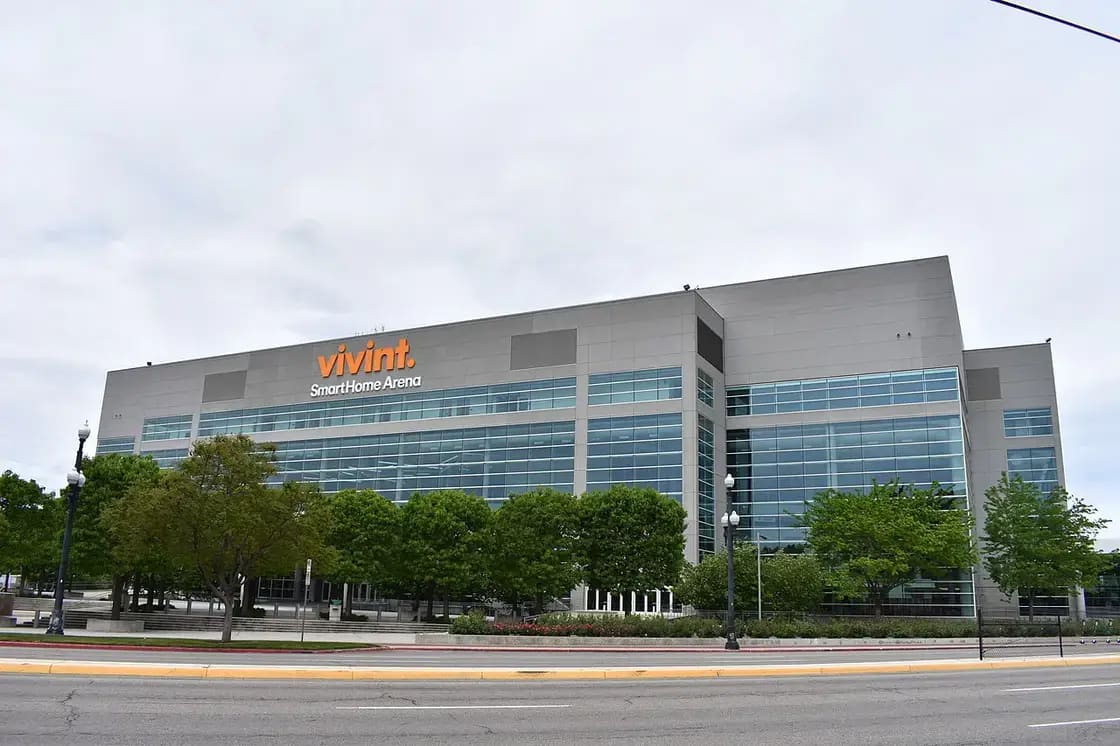
Vivint bought the naming rights to the Utah Jazz arena in 2015 under a ten-year agreement. The building was Vivint Smart Home Arena until August 2020, when the name was shortened to Vivint Arena. It hosted an NBA All-Star Game, a stack of concerts, and roughly a decade of Utah's shared civic memory.
Then it came down early. In January 2023 the Jazz announced the arena would revert to the Delta Center on July 1, 2023 — two years before Vivint's naming deal was due to expire, and in the same year NRG closed its acquisition. Vivint did not leave the building: it traded the marquee for a partnership running through 2030, keeping its courtside suite, its ticket packages, in-arena promotions and signage. The sign is what changed hands.
If you are a Utah Valley resident who remembers the name on the arena and has vaguely assumed the company faded, that is the source of the impression — and it is wrong. The company got substantially larger while its name got smaller.
Vivint Solar Was a Different Company
This causes more confusion than anything else about the business, and the distinction matters for both customers and job applicants.
Vivint Solar was a separate, independently run company. It launched in 2011, shared the brand and the sales culture, went public on its own in October 2014, and was acquired by Sunrun in 2020. It no longer operates under the Vivint name.
Today's Vivint sells smart-home and security systems. It does not sell you solar panels. If a door knock or a search result has you comparing solar quotes, our Utah home solar guide is the right starting point, and the company you are being pitched is not this one.
The Honest Ledger
A profile that skipped the legal history would not be honest, and in this case the legal history is also the clearest window into how the sales model worked.
On April 29, 2021, the Federal Trade Commission announced a $20 million settlement with Vivint — $15 million as a civil penalty, the largest ever in an FTC Fair Credit Reporting Act case, plus $5 million to compensate injured consumers. The complaint, filed by the Department of Justice on the FTC's behalf, charged violations of the Fair Credit Reporting Act, the FTC Act, and the Red Flags Rule.
The mechanism is the part worth understanding. To sell a financed system, a representative had to pull a credit report and qualify the buyer. According to the FTC's complaint, when a prospective customer did not qualify, some representatives used two workarounds:
- "White paging." A representative would open a White Pages app, find a different consumer with the same or a similar name, and run that stranger's credit history to qualify the sale.
- Unwitting co-signers. A representative would ask the unqualified buyer to name someone they knew with good credit — usually a relative — and add that person as a co-signer without their knowledge.
The harm landed on people who had never met a Vivint salesperson. When the customer defaulted, the innocent third party's name went to Vivint's debt buyer, and they got calls from collectors. Many of them complained to the FTC that they had been victims of identity theft. The agency also alleged that Vivint knew: that it terminated numerous representatives for this conduct and then rehired some of them. Commissioner Rohit Chopra said publicly that leadership had reason to look away while the company's valuation was being prepared for its 2020 listing.
The settlement required more than money. Vivint had to implement an employee monitoring and training program, build the identity-theft prevention program it had lacked, stand up a customer-service task force to verify that an account belonged to the right person before referring it to collections, help consumers who had been wrongly referred, and submit to independent third-party assessments every two years. In 2023 the FTC opened a claims process through which more than 9,000 consumers could apply for compensation.
None of that erases the business achievement, and the company has said it strengthened compliance in response. But it belongs in the record, and there is a local lesson in it that no national coverage draws: the failure mode was a structural feature of the commission-only summer sales model, not a rogue branch. Anyone in Utah Valley about to sign a summer sales contract — for alarms, solar, pest control or anything else — should read the incentive structure they are agreeing to. Our summer sales guide has the unvarnished version.
What NRG Ownership Actually Means
Three years in, the honest description of Vivint in 2026 is that it is a channel for an energy company.
NRG's own 2026 filings with the Securities and Exchange Commission describe a company serving roughly 8 million residential customers — about 6 million retail energy and about 2 million smart home — under the brand names NRG, Reliant, Direct Energy, Green Mountain Energy and Vivint. That is the strategic logic of the acquisition stated by the buyer: NRG already sells you electricity and gas, Vivint already has a technician inside your house and an app on your phone, and the company that owns both can sell each customer more of the other.
For Provo, the practical consequence is the one that matters with any acquisition: decisions about the brand are now made in Houston. The headquarters, the monitoring operation and the engineering are still here. Strategy is not.
The Utah Valley Footprint
Vivint's headquarters campus sits in north Provo at 4931 N 300 W, near the I-15 corridor. Third-party business databases put total headcount around 12,000 nationwide — installation technicians, monitoring-center staff, engineers, corporate functions and a large sales organization.
Utah's Department of Workforce Services publishes local employment only in bands rather than exact counts, and it places Vivint in the 2,000–2,999 range for Utah County. That makes it one of the county's largest private employers, though well behind the anchor institutions — BYU, the school districts, Intermountain Health and UVU — that top the list. Our biggest employers directory has the full ranking.
One quietly revealing detail for anyone job-hunting: Vivint's own technician postings list preferred backgrounds as experience in cable or satellite installation, pest control, construction, or solar. That is a precise description of the Utah Valley labor pool, written by the employer.
Why It Matters Here
Provo's economic story usually gets told through BYU on one end and Lehi's tech corridor on the other, with Provo itself cast as the college town in between. Vivint is the standing counter-example: a category-leading national company, built in Provo, headquartered in Provo, and still operating from Provo after a $2.8 billion sale.
It also did something less measurable. Two decades of summer crews means a very large number of Utah Valley adults learned to sell — and to manage, recruit and run a territory — inside this company or one modeled on it. Aptive, Moxie, LGCY and much of the valley's direct-sales sector share that DNA. Whether you regard that as an achievement or an affliction probably depends on how many times someone has knocked on your door in July.
For the wider list Vivint belongs to, see companies founded in Utah Valley and our explainer on Silicon Slopes.
Provo Has Rules for the Knock, and Almost Nobody Knows Them
Here is the fact that closes the loop, and it appears nowhere else in local coverage: the city that Vivint is headquartered in has a detailed ordinance governing exactly what a door-to-door salesperson must show you. It is Provo City Code Chapter 6.09, and if you live in Provo it is the most useful thing on this page.
They need a badge, and the badge has to say "Provo" on it. Registered solicitors are issued a certificate they must carry at all times, plus a photo identification badge worn prominently that bears the name of the City (Provo City Code 6.09.110). If nobody on your porch is wearing one, that is your answer.
They have to tell you three things, unprompted. Their name, the name and address of the company they represent, and why they are there. A badge and an informational flyer can satisfy this.
They cannot use a fake name, and they cannot imply the city endorses them. Both are spelled out. "The city sent us out to check the neighborhood" is not a thing that happens.
There are hours. It is unlawful to solicit at a residence before 9:00 a.m. or after 9:00 p.m., unless the resident has given permission.
A "No Solicitation" sign is legally operative, not decorative. Posting one on or near your main entrance door, or near the property line by the walk to your house, is recognized notice under the ordinance.
Some knocks are exempt from the permit, and that changes less than you think. People you invited, people licensed by the state for door-to-door sales, deliveries of things already ordered, religious or political advocacy, and charitable solicitation including students raising money for school activities. Being exempt from registration does not exempt anyone from the conduct and hours rules.
And Provo's own definitions tie a home solicitation sale to your right to rescind within three days under applicable federal, state or local law. Never sign at the door; the whole point of the summer sales calendar is that the crew will be in another state by the time you have second thoughts.
Questions about a specific solicitor go to Provo 311 — dial 3-1-1, or (801) 852-6000.
Related Guides
- LGCY Power: Lehi's Homegrown Solar Company
- Jobs in Provo & Utah Valley: Who's Hiring, What It Pays, and What Nobody Tells You (2026)
- Direct Sales in Utah Valley: Why the Industry's Capital Is Here
- Getting Your First Provo Job: Applications That Actually Work Here
- Jobs in Provo With No Degree or Experience: The Honest Map
- What Jobs Actually Pay in Provo: A Sector-by-Sector Wage Guide
Frequently Asked Questions
What does Vivint do?
When was Vivint founded — 1997 or 1999?
Where is Vivint headquartered?
Who owns Vivint?
Is Vivint the same company as Vivint Solar?
How many people work at Vivint?
Why did Vivint pay the FTC $20 million?
What are the rules for door-to-door salespeople in Provo?
Sources
The facts in this guide were checked against these sources. Hours, fees and rules change, so confirm anything time-sensitive with the source before you go. How we make Provo.com.
- Smart Home Monitoring Company Vivint Will Pay $20 Million to Settle FTC Charges, Federal Trade Commission. Checked October 12, 2026.
- NRG and Vivint merger announcement (Ex. 99.1, Dec. 6, 2022), NRG Energy (SEC EDGAR). Checked October 12, 2026.
- Vivint Smart Home Form 8-K (merger completion), Vivint Smart Home (SEC EDGAR). Checked October 12, 2026.