
Ask what drives Utah Valley's economy and you'll get the shorthand answers — "BYU," "Silicon Slopes," "the church," "MLMs." All partly true, none complete. The real picture is an economy built on a handful of giant anchor institutions, a large tech corridor at the county's north end, a direct-sales industry that's uniquely concentrated here, and a healthcare system in the middle of its biggest local expansion in decades.
Here's who signs the paychecks — with employment figures sourced where solid numbers exist, and honest ranges where they don't. A note on the numbers: the State of Utah publishes employer sizes only as ranges (through the Department of Workforce Services), companies self-report totals that often span multiple states, and third-party databases estimate the rest. We've labeled which is which throughout.
The Anchor Institutions
Brigham Young University — Provo. The county's largest employer, and it isn't close. The Utah Department of Workforce Services' most recent statewide report puts BYU at 15,000–19,999 employees, which ranks it among the largest employers in the entire state. That figure covers far more than professors: BYU runs its own dining services, grounds crews, custodial teams, creamery, bookstore, broadcasting operation, and police department, and the adjacent Missionary Training Center adds its own workforce. It's also the county's single biggest source of student jobs — thousands of on-campus positions turn over with the academic calendar. If you're a student, our part-time jobs guide covers how to get one.
Alpine School District — American Fork (for now). Utah's largest school district has long been the county's biggest K-12 employer — Workforce Services puts its employment at 7,000–9,999. The big caveat: Alpine is in its final stretch as a single district. Voters approved splitting it, and the successor districts — including the Timpanogos School District, whose name has been adopted — begin operating for the 2027–28 school year. Alpine runs the county's north-side schools through 2026–27; after that, the same jobs exist but the employer names on the paychecks change. (Provo City School District and Nebo School District cover Provo proper and the south county, and each is a major employer in its own right.)
Intermountain Health — Utah Valley Hospital, Provo. Intermountain is the region's healthcare giant — Workforce Services ranks it Utah's largest employer at 20,000+ — and its flagship presence here is Utah Valley Hospital on Provo's west side, the county's largest hospital and one of its largest single worksites. Intermountain's county footprint extends well beyond the hospital: clinics, instacares, and specialty practices across the valley. And healthcare employment here is about to grow again — the Huntsman Cancer Institute's $400 million Vineyard campus, covered in our Utah City explainer, is under construction now. For finding care rather than work, see our healthcare guide.
Utah Valley University — Orem. The largest university in Utah by enrollment (48,000+ students as of fall 2025) and the largest employer in Orem. UVU's own fall 2025 HR figures count roughly 4,500 faculty and staff — about 800 full-time faculty, 1,300 part-time faculty, and 2,350 staff — plus around 1,600 student employees. UVU says it indirectly supports several thousand more jobs in its service region. Smaller payroll than BYU, but the same anchor-institution effect on Orem that BYU has on Provo.
Government. The usual public-sector block rounds out the anchors: Provo City (which runs its own power utility), Utah County, and state offices collectively employ thousands, and the U.S. Forest Service and IRS have long-standing Provo-area operations.
The Provo Flagships
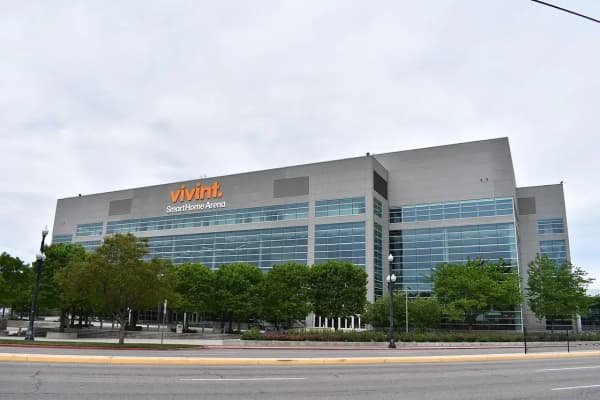
Vivint. The biggest homegrown corporate name in Provo proper — a smart-home and home-security company with a large campus in north Provo. Founded in Utah Valley and acquired by NRG Energy for $2.8 billion in 2023, it remains one of the county's largest private employers. Full story in our Vivint company profile.
Qualtrics. The survey-and-experience-management software company Ryan Smith co-founded in a Provo basement in 2002 became one of Utah's defining tech success stories — an $8 billion acquisition by SAP in 2018, a 2021 IPO, and a take-private by Silver Lake in 2023 valued around $12.5 billion. The company operates dual headquarters in Provo and Seattle; the Provo tower along I-15 remains one of the most visible tech addresses in the county. Smith, meanwhile, bought the Utah Jazz — Utah Valley basements have produced stranger things, but not many.
Nu Skin Enterprises. The publicly traded skincare and wellness company (NYSE: NUS) has headquartered in downtown Provo since its 1984 founding — its campus and innovation center occupy a full stretch of Center Street's west end and anchor a significant white-collar workforce downtown.
Silicon Slopes, Utah County Edition
The county's tech weight sits at its north end, where Lehi's I-15 corridor forms the southern half of Silicon Slopes. The landmarks, per our Living in Lehi guide:
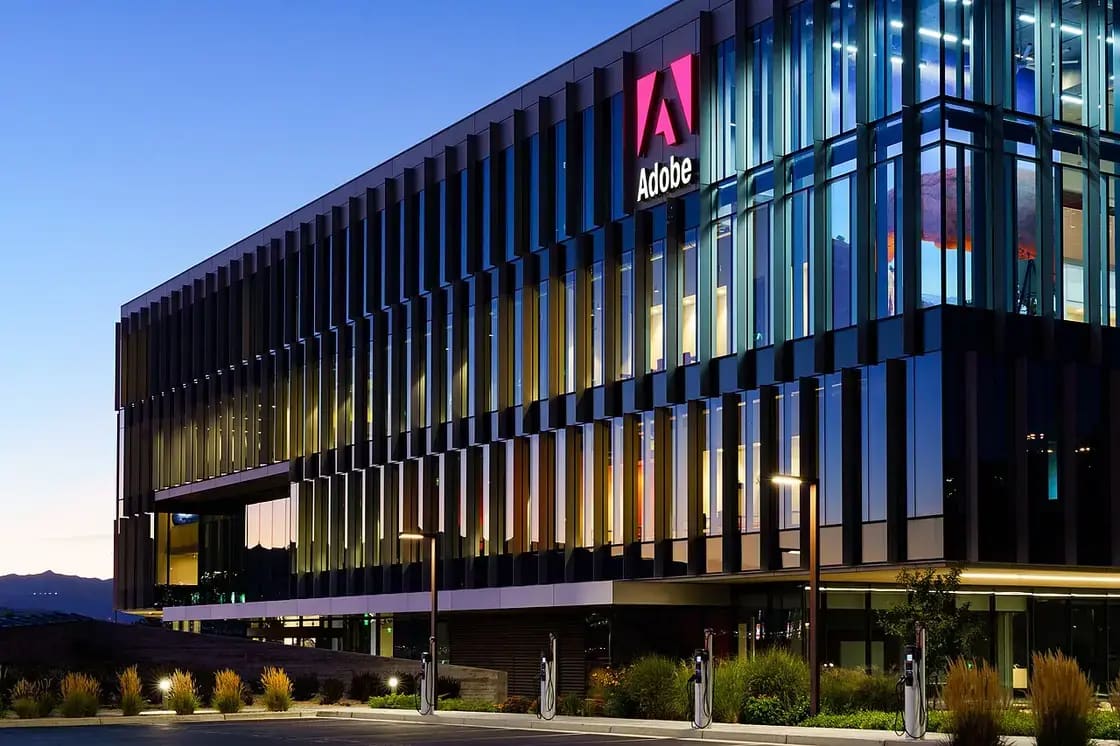
- Adobe — the campus that made the corridor famous. Set right alongside I-15 and later expanded with a second building, it's the image most people picture when they hear "Silicon Slopes."
- Texas Instruments — the county's biggest advanced-manufacturing story. TI acquired the former Micron/IM Flash semiconductor fab in Lehi in 2021, then announced a second Lehi fab in 2023 as part of a multibillion-dollar Utah investment — chip fabrication is capital-heavy and jobs-rich, and it's happening in Utah County.
- Ancestry — the genealogy giant, a natural fit for the world's family-history capital, headquartered in Lehi.
- The homegrown software layer — Podium, Entrata, Weave, and a rotating cast of venture-backed companies fill the corridor's office parks. Names change with funding cycles; the aggregate employment keeps growing.
The practical upshot for job seekers: a huge share of the county's white-collar hiring happens in Lehi even though most of the county's people live south of it, which is why Utah Valley's commute patterns point north. Our internships and careers guide covers how students break into the corridor.
The Direct-Sales Capital
No honest accounting of Utah Valley employment skips direct sales — the industry is more concentrated here than anywhere in America, and we break down the numbers in our guide to direct selling in Utah Valley.
- doTERRA — the essential-oils company headquartered in Pleasant Grove, one of the county's largest private employers and the operator of one of Utah's biggest annual corporate conventions.
- Nu Skin — covered above; the elder statesman of the category at 40+ years.
- Young Living — the other essential-oils major, headquartered in Lehi with its farm operations spread across Utah and beyond.
Adjacent to the product companies is the door-to-door summer sales industry — pest control, solar, alarms — which is headquartered in Utah Valley to a degree that surprises outsiders and recruits thousands of BYU and UVU students every year. We've covered it in our summer sales guide, including profiles of local players like LGCY Power.
Healthcare Beyond Intermountain
Revere Health, headquartered in Provo, is one of Utah's largest independent physician groups, with dozens of clinics concentrated in Utah Valley. Add the county's dental, physical-therapy, and behavioral-health networks and healthcare quietly rivals tech as the county's employment growth engine — a trend the Huntsman Vineyard campus will accelerate.
What It Means If You're Job Hunting
Three practical takeaways from the shape of this list:
- The anchors hire constantly. BYU, UVU, the districts, and Intermountain post positions year-round — benefits-heavy, stability-heavy jobs that don't depend on venture funding.
- The tech corridor is a commute, not a mystery. Most of the county's software hiring happens in Lehi. Living in Provo or Orem and working the corridor is the standard play — factor it into where you live using our cost of living guide.
- Seasonal and student work is a genuine layer of the economy. Between campus jobs, the summer-sales industry, and the event/retail cycle, Utah Valley has more legitimate short-term work than most metros its size — with the usual caveats we cover in the guides linked above.
For the story behind the tech corridor those Lehi jobs sit in, see our Silicon Slopes explainer — and for the companies this valley produced in the first place, our guide to companies founded in Utah Valley.
New to the area entirely? Start with our Moving to Provo guide.
How employer headcounts are counted, and why rankings disagree
Search for the largest employers in Utah County and you will find lists that do not match each other, including this one. That is not sloppiness on anyone's part. Employment counts are produced by several methods that answer different questions, and knowing which method a list used tells you how much weight the ordering can carry.
Ranges, not point figures. State workforce data on large employers is typically published in employment ranges rather than exact counts, because a specific firm's precise employment is confidential business data. That has a direct consequence for any ranking: two employers inside the same band cannot be meaningfully ordered against each other. When a list confidently places one company above another, check whether the underlying source distinguishes them or whether the ordering was imposed by whoever made the list.
Headcount versus full-time equivalent. These diverge sharply here, and the universities are the clearest case. An institution employing several thousand students part-time has a headcount far above its full-time equivalent figure. Whether a list counts student employees, and whether it counts heads or FTEs, can move a university several positions. Neither choice is wrong; they answer different questions, and the answer to "who employs the most people" is different from "who represents the most full-time work."
Establishment versus enterprise. A company operating several sites in the county may appear once as an enterprise or several times as separate establishments, depending on how the data was assembled. Health systems are the standard example — a system with a hospital plus a set of clinics can be counted as one large employer or as a collection of medium ones.
Where the employees are, versus where the company is. This is the distinction that matters most in Utah County and the one most often lost. A company headquartered in Lehi with a distributed or multi-state workforce contributes far fewer local jobs than its total headcount suggests. The direct-sales and residential solar companies are the sharpest version: a large share of their seasonal sales workforce is recruited here and then deployed to other states for the summer, so the company is unambiguously a Utah County employer and its headcount is substantially not a Utah County jobs number.
Seasonality. A county with two large universities and a major summer sales industry has a workforce that changes shape between semesters. An annual average, a September snapshot and a July snapshot are three different numbers, and lists rarely say which one they used.
So how should you use a list like this one? As a map of where the sectors are, not as a leaderboard. The useful information is that education, healthcare, software and direct sales dominate, that the software concentration sits at the north end of the county, and that the two universities anchor the middle. The ordinal positions are the least reliable part. If a specific employer's size matters for a decision you are making — a job search, a commercial lease, a relocation — ask the employer directly for current local headcount, and expect that number to differ from any published figure.
Where the underlying numbers come from
Two sources sit behind almost every employer list, and they behave differently.
The first is administrative data derived from unemployment insurance filings, which counts covered employment by establishment. It is comprehensive for employers in the system and consistent over time, which makes it the better instrument for trends. It also counts establishments rather than brands, reports on a quarterly cycle, and is published for large private employers in ranges to protect confidentiality.
The second is self-reported survey data, where a publication asks employers directly for a headcount. It is timelier and can capture a company's own definition of its workforce, and it is exactly as reliable as the responses — participation is voluntary, definitions vary between respondents, and a firm with a reason to look larger or smaller can supply a number accordingly.
Two classification quirks compound this. Employers are assigned an industry code based on their primary activity, so a company whose largest single group of employees does something other than the firm's headline business is still counted entirely under the headline. And acquisitions surface slowly: a locally founded company bought by an out-of-state parent may keep its name, its building and its headcount while the entity behind it changes, and lists frequently lag that by a year or more. In a county whose signature companies have been acquired, spun out and renamed repeatedly, that lag is not a minor caveat.
The honest summary is that the sector picture in this article is solid and the ordinal ranking is soft. Treat any specific number as a range, any position as approximate, and any list — including this one — as a snapshot of a workforce that reorganizes itself every semester.
Place of work and place of residence are separate counts. Establishment data tells you how many jobs sit inside the county. Household survey data tells you how many employed people live inside it. Those two numbers differ by net commuting, and in a corridor where a substantial number of residents drive north to Salt Lake County each morning while others drive south into Utah County, the gap is real and it moves. A statement that the county gained jobs and a statement that its residents gained employment are different claims that can point in opposite directions in the same year.
Remote work widened the same gap. A company headquartered in Lehi may employ people who have never worked in the building, and depending on how a payroll is registered those employees may or may not appear in Utah County's job counts at all. Nobody has fully settled how to attribute distributed work geographically, which is a live measurement problem rather than a solved one. It is another reason to treat the ordering of any list as approximate.
A final caution about job-posting counts, which are increasingly used as a proxy for who is hiring. Postings are a marketing artifact as much as a staffing one. Companies keep evergreen listings open for roles they hire continuously, repost the same position across boards, and advertise pipelines rather than vacancies — a pattern especially pronounced in commission sales, where recruiting is permanent by design. A high posting count in this county frequently signals a high-turnover role rather than a growing employer, and the two deserve very different weight in a job search.
Related Guides
- Healthcare Jobs in Utah Valley
- The Genealogy Industry in Utah Valley
- The chip factory in Lehi
- The Omniture story — why Adobe employs people in Lehi at all
- The Best Companies to Work For in Utah Valley: How Those Lists Are Made
- doTERRA in Pleasant Grove
Frequently Asked Questions
What is the biggest employer in Utah Valley?
What big tech companies are in Utah Valley?
Is BYU or UVU a bigger employer?
What direct-sales companies are headquartered in Utah Valley?
Where do most people in Utah Valley work?
Why do lists of Utah County's biggest employers disagree with each other?
Do BYU and UVU student jobs count toward employer size?
Does a company's headcount mean it has that many jobs in Utah County?
Sources
The facts in this guide were checked against these sources. Hours, fees and rules change, so confirm anything time-sensitive with the source before you go. How we make Provo.com.
- Utah's Largest Employers, Annual Average Employment 2024, Utah Department of Workforce Services. Checked October 12, 2026.
- NRG Energy to acquire Vivint Smart Home (press release, Exhibit 99.1), NRG Energy via U.S. SEC. Checked October 12, 2026.
- Vivint Smart Home Form 8-K (merger completion), U.S. SEC. Checked October 12, 2026.
- SAP SE to Acquire Qualtrics International Inc. (Exhibit 99.1), SAP via U.S. SEC. Checked October 12, 2026.
- Qualtrics to be Acquired by Silver Lake and CPP Investments (Exhibit 99.1), Qualtrics via U.S. SEC. Checked October 12, 2026.
- SkyWest Leader and Nu Skin Enterprises to be Awarded at Economic Summit, Governor's Office of Economic Opportunity. Checked October 12, 2026.
- Texas Instruments Form 10-Q, June 30, 2021, Texas Instruments via U.S. SEC. Checked October 12, 2026.
- Texas Instruments (Utah), National Institute of Standards and Technology. Checked October 12, 2026.
- Breaking ground on our comprehensive cancer center in Vineyard, Huntsman Cancer Institute, University of Utah Health. Checked October 12, 2026.
- Fall 2025 enrollment, Utah Valley University. Checked October 12, 2026.