
Married and family student housing at BYU is a completely different world from the single-student scene — different buildings, different rules, and a different set of decisions. If you're getting married, coming to BYU with a spouse, or raising kids while you finish a degree, almost none of the advice aimed at freshmen in the dorms applies to you.
This guide covers what you need to know: BYU's two on-campus family communities, who qualifies, what it costs and includes, the waiting-list reality, and how living on campus stacks up against renting off campus in Provo. As always with housing, the specifics change — treat BYU's official housing site as the final word and verify current rates and availability directly before you sign anything.
First, the Rule That Sets You Free
Here's the most important thing to understand, and it's good news: BYU's approved-housing requirement does not apply to married or family students.
Single, matriculated undergraduates have to spend their first two semesters in BYU on-campus housing or a BYU-contracted off-campus complex. That's the system our finding student housing guide walks through in detail — sex-separated buildings, an approved list, the whole framework.
Married students and students with dependent children are exempt. You can live in BYU's on-campus family housing if you want the price and convenience, or you can rent literally any apartment, condo, or house on the open market — same as any other Provo resident. That freedom is why family students have such different options than their single classmates, and it's the fork every couple has to think through.
So the real question isn't "which approved complex do I pick?" It's "on-campus family housing, or the open market?" Let's take both.
On-Campus Option 1: Wymount Terrace
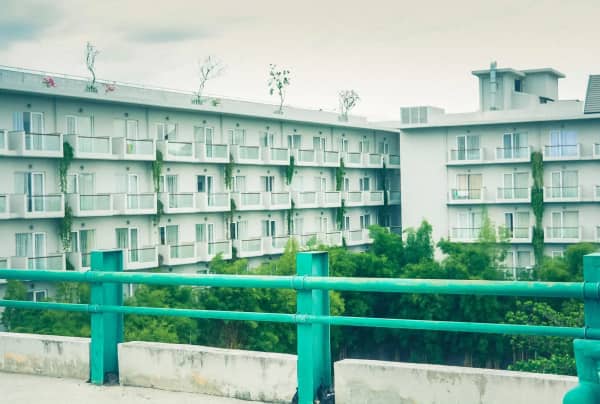
Wymount Terrace is the one you've probably seen — the brick apartment community on BYU's campus. It's been home to BYU student families for more than sixty years, and it's the more affordable, more compact of the two on-campus family communities.
Wymount offers several floor plans in a range of sizes. Apartments come furnished with the basics — refrigerator, stove and oven, garbage disposal, and blinds — but you bring your own furniture and décor. Rent bundles in most utilities; confirm with BYU housing which ones your unit includes. There's free on-site parking for registered vehicles, plus sport courts, playgrounds, and lawns, and the community is organized around family wards, with a multipurpose building and basements available for ward activities.
One big caveat for the next couple of years: Wymount is under construction. BYU is deconstructing nine aging buildings on the south section and replacing them with 11 new ones — 240 apartments in two- and three-bedroom floor plans — in a project expected to run from mid-2026 into roughly 2028. The families in the affected buildings were relocated ahead of demolition, but it does mean part of Wymount's inventory is offline during the build. We covered the full project in our report on BYU's Wymount Terrace rebuild.
On-Campus Option 2: Wyview Park
Wyview Park sits on the northwest side of campus, near the football stadium. It has both a single-student community and a family-housing community — the family side is what concerns us here. Wyview's family apartments are generally larger than Wymount's, which is reflected in the rent.
For the 2025–26 year, Wyview's family units ran about $1,055 per month for a two-bedroom and $1,215 per month for a three-bedroom. (Those are recent reference figures, not a current quote — BYU adjusts rates every September, so verify before you budget.) Like Wymount, most utilities are included, apartments come with basic appliances but no furniture, and there's free on-site parking, sport courts, playgrounds, and lawns. Laundry is handled through a central building in the complex.
With Wymount's south section under construction, Wyview is carrying more of the on-campus family demand than usual, so it's worth checking availability there early.
Who Qualifies for BYU Family Housing
Family housing is restricted — it's not just "married-friendly" apartments. To live in Wymount or Wyview family housing, your household has to fit one of these categories, with at least one member enrolled as a full-time day continuing BYU student (generally 9+ credit hours as an undergraduate or 2+ as a graduate student; the requirement is lower during spring and summer terms):
- Married couples, with or without children. Both spouses have to live in the apartment. The spouse doesn't have to be a BYU student, but they do need to create a BYU NetID and sign the housing agreement.
- Engaged couples. You can apply before the wedding, but with a catch: your apartment's availability date can be no more than 30 days before your marriage date. So if you're getting married January 30, you can submit an agreement anytime, but only for a unit available January 1 or later.
- Single students with dependent children.
A few edge cases: post-baccalaureate, concurrent-enrollment, and Bachelor of General Studies students may petition BYU's Housing Review Board for eligibility on a case-by-case basis, and English Language Center students aren't admitted to BYU and therefore can't live in on-campus housing. Graduate students, who are disproportionately married, are a natural fit here — our grad students in Provo guide covers the bigger picture for that group.
What It Costs and What's Included
The financial pitch for on-campus family housing is straightforward: modest rent, bundled utilities, and no surprises.
Rent in both communities includes most utilities, so you have fewer separate bills to track. That bundling makes budgeting far easier than a typical off-campus lease, where you're stacking separate bills for gas, water, trash, and internet on top of rent.
Two things to plan for. First, apartments are furnished with appliances but not furniture — you'll need a bed, a couch, a table, and so on. Second, BYU raises family-housing rates roughly 3–5% each September, so the number you see today isn't locked in for your whole time as a student. Neither is a dealbreaker, but both belong in your math.
Historically, on-campus family housing has undercut comparable off-campus family apartments in Provo, which is a big part of its appeal. That's the reputation, but rents move — so compare current on-campus rates against real off-campus listings when you're deciding, rather than assuming on-campus always wins.
The Waiting-List Reality
Here's the part that catches couples off guard: you often can't just sign up and move into on-campus family housing whenever you want. Demand regularly exceeds supply, so BYU runs a family-housing waiting list.
The mechanics: you can add yourself to the list up to 18 months before your desired contract date, and you can stay on it for up to 18 months. As apartments open up, BYU offers them to people on the list according to position and stated preferences — and rent starts on the unit's availability date once you accept. Openings can appear with relatively little lead time.
The practical advice writes itself: get on the waiting list as early as you reasonably can, even if your plans aren't fully firm, and keep your preferences realistic (being open to either community and a range of unit sizes gets you an offer faster). With Wymount's south section temporarily reduced during construction, that early-bird approach matters even more over the next couple of years.
The Off-Campus Alternative
Because family students aren't bound by the approved-housing rules, the entire Provo–Orem rental market is open to you — and for a lot of couples, that's the better fit.
Off-campus, you'll generally find more space and more variety: two- and three-bedroom apartments, townhomes, basement apartments, and small houses, often with in-unit laundry and layouts that on-campus family units can't match. You also skip the waiting list entirely. The trade-offs are the ones you'd expect — higher effective rent once you add up separate utilities, more legwork to find and vet a place, and none of the built-in family-ward community that Wymount and Wyview are known for.
Where to look depends on your budget and how close to campus you need to be. The neighborhoods immediately around BYU carry the highest near-campus rents; heading a little farther out — into Orem, or south and east toward the edges of Provo — usually buys more space for the money. And plenty of BYU couples end up in the surrounding towns entirely, where family-sized housing tends to be more affordable. Communities like Springville, Mapleton, and the fast-growing Vineyard area are common landing spots, all within a reasonable commute. For the full picture on how those markets and prices compare, see our look at the Provo real estate market in 2026 and our cost of living breakdown.
If you're renting off-campus for the first time as a couple, don't skip the fundamentals — our first-time renter's checklist covers reading a lease, deposits, and the questions to ask before you sign.
On-Campus vs. Off-Campus: How to Decide
There's no universally right answer — it depends on what you're optimizing for. A rough way to think about it:
Lean on-campus (Wymount or Wyview) if price and predictable bills are your top priority, you want to walk or bike to class, you value the family-ward community, and you can plan far enough ahead to work the waiting list. It's the efficient, low-friction choice for a couple focused on finishing school.
Lean off-campus if you need more square footage (especially with kids), you want a specific layout or in-unit laundry, you're arriving on short notice and can't wait for a list, or you'd rather trade a bit more rent for more control over where and how you live.
In practice, the smartest move for many couples is to do both at once: get on the family-housing waiting list early and actively shop the off-campus market, then take whichever comes through first on terms you like. That way you're not betting everything on a waiting list, and you're not paying off-campus prices if a great on-campus unit opens up.
Before You Sign: The Non-Negotiables
A few reminders that apply no matter which route you take:
- Verify everything current with BYU. Rates, availability, floor plans, and waiting-list rules all change. BYU's official housing site is the authoritative source — a number in this guide or anywhere else is a reference point, not a quote.
- Read the housing agreement. On-campus family housing comes with terms and conditions (and Honor Code expectations); off-campus leases come with their own fine print. Know what you're agreeing to.
- Budget for the full picture. Rent plus any unbundled utilities plus furniture on-campus; rent plus all utilities plus deposits off-campus. Compare total monthly cost, not just the headline rent.
- Start early. Whether it's the family-housing waiting list or the competitive off-campus market, the couples who plan months ahead get the best options. The ones who wait take what's left.
Getting settled as a student family in Provo is very doable — the options are real and, on the whole, more affordable than a lot of college towns. Start with a clear picture of what you qualify for and what you're optimizing for, and the right choice usually becomes obvious.
For more on making Provo home as a couple or family, see our guides to student life in Provo, Provo for families, and moving to Provo.
The Two Reports That Only Exist Because It Is University Housing
Choosing between Wymount Terrace or Wyview Park and a private apartment across town usually comes down to rent, commute and waiting lists. There is a fourth difference that nobody puts in the comparison, and for a family it is worth knowing about: university-owned family housing carries federal disclosure obligations that a private landlord simply does not have.
It is inside Clery geography, and your off-campus alternative is not
The Clery Act requires universities to publish an Annual Security Report every fall, covering three calendar years of crime statistics across a defined geography. That geography includes property the institution owns or controls, which is exactly what BYU family housing is. Incidents there are counted and disclosed in a public document.
A privately owned complex is outside that geography no matter how many student families live in it. There is no equivalent report, because no law requires one. If you want comparable information about a private building, you are asking the city for police records and reading a rental listing's reviews -- a materially worse evidence base than a federal compliance document.
That is not an argument that university housing is safer. It is an argument that university housing is legible in a way private housing is not, and for a family weighing a move to an unfamiliar city that legibility has real value.
The fire safety report almost nobody reads
Institutions with on-campus student housing carry a second obligation: an annual fire safety report. It may be published inside the security report or alongside it, and it covers fire statistics for the housing facilities, the fire safety systems in each building, evacuation procedures, and rules about what residents may keep and use in a unit.
For a single student in a shared apartment, this is a formality. For a family with a toddler, a stroller in a stairwell and a kitchen that gets used three times a day, it is the most practically useful document the university publishes. It will tell you what detection and suppression systems a specific building actually has -- which is not uniform across older and newer housing stock -- and what the evacuation route is before you need it.
Institutions with on-campus housing also have to maintain a missing student notification policy, which lets a resident register a confidential contact to be reached if they are reported missing. It is a two-minute task at move-in that most people never learn exists.
What this changes about the decision
Not much, honestly, if the private apartment wins on rent and location. Waiting lists and cost usually decide this, and they should.
What it does change is what you can find out before committing. Before you sign anywhere, read the current Annual Security Report and fire safety report for the Provo campus -- BYU publishes separate reports for its non-Provo locations, so check you have the right edition -- and ask the private alternative the questions those documents would have answered. How are residents notified about incidents. What detection systems are in the unit. What the evacuation route is from a third-floor apartment with a child who cannot manage stairs alone.
A management company that can answer those crisply is telling you something. One that cannot is also telling you something. For the tenant-law side of a private lease -- deposits, habitability, entry and the repair obligations a landlord cannot contract out of -- see our guide to Utah renters' rights.
Related Guides
- UVU Student Housing: There Are No Dorms — How Renting Near UVU Actually Works (2026)
- Provo & Orem Apartment Directory — filter by who each building houses
- The BYU Guide to Provo: housing, food, game days and campus
- Student Budget Calculator — two incomes and one lump tuition bill is exactly the shape this handles
Frequently Asked Questions
Does BYU have housing for married students?
Who is eligible for BYU family housing?
How much does married student housing cost at BYU?
Is there a waiting list for BYU family housing?
What's included in BYU family housing rent?
Should married students live on-campus or off-campus at BYU?
Is BYU family housing included in the university's crime statistics?
What is the annual fire safety report and does it apply to family housing?
Sources
The facts in this guide were checked against these sources. Hours, fees and rules change, so confirm anything time-sensitive with the source before you go. How we make Provo.com.
- 34 CFR 668.46 — Institutional security policies and crime statistics, Electronic Code of Federal Regulations (eCFR). Checked October 12, 2026.
- Eligibility Requirements (Student Family Housing), BYU Residence Life. Checked October 12, 2026.
- Family Waiting List Info, BYU Residence Life. Checked October 12, 2026.
- Family Housing Rates, BYU Residence Life. Checked October 12, 2026.
- Eleven new buildings to be built at Wymount Terrace, BYU News. Checked October 12, 2026.