
Utah has some of the best natural hot springs in the American West, and several of them are within an easy day trip from Provo. Soaking in a natural hot spring after a hike — surrounded by forest, canyon walls, or mountain views — is one of those experiences that reminds you why living in Utah is worth the inversions and early-closing restaurants.
This guide covers the best hot springs accessible from Provo, from the famous to the hidden, with the practical details you need to plan your visit.
Fifth Water Hot Springs (Diamond Fork)
Distance from Provo: ~35 minutes · Hike: about 5 miles round trip · Difficulty: Moderate
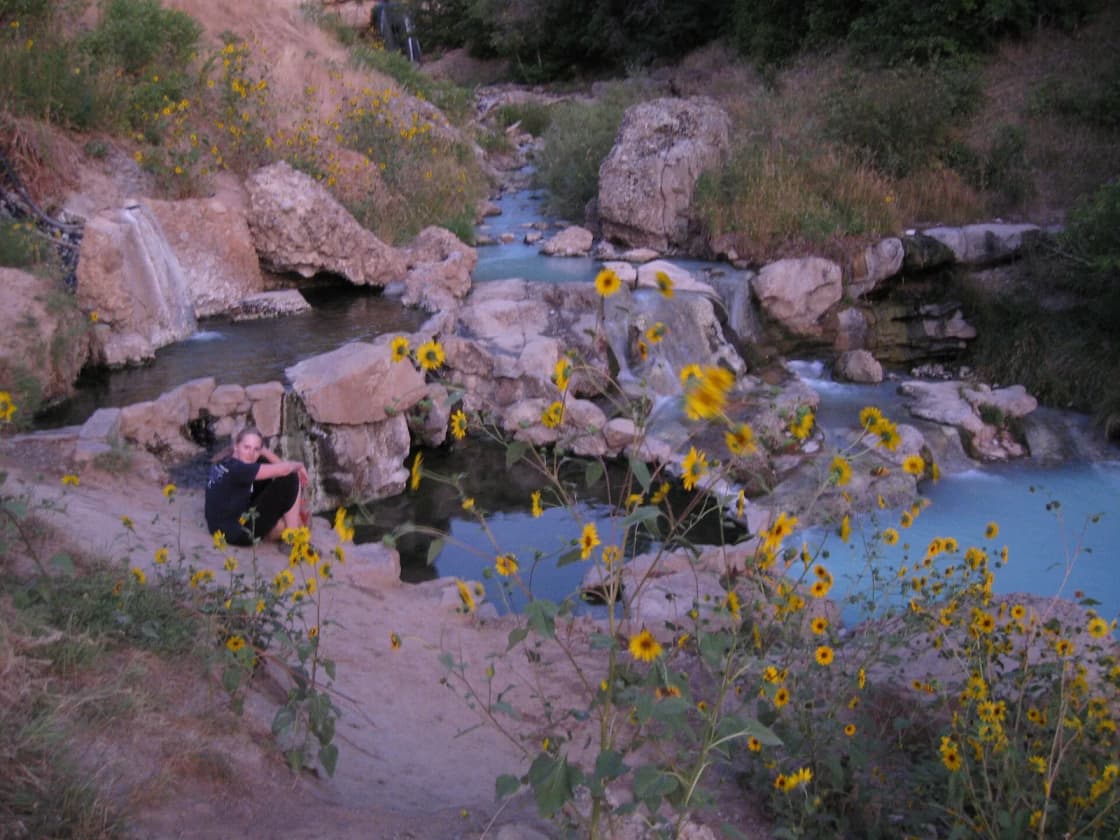
The most popular hot springs near Provo, and for good reason. Fifth Water sits at the end of a beautiful canyon hike through Diamond Fork Canyon, with a series of pools at different temperatures cascading down a hillside next to a waterfall. The pools vary in temperature, with cooler ones below where hot spring water mixes with the cold creek.
What to expect: The hike in is about 2.5 miles through a scenic canyon with several creek crossings (expect wet feet in spring). The trail is well-maintained but can be muddy and icy in winter. The pools are natural but have been reinforced with rocks over the years. On summer weekends, expect crowds, especially on Saturday afternoons. The Forest Service and Utah water-quality officials also warn that harmful bacteria may be present: don't dunk your head, keep the water out of your mouth, and don't let pets drink it.
When to go: Weekday mornings are the least crowded. Winter visits offer a magical experience — hiking through snow to soak in steaming pools — but require proper footwear (traction devices recommended) and awareness of avalanche conditions. Spring is peak runoff season, which can make creek crossings challenging.
Practical tips:
- Bring a towel, water shoes for the creek crossings, and a dry bag for your phone
- Pack out everything you bring in — this area has struggled with littering
- The parking area at the trailhead fills fast on weekends; arrive before 9 AM
- Dogs are allowed but must be on-leash
- No glass containers at the springs
Directions: From Provo, take I-15 south to Spanish Fork and US-6 east up Spanish Fork Canyon, then turn left on Diamond Fork Road (Forest Road 029) and drive about 11 miles to the Three Forks trailhead. A Forest Service day-use pass is required.
Meadow Hot Springs
Distance from Provo: ~90 minutes · Hike: None (drive-up) · Difficulty: Easy
A completely different experience from Fifth Water. Meadow Hot Springs consists of three crystal-clear pools on private ranch land that the owners have generously kept open to the public. The water is warm and remarkably clear, and you can see well down into the pools. The setting is flat, open rangeland — not a mountain canyon — which gives it a surreal, otherworldly quality.
What to expect: No hike required — you park and walk a few minutes to the pools. The main pool is large enough for 15–20 people comfortably. The second pool is smaller and slightly warmer. The third pool is cooler and less visited. The water visibility is stunning — on sunny days, the pools glow turquoise.
Practical tips:
- This is private land — respect the property. No camping, no fires, no glass, no littering
- There are no facilities (no bathrooms, no changing rooms)
- The road to the springs is dirt and can be rough — a higher-clearance vehicle is recommended
- Best visited spring through fall; winter access depends on road conditions
Directions: Take I-15 south to the Meadow/Kanosh exit, then follow local roads east. The springs are near the town of Meadow in Millard County. GPS coordinates are widely available online.
Homestead Crater (Midway)
Distance from Provo: ~45 minutes · Difficulty: None (commercial facility)
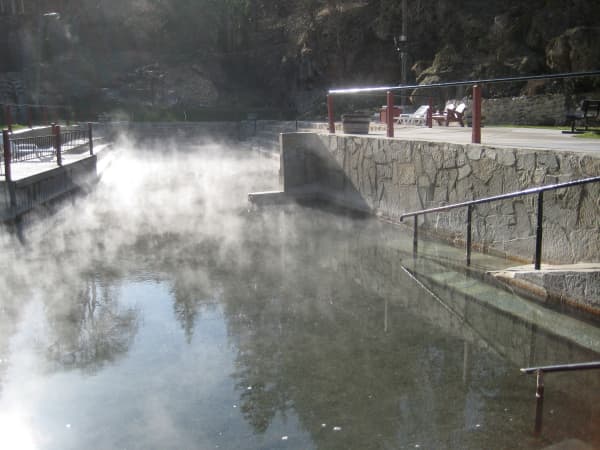
Not a backcountry experience — Homestead Crater is a commercial hot spring inside a limestone dome near Midway in the Heber Valley. The water stays warm year-round, and the dome creates an otherworldly atmosphere with light filtering through an opening at the top. You can swim, soak, snorkel, or even scuba dive inside the crater.
What to expect: This is a paid, managed facility with changing rooms, showers, and equipment rentals. Reservations are recommended, especially on weekends. The experience is less "wild hot spring" and more "unique indoor pool," but the geology of soaking inside a limestone cave is impressive. If you're making the drive, our Heber Valley & Midway guide covers everything else worth doing on the same trip.
Pricing: Varies by activity (soaking, snorkeling, scuba). Check the Homestead Resort website for current rates and reservations.
Best for: Families, date nights, anyone who wants the hot spring experience without the hiking or backcountry logistics.
Saratoga Hot Springs
Distance from Provo: ~25 minutes · Hike: None · Difficulty: Easy
The closest option to Provo, and the one most often described inaccurately.
Two different things share this name. The historic Saratoga resort pools, piped from the springs on the site of the old Beck's Saratoga Springs resort, sit inside a private development and are not open to the public. The springs people soak in are the undeveloped pools in the lakeside wetlands, reached on a short walk from the parking area at Inlet Park.
They are also not in Saratoga Springs. The city's own parks and trailheads listing describes the Saratoga Hot Springs as natural hot springs outside the city boundary and states that only the trailhead is within city limits — the pools sit roughly a quarter-mile south of Inlet Park.
What to expect: warm rather than hot, with pockets of hotter water; shallow; muddy underfoot; and a distinct sulfur smell. No facilities, no staff, no lifeguards. Bring a tarp for your belongings and a towel you do not mind. The setting is wetland and lakeshore rather than canyon — it is not a wilderness experience, but on a clear winter evening with snow on Timpanogos across the water it is a much better one than "suburban" suggests. Our guide to Saratoga Springs has the rest of the city, including how it came to be named after springs it does not contain.
What to expect: Free, no reservation needed. The water temperature is warm but not hot (around 90°F). The area can be crowded on warm evenings. Facilities are minimal.
Tips for Hot Spring Visits
Hydrate. Hot water dehydrates you faster than you'd expect. Bring water and drink it — especially if you've hiked to reach the springs.
Protect your valuables. Steam and water damage phones and electronics. Use waterproof cases or dry bags.
Leave no trace. Utah's hot springs face increasing pressure from overuse. Pack out all trash, don't bring glass, and leave the area cleaner than you found it.
Check conditions. Spring runoff can make creek crossings dangerous. Winter adds ice and avalanche risk on canyon trails. Check trail reports before heading out.
Respect the space. Hot springs are shared resources. Keep music on headphones, give others space, and be mindful of group size.
Which One Should You Actually Drive To?
The four springs in this guide are not variations on one trip. They differ on the axis that decides most Utah Valley outings — how much of the day the approach eats — and choosing well means being honest about which constraint you are under.
If the constraint is time, Saratoga is the only one that works as an evening trip. It is close enough to Provo to go after work and be home the same night, and the cost of that convenience is the setting: undeveloped wetland pools rather than a canyon.
If the constraint is effort, Meadow is the answer despite being the furthest south. The drive is long but it is interstate the whole way, and the walk from the parking area to the water is measured in minutes. A group with small children, older relatives, or anyone who does not want to hike gets more soaking time at Meadow than at Fifth Water, even accounting for the extra driving.
If the constraint is that you want the hike to be part of it, Fifth Water is the reason people talk about Utah hot springs at all. The trail follows a creek up a canyon and the pools arrive as a reward rather than a destination you park next to. Budget the whole day and treat the soak as the turnaround point.
If the constraint is certainty, Homestead Crater is the only one that can be booked. Everything else in this guide is subject to weather, road gates, crowding, and in Meadow's case a landowner's continuing permission. If the trip cannot fail — a visiting family, a birthday, a narrow window — the commercial option is the one that will still be there when you arrive.
The Access Problem Nobody Mentions Until They Are Parked
The single most common way a hot springs trip fails around here is not weather and not crowds. It is a closed gate.
Diamond Fork Canyon, the approach to Fifth Water, is a seasonal road. It closes for winter and the closure is not a fixed calendar date — it moves with conditions, and the canyon has more than one gate on the same road, which means "the road is open" and "the road is open all the way to the trailhead" are two different statements. People drive out from Provo, reach a gate, and turn around.
The durable advice is procedural rather than a date: check the current gate status the morning you go, not the week before, and check it for the specific trailhead rather than for the canyon in general. Our canyon and commute conditions page tracks this because it is the recurring failure for Diamond Fork specifically.
Meadow has the opposite profile. It is reachable in winter because it sits in open desert a few miles off I-15 with no mountain road involved. Its access risk is not seasonal — it is the dirt road at the end, which degrades badly after rain, and the landowner's permission, which is not a permanent condition.
What Private Land Actually Means Here
Meadow Hot Springs is the most-visited spring in this guide and the least secure. It is private property. The owners have historically allowed public access, the site has been improved with fencing and a graded path, and visitor accounts increasingly describe a donation box near the entrance.
That arrangement has been suspended before. Reports from previous years describe fencing dismantled for firewood, vehicles driven across wet ground, and trash left in an area with no facilities and no staff. This is the mechanism by which a free thing stops being available: not a policy change, but an owner deciding it is no longer worth it.
Two practical consequences. First, contribute if there is a box — the running cost of maintaining a path, a fence, and a parking area for thousands of strangers is real and it is being paid by someone. Second, treat posted signs as the actual rules rather than as suggestions that a guide article can override. Anything written here, including directions, is less current than a sign at the gate.
The same logic applies in weaker form everywhere else in this guide. Fifth Water's pools have been repeatedly rebuilt by visitors and repeatedly damaged; land managers have closed Utah springs before when the maintenance burden outgrew the benefit.
Getting the Practical Details Right
Bring more water than you think. Soaking is dehydrating, the elevation is working against you, and neither Fifth Water nor Meadow has a tap. This is the most common minor mistake at all four.
Bring a way to carry wet things out. No facilities means no bins and no changing rooms. A dry bag or a spare grocery sack for a wet suit and towel is the difference between a comfortable drive home and a wet car seat.
Footwear matters more than swimwear. Mineral deposits are slick, creek crossings at Fifth Water are rocky, and Meadow's approach turns to mud after rain. Sandals that stay on your feet beat anything that floats away.
No glass, anywhere. It is the one universal rule at Utah springs and the one most often broken. Broken glass in a pool people enter barefoot is how a spring gets closed.
Go early or go late, not midday. The parking areas at both Fifth Water and Meadow are the limiting factor on busy weekends, and neither has overflow.
Cell service is inconsistent. Meadow's open desert setting generally has coverage from the parking area; Diamond Fork canyon does not reliably. Download directions before you leave the valley and tell someone your plan.
A Note on the Numbers in This Guide
Drive times, pool temperatures and trail distances are the details most likely to be wrong by the time you read them, and they are wrong in a specific direction: they get copied between guides without anyone re-checking the source.
Distances here are round-trip from Provo and assume the direct route in ordinary conditions, which is the number that stops being true first — a canyon closure does not lengthen the drive, it ends it. Temperatures at natural springs are not regulated by anything; they move with flow, season and how much cold creek water is mixing in that week. Trail mileage for Fifth Water is quoted between roughly 4.5 and 5 miles round trip across reputable sources, a spread that comes from where people start counting rather than from disagreement about the trail.
None of that makes the figures useless. It means the ordering is more durable than the values: Saratoga is closest, Fifth Water is the real hike, Meadow is the long drive with the short walk, and Homestead is the one you book. That ranking has held for years and will outlast any specific number on this page.
Nobody is going to warn you, and that is the law rather than an oversight
The access section above explains who owns what. This one explains why none of these places has a sign telling you the water can scald, and why that absence is not negligence.
Utah Code § 57-14-201 provides that an owner of land owes no duty of care to keep the land safe for anyone using it for a recreational purpose and no duty to give warning of a dangerous condition, use, structure, or activity on the land. The no-warning half is stated as its own obligation and then removed. It is not an inference from the no-duty half.
The chapter reaches these springs by two routes. Utah Code § 57-14-102 defines "land" to include water and water courses, and lists swimming, hiking and the viewing or enjoying of scenic or scientific sites among the recreational purposes. It also defines "owner" broadly enough to catch every arrangement you will encounter here — the possessor of any interest in the land, public or private, including a tenant, lessee, occupant or person in control. A federal agency, a ranch, and whoever holds the grazing lease are all owners for this purpose. Utah Code § 57-14-101 confirms the chapter was written for public and private owners alike.
So the undeveloped springs on this page are, legally, places where the person who owns the ground owes you nothing and is not required to tell you anything. The water temperature varies with the source and the season, the footing is bad in the obvious places and worse in the non-obvious ones, and there is no mechanism in Utah law that obliges anyone to post that.
Where the protection stops
Three limits, all in the same chapter, and each one changes what you should expect at a different kind of site.
Charging. Utah Code § 57-14-202 keeps the immunity only for owners who permit use without charge, or for a nominal fee of no more than one dollar a year, and Utah Code § 57-14-204 removes it where the owner charges a person to enter or use the land. A developed, paid facility is therefore in an entirely different legal position from a roadside seep. That is the sharpest practical distinction on this page: the places that take your money are the places that owe you a duty of care.
Willful or malicious conduct. The same section preserves liability for a willful or malicious failure to guard or warn against a dangerous condition and for deliberate injury to persons or property. Ordinary negligence is immunized; a deliberately concealed hazard is not.
Your own carelessness. Utah Code § 57-14-205 states that the chapter cannot be read to relieve a person using another's land from any duty they would otherwise have to exercise care, or from the consequences of not doing so. Soaking is entirely your risk to manage.
The number at the end of it
Where a claim does survive all of that, Utah Code § 57-14-501 caps noneconomic damages against a landowner at four hundred and fifty thousand dollars for actions arising on or after 14 May 2019. The cap does not reach punitive damages, wrongful-death claims, or the willful-conduct and paid-access liabilities preserved by Utah Code § 57-14-204.
Read together, the chapter is a deliberate policy choice: Utah decided that open access to wild water was worth more than a private right to sue over it. Whether that is the right trade is a question for the Legislature. On the ground it means the sign you are looking for does not exist and is not coming.
Related Guides
- The Complete Provo Hiking Guide
- Day Trips from Provo
- Best Date Ideas in Provo
- Winter Activities in Provo
- Summer Activities in Provo
- Bear Lake from Provo: Turquoise Water, Raspberry Shakes, Real Distance
- The Heber Creeper: A Complete Guide to the Heber Valley Railroad
- Camping Near Provo: Best Campgrounds & Tips (2026)
- Park City from Provo: The Year-Round Day Trip Guide
- Logan and Cache Valley from Provo: The Other College Valley
- Canyon & commute conditions — Diamond Fork has two gates on one road, closing at different times
- Rockhounding from Utah Valley: Topaz, Geodes, Trilobites and the 25-Pound Rule
- Spanish Fork Canyon: Diamond Fork, Sheep Creek and the Thistle Site
- Lava Hot Springs From Provo
Last updated: August 2026. Access, conditions, and policies change — verify before visiting, especially for hot springs on private land.
Frequently Asked Questions
Where are the closest hot springs to Provo?
How do I get to Fifth Water Hot Springs?
Are hot springs near Provo free?
What is the best time of year to visit hot springs near Provo?
Can you soak in a swimsuit, or is it clothing optional?
Are the hot springs near Provo safe for kids?
How hot is the water, and how long should you stay in?
Can you visit hot springs near Provo in winter?
Sources
The facts in this guide were checked against these sources. Hours, fees and rules change, so confirm anything time-sensitive with the source before you go. How we make Provo.com.
- Three Forks Trailhead, USDA Forest Service, Uinta-Wasatch-Cache National Forest. Checked October 12, 2026.
- Fifth Water Trail #015, USDA Forest Service, Uinta-Wasatch-Cache National Forest. Checked October 12, 2026.
- Diamond, Uinta-Wasatch-Cache National Forest, Recreation.gov (USDA Forest Service). Checked October 12, 2026.
- Utah Code 57-14-501: Limitation of award of noneconomic damages, Utah State Legislature. Checked October 12, 2026.
- Utah Code 57-14-201: Owner owes no duty of care, Utah State Legislature. Checked October 12, 2026.
- Utah Code 57-14-204: Liability not limited where willful or malicious conduct involved or admission fee charged, Utah State Legislature. Checked October 12, 2026.
- Fifth Water Hot Springs Trail, AllTrails. Checked October 12, 2026.