
Provo is one of the most convenient climbing cities in the United States, and the reason is geography rather than culture. The Wasatch Range ends abruptly at the eastern edge of town, so the rock does not require a road trip — it requires a ten-minute drive and a short walk. Rock Canyon opens directly onto the bench. American Fork Canyon, one of the most historically important sport-climbing areas in the country, is half an hour north. And in winter the same canyons that hold the rock hold the ice.
That last part is the piece most guides leave out.
The season, in one paragraph
Rock climbing here runs roughly March through November, with spring and fall the best of it. Midsummer is not off the table, but it moves to shaded walls and early starts. Winter belongs to two things: the gyms, and ice. Aspect matters more than the month — a wall that catches morning shade is climbable in July, and a sunny wall may be fine in February. Wet limestone and wet quartzite are both dangerously slick, and thunderstorms in a narrow canyon are a serious hazard rather than an inconvenience.
Outdoor rock
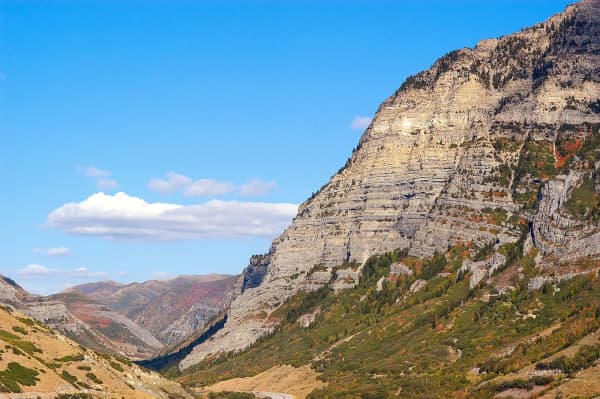
Rock Canyon
Approach: 10 minutes from downtown Provo, then a walk of minutes to an hour · Rock: quartzite and limestone · Grades: roughly 5.5 to 5.13
The canyon is the reason Provo has a climbing culture at all. It spills straight into the bench neighborhoods, all parking sits at the mouth, and a large number of popular routes are within about ten minutes' walk of the lot.
A correction worth making here: this page previously described Rock Canyon as a limestone crag. It is quartzite and limestone both, which is what our own Rock Canyon trail guide has said all along. The mixed geology is not trivia — it is why the friction, the hold shapes and the route character change so much between walls a few hundred meters apart.
On route counts, we are going to disagree with ourselves in public. Published figures for Rock Canyon range from over 200 to over 500, and at least one source claims the canyon holds the longest sport climbs in Utah at twenty-plus pitches. Those numbers are not reconcilable from outside, because sources draw the canyon's boundary differently and count trad and sport lines differently. Use Mountain Project for what is bolted and where, and treat any single total, including ours, as an approximation.
Where people start. The first significant wall you meet walking in is the one usually called the Red Slab, a well-bolted beginner-to-intermediate area in roughly the 5.6 to 5.10 range, and a good place to learn to lead without the difficulty of the terrain fighting you. Directly behind it sits another large outcrop, and the canyon keeps going: there are routes on both sides, which means you can chase shade or sun as the day demands. Walls higher in the canyon carry longer approaches and thinner crowds. Some of the longest sport routes in the canyon sit at mid-canyon walls that come into shade in the afternoon.
The same trailhead carries the canyon's hikers and runners, and it is busy. Our running routes guide rates the lower canyon as runnable and the upper canyon as hiking-paced, which is a fair description of the approach as well.
American Fork Canyon
Approach: about 30 minutes north · Rock: limestone · Grades: 5.6 through the 5.14s
If Rock Canyon is where Provo learns, American Fork is where the sport got serious. The climbs sit within minutes of gravel pullouts along the Alpine Loop Scenic Byway (SR-92), on a roughly seven-mile band of Forest Service land that begins a short distance past the Timpanogos Cave National Monument visitor center. Our American Fork Canyon guide covers access, fees and the rest of the canyon.
The advantage fact on this page is the history, and it starts in Provo. In the mid-1980s the received wisdom was that Utah limestone was too crumbly to hold hard routes. Climbing magazine's account of the era credits Jeff Pedersen and Boone Speed with pushing against that, and it places their earliest first-ascent efforts in Rock Canyon in 1986 — inventing contrived lines on toprope between the natural ones, because what they wanted to climb did not exist yet. That work moved up the road to American Fork, where radically overhanging limestone was bolted at a time when the global template for sport climbing was still the smooth vertical faces of France's Verdon Gorge. American Fork is one of the places where American steep-rock climbing, and the acceptance of imperfect stone, began.
The rock itself is older than the argument by some margin: the limestone formed in a shallow inland sea during the Mississippian, on the order of 340 million years ago.
Two walls worth knowing by name, because they show how different one canyon can be with itself. The wall commonly called Cool World, a few hundred feet past the second stream crossing on the east face of a large outcrop running down to the streambed, carries only a handful of routes but includes a multi-pitch line on good limestone and some of the longest sport climbing in the canyon; it comes into shade in the afternoon, which makes it a late-day wall. The AC/DC Wall, approached past the water tank and up a gully, looks chossier and climbs better than it looks, with roofs, overhangs and multi-pitch terrain.
Provo Canyon rock
Provo Canyon has scattered limestone sport routes, generally quieter than Rock Canyon and worth exploring if you already know what you are doing. But rock is not what Provo Canyon is known for.
Bouldering outdoors
The lower sections of Rock Canyon hold a spread of boulder problems from beginner grades up into the V8-plus range, with approaches short enough that bouldering here is a casual after-work activity rather than an expedition. Bring a crash pad and a spotter — the landings are natural ground, not gym flooring, and a bad landing on talus does not care how easy the problem was.
Bouldering is also the cheapest possible entry to outdoor climbing. There is no rope, no anchor, no belay partner, and no system to get wrong. The equipment is shoes, chalk, a pad, and someone paying attention.
Two practical notes. The canyon shares its floor with hikers, trail runners, dogs and mountain bikers, and the popular problems sit close to the main path — set pads where they will not become a trip hazard. And autumn is the season worth planning for: the maples in the lower canyon turn deep red against pale rock, which is why our photography spots guide sends people up here in October. Cool rock and good friction happen to arrive at the same time.
Ice climbing in Provo Canyon
Almost every guide to climbing near Provo stops at the rock, which leaves out the season this canyon is known for among climbers who travel.
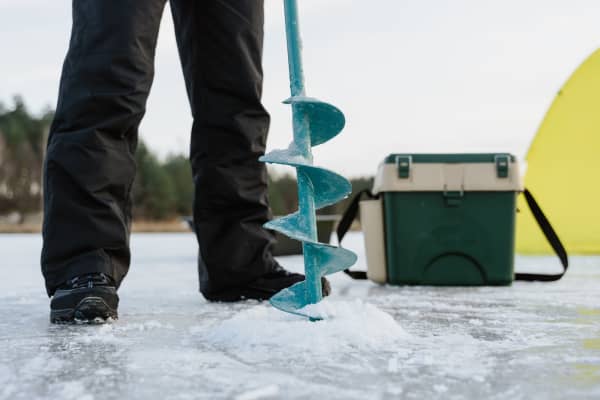
Provo Canyon holds the highest concentration of ice in the Salt Lake and Utah County area. Most of the thickest routes are on the shaded south side of the canyon. The two centers of activity are the Bridal Veil Falls area and the formation immediately down-canyon from it called Stairway to Heaven, both accessed from Nunn's Park. Our Bridal Veil Falls guide covers the falls in their summer form.
Stairway to Heaven is the marquee line: a multi-pitch route of 800 feet or more, graded around WI5, with as many as ten pitches of climbing when everything is in. The upper pitches do not always form. Mixed variations to either side push into M-grade terrain.
The Apron, the first pitch, is the part most people meet. It forms reliably at a moderate grade, runs about 190 feet, and has fixed anchors on a large boulder above it, which makes it one of the region's standard beginner top-rope venues. Provo Canyon's own park literature describes it exactly that way.
Two safety points that are specific rather than generic:
- The ledge above the first pitch is loose. There is significant rockfall hazard rappelling from those anchors when there is no snow holding the rock in place. This is a documented, named hazard rather than a general caution.
- This terrain kills experienced, helmeted climbers. In one widely reported incident an ice climber fell roughly 200 feet to his death from the upper tier of Stairway to Heaven while wearing safety gear including a helmet. The route's easy roadside access is exactly what makes it easy to underestimate.
Other named lines in the area include All Is Quiet, White Nightmare, and Upper Bridal Veil Falls, with more in the gullies above the upper falls parking area.
On first ascents and dates: local park literature credits the first ascent of Stairway to Heaven to Jim Knight and Mike Ward in 1975, sourced onward from a secondary account. We have not been able to confirm that against a primary source, so treat it as reported rather than established.
Conditions are the whole game. Ice forms and fails on a timescale of days. Nothing on this page tells you whether a route is in — that comes from current conditions reports and from looking at it. Our winter activities guide covers the rest of the season.
Indoor climbing
The Quarry Indoor Climbing Center
2494 N University Parkway, Provo
Provo's dedicated climbing gym, open since September 2000 and built by climbers rather than converted from something else. By the gym's own description it holds nearly 13,000 square feet of wall, an inventory of more than 125 top-rope and lead routes from 5.4 to 5.13, top-rope walls of 32 feet, a 42-foot lead wall with routes running as long as 55 feet, and six crack features — five splitters and one variable — which is unusual for a gym this size and useful practice for desert climbing. The entire upstairs is bouldering, on 14-foot walls, with problems from V0 to V13. There is a kids' area.
Routes are reset on a rolling basis. It gets crowded at peak times, which is what happens when a college town of this size has one dedicated gym.
The Project, at UVU
800 W University Parkway, Orem
UVU's climbing wall, run by the university's Outdoor Adventure Center: 16 ropes and more than 50 routes in the 5.5 to 5.12-plus range, with instruction from intro clinics up to lead certification.
The part worth knowing is the access model. It is free to UVU students carrying ten or more credit hours and to anyone with a paid Student Life and Wellness Center membership — and community members can buy a guest day pass. Gear rental is priced at a few dollars per item. If you are a UVU student, you have a rope gym included in something you already pay for, and a surprising number of students do not know it.
Our date night ideas guide has named The Project for a while. This page had not, which is the sort of gap a site notices only when it re-reads itself.
Recreation center walls
The Provo Recreation Center (320 W 500 N) has a climbing wall as part of a much larger facility, and Orem's recreation department runs graded bouldering classes from a genuine beginner level upward. Neither is a substitute for a dedicated gym, but both are inexpensive ways to find out whether you like this before buying anything.
The Sunday problem
Every indoor climbing option in Utah Valley is closed on Sunday. The Quarry, the Provo Recreation Center, UVU's wall and the local gear shops all post Sunday closures. On the one day of the week many people are free, the indoor option is not there — so Sunday is an outdoor day or a rest day, and that is worth planning around rather than discovering at a locked door. The same pattern runs through much of the valley; our guide to what is open on Sunday in Provo explains the mechanism.
Posted hours also drift. Check before you drive.
Getting started
If you have never climbed
Start indoors, and start bouldering. No rope, no partner, no experience — shoes and a willingness to fall a short distance onto a pad. Problems are marked by difficulty starting at V0, and most people know within one session whether this is going to be a hobby.
Take a class rather than watching videos. The Quarry runs beginner and lead-certification courses; UVU's Outdoor Adventure Center runs clinics that cover belaying, clipping and rope management. A few hours of instruction removes months of bad habits and one or two dangerous ones.
Find partners before you need them. Roped climbing requires a belayer. University clubs, gym community boards and local climbing groups are where partnerships form. Showing up alone and regularly works better than posting once.
Gear, in order of what matters
Shoes first. Rentals are fine for the first few sessions. Your own pair, even an entry-level one, changes the experience more than any other purchase.
A chalk bag is the cheapest thing you will buy and you will notice it immediately.
A rope system — rope, quickdraws, harness, belay device, helmet — is a real investment. Split it with a partner, or rent through UVU's Outdoor Adventure Center before committing.
Buy locally. This guide used to send readers to Salt Lake for a fitting, which is a strange thing for a Provo guide to do. Out N Back at 418 N State Street in Orem has been the valley's outdoor shop for decades. UVU's Outdoor Adventure Center rents. Both are closer than the freeway drive north.
Ice gear is a separate conversation. Tools, crampons, screws and the judgment to use them are not an extension of a sport-climbing rack. Ice is a discipline you enter through instruction and mentorship, not through a gear list.
Safety
Climbing carries real and unforgiving risk. The essentials, in the order they get people hurt here:
- Wear a helmet outdoors, always. Rockfall is a genuine hazard in these canyons, on both the limestone and the quartzite, and it does not care what grade you are climbing.
- Check knots and belay setup every single time. Complacency, not difficulty, is the pattern in accident reports.
- Loose rock above a route is everyone's problem. In Rock Canyon and above the ice, parties are frequently stacked. Look up and communicate.
- Wet rock is a different surface. Both quartzite and limestone become slick when wet, and limestone stays weak for a while after saturation.
- Weather in a narrow canyon escalates fast. Lightning is life-threatening, and afternoon storms are routine in summer.
- Ice is conditions-dependent in a way rock is not. A route that was in yesterday may not be today. Never take an ice route's grade as a fixed property.
Related guides
- Rock Canyon Trail Guide
- Bridal Veil Falls
- American Fork Canyon
- The Complete Provo Hiking Guide
- Winter Activities in Provo
- Indoor Activities in Provo
- Mountain Biking Near Provo
- The New Provo Temple, Explained: The Rock Canyon Rebuild
- The Utah Valley Marathon: The Runner's Guide and the Spectator's Guide — Wallsburg to the Courthouse, the 1,444-Foot Drop, the Shuttle, the Canyon Closure and the First Saturday of June (2027)
- Jolley's Ranch: Camping in Hobble Creek Canyon, Twenty Minutes from Provo
- Hobble Creek Canyon: The Name Springville Gave Away
- Slate Canyon: South Provo's Quiet Canyon, and the Fight Over Its Mouth
- Utah Valley Hike Finder — filter every trail by difficulty, length, season, dogs and fees
Last updated: August 2026. Route counts, grades and conditions change; Mountain Project and current conditions reports are the live sources. No prices are quoted here because gym rates and pass structures change faster than this page does.
Frequently Asked Questions
Is Provo good for rock climbing?
What kind of rock is Rock Canyon?
How many climbing routes are in Rock Canyon?
Where can I go indoor climbing in Provo?
Can you ice climb near Provo?
Is Rock Canyon good for beginner climbers?
When is climbing season in Utah Valley?
Where do I buy or rent climbing gear in Utah Valley?
Sources
The facts in this guide were checked against these sources. Hours, fees and rules change, so confirm anything time-sensitive with the source before you go. How we make Provo.com.
- Alpine Scenic Loop Backway, USDA Forest Service. Checked October 12, 2026.
- The Quarry. Checked October 12, 2026.