
More on Provo: every guide we have published there, in one place.
Almost every guide to Mexican food in Provo — including, until this update, this one — tells you the good stuff is in South Provo. It is a tidy story and it does not survive an address check. The single most-recommended taqueria in the city sits at 150 W 1230 North, which is Bulldog Boulevard, minutes from BYU campus and about as far north as Provo's grid runs before it reaches the Riverwoods. The second-most-recommended one is a block away. A third sits well up University Parkway toward the Orem line.
Provo has two Mexican food neighborhoods, and treating them as one is why people drive to the wrong end of town.
The two clusters
The Bulldog Boulevard cluster runs along 1230 North between the freeway and the university. This is where the street-taco kitchens are — small rooms, corn tortillas, a self-serve condiment bar, and a meat list that runs well past carne asada. It is not a neighborhood most visitors associate with Mexican food, because the surrounding blocks are student apartments and drive-throughs, and the taquerias occupy strip-mall units you would drive past without looking. That is a large part of why they are still good value.
The Center Street and Freedom Boulevard cluster is the older one. It runs from the west end of downtown out along Freedom Boulevard — which Provo's own municipal documents identify as 200 West — and it holds the sit-down restaurants and the Central American kitchens. These are rooms with dining tables, full menus, combination plates and, in one case, a liquor license.
The two clusters answer different questions. If you want four tacos and to be eating within six minutes, go north. If you want to sit down with a group and work through a plate of enchiladas, go west. The reason this distinction matters more here than it would in a larger city is that Provo's street grid makes the two ends feel adjacent on a map and about fifteen minutes apart in a car at the wrong time of day.
The northern cluster
Street Tacos Don Joaquin
Street tacos · 150 W 1230 N
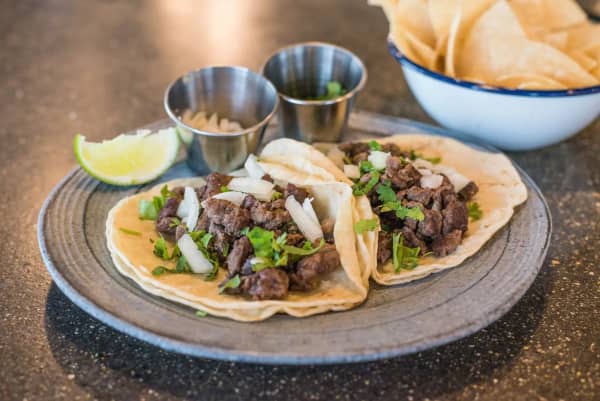
The default answer, and it earns it. The meat list is the tell: alongside asada and pollo asado you can order lengua, cabeza, tripa, suadero, chorizo and campechano. A kitchen that stocks beef tongue and tripe is cooking for a clientele that expects them, and that is a more reliable signal than any review score. The condiment setup is self-serve — onion, cilantro, radish, lime, several salsas — which is the second tell.
Two things about it that almost no listing mentions. First, it posts seven-day hours and runs late, in a city where the Sunday and late-night restaurant map is short; its own social account advertises menudo on Sundays, which is the traditional slot for it. Second, there is a second Don Joaquin location in Lindon, and delivery-platform reviewers are unusually blunt that the two are not interchangeable — more than one specifies ordering from the Provo store. Treat that as anecdote rather than fact, but it is worth knowing before assuming that a shared name means a shared kitchen.
The business is named for its founder, described in its own delivery-platform biography as a Querétaro native who came to the United States intending to cook the food he grew up with.
One Hundred Eighty Street Tacos
Street tacos · 3368 N University Ave
⚠ It has moved, and this guide previously had it on the wrong street. The restaurant's own site now gives 3368 North University Avenue, well north of campus; the Bulldog Boulevard address this guide carried (227 W 1230 N) reads as closed on the review platforms. The operator's own domain is the source here, which outranks the aggregators that still publish the old one.
That move costs this guide an argument it used to make. Two taquerias within a block of each other on Bulldog Boulevard was the cleanest evidence available that the street is Provo's taco corridor — one taqueria is a business, two within sight of each other is a market. That pair no longer exists. Don Joaquin still anchors Bulldog on its own, and the corridor claim now rests on one restaurant rather than two, which is a weaker claim and is stated as such.
What moved with them is the cooking, which was never conventional: the menu runs fusion rather than traditional, with Korean and Buffalo-chicken tacos alongside al pastor and carnitas. It is closed Sunday.
Brasas Mexican Grill
Grilled meats and tacos · 2448 N University Pkwy
Read the address twice, because this is the entry this guide previously had most wrong. Brasas is well up University Parkway toward the Orem line, not downtown. The distinction is practical rather than pedantic: this is a drive, not a walk from Center Street, and a guide that recommends it as a quick stop before a downtown evening — as this one previously did — is sending you a couple of miles in the wrong direction.
The kitchen's own claim is that the steak and chicken go over a wood flame rather than a flat-top, and the specialty tacos are built around that. A 2016 BYU student-newspaper profile records the business opening in February 2015 under Veronica and Eliezer Coca, who had planned to run a food truck and took a restaurant unit instead, and describes a late-afternoon two-for-one taco window. Promotions come and go. The origin story is the durable part, and it is a familiar Utah Valley shape: the truck that became a building.
⚠ Its address is contested, and this guide still does not resolve it — but it can now say more about why. There are two different phone numbers in circulation under this one name. One (801-375-0240) attaches to both 2448 N University Parkway and a downtown address at 238 W 100 S. The other (801-377-2565) attaches to a Cougar Boulevard address — Cougar, Bulldog and 1230 North being the same street under three names — and a review platform lists that one as closed. One customer review refers to "both Provo locations," which would make this two restaurants rather than one that moved. The downtown listing carries customer photographs uploaded in 2026; the University Parkway listing is the one a 2024 review says the business had already left. A regional tourism listing describes it as "just off Center Street," which fits the 100 South address and is almost certainly the origin of the downtown claim that has propagated through local guides including ours. Call before you drive.
What is not in doubt is the city. Every version of this address is in Provo, not Orem — this guide and our directory both previously implied otherwise, and the directory has been corrected. University Parkway runs toward the Orem line without crossing it here, and the zip codes on every listing are Provo's.
Taco Paraiso
Family-run Mexican · 279 E 300 South
⚠ Two corrections here, and the first is ours. This guide previously printed 300 North. Every listing that carries this business — including its own ordering page — gives 279 East 300 South, in the 84606 zip, which is south-east of the downtown core rather than north-east of it. A single letter put this restaurant most of a mile from where it is.
Second: we cannot currently confirm it is open. Two platforms mark it closed, one of them "permanently," while its own ordering page still shows it trading. We are not calling it closed on that evidence — aggregators mark live restaurants dead all the time, which is the whole reason this site refuses to publish hours — but we are not going to send you there without saying so. Call first.
A Provo business with a local origin that this site had never once mentioned across any of its guides. Per the same student-newspaper reporting, Taco Paraiso was started by Everardo and Moroni Zavala, a father and son who sold at the Provo Farmers Market from 2007 before taking a permanent address, cooking family recipes carried from Michoacán.
That makes at least the second Provo food business the farmers market has produced, and the pattern is worth noticing: the market is not only a Saturday outing, it is the cheapest commercial kitchen in the city to test a recipe in front of strangers.
The Center Street and Freedom Boulevard cluster
Joe Vera's Mexican Restaurant
Sit-down Mexican · 201 W Center St
Provo's long-running Mexican dining room, on the west end of Center Street. The W in that address is not optional — dropping it, as this guide previously did, puts you several blocks east of the restaurant on the wrong side of the grid origin. The operator brands it "Joe Vera's Mexican Fiestaurant," which is worth knowing when a search for the plainer name returns nothing.
It is the wrong place to look for a taqueria experience and the right place for the other thing entirely: enchiladas, chile rellenos, tamales and combination plates, large portions, a private room for groups, and a dining room that will seat a family of nine without an ordeal. It holds a liquor license, which in this city is unusual enough to be a planning fact rather than a footnote. It is closed on Sunday.
Our Center Street dining guide covers it alongside the rest of that half-mile strip and is the better page if you are choosing among several downtown restaurants rather than specifically wanting Mexican food.
El Mexsal
Salvadoran and Mexican · 325 S 200 W
Salvadoran and Mexican on one menu, which in practice means pupusas and tacos in the same sitting. The pupusas are the reason to come — thick masa rounds filled before they hit the griddle, served with curtido, the fermented cabbage relish that does the job a salsa does elsewhere. Small room, short menu, and a category of food Utah Valley barely has.
El Salvador Restaurant
Salvadoran and Mexican · 332 W Center St
The second of the two, further west on Center Street, and the pairing is the point: Provo has two Salvadoran kitchens and they are a short walk apart. Handmade pupusas, and tamales in the Salvadoran style — wrapped in plantain leaf rather than corn husk, softer and differently seasoned, and a different dish from its Mexican namesake rather than a regional variation on it. If you have eaten exactly one pupusa in your life, eating the second one somewhere else is how you find out what varies.
Blue Poblano
Modern Mexican · 1796 N 950 W
Newly listed here, and it arrives by way of a correction rather than a discovery. This address was Mountain West Burrito, which several platforms now list as permanently closed. The same address and phone number are used by Blue Poblano, which regional food coverage identifies as part of the group behind Black Sheep Cafe downtown, with a menu from the same executive chef and a modern treatment of traditional tacos.
Because the closure of the previous tenant is better documented than the current tenant's present-day hours, treat this as a call-ahead rather than a walk-in until you have confirmed it once yourself.
⚠ That caution has since hardened. A review platform now marks Blue Poblano itself as closed, and we can find no coverage, review or photograph of it dated later than 2019 — the year the Provo location opened. If that holds, this address has now lost two kitchens in a row, which is worth knowing before you plan around the third. We are not recording it as closed without better evidence than an aggregator badge. Call first.
The chains, and the lawsuit nobody mentions
Provo's fast-casual Mexican options skew local rather than national, and the two that dominate are both Utah companies with a shared history that is more interesting than either menu.
Cafe Rio opened its first restaurant in St. George in 1997, founded by Steve and Patricia Stanley, with a menu the company describes as drawn from the Rio Grande region of northern Mexico, southern Texas and New Mexico. It was still a six-restaurant chain when the Stanleys sold it in December 2004 to a group including Bob Nilsen, a former president of Burger King. It has since passed a hundred and fifty locations across roughly a dozen states.
Costa Vida opened in Layton in 2003, founded by Kenny Prestwich and JD Gardner, with a coastal theme against Cafe Rio's rustic one.
The two are similar enough that Utahns argue about them, and the folk explanation — that they were once one restaurant and split after a falling-out — is the version most people here will tell you. The documented version is different. Per reporting in Utah student press and subsequent trade coverage, a general manager of a Cafe Rio location in the Salt Lake Valley was terminated in 2001 and signed a confidentiality agreement, then went to work for the newer chain after it launched. Cafe Rio sued in 2005, alleging the recipes, the layout and the décor had been copied down to the frequent-diner cards. It was settled out of court for an undisclosed sum, which means nothing was ever proven in front of a judge — worth stating plainly, because the internet tends to report the complaint as though it were a verdict.
One more detail worth carrying: the sweet pork barbacoa that Utah customers order by default is not the national pattern. Company-side reporting has repeatedly noted that East Coast locations sell more chicken than pork — a regional preference strong enough that the dish most Provo residents think of as the point of the restaurant is a local habit rather than a universal one.
None of this makes the chains taquerias, and comparing them to the Bulldog Boulevard rooms is not especially useful. A fast-casual burrito is engineered for consistency across a hundred and fifty stores; a taqueria is one kitchen cooking a short menu for people who will come back next week and notice if anything changed. Order whichever answers the meal you want.
Sunday, and the pour rule
Two constraints shape eating out in Provo more than anything printed on a menu, and Mexican restaurants sit in the middle of both.
Sunday. A large share of the sit-down restaurant scene closes, and the pattern is not brand-level — it is store-level, and it differs between two branches of the same business ten miles apart. Joe Vera's is closed Sunday. Don Joaquin posts seven-day hours. Our guide to restaurants open on Sunday in Provo exists precisely because this is the question that ruins the most plans here, and the honest instruction is to confirm the specific location rather than trust a brand-level statement anywhere — including on this page.
The margarita. If you want one with dinner, the mechanics are worth knowing before you sit down. Utah Code 32B-5-304 caps a primary spirit at 1.5 ounces per drink, dispensed through a calibrated metered system rather than free-poured, and a patron may have no more than 2.5 ounces of spirituous liquor in front of them at any one time. Under a restaurant license, alcohol is served alongside a food order rather than on its own, and drinks come one at a time — pitchers of margaritas are not a thing here. None of this is discretionary for the restaurant and none of it is a judgment about you. Our happy hour and drinks guide and the Provo nightlife guide cover the licensing landscape in full.
The practical version: most of the best Mexican food in this city is served in rooms with no alcohol at all, and the places that do serve it are working inside a tighter specification than the one your margarita was built to in Phoenix.
What Provo does not have
Worth saying plainly, because the gaps are as useful as the picks and no competing guide names them.
There is no dedicated mariscos restaurant in the city. The Sinaloan seafood tradition — aguachile, ceviche tostadas, camarones a la diabla — is thin across Utah Valley generally and absent inside Provo, which is a real gap in a city this size.
There is no full panadería inside Provo city limits, so a pan dulce run means driving. Our grocery guide covers the Latin markets that carry some of the same shelf.
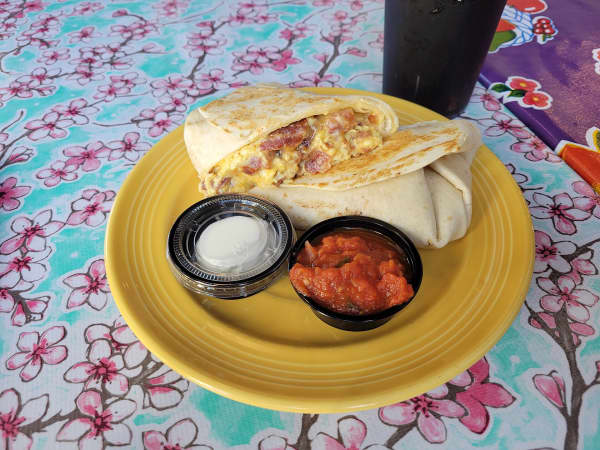
And there is no Mexican breakfast specialist. Chilaquiles and huevos rancheros turn up as line items on general menus rather than as the reason a restaurant exists, which means the one meal Mexico is arguably best at is the one this city has least of.
For the wider county picture — including the upscale end, which Provo does not have — our Mexican restaurants in Utah Valley guide covers Sol Agave in American Fork, Oteo in Pleasant Grove and Los 2 Potrillos in Spanish Fork.
The Delivery Problem With the Best Mexican Food Here
There is an awkward relationship between Mexican food in Utah Valley and delivery, and it is worth stating plainly: the places most worth eating from are frequently the hardest to get delivered.
The taquerias and trucks that anchor this scene tend to be small operations run on thin margins. Signing onto a delivery platform means handing over a meaningful share of each ticket, and for a kitchen already pricing at four dollars a taco, that share is not available. So the platform list skews toward larger operations and chains, and the result is that ordering Mexican food through an app in this valley gets you a systematically different and usually worse selection than driving.
There is also a food-physics problem. Tacos are assembled to be eaten within about a minute. Tortillas absorb moisture, salsa breaks down the shell, and crema separates. Anything served with a crisp element loses it. A taco that was excellent when it left is merely acceptable when it arrives, and that gap is larger here than for almost any other cuisine.
What does travel: burritos, which are engineered for transport and hold together for a long time; anything braised, where the sauce is the point; tamales; and rice-and-bean plates. Ask for salsas, crema and any garnish on the side, and the whole thing improves.
The best compromise is pickup rather than delivery. Order by phone, drive over, and you get the full range of places, no platform markup, and food that is minutes old.
Our food delivery guide explains the four-part cost stack that makes app ordering more expensive than it looks.
Related Guides
- 30 Best Restaurants in Provo
- Best Mexican Restaurants in Utah Valley
- Center Street Dining Guide
- Cheap Eats in Provo
- Restaurants Open on Sunday in Provo
- Hidden Gem Restaurants in Provo
- Late Night Food in Provo
- Eating on a Student Budget in Provo
- Pupusas and Salvadoran Food in Provo: Where to Go and What to Order
- The Provo & Orem restaurant directory — every place we cover, with its address, filterable by cuisine and city
- Latino Markets, Panaderías & Carnicerías in Provo
Last updated: August 2026. Hours, addresses and promotions change, and several of the businesses here are single-location family operations without a staffed phone all day — confirm directly before you drive.
Frequently Asked Questions
What is the best Mexican food in Provo?
Where is Provo's authentic Mexican food located?
Is any Mexican restaurant in Provo open on Sunday?
Can I order a margarita with Mexican food in Provo?
Where can I get cheap tacos in Provo?
What happened to Mountain West Burrito?
Is Cafe Rio authentic Mexican food?
How do I tell a good taqueria from a bad one in Provo?
Sources
The facts in this guide were checked against these sources. Hours, fees and rules change, so confirm anything time-sensitive with the source before you go. How we make Provo.com.
- Cafe Rio: Our Story, Cafe Rio. Checked October 12, 2026.
- Costa Vida: About, Costa Vida. Checked October 12, 2026.