
A breakfast burrito is not one item. In Provo it is at least four distinct foods sharing a name, sold at prices that vary widely, and nobody labels which is which.
That is the entire problem. Someone who wants a tight chorizo-and-egg burrito from a taquería and someone who wants a plate-sized potato burrito smothered in green chile are both searching the same phrase, and both are likely to end up disappointed by the other one.
So this guide is organized by category rather than by ranking, because the useful question is not which is best. It is which kind you want this morning.
The four kinds
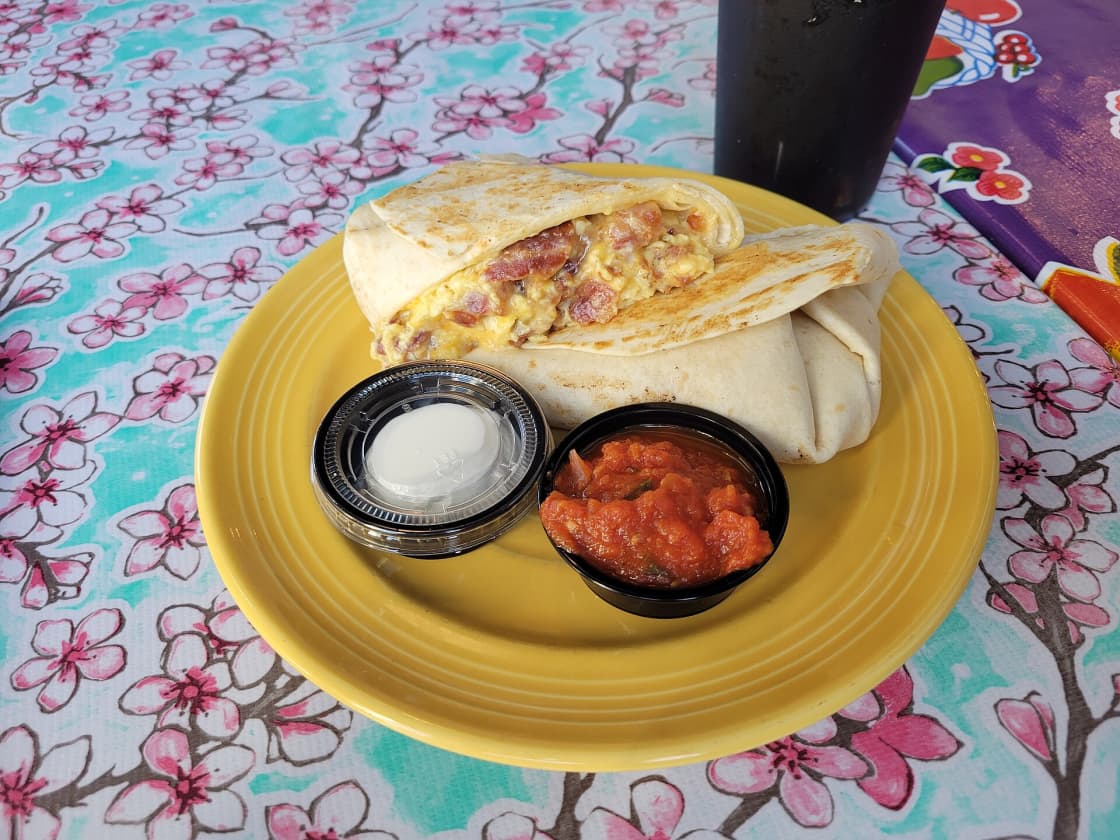
The taquería burrito. Made at a Mexican restaurant or taco shop, tighter and smaller than the American versions, built on eggs plus one strong protein — chorizo, machaca, al pastor, sometimes carne asada — with beans and cheese. Salsa comes on the side and is usually real. Best value in the city by a comfortable margin.
The sit-down restaurant burrito. Built at a breakfast or brunch restaurant, considerably larger, and using potato as a bulk ingredient. Frequently smothered in sauce and cheese and served as a plated dish with a fork. This is a meal you sit down for, not something you carry.
The drive-through burrito. Chains and fast-food operations. Consistent, fast, cheap, and exactly as good as you expect. Its virtue is that it exists at 7:15 a.m. when you are late.
The grab-and-go. Gas stations, convenience cases, campus outlets. Wrapped, heated, and functional. Nobody's favorite, but it is the right answer at certain hours in a city where late-night and very-early options are thin.
Knowing which one you are walking into solves most of the disappointment.
Where the taquerías are
Provo's Mexican kitchens cluster on the west side of the city and along the State Street corridor running north into Orem, which is a geography worth understanding — it maps closely onto where the valley's Hispanic community lives, and it is not where most students or newcomers spend time.
This matters practically. A student living near campus who searches for breakfast burritos will be shown the sit-down restaurants and the chains first, because those have better search visibility and are physically closer. The better burritos are a ten-minute drive west or north.
Center Street and the downtown blocks carry a few options. Our guides to Mexican restaurants in Utah Valley and Latino markets and panaderías cover that territory in more depth, and the markets are worth knowing about here — several have a hot counter, and a market counter burrito is frequently better than a restaurant one.
A warning that applies to this whole category: these are small kitchens with variable hours. Some open at 7, some at 9, some are closed Sundays and some are closed Mondays. Confirm before you drive. This is the single most common way a breakfast burrito trip in Provo fails.
What separates a good taquería burrito from a mediocre one
Four things, and they are all visible before you eat.
The tortilla is griddled. A good burrito is finished on a flat-top so the outside develops color and the seam seals. A pale, floppy tortilla straight from the warmer means nobody is paying attention, and it will fall apart in your hands.
The eggs are cooked to order. Eggs that have been sitting in a hotel pan go rubbery and weep water into the tortilla. If your burrito arrives in ninety seconds at 10 a.m., that is what happened.
The protein is not an afterthought. Chorizo should render its fat and season everything it touches. Machaca should be shredded and slightly chewy. Al pastor should show some char.
The ratio favors filling over tortilla. The most common failure in the American versions is enormous size achieved through potato and tortilla, which is bulk rather than food.
The vocabulary that gets you a better burrito
The menu is often the least informative thing in the restaurant. Some terms worth knowing:
Chorizo here means Mexican chorizo — fresh, loose, crumbled and cooked, not the cured Spanish sausage. It is the default best choice at most taquerías.
Machaca is dried, shredded, rehydrated beef, cooked with egg, onion, tomato and chile. Northern Mexican, deeply savory, and the most interesting thing on most breakfast menus.
Al pastor is pork marinated with chile and pineapple, traditionally cooked on a vertical spit. Uncommon at breakfast and excellent when available.
Barbacoa is slow-cooked beef, rich and shredded, and it makes a heavier burrito.
Papas are potatoes. A burrito described as huevos con papas is potato-forward by design, which is fine if that is what you want.
Smothered or ahogado means covered in sauce. Fork territory.
Salsa verde vs. green chile is a real distinction and one Utah is inconsistent about. Salsa verde is a tomatillo-based salsa, tart and usually cold. Green chile is a cooked sauce built on roasted green chiles, thicker and warm. Utah sits at the northern edge of the green chile belt, so some kitchens do the real thing and others do not. Ask.
Where Utah's breakfast burrito sits on the map
The breakfast burrito is regional in a way most people never think about, and knowing the regional styles explains why Provo's version is what it is.
New Mexico has the strongest claim to the modern form and the most rigid conventions. The burrito is smothered in red or green chile — the state question "red or green?" is literal — and Christmas means both. The chile is the point; the burrito is a delivery mechanism.
Colorado, particularly along the Front Range, took the smothered convention north and made green chile with pork the default. Portions grew.
California, especially San Diego, went the opposite direction: no smothering, foil-wrapped, portable, and frequently containing french fries. The California breakfast burrito is engineered to be eaten with one hand.
Texas does the breakfast taco instead and considers the burrito a different and lesser thing, which is an argument nobody in Texas will concede.
Utah sits at an intersection of the Colorado smothered tradition, the California portable tradition, and the northern-Mexican cooking that arrived with the actual immigrant population. That is exactly why the category is so inconsistent here. Two restaurants three blocks apart can be working from entirely different assumptions about what the food is, and neither will state which.
The upshot is that Provo has no single house style — and that variety is a feature once you know to ask which tradition a kitchen is drawing on.
What is in it, and why the order matters
A breakfast burrito seems too simple to have technique in it, which is why so many are mediocre.
The tortilla should be flour, warmed until pliable, and large enough that the fold is not straining. A cold tortilla cracks at the seam.
The eggs are the structural element and the most commonly abused. They want to be soft-scrambled and slightly under-done when they go in, because they keep cooking inside a hot burrito. Eggs fully cooked before wrapping arrive dry.
The potato, where used, should be crisped separately and added late. Potato steamed in the mix turns the whole thing to mush, and this is the single most common defect in the larger American versions.
The beans — usually refried pinto — do real work as a binder and a moisture buffer between egg and tortilla. A burrito without them is more likely to go soggy.
The cheese goes against the tortilla rather than in the middle, so it melts into a layer that seals the wrap.
Then the whole thing gets griddled seam-side down, which welds it shut. That last step is the difference between a burrito you can eat one-handed and one that unloads into your lap at the first bite.
Knowing the sequence is useful even as a customer, because you can see most of it happening on the flat-top while you wait, and you learn quickly which kitchens are doing it properly.
The all-day breakfast burrito, which is a genuine Provo advantage
Most American breakfast is time-locked. Taquerías largely are not.
A great many Mexican kitchens in Provo and Orem treat the breakfast burrito as a menu item rather than a morning special, which means chorizo and egg at 6 p.m. is a normal order. In a city where late-night food options are limited and a lot of the student population keeps irregular hours, that is more useful than it sounds.
It also makes the breakfast burrito one of the more reliable answers to the Sunday problem. Sunday closures are extensive across Utah Valley, and while many taquerías do close, the ones that stay open become disproportionately valuable. Our Sunday-aware dining coverage is worth checking before assuming anything is open.
The student calculation
For anyone at BYU or UVU, the breakfast burrito is arguably the best food value available, and the arithmetic is worth doing explicitly.
A taquería burrito is a single item that delivers protein, carbohydrate and fat in a portable form, at a price that competes with a campus coffee and pastry while being an actual meal. It reheats acceptably. It survives a backpack for an hour if wrapped properly. Two of them cover a day.
Compare that to the campus and near-campus options, which are convenient and priced accordingly, and the case is straightforward. The obstacle is purely geographic — the good ones are not walkable from campus, which means it is a car trip and therefore a batch purchase rather than a daily habit.
The practical move: buy several, refrigerate, reheat in a dry pan rather than a microwave. A microwave turns the tortilla to steam-softened paste; ninety seconds a side in a dry skillet restores the griddled exterior almost completely. Our student budget eating guide works through the wider economics.
The sit-down version, and when it is the right call
None of the above is an argument against the restaurant version. It is a different meal with a different purpose.
Provo's breakfast restaurants build a substantially larger burrito, usually potato-heavy, frequently smothered, and served as a plated dish. The breakfast and brunch guide covers the sit-down landscape properly, and several downtown restaurants do a strong version alongside the rest of a breakfast menu.
When it is right: a group breakfast where people want different things, a weekend with time, a situation where sitting down is the point. A smothered burrito with good green chile and an egg on top is excellent food, and it is not something you can replicate in foil.
When it is wrong: any circumstance involving a car, a trailhead, or a schedule.
Before a hike, which is the real Provo use case
A large fraction of breakfast burrito demand in this city is fuel for a morning outdoors, and it is worth being specific about how to do that well.
The burrito is a good pre-hike food — eggs, beans, potato and tortilla give you protein and slow carbohydrate in a package that does not need refrigeration for a couple of hours.
Two adjustments. Eat it an hour before, not at the trailhead. A large burrito immediately before the Y Mountain climb or the first steep section of Rock Canyon is a mistake with a very short feedback loop, and altitude does not help. Skip the smothering if you are carrying it — sauce and foil are a bad combination in a pack.
The other move is to carry one rather than eat one. A foil-wrapped taquería burrito eaten at a summit is meaningfully better than anything else you could have brought, and it stays acceptably warm for longer than you would expect.
How to order well
Ask what the kitchen makes best. In a small taquería this consistently outperforms the menu.
Ask for salsa on the side unless you know the heat level. Kitchens cooking for a Hispanic clientele are not calibrating for a mild palate, and the green ones are frequently hotter than the red.
Ask whether it comes smothered. Some places do it by default and do not mention it, which ruins a burrito you intended to carry.
Order the second one cold. If you like the first, buy another for tomorrow at the same time. It reheats better than almost any other takeout food.
Bring cash. Not universally necessary, but the smallest and best operations sometimes prefer it, and a card-only assumption occasionally fails.
Making a batch, which is what a lot of households here do
Utah County families make breakfast burritos in bulk, and it is a sensible response to large households and early mornings.
The method that works: cook everything separately and cool it before assembling. Warm filling in a wrapped burrito steams the tortilla and produces the sogginess that ruins frozen batches. Scramble the eggs slightly under-done, crisp the potatoes, cook the chorizo and drain it, and let all three come to room temperature.
Assemble with cheese against the tortilla, wrap tightly in parchment or foil, then freeze flat on a tray before bagging so they do not fuse into a block.
To reheat from frozen: microwave wrapped in a paper towel for about two minutes to thaw the interior, then finish in a dry skillet for a minute or two a side to restore the exterior. The two-stage approach is the whole trick — microwave alone gives you a hot, limp burrito, and skillet alone gives you a scorched shell around a cold middle.
Avoid freezing anything smothered, and be cautious with wet salsa inside the wrap; both introduce water where you do not want it. Keep sauces separate and add them at serving.
Made this way a batch keeps well for a couple of months, and it is the reason a lot of local households never buy the freezer-aisle version despite it being right there.
The honest assessment
Provo does not have a famous breakfast burrito. There is no single place that people drive from Salt Lake for, and anyone claiming a definitive citywide ranking is grading four different foods on one scale.
What Provo has is a deep supply of quietly good taquería burritos on the west side and along State Street, largely invisible to the people most likely to search for them, at prices that make them the best value breakfast in the valley. Alongside that sits a solid sit-down scene doing a bigger, richer, fork-and-knife version that is a different pleasure.
The mistake is treating them as competitors. The correct approach is knowing which of the four you want before you leave the house, and confirming the small places are open before you go.
Start with a chorizo and egg from a taquería, salsa on the side, griddled properly. If that is the one you want, you now know where the category lives.
Breakfast Burrito Delivery: The Best-Engineered Option
After pizza, the breakfast burrito is the food most accidentally suited to delivery, and it is worth understanding why.
It is wrapped in foil, which holds heat far better than a vented box. It is dense, so it loses temperature slowly. It is structurally self-contained, so nothing shifts or spills. And it is eaten from the hand rather than plated, so nothing about presentation degrades on the drive. A burrito that leaves a kitchen hot is still hot thirty minutes later, which is not true of almost anything else on a breakfast menu.
The one weakness is moisture. Salsa, crema and anything watery will soften the tortilla from the inside, and twenty minutes is enough to turn a tight burrito into a damp one. Ask for salsa on the side and the problem disappears entirely. Most places here will do it without comment.
The real constraint on breakfast delivery is not the food, it is the hour. Driver availability is thinnest early in the morning, because far fewer people are working then than at dinner. A seven-thirty order can sit waiting for a driver longer than the same order would at seven in the evening, and some mornings the platform will tell you nobody is nearby at all.
If you need breakfast at a fixed time, order earlier than feels necessary, or pick it up. A burrito is the one breakfast item where a fifteen-minute drive costs you nothing.
Our food delivery guide covers the platforms operating here and how their timing estimates behave.
Related Guides
- Best Breakfast Spots in Provo & Orem
- Best Mexican Restaurants in Utah Valley
- Latino Markets and Panaderías in Provo
- Late Night Food in Provo
- The Student Budget Eating Guide
- Best Food Trucks in Provo & Orem
- South American Food in Utah Valley
Frequently Asked Questions
Where can I get a breakfast burrito in Provo?
What is the difference between a taquería breakfast burrito and a diner one?
What does smothered mean on a breakfast burrito?
Are breakfast burritos available all day in Provo?
What is machaca?
How much should a breakfast burrito cost in Provo?
Is a breakfast burrito good before a hike?
Do Provo breakfast burritos come with green chile?
Sources
The facts in this guide were checked against these sources. Hours, fees and rules change, so confirm anything time-sensitive with the source before you go. How we make Provo.com.
- State Question, New Mexico Secretary of State. Checked October 12, 2026.
- Senate Memorial 34 (2023), Chile Day, New Mexico Legislature. Checked October 12, 2026.
- Leftovers and Food Safety, USDA Food Safety and Inspection Service. Checked October 12, 2026.