
More on Eagle Mountain: every guide we have published there, in one place.
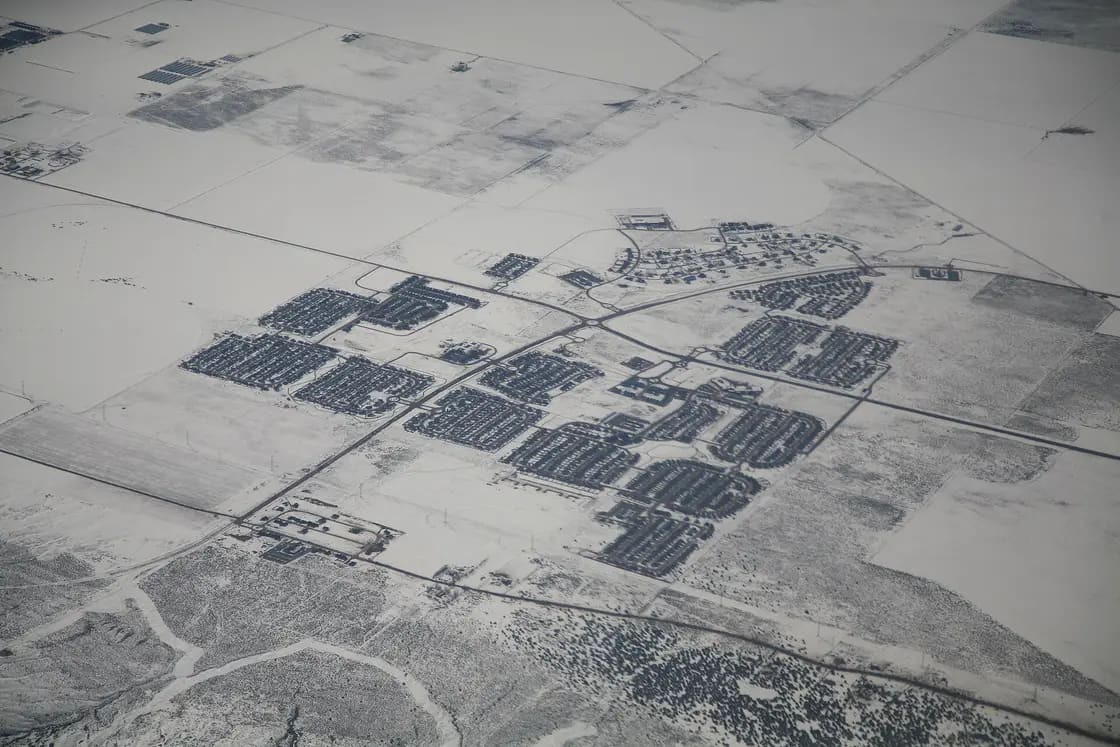
Eagle Mountain has grown faster than almost anywhere in Utah, and its restaurant scene has not caught up in the way you would expect. There is no restaurant row. There is no historic main street with a dozen storefronts on it. Driving Pony Express Parkway, the impression is of a city that has not been built out yet — which is accurate, but leads people to a conclusion that is not.
Because a lot of the best food in Eagle Mountain does not have an address in the conventional sense. It has a parking spot.
This is the defining fact about eating here, and no other city in Utah Valley is quite like it. Several of the highest-rated places to eat in Eagle Mountain are food trucks, some of them permanently parked, clustered at a couple of addresses that function as informal food courts. If you are used to judging a city's food by its storefronts, you will write Eagle Mountain off and be wrong.
Here is how it works.
The truck clusters, and why they matter
Two addresses do most of the work.
The Pony Express Parkway lot is the busier of the two. Multiple independent businesses operate from that single address — a sit-down taqueria in one unit, and alongside it a rotating group of trucks covering fried chicken and waffles, burgers and Philly cheesesteaks, and Japanese-style filled waffle desserts. On a good evening you can feed a group with different tastes without moving the car, which is exactly what a food court does, assembled by accident rather than by a developer.
The second cluster sits around East Campus Drive, on the north side of the city, where a smaller set of trucks operates including a well-regarded smashburger and a wings-and-flatbread kitchen.
Separately, Eagle Mountain City runs an organized food truck rally on Pony Express Parkway during the warmer months, which is a different thing from the permanent clusters — a scheduled event with a rotating lineup rather than a standing set of vendors.
One firm warning about all of this. Trucks move, change their operating days, go quiet in winter and sometimes close outright — there is at least one Eagle Mountain truck still carrying strong reviews on a listing platform that has been closed for years. Directory listings lag reality here by a wide margin. Check the individual business's own social account the day you plan to go. This is the single most useful piece of advice on this page, and it applies more strongly in Eagle Mountain than anywhere else in the valley.
The trucks themselves
Naming individual trucks in print is slightly risky — see the warning above — but these are the operators with enough of a track record to be worth seeking out, and skipping them would misrepresent the city.
Smashed Down runs smashburgers out of a truck on the north side and has the highest ratings of anything in Eagle Mountain, albeit on a smaller review count than the restaurants. The menu leans into named burgers rather than a numbered list, and the loaded fries come up as often as the burgers do. It operates a short week — a few evenings plus a Saturday lunch — which is the pattern for most of the city's trucks and the reason to check before driving.
Fuel, at the Pony Express cluster, does fried chicken and Belgian waffles, with hot honey and a house sauce that people write about at length. Everything is cooked to order, so it is slower than the format suggests. The owners are from Georgia, which shows in the food.
Biko works the same cluster with burgers, Philly cheesesteaks and fish and chips. Portions are the recurring theme in its favor; a couple of reviewers flag the fish and chips as pricey for what arrives. Seating is picnic tables.
Pandayaki is dessert — filled, panda-shaped waffle cakes and drinks — and is worth knowing about mostly because it is the answer to "what do we do after" at that cluster. It runs weekday evenings and closes weekends, which is the reverse of what you would guess.
The Munch Box Kitchen on East Campus Drive does wings and flatbread pizza and is the newest of the group, with a small but uniformly positive following. A creperie also operates in that area.
What these have in common is worth stating plainly: they are owner-operated, cash-flow-thin, weather-dependent businesses. The upside is that the food is better than the format implies and the people running it are usually the ones handing it to you. The downside is volatility. Treat any specific truck named here as a starting point rather than a guarantee.
Eating at a truck, practically
A few things that catch people out, none of them obvious from a listing.
There is usually nowhere indoors to sit. The clusters have picnic tables and not much else. In July that means shade is scarce and in January it means you are eating in your car. This is much of why the scene contracts in winter.
Order times are longer than fast food. Almost everything at these trucks is cooked to order, and a queue of four parties can mean a twenty-minute wait. Arriving at 6:30 on a Friday with hungry children is a mistake people make once.
Hours are short and irregular. Several trucks run three or four days a week, some close mid-afternoon, and almost none open Sunday. The published hours on aggregator sites are frequently stale.
Bring a card and expect to tip at the window. Most operate on tablet checkout systems.
The sit-down options
Taqueria 27 on Pony Express Parkway is the biggest and most reviewed restaurant in the city. It is part of a Utah restaurant group rather than an independent, which shows in both directions: the menu is broader than a neighborhood taqueria — mole, bacon-wrapped jalapeno tacos, fried ice cream — and the service is a proper restaurant operation, but the prices reflect that and some diners find the portions modest against the bill. It is the default when you want to sit down with a group and not think about it.
No. 1 Cuisine on Pony Express Parkway covers Chinese and Japanese, including sushi, and it is the city's family-meal restaurant in the literal sense — the large shared family meal is what most reviewers order, and portions are the recurring theme. It is also one of the few places in the city open seven days.
On the north side, there is a brunch and cafe operation that draws consistently strong notices, particularly for its potatoes and its cinnamon-forward coffee. Be aware before you drive: it appears in listings under more than one name and more than one ZIP code, with reviewers using a different name from the one on some directory entries. We are not going to guess which is current. Search the address rather than the name, and confirm before you go.
For something more distinctive, Latin Bites operates on the south side of the city serving Venezuelan cooking — arepas, pabellon — which is not something you will find easily elsewhere in Utah County. It runs split lunch and dinner service rather than continuous hours.
What Eagle Mountain does not have
This part matters as much as the recommendations, and most city restaurant guides skip it.
Eagle Mountain has no meaningful fine-dining option, no brewpub, and a thin selection for anything you might class as a special-occasion dinner. It has very little that is open late. And Sunday closure is close to universal among the independents and the trucks, which in a city built around family schedules catches visitors out constantly.
The city also lacks the density that makes browsing possible. You cannot park once and walk past eight options deciding what you feel like, the way you can on Provo's Center Street. Eating in Eagle Mountain is a decision you make before you leave the house.
None of that is a knock on the city. It is a young place at the western edge of the county whose commercial base is still arriving, and our Eagle Mountain city guide covers what that trade-off looks like for residents. But it does mean the honest answer to "where should we eat" sometimes points outward.
Why the scene looks like this
It is worth understanding the mechanism, because it predicts what happens next.
Eagle Mountain added residents far faster than it added commercial square footage. That gap is normal in a fast-growing exurb and it produces a specific sequence. National chains and franchise operators generally will not commit to a site until an area clears internal thresholds for rooftops, traffic counts and daytime population, and those thresholds lag actual growth by years. Independent restaurateurs face the same math with less capital to absorb a slow first year. So a city can grow to tens of thousands of residents and still look, from the road, like it has nowhere to eat.
Food trucks arrive first precisely because they invert that risk. The fixed cost is a vehicle rather than a lease and a build-out, the operator can leave if the location does not work, and the break-even headcount is a fraction of a restaurant's. In a market with demand but no infrastructure, that is the only format that pencils — which is why Eagle Mountain's food scene is shaped the way it is, and why it appeared as suddenly as it did.
The corollary is that this is a transitional state rather than a permanent identity. As commercial development fills in along Pony Express Parkway, expect the buildings to catch up. Some of today's trucks will become those buildings; that is the usual path, and it is worth eating at them now either way.
The seasonal calendar
Eating here is more seasonal than in the rest of the valley, and it is worth planning around.
Late spring through early autumn is the real season. The trucks run their fullest schedules, the city's food truck rally operates, and the picnic-table format is pleasant. This is when Eagle Mountain's food is at its best and the argument for driving elsewhere is weakest.
Late May brings Pony Express Days, the city's flagship festival, which is food-heavy by design — the multi-day program at Cory Wride Memorial Park and Nolen Park carries food trucks alongside the parade, rodeo, carnival and fireworks. If you want to sample the local operators in one place with the least planning, that week is the answer. Dates shift year to year, so check the city's schedule.
Winter is the lean season. Several trucks reduce hours or park entirely, outdoor seating stops being viable, and the city's dining contracts to its handful of permanent rooms. Plan on the sit-down restaurants or on driving.
When to drive instead
Saratoga Springs is the nearest city with a broader selection, and for many Eagle Mountain households it is the default when the answer at home is no. Lehi is the largest option within a reasonable drive and has added substantial dining alongside its tech growth — it is where you go for a genuine special occasion. Further out, the valley-wide guide covers the rest.
The drive is real, though. Eagle Mountain's geography is the whole story of the city — it sits west of Utah Lake in the Cedar Valley, separated from the I-15 corridor by the Lake Mountains, and the routes out are SR-73 and Pioneer Crossing rather than a freeway ramp. Twenty minutes each way to dinner adds up, and it is precisely why the local trucks have found a market.
How to eat well here in practice
If you want the best food in the city, go to one of the truck clusters on a weekday evening in the warmer months, check the individual accounts first, and be prepared to eat at a picnic table. The burgers and the fried chicken coming out of those windows outrank most sit-down food at the same price point anywhere in the county.
If you need a table and a server, Taqueria 27 for a group, No. 1 Cuisine for a family meal or when it is Sunday.
If you are visiting rather than local, pair it with something else in the city rather than driving out specifically to eat. Our guide to things to do in Eagle Mountain covers Cory Wride Memorial Park, the Pony Express Trail history and the city's dark-sky stargazing, which is the genuine reason to make the trip west.
And if it is winter, adjust expectations. The trucks thin out considerably when the weather turns, and the city's food scene contracts to its handful of buildings. That is the season to drive.
The bottom line
Eagle Mountain is an easy city to underrate on food, and the reason is structural rather than culinary: its best operators are not visible from the road. A city of this size with this few storefronts should be a dining desert, and it is not — it just requires you to know where the trucks park and to check before you go.
Treat the two clusters as the city's restaurant row, keep the neighboring cities in reserve for occasions and Sundays, and Eagle Mountain feeds you better than its skyline suggests.
Why a city this size has so little sit-down food
Eagle Mountain is one of the fastest-growing cities in Utah and it still has a restaurant count that reads like a much smaller town. The reasons are structural, and understanding them tells you what will and will not change.
The city is enormous and thinly settled. Eagle Mountain covers a very large land area with development spread across separated pockets rather than concentrated around a single core. Restaurants need traffic density, and a city whose rooftops are distributed over dozens of square miles does not deliver it to any one intersection — even when the total population is substantial.
There is no commercial core to anchor a restaurant row. The city grew as residential subdivisions first, with retail following slowly. A sit-down restaurant depends on neighboring businesses generating foot traffic; in a subdivision-first city there is nothing next door to generate it.
The daytime population leaves. Eagle Mountain is heavily a commuter city, with a large share of working residents driving out to the north county tech corridor or further. Lunch traffic, which is what keeps most independent restaurants solvent, largely happens somewhere else.
Licensing adds friction at the top end. Utah issues restaurant liquor licenses against a population-based quota and applies proximity restrictions relative to schools, churches, parks and libraries — the kind of uses that dominate a residential city. That is one more reason the destination-dinner category has not appeared here, and it is why our date-night guide points elsewhere.
Together these produce exactly the scene the city has: food trucks, which need no building and can move to where the people are on a given evening, plus a thin layer of counter service and chains near the main arterials.
Living with it: the household strategy
The families who eat well here have systems rather than favorites.
Treat the drive as scheduled, not spontaneous. The realistic sit-down options are in Saratoga Springs, Lehi and American Fork, and the drive is long enough that it is a plan rather than an impulse. Households that eat out well here pick a night and go, rather than deciding at six that nobody wants to cook.
Stack the trip. Because the drive is the cost, pairing dinner with the grocery run, a Costco trip or a kid's activity in the same direction changes the economics entirely.
Learn the truck schedule rather than the truck. The clusters move and rotate, and the operators post their own schedules. Following two or three directly is more reliable than checking a location and hoping.
Delivery coverage is real but uneven. The major platforms reach much of the city, though delivery windows run longer and fee structures differ from the valley floor because of the distance from restaurant to door. Coverage at the edges of the city is patchier than in the built-up center.
Winter compresses everything. Snow on the access routes turns the twenty-minute drive into a genuine decision, and the food-truck clusters that carry the summer scene are a seasonal resource rather than a year-round one. The honest winter answer here is a well-stocked kitchen.
Groups have it easier than couples. For a large family gathering, the drive down to the north county unlocks restaurants with real banquet capacity, and a group is more likely to plan ahead anyway. It is the ordinary weeknight dinner for two that Eagle Mountain serves least well.
Delivery in Eagle Mountain: Plan Around It
Eagle Mountain is the most difficult place in Utah County to get food delivered to, and the honest advice is to build your eating around that fact rather than fighting it.
The reasons are the same ones this page opens with. There are few kitchens in the city, no restaurant row to draw from, and the nearest real concentration of restaurants sits over in Saratoga Springs or Lehi. That is a genuine drive, not a few blocks. Add low housing density spread across a large area, and a driver taking an Eagle Mountain order is committing to a long trip for one delivery rather than stringing several together the way they would in Provo.
What follows is predictable: longer waits, more orders that go unclaimed, more cancellations, and higher effective costs. Whether a given platform serves a given Eagle Mountain address at all is worth checking before you plan an evening around it, because coverage out here is not uniform across the city.
The approach that works is to treat this as a pickup and stock-up city. Ordering ahead and collecting on the way home from work turns the drive you were already making into the delivery. Keeping the freezer and pantry stocked means a bad night does not depend on a driver being willing to come out.
None of this is a complaint about the city. It is the ordinary trade of living somewhere with space, and it is the same arithmetic as everything else out here.
Our food delivery guide covers how the platforms work and where their limits sit.
Related Guides
- The Best Restaurants in Pleasant Grove & Lindon (2026)
- 16 Best Pizza & Italian Restaurants in Utah Valley (2026)
- Restaurants on the North Bench: Highland, Alpine & Cedar Hills (2026)
- 18 Best Restaurants in Spanish Fork, Utah (2026)
- The Best Restaurants in Springville, Utah (2026)
- 11 Best Restaurants in Vineyard, Utah (2026)
Frequently Asked Questions
Does Eagle Mountain have good restaurants?
Where are the food trucks in Eagle Mountain?
What is the best Mexican food in Eagle Mountain?
Is there anywhere to get breakfast in Eagle Mountain?
Do Eagle Mountain restaurants open on Sunday?
Should I just drive to Saratoga Springs or Lehi instead?
Why doesn't Eagle Mountain have more restaurants?
Where do Eagle Mountain residents go out to eat?
Sources
The facts in this guide were checked against these sources. Hours, fees and rules change, so confirm anything time-sensitive with the source before you go. How we make Provo.com.
- Eagle Mountain Planning Commission meeting packet, April 22, 2025 (General Plan), Eagle Mountain City (Utah Public Notice Website). Checked October 12, 2026.