
If you have a child in school in Orem, Lindon, Pleasant Grove or Vineyard, your school district is changing — and most of what parents have heard about it is either out of date or belongs to a different city.
Here is the short version. On July 1, 2027, Alpine School District — for years the largest school district in Utah — stops existing in its current form. Three districts take its place. The four cities above become the Timpanogos School District. Nothing changes for the 2026-27 school year that starts next month.
The longer version is worth your time, because the decisions that will affect your family — money, boundaries, which building your ninth-grader reports to in 2028 — are being made right now, in public meetings, by people you can email.
What happened, and when
In the November 2024 general election, two propositions passed in northern Utah County.
Proposition 11 carried in Alpine, Cedar Hills, Highland, Lehi and part of Draper. Proposition 14 carried in Eagle Mountain, Saratoga Springs, Cedar Fort and Fairfield. Each created a new school district out of Alpine.
There was no proposition on the ballot in Orem, Lindon, Pleasant Grove or Vineyard. Residents of those four cities did not get a vote on whether to form a district of their own. When the other two groups left, the remainder became a third district automatically.
That detail explains a lot about how this feels locally. In Lehi, the split was something people chose. In Orem, it is something that happened. Both of the district's most visible leaders — Superintendent Joe Jensen and Board President Jen Lyman — publicly opposed the split before they were the ones responsible for making it work. Lyman's line about it, delivered to the Daily Herald this spring, has become the district's unofficial motto: they were handed a lot of lemons, and they intend to make good lemonade.
The four cities did sign an interlocal agreement in December 2024 to work together on the new district, so the cooperation is real even if the origin story is not one anybody here picked.
Which district are you in?
This is the single most common point of confusion, and it is worth being precise, because Utah Valley families move between these cities constantly.
Aspen Peaks School District — Alpine, American Fork, Cedar Hills, Highland, Lehi and the Utah County portion of Draper. The largest of the three, expected to serve more than 35,000 students. Superintendent: Joel Perkins.
Lake Mountain School District — Saratoga Springs, Eagle Mountain, Cedar Fort and Fairfield: the cities west of Utah Lake. Superintendent: Vicki Carter.
Timpanogos School District — Orem, Lindon, Pleasant Grove and Vineyard. The smallest of the three at roughly 23,000 students. Superintendent: Joe Jensen.
All three names are final. Earlier coverage used placeholders — you may still see "Central School District" in older articles and even in some real estate listings, referring to what is now Aspen Peaks. If a source is using that name, it is at least a year out of date, and probably wrong about other things too.
Who is not affected
Provo is not part of any of this. Provo City School District has always been separate, serving Provo alone with its own board, its own boundaries and its own tax rate. Nothing about the Alpine split touches Provo High, Timpview, or any Provo elementary.
Nebo School District is also unaffected — that's Spanish Fork, Springville, Payson, Salem, Santaquin and the south end of the county.
So when a neighbor tells you "the district is splitting," the first question is which city they live in. In Provo and in the south county, the answer is: not yours.
Timpanogos by the numbers
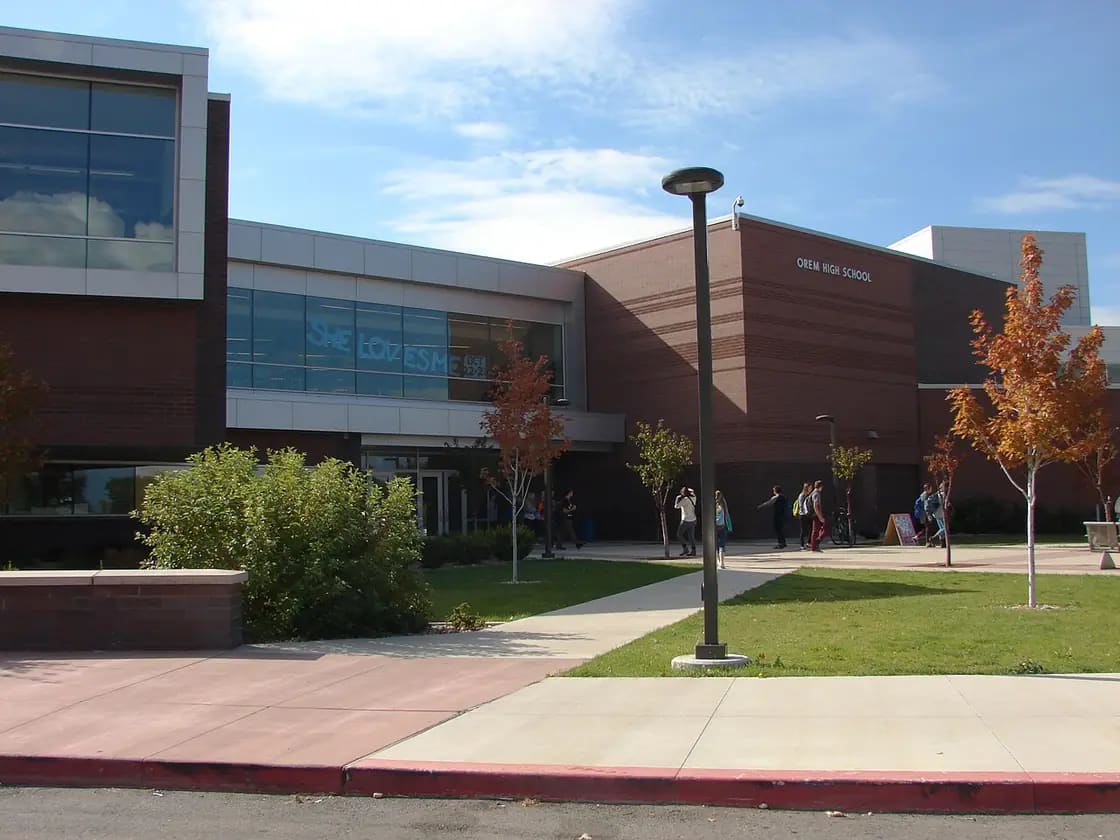
The new district inherits 29 schools — four high schools, five junior highs and twenty elementaries — serving roughly 23,000 students across the four cities. The high schools are Orem, Timpanogos, Mountain View and Pleasant Grove.
Compare that to Alpine today, which runs more than 90 schools. District leaders see the smaller footprint as the real upside: Jensen visited nearly every one of the 29 schools in a single spring, which is simply not possible at Alpine's scale. Board member Michele Sorensen has framed it as a chance to build community identity around schools in a more focused way.
The leadership team came together quickly. The three new boards were sworn in at the end of November 2025. Jensen — previously principal of Orem Junior High and Timpanogos High, most recently Alpine's director of administrative development — was appointed unanimously and sworn in as inaugural superintendent on Wednesday, January 28, 2026. Jen Lyman serves as board president, Sterling Hilton as vice president.
The district adopted a vision statement this spring after taking it to school communities across all four cities: "Together, we cultivate joyful, thriving students through high levels of genuine learning for each student in a culture of exceptional care, curiosity, and community."
The hard part: the money
This is the section parents should read twice, because it is where the real decisions of the next eighteen months live.
State education funding in Utah flows on a per-pupil basis. A smaller district collects less of it while still needing most of the same central functions — payroll, special education administration, transportation routing, technology, human resources. Alpine spread those costs across more than 90 schools. Timpanogos will spread them across 29.
District officials estimate that operating at this smaller scale adds roughly $300 per student per year in district service costs. And they have projected an annual shortfall of about $20 million if every school and service continues exactly as it runs today.
Closing a gap that size, the district has told residents, comes down to three options: raise property taxes by about 17%, cut programs and services, or do some of both.
Two things matter about that figure. First, it is a projection published to start a public conversation, not a rate anyone has adopted. Second, any actual tax increase in Utah has to go through the Truth in Taxation process, which requires public notice and a public hearing before an elected board can vote. If it happens, you will get the chance to show up — and the notice will arrive in the mail.
The enrollment picture underneath the math is the part that doesn't get discussed enough. Enrollment across these four cities is declining, driven by housing costs and lower birth rates. Orem and Pleasant Grove are largely built out. This is not a district that can grow its way out of a funding gap the way Lehi or Eagle Mountain can, and that structural difference is likely to shape budget decisions here for years.
What has already been settled
More is decided than most parents realize. On Thursday, June 25, 2026, the boards of all three new districts unanimously ratified a resource allocation agreement — the negotiated division of Alpine's assets, money and obligations. Alpine called it historic; every side described it as requiring concessions.
Some specifics worth knowing:
Employees are protected in the transition. Current Alpine employees moving to one of the new districts carry over their accrued vacation hours and associated obligations. Post-retirement benefits are locked in for qualifying employees, even if they later move between the three new districts. That matters for teacher retention, which was the loudest staff-side worry when the split was announced.
School-specific money stays with the school. Student activity funds and Alpine Foundation accounts already assigned to a particular school or program remain with the district where that building physically sits. Your PTA's balance and your marching band's fundraising don't get pooled and redistributed.
The remaining money splits by enrollment. The agreed working percentages are Aspen Peaks 41.78%, Lake Mountain 30.16% and Timpanogos 28.06% — but unassigned funds get divided on final enrollment counts taken in June 2027, so those numbers will move.
Alpine still runs everything until the handover. Until July 1, 2027, Alpine School District retains sole responsibility and oversight of all schools and assets. Your principal, your bus route and your registration process this fall all still run through Alpine.
Teachers, staff, and why the startup budget is so strange
Parents tend to ask about buildings first and staffing second. It should probably be the other way around, because teacher retention is the variable most likely to show up in your child's classroom.
The staffing worry after November 2024 was straightforward: Alpine had competitive salaries and scale, and teachers weren't sure whether a smaller district could match either. The resource agreement answered part of that by protecting accrued leave and post-retirement benefits across the transition. Salary schedules for the new district are a separate question that will be settled with its first real budget.
The startup arrangement is odd and worth understanding, because it explains why the new district has been slower to answer questions than parents would like. Until the handover, Alpine remains the taxing entity — it collects the money and manages a subaccount for Timpanogos, which controls how those funds are spent. That startup budget has to cover the superintendent's salary, a business administrator, board stipends and every other expense of standing up an organization. Lyman put the scale of it plainly early on: a school district typically operates on something like $8,000 per student, and the new district's startup allocation worked out to about $60 per student.
That's not a complaint about Alpine — it's what a startup budget is. But it does mean that when district leaders say they don't yet have an answer on boundaries or budget specifics, the constraint is usually real rather than evasive.
Boundaries: what's happening
The Timpanogos board launched a boundary study in May 2026, and this is where rumor moves fastest.
Jensen has been direct about the intent: the goal is not to immediately close schools or realign boundaries. The first phase is defining criteria — what makes a robust elementary, junior high and high school in this district. Draft criteria went to principals for feedback at the end of May, and community meetings were held on June 1 and 2, one at each high school. Lyman has described it as a three-phase process with community input at every stage.
What that means practically:
- No school closures have been adopted, but closure studies are now formally underway. The board's August 26, 2026 meeting agenda included school closure studies and notices for Canyon View, Oak Canyon and Orem junior highs and for Aspen, Bonneville, Foothill, Lindon, Northridge, Orchard, Orem, Parkside, Rocky Mountain and Windsor elementaries, studies on closing or moving the Chinese dual language immersion program at Cascade Elementary and the Spanish program at Cherry Hill Elementary, and boundary studies covering every high school, junior high and elementary. A study and notice starts a public process; it is not a decision. Check the board's agendas and minutes before acting on anything you hear.
- Current attendance boundaries remain in force, including for the 2026-27 school year.
- Staff stay put. District leaders have said the 29 schools keep their existing staff through the transition.
- A smaller, enrollment-declining district with a $20 million projected gap will eventually have to talk about building use. Nobody should be shocked when that conversation arrives. The honest read is that it's coming, on a timeline nobody has set yet.
The distance between "no decisions have been made" and "nothing will change" is where anxiety lives. Both statements are true right now; only the first will stay true indefinitely.
If you're buying a house here
Utah Valley real estate conversations lean heavily on school assignment, and there's a temptation to price in a district that doesn't exist yet. A few notes for anyone house-hunting in these four cities:
Verify the school assignment for the specific address, today, with the district. This has always been the rule here and the split makes it more important, not less. Boundaries within Alpine have shifted before and will shift again.
Don't treat the tax scenario as a tax rate. A 17% increase in the school portion of a property tax bill is not a 17% increase in the bill — school district taxes are one line among several, alongside county, city and other levies. Ask a lender or agent to model the actual line item rather than the headline.
A house in Orem and a house in Highland are now in different systems with different sizes, different budgets and different growth trajectories. That's a new factor in a Provo-versus-Orem-versus-north-county comparison that didn't exist two years ago.
Ignore listing copy on this subject. Real estate descriptions are still circulating retired district names. It's a fast-moving civic story and marketing copy is the last thing to catch up.
Timeline: now through the handover
Now through June 2027 — Alpine operates all schools normally. The 2026-27 school year, starting in August, runs exactly as previous years have.
Through 2026 and into 2027 — the boundary study continues in phases, with community input built in. Budget work continues in parallel; expect the tax-versus-cuts conversation to sharpen as the district's first real budget approaches.
June 2027 — final enrollment counts are taken, setting the actual division of remaining funds among the three districts.
July 1, 2027 — Timpanogos School District officially assumes operations.
August 2027 — the first school year run by the new district begins.
What parents should do
Not much is required of you right now. A few things are worth the ten minutes:
- Find out which of the three districts you'll be in — by city, using the list above. If you're in Provo or south county, you're out of scope entirely.
- Subscribe to board meeting notices for your new district rather than relying on neighborhood social media, where the split generates more heat than information.
- Show up for boundary study meetings. The board has committed to community input at each phase, and turnout at the criteria stage carries more weight than objections after a map is drawn.
- Watch for a Truth in Taxation notice. If a rate increase is proposed, that notice is your formal cue, and the hearing is public.
- Confirm your child's school assignment directly with the district before you sign anything — a lease, a purchase contract, an intra-district transfer request.
The people running this district didn't ask for it, said so publicly, and took the job anyway. Eighteen months out, they've hired leadership, ratified an asset agreement, visited nearly every school and put uncomfortable budget numbers in front of residents before anyone forced them to. That's a reasonable starting position. What happens next depends a good deal on how many parents pay attention while the decisions are still open.
Related reading: Best schools in Provo & Orem · Provo for families · Moving to Provo · Living in Orem
The statutory reason Orem never got a vote
The most common complaint about this district is that nobody here chose it. That is accurate, and it is not an oversight or a drafting error. It is the operation of a defined term, and reading the definition is the fastest way to understand what Timpanogos is.
Utah Code § 53G-3-102(10), as rewritten by S.B. 188 in 2025, defines a reorganized new school district as the remaining portion of a divided school district after voters approve the creation of a new district — where either the entire geographical area of the reorganized district was not included in a proposal for the new district, or it was included in a proposal that voters turned down while sitting inside an existing district that contains an area where the creation was approved.
Orem, Lindon, Pleasant Grove and Vineyard fall squarely into the first branch. No proposal for a new district ever covered them. Propositions 11 and 14 covered other cities, those cities approved them, and the statutory definition did the rest. A reorganized new school district is not something anybody votes for. It is what the law calls the part that is left.
The same chapter explains the name. Utah Code § 53G-3-202(1)(b) requires the
name of a district created after May 1, 2000 — including a reorganized new
district — to comply with Utah Code § 17-60-103, to be a name the district's
own local school board selects, and to be one no other school district has
previously chosen and recorded. That is why the naming happened after the
board existed rather than before, and why it could not simply inherit Alpine's.
A note on that cross-reference, because it moved recently. The provision
prohibiting the use of "county" in a name sat at § 17-50-103 for years, and
that is the number every older source quotes. Utah recodified the whole of Title
17 through SB 1006 and SB 1007 of the 2025 First Special Session, effective
November 6, 2025, and it was renumbered to § 17-60-103. The live text of
§ 53G-3-202(1)(b)(i) now points at the new number. If you are checking this
against a source that still cites 17-50-103, the source has not been touched
since 2025 — the substance is unchanged, the address is not.
The six-year rule that matters most to families near a seam
Buried in Utah Code § 53G-3-302(2)(a)(iv) is the single most useful provision
in the chapter for an ordinary household, and almost nobody knows it exists.
An individual residing within the boundaries of a new or reorganized new district when the district is created may, for six school years following the creation, elect to enroll in a secondary school located outside the new district's boundaries — provided that on the day before creation the student lived within that secondary school's boundaries and would have been eligible to enroll there had the district never been created.
This is not a courtesy and it is not discretionary. The statute goes further: the district in which that secondary school sits shall provide educational services to a student making the election, including busing for each school year the election is made, if busing was provided before the creation of the new district. A family a block on the wrong side of a new district line does not automatically lose the high school it was zoned for, and does not automatically lose the bus either.
There is a companion obligation for a different group of students. Under Utah Code § 53G-3-301(9), a new district and a reorganized new district must enter
into a shared services agreement — unless both boards mutually agree not to —
permitting students in each district to attend a school serving students with
disabilities inside or outside their own district's boundaries. It runs for up
to five years after the new district begins providing educational services, is
charged at the actual cost of services, and may not affect services provided to
other students.
Ask about both by name. They are easy to miss and hard to argue with once raised.
Related Guides
- Martial Arts in Provo & Utah Valley: Choosing a School Without Signing the Wrong Contract
- The Legend of Timpanogos Was Written by a Track Coach in 1922
- Provo City School District: The Parent's Guide to How It Actually Works
- Charter Schools in Utah Valley: How the Lottery Works and What You Give Up
- Which School District Am I In? Utah County Before and After the Alpine Split
- American Fork vs. Pleasant Grove — two neighbors split between two new districts
Frequently Asked Questions
What cities are in the Timpanogos School District?
When does the Alpine School District split happen?
Will my child change schools because of the split?
Will property taxes go up because of the new district?
Why do Orem, Lindon, Pleasant Grove and Vineyard have a new district if they never voted for one?
Why did Orem, Lindon, Pleasant Grove and Vineyard get a school district without voting on one?
Can my child stay at their current high school if a new district line now runs between us?
What happens to students who attend a school serving students with disabilities across the new line?
Sources
The facts in this guide were checked against these sources. Hours, fees and rules change, so confirm anything time-sensitive with the source before you go. How we make Provo.com.
- Timpanogos School District Board Meeting (August 26, 2026) - Utah Public Notice, Utah Public Notice Website (State of Utah). Checked October 12, 2026.
- Voters approve split of Alpine School District, Eagle Mountain City. Checked October 12, 2026.
- Utah Code 53G-3-302: Rights of students after district creation, Utah State Legislature. Checked October 12, 2026.
- Utah Code 53G-3-102: Definitions, Utah State Legislature. Checked October 12, 2026.