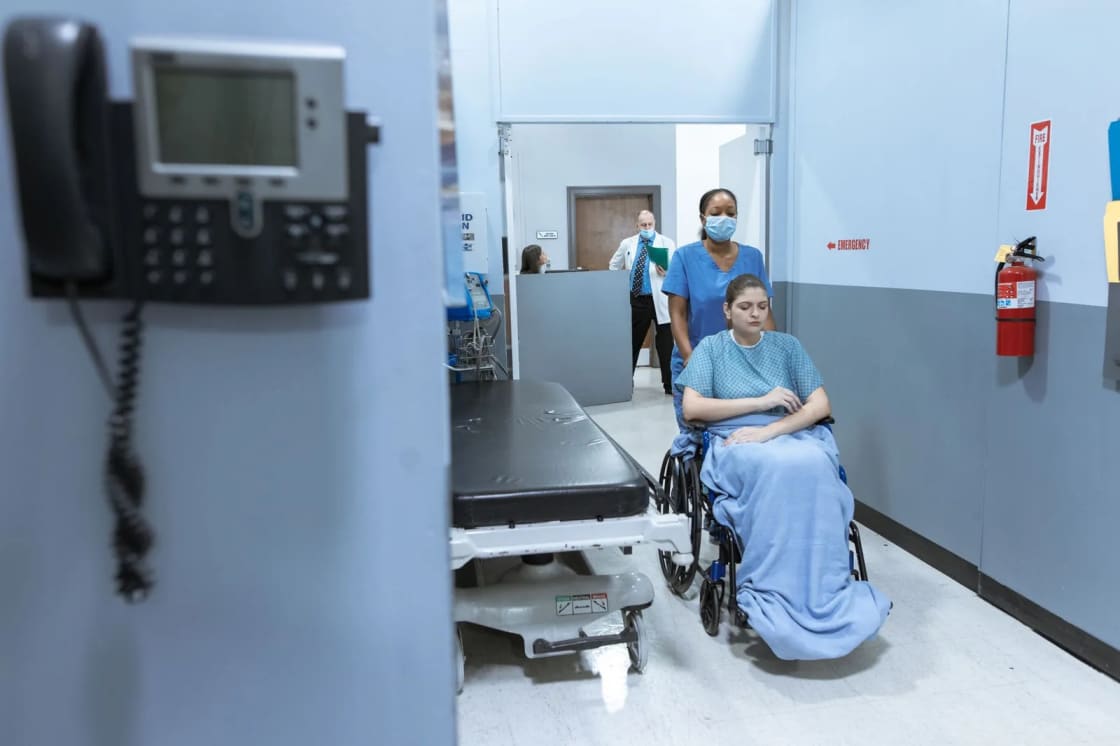

Utah Valley's job market has a reputation problem. Ask what people do here and you will hear about tech, direct sales and the universities. Healthcare rarely makes the sentence, which is strange, because it is one of the largest and steadiest sources of employment in the county and one of the few sectors that hires continuously across the whole credential range.
The valley has hospitals in Provo, Orem, American Fork and Payson, a large physician-owned group headquartered downtown, and a population growing fast enough to keep expanding all of it. That is a lot of jobs, and they are not all nursing.
This guide maps the employers, the credential ladder underneath the degrees, and the local quirks that make hiring here different from hiring in a normal metro — most of which trace back to the fact that a large share of the workforce is also enrolled somewhere.
The employer map
Clinical employment in Utah County concentrates in a handful of organizations, and knowing which is which saves a lot of scattershot applying.
Intermountain Health operates the largest hospital footprint in the county. Utah Valley Hospital in Provo is the anchor and the largest facility in the valley, with American Fork Hospital serving the north end and Orem Community Hospital in between. Intermountain also runs InstaCare urgent care clinics around the county, and those clinics are their own hiring channel with a different staffing pattern from the hospitals.
MountainStar Healthcare operates Timpanogos Regional Hospital in Orem and Mountain View Hospital in Payson. Two hospital systems in one county is useful for a job seeker, because it means a competitive market for the same labor pool rather than a single employer setting terms.
Revere Health is a large physician-owned multispecialty group headquartered in Provo. Clinic groups hire differently from hospitals — more weekday scheduling, more front-office and medical assistant volume, less night and weekend work.
Around those four sit a long tail that collectively employs a lot of people: dental and orthodontic practices, physical therapy and sports medicine clinics, dermatology, behavioral health and substance use treatment providers, home health and hospice agencies, skilled nursing and assisted living facilities, dialysis centers, imaging centers, and Utah County's own public health department.
The tail is where a great deal of the actual hiring happens, and it is invisible if you only look at the two hospital systems' career pages.
The credential ladder, from the bottom
The single most useful thing to understand about healthcare employment is that it is a ladder with rungs much closer together than outsiders assume. You do not enter at "nurse."
No credential required. Patient transport, environmental services, dietary and food services, patient access and registration, unit secretary and scheduling roles. These are real hospital jobs, they put you inside the building, and they are the most common way people find out whether they like clinical environments.
Short certificate, measured in weeks to months. Certified nursing assistant, phlebotomy, medical assistant, pharmacy technician, sterile processing, emergency medical technician. This tier is the workhorse of the local market.
One to two years. Surgical technology, radiologic technology, respiratory therapy, licensed practical nursing where offered, paramedic.
Two to four years. Registered nursing via associate or bachelor's routes, sonography, medical laboratory science, health information management.
Graduate. Nurse practitioner, physician assistant, physical and occupational therapy, pharmacy, medicine.
The reason to see it as a ladder rather than a set of separate careers is that employers here fund movement up it. Tuition assistance is a standard benefit at the larger systems, which means the rational path for many people is to take a certificate-level job first and let an employer help pay for the next credential.
Where you train, locally
Utah Valley is unusually well supplied with training, which is both an advantage and the source of the local bottleneck.
Utah Valley University runs health professions programs including nursing, and is the largest single pipeline into the local clinical workforce.
Brigham Young University runs a nursing program.
Mountainland Technical College is the county's technical college and the usual home for the shorter certificate programs — the CNA, medical assistant, phlebotomy and similar tier.
Rocky Mountain University of Health Professions, based in Provo, offers graduate health professions education.
Program details are the part to verify rather than assume. Prerequisites, cohort sizes, application windows and whether a given program is currently accepting students all move year to year, and clinical placement capacity is a real constraint that can change admissions numbers without warning. Every institution named here publishes current program pages; use them.
The bottleneck nobody mentions until you hit it
Here is the local dynamic that shapes everything else: Utah Valley produces a very large number of health professions students relative to its size, and clinical placement capacity does not scale as easily as classroom capacity.
The consequences show up in three places.
Program admission is competitive, particularly nursing, and particularly for applicants without healthcare experience. This is precisely why the certificate-first route is not a consolation prize — a CNA position is one of the strongest things an application can carry.
Clinical hours are contested. Pre-nursing, pre-PA and pre-med students all need documented patient-care hours from a limited set of local opportunities.
New-graduate positions have cycles. Nurse residency programs run on application windows rather than rolling hiring, and missing a cycle means waiting for the next one.
None of this means the market is closed. It means the sequencing matters more here than it would in a market with fewer students chasing the same placements.
How the student calendar bends local hiring
Employers in a university town staff around an academic year, and health employers here are practiced at it.
That cuts in the job seeker's favor more often than not. Schedulers are accustomed to class blocks, part-time clinical roles exist rather than being nominal, and there is real turnover every spring and every August as students graduate, leave for the summer, or depart for missionary service.
It also produces predictable soft spots. Late spring and late summer are when units feel understaffed, which is when a candidate with open availability has the most leverage. Somebody who can work nights, weekends and through the summer is solving a problem that recurs on a calendar.
The mirror image is that the surge of applicants arrives with the semester. Applying in the same two weeks as several thousand other students is a choice, and it is avoidable.
Licensing, and who decides
Getting the regulator right saves weeks.
Most clinical licensing in Utah runs through the Division of Professional Licensing, which covers nursing, therapies, dental, pharmacy and a long list of other health professions. Emergency medical certification runs through the Utah Bureau of Emergency Medical Services, which is a separate body with separate rules. Nursing assistant certification has its own registry pathway.
Utah has participated in the Nurse Licensure Compact, which allows nurses to hold a multistate license — significant for travel nursing and for anyone relocating here with an existing license. The multistate privilege turns on your declared primary state of residence, not on where you happen to be working, and compact participation and rules are subject to change.
Two standing cautions. First, requirements and fees are set by the regulator and revised, so a program's marketing page is not a source. Second, background checks and fingerprinting are commonly part of both licensure and employment, and a history that will need explaining is better addressed at the start of a process than at the end of one.
Behavioral health is the corner growing fastest
If there is one part of the local picture that has changed most in recent years, it is behavioral health.
Utah County supports a substantial cluster of mental health, substance use treatment, eating disorder and adolescent residential programs, and that cluster hires across a wide range of credentials. Residential and outpatient programs need behavioral health technicians, recovery support staff, case managers and group facilitators alongside licensed clinicians.
The entry-level rung here is accessible. Behavioral health technician roles frequently ask for a bachelor's degree in any field, or sometimes no degree at all, plus the temperament for the work. For a psychology graduate from either university wondering what the degree leads to locally, this is the honest answer, and it is also the standard prerequisite experience for graduate clinical programs.
The licensed side runs through the Division of Professional Licensing — social work, clinical mental health counseling, marriage and family therapy and psychology each have their own credential and supervised-hours requirements. The supervised hours are the constraint, and finding a supervisor is the step people underestimate.
Senior care, and a demographic the valley has not met yet
Utah County is one of the youngest large counties in the United States, which has produced a genuine blind spot: relatively little of the local conversation is about aging.
That is changing, and the employment consequences arrive before the demographic ones. Assisted living, memory care, skilled nursing, home health and hospice already employ a large number of people in the valley, and they hire on a rolling basis at the CNA and caregiver level with fewer applicants competing than at the hospitals.
This is unglamorous work and the sector is honest about turnover. It is also the fastest way into paid clinical experience in this market, it is the most flexible on scheduling, and hospice in particular tends to attract people who find they are unexpectedly suited to it.
For anyone building hours toward a nursing or therapy application, home health and senior living will generally say yes faster than a hospital will.
The geography, and what a commute looks like
Utah County's health facilities are strung along the I-15 corridor rather than clustered, and that has practical consequences for anyone taking shift work.
Utah Valley Hospital sits in central Provo. Orem Community Hospital and Timpanogos Regional are in Orem. American Fork Hospital serves the north end, and Mountain View Hospital is down in Payson. Clinics and specialty practices fill in around all of them.
Two things follow. First, a job seeker willing to work at the ends of the county — Payson to the south, American Fork and the Lehi corridor to the north — is competing against a smaller applicant pool than someone who will only work in Provo or Orem. Second, shift work and public transit interact badly. A 6 a.m. start or a shift ending after midnight is not something the local bus and FrontRunner schedule serves well, and FrontRunner does not run on Sundays at all.
If you do not drive, confirm the actual shift times against actual transit schedules before accepting a role. This is the single most common practical mistake students make when taking a first hospital job.
What a résumé needs in this market
Local hiring managers in healthcare are reading for a short list of things, and the list is not the one a general career site describes.
Current credential, stated plainly and with an expiration date. CNA, BLS, ACLS, EMT — whichever applies. Put it at the top, not in a skills section at the bottom.
Availability, specifically. In a market staffed heavily by students, availability is a differentiator rather than a detail. Nights, weekends, holidays, summers, twelve-hour shifts — say which.
Patient-contact hours, quantified. Not "volunteered at a hospital" but the role, the setting and the hours.
Any Spanish. Utah County has a substantial Spanish-speaking population and bilingual staff are actively sought in clinics, emergency departments and patient access roles. If you served a Spanish-speaking mission or grew up bilingual, that belongs high on the page.
A reason you want this employer. Two hospital systems in one county means the question of why this one is fair, and a candidate who has an answer stands out from one who applied to both identically.
Travel, agency and per diem work
A last route that suits some people well and is largely invisible from outside.
Staffing agencies and per diem pools place clinicians into local facilities on short-term contracts. Pay is typically higher than staff equivalents and benefits typically thinner, and the trade is stability for flexibility.
Two local notes. Travel contracts generally require prior experience — usually a couple of years — so this is not an entry route, it is a mid-career option. And for nurses, the multistate licensure question discussed above becomes central rather than incidental, because agency work is precisely where crossing state lines happens.
For someone with experience who wants to stay in the valley but does not want a single employer, per diem pools at local facilities are worth asking about directly. They are rarely advertised as prominently as staff positions.
Non-clinical jobs inside clinical organizations
A hospital is a large business, and a substantial share of its employees never touch a patient.
Revenue cycle and medical billing, health information management and coding, credentialing, supply chain, biomedical equipment technology, facilities and plant operations, IT and clinical informatics, marketing, human resources and finance all exist inside these organizations at scale.
For a Utah Valley resident with a business, accounting, IT or communications background who wants the stability of a health system without a clinical credential, this is the underused door. Medical coding in particular has a defined certification path that is shorter than most clinical routes and has historically supported remote and hybrid work.
How to run a search here
A few things that work in this specific market.
Apply directly on employer career sites. The large systems post their own openings, and aggregators lag and duplicate.
Do not skip the long tail. Clinics, dental groups, therapy practices, home health and senior living hire steadily and advertise less prominently than hospitals.
Treat a certificate as an entry strategy, not a fallback. Getting inside an organization changes what you can see and what gets funded.
Ask about tuition assistance in the first conversation, not the fifth. It is often the largest number in the compensation package for someone planning to climb.
Watch the seasonal soft spots, and pitch availability rather than credentials if that is your advantage.
We have not printed wage figures anywhere on this page, deliberately. Pay here moves with shift differential, employer, unit and experience, and a number that was accurate last year is a liability rather than a service. Utah's state wage data and the employers' own current postings are the places to get it.
The short version
Utah Valley has two hospital systems, a large physician group, and a deep tail of clinics and care providers that collectively hire across every credential level. The ladder starts below a degree and employers will often pay for the next rung. The local squeeze is program admission and clinical placement rather than a shortage of jobs, which means the sensible move for most people is to get inside first and credential from there.
Related Guides
- Urgent Care or the ER? Where to Go in Provo & Orem (and When)
- Finding a Doctor in Provo
- Jobs in Provo & Utah Valley
- The Biggest Employers in Utah Valley (2026)
- Jobs in Provo With No Degree or Experience
- What Jobs Actually Pay in Provo
Frequently Asked Questions
Who are the biggest healthcare employers in Utah Valley?
Can you get a healthcare job in Utah Valley without a degree?
Where can you train for healthcare careers in Utah County?
Is there a nursing shortage in Utah Valley?
Do Utah Valley hospitals hire BYU and UVU students part time?
What licenses does Utah require for healthcare workers?
Does Utah participate in the nurse licensure compact?
What pays well in Utah Valley healthcare without a four-year degree?
Sources
The facts in this guide were checked against these sources. Hours, fees and rules change, so confirm anything time-sensitive with the source before you go. How we make Provo.com.
- 2025 Trauma Centers (05/14/25), Utah Bureau of Emergency Medical Services. Checked October 12, 2026.
- QCEW Open Data: Utah County, 2024 Annual Averages (area 49049), U.S. Bureau of Labor Statistics. Checked October 12, 2026.