
If you've driven I-15 through Utah County in the last couple of years, you've seen the billboards. Utah City. Clean, confident, a little mysterious. Maybe you've noticed cranes and new buildings rising on the lakeside flats near the Vineyard exit, where for years there was nothing but empty ground. And maybe, like a lot of people, you've wondered: what exactly is that?
It's a fair question, and a surprisingly hard one to answer from the outside. There's marketing copy everywhere and very little plain explanation. So here it is — the full story of Utah City: what it is, the remarkable history of the ground it sits on, the people and ideas behind it, what's really open as of mid-2026, and what the next decade is supposed to hold. It's one of the most ambitious things happening in Utah right now, and it's unfolding right in our backyard.
The short version
Utah City is a master-planned development of roughly 700 acres (recent coverage sometimes rounds it to 800) on the eastern shore of Utah Lake, in the city of Vineyard, just north of Orem and a short drive from Provo. It's being built on the site of the old Geneva Steel mill, and its goal is unusually bold: to become the walkable "urban core" of Utah County — essentially, a downtown built from scratch for a county that has never really had one.
A few things to get straight right away, because they're the most common points of confusion:
- It is not a city. Despite the name, Utah City is a private real-estate development inside the existing, incorporated city of Vineyard. The name is a branding bet — a way of planting a flag as the recognizable center of Utah County.
- It is enormous and long-term. The plan calls for a huge amount of mixed-use space — homes, shops, restaurants, offices, hotels — built out in phases over decades. No completion date has been published, and given the scale, that's honest.
- It is already partly real. Construction on the first 450 residential units was underway when the Utah City name was unveiled in 2023. The first apartments and the first grocery store opened in 2025. Through 2026, parks, restaurants, and amenities have been opening month by month.
If you want the headline: a defunct WWII steel mill is being turned into the densest, most deliberately walkable new community Utah has ever attempted, anchored by commuter rail and a major cancer-research campus, on one of the most striking lakeside sites in the state.
Now the longer story — because the longer story is interesting.
Before it was Utah City: the ghost of Geneva Steel
You can't understand Utah City without understanding what was there before, because the development is, in a real sense, the final chapter of one of the most important industrial stories in the history of the American West.
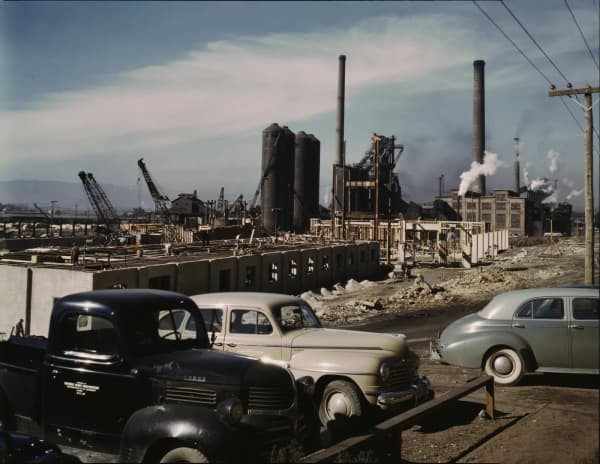
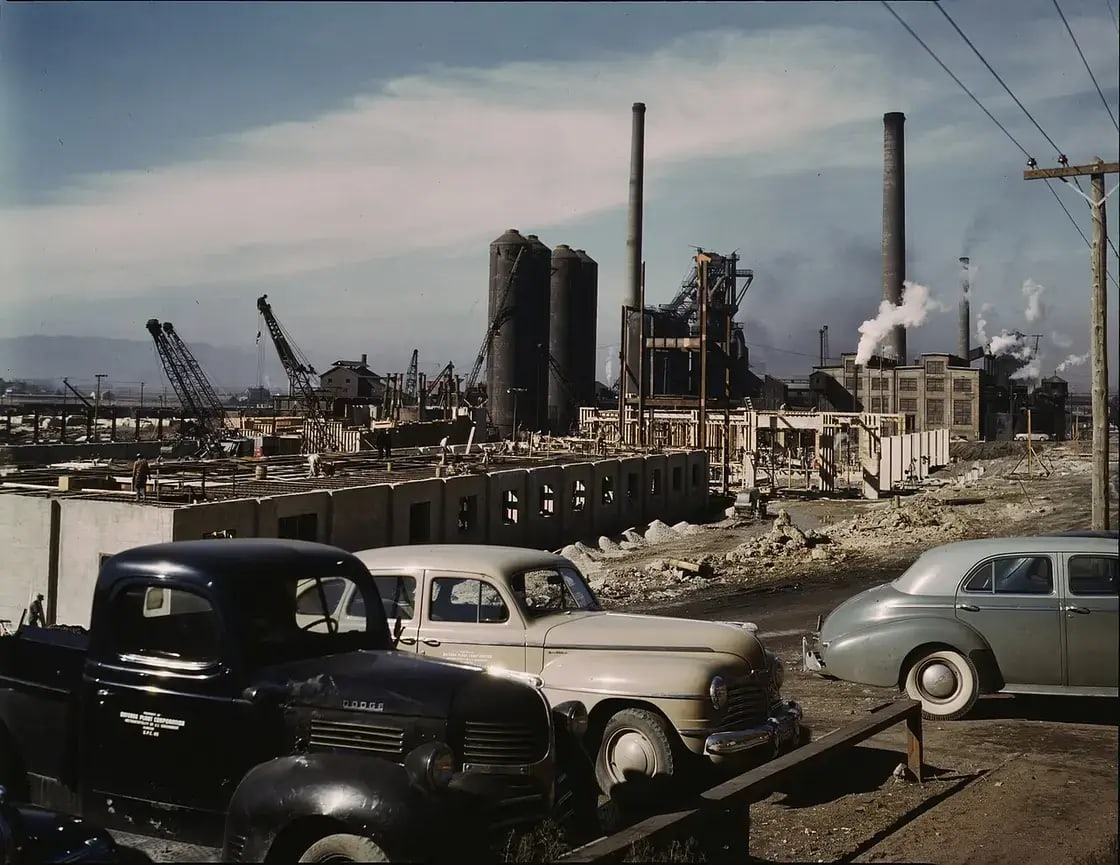
In 1941, with the country on the edge of World War II, the federal government recognized a strategic problem: nearly all of America's steelmaking sat clustered in the Midwest and along the coasts, dangerously exposed in the event of an attack or a blockade of the Panama Canal. The solution was to build a massive new steel plant deep inland, in a place safe from a Pacific invasion but close to the raw materials steel requires. Utah Valley fit perfectly — coal from Carbon County, iron ore from Iron County, limestone nearby, rail lines already running through, and Utah Lake for water.
Construction began in November 1941 under the federal Defense Plant Corporation, with thousands of workers raising the plant at remarkable speed. It took its name not from any European city but from Geneva Resort, a long-gone recreation spot that once sat on the lakeshore nearby. By December 1944 Geneva Steel was in full production, shipping plate steel to the West Coast shipyards building America's wartime fleet. To honor Utah's contribution, several Liberty Ships were named for the state — including the USS Provo.
When the war ended, the government sold the plant. In 1946, U.S. Steel bought Geneva for $47.5 million — a steep discount on a facility estimated to be worth more than $144 million. For the next four decades, Geneva Steel was the beating heart of Utah County's economy. At its peak it employed thousands, supported an entire web of related businesses, and quite literally reshaped the valley's landscape, transportation, and daily life. The complex eventually sprawled across some 1,700 acres with nearly 180 industrial buildings, some of them a mile long, laced together by an internal railroad that moved molten iron and finished steel between blast furnaces, open-hearth furnaces, coke ovens, and rolling mills.
But heavy industry in interior Utah was always swimming against the tide. By the 1980s, the same forces hammering the entire American steel industry — foreign competition, aging technology, rising labor and pension costs, and mounting environmental concern — caught up with Geneva. The plant's emissions were a serious local issue, and BYU students famously protested the pollution while researchers studied its effects on respiratory health in the valley. U.S. Steel shut the plant down in 1987; a group of local investors led by Joseph Cannon bought it and reopened it that same year as an independent Geneva Steel, betting that local ownership could make it work where a corporate giant couldn't.
For a while, it did. But the market was relentless. Geneva Steel entered bankruptcy and the plant closed permanently in 2001, ending nearly six decades of steelmaking. The story's coda is almost poetic: the bankruptcy estate sold the steelmaking equipment to an iron and steel company in Qingdao, China, which disassembled the works and shipped them overseas, finishing the job by early 2006. The remaining structures — including furnaces built to win a world war — were sold off or demolished to grade in the mid-2000s.
What remained was a vast, contaminated, empty industrial flat. In 2005, Anderson Geneva and affiliates purchased the land out of the bankruptcy estate and took on the long project of deconstruction, remediation, and redevelopment. The environmental cleanup — overseen under state permits, with progress reported to the Utah Department of Environmental Quality — has been a major undertaking in its own right, including consolidating impacted soil into an engineered, membrane-covered containment structure on site. For years, the most striking thing about the old Geneva site was simply how barren and silent it was: a blank space on the map where the valley's industrial past had stood.
That blank space is the canvas Utah City is now painted on.
That is the compressed version, told from Utah City's side of the story. For the mill's own history in full — why the government sited it here, the 1986 stoppage that it never reopened from, the phone call to Senator Hatch that saved the coke ovens in 1987, the air-quality argument, and the one building in Utah County you can still walk into that is made out of Geneva — see Geneva Steel: the mill that built Utah Valley.
The big idea: a downtown for a county that never had one
Here's the thing about Utah County: it's huge, it's booming, and it has no center.
The county passed 700,000 residents in recent Census estimates and consistently leads the state in growth — a figure from the American Community Survey, one of the publishers in our guide to Utah County data sources —. Yet across its string of cities — Provo, Orem, Lehi, American Fork, Pleasant Grove, Spanish Fork, and the rest — the county has never had a single, recognizable downtown the way Salt Lake City does. Ask someone to picture "downtown Utah County" and they can't, because there isn't one.
The developers behind Utah City have made that exact gap their entire pitch. As Woodbury Corporation's Jeff Woodbury put it when the project was unveiled: "No one knows where Lehi, Utah, is — but everyone will know where Utah City is. What we're creating is the downtown of Utah County."
And they're not just trying to build a downtown — they're trying to build a specific kind of downtown: dense, walkable, and transit-oriented, where you can live, work, shop, eat, and see a doctor without getting in a car for every errand. That's a radical proposition in Utah Valley, which like most of the Mountain West was built almost entirely around the automobile, with wide roads, big parking lots, and separated single-use zones.
The reason the idea has real credibility — and isn't just developer hype — comes down to who's behind it and who was hired to design it.
The people and ideas behind it
The developers. Utah City is a partnership between two Utah firms. Flagship is the homebuilder responsible for much of Vineyard's explosive growth: it built its first home there in 2012, when the area had about 150 residents, and — in the words of co-managing partner Nate Hutchinson — later "acquired 90% of the developable land left in the city," completing those purchases by 2021. Woodbury Corporation is one of Utah's most established commercial real-estate firms (it's also the company behind Orem's University Place). The two operate Utah City through a 50/50 joint venture called Flagborough. Vineyard's growth since then has been among the fastest in the state.
The designers. This is the part that gives urban-planning nerds chills. The developers set out to design the community around walkability from the ground up, with the FrontRunner station and the Greenline as its organizing spine.
The design intent is specific: streets built for people, not just cars; buildings that front onto sidewalks and plazas instead of parking lots; protected bike lanes and deliberately narrower roads that slow traffic; and daily needs within an easy walk of the FrontRunner station. Hutchinson frames the philosophy bluntly: "Historically, communities were all designed around people, and over the last 70 years — especially in the United States — we've designed things around the automobile. … We used to work, live, worship, recreate, do everything within walking distance."
In other words: this isn't a developer slapping the word "walkable" on a conventional subdivision. The people who wrote the playbook on walkable cities are the ones drawing it.
What it's supposed to be, by the numbers
At full build-out, the published plans describe something large:
- Roughly 700 acres of total land on the eastern shore of Utah Lake.
- Mixed-use space for living, shopping, dining, entertainment, hospitality, and offices.
- Parks and green space organized around the 12-acre Greenline Promenade.
- A town center near the FrontRunner station.
- Housing across the full spectrum. Hutchinson describes it as a place where "[up to] $4 million product is sold, and … a place where you can rent a studio apartment." How fully the affordability half of that vision is realized is one of the real open questions — a fair thing for residents to keep watching.
The organizing feature is The Greenline — a roughly 12-acre ribbon of parks and public space designed to run from the Vineyard FrontRunner station through the heart of the development to the shore of Utah Lake. The idea is that the train drops you steps from the action and a continuous green corridor pulls you all the way to the water. Announced plans for its waterfront stretch include an amphitheater, an off-leash dog park, sand volleyball courts, and an eventual direct lake connection — with more than a thousand drought-tolerant trees planned along the corridor.
Two anchors give the whole thing weight beyond shops and apartments:
The FrontRunner station. This is the foundation the entire project is built on. UTA's Vineyard FrontRunner station opened in August 2022, giving the site direct commuter-rail access to Provo, Orem, Salt Lake City, and points north. A walkable downtown is only walkable if it connects to the wider region without a car, and the station is what makes Utah City's transit-oriented premise real rather than aspirational. (The statewide FrontRunner 2X double-tracking program, if delivered as planned, would make that connection considerably better — and the developers say light rail and stronger bus service are part of the long-term picture.) Utah Valley's other connectivity story is in the air: Provo's own airport is now Utah's second-busiest and is building toward 10 gates. Just across the tracks, Utah Valley University holds more than 200 acres for a future Vineyard campus, adding a university population to the mix — see our UVU guide for how that school is growing.
The Huntsman Cancer Institute. In a move that instantly elevated the project from "ambitious development" to "regional landmark," the Huntsman Cancer Institute — the Mountain West's only National Cancer Institute-designated Comprehensive Cancer Center — chose Utah City for its second major campus. Site work began in late 2024, and the ceremonial groundbreaking came on April 8, 2025. Phase 1A is a 284,000-square-foot facility — a five-story clinical care building and a three-story research building on about 20 acres of land donated by the developers — carrying a price tag of about $400 million, the largest single investment in the institute's history, backed by a $75 million matching gift from the Huntsman Family Foundation and contributions from The Church of Jesus Christ of Latter-day Saints, the State of Utah, and the developers themselves. Per the institute's published timeline, the facility is anticipated to open in 2028, with first patient visits anticipated that September — and a later phase is planned to add inpatient care and a surgical center. The logic is straightforward: a Vineyard campus saves families in the central and southern parts of the state hours of round-trip driving per visit.
The sustainability angle (and the geothermal experiment)
Utah City's marketing leans hard on sustainability, and some of it is more than marketing. The developers have said they aim to make it the first LEED-certified community in the state.
The most concrete and novel piece is the energy system. Utah City is being built with a district energy system — developed with the energy company Corix — that uses geothermal technology and recycled waste heat to provide heating and cooling through a shared underground network rather than a furnace and air conditioner in each building. The project touts a large cut in carbon emissions compared with conventional systems. Whether the system delivers on its promises at full scale is something the next several years will reveal, but it's a real attempt at something most American developments don't even try.
What's open (as of July 2026)
This is the part that cuts through the renderings. Here's what has moved from concept to concrete:
- First residents (2025). The first residential phase — hundreds of units from studios up through three-bedroom townhomes across the first completed buildings — opened and began filling.
- Bella's Market (November 2025). The development's first major amenity, and a genuine milestone for Vineyard: a full grocery store, locally owned and operated by Logan-based Lee's Marketplace in partnership with Utah City, with a scratch bakery, butcher block, florist, and drive-thru pharmacy. Its grand opening drew more than 1,000 people and it ended residents' need to drive to Orem for milk.
- Berliner Play Area (spring 2026). An inclusive, all-abilities playground — anchored by a striking hot-air-balloon play structure — opened along the Greenline as one of the first public green-space pieces, alongside Civic Park and its outdoor fitness programming.
- Fini Pizza and Fini Café (May 2026). The attention-grabbing get: Brooklyn restaurateur Sean Feeney chose Utah City for a Fini Pizza location. It opened in early May 2026 next to Bella's Market with a packed crowd, a custom Fini Hoops basketball court outside, and a community league to go with it. Feeney hired a 35-person team in two weeks — six of them culinary students at UVU.
- Utah City Racquet Club (2026). The racquet club, built around outdoor padel courts, opened in 2026.
- In the works. Further stretches of the Greenline and its waterfront parks, which were still under construction this spring.
It's worth being clear-eyed: a large majority of the 700 acres is still fenced construction site or open ground waiting its turn. The cancer campus isn't anticipated to open until 2028. The lakefront isn't connected yet. But the difference between 2023 — when, as Feeney put it, the site was just "800 acres of dirt" and renderings — and the summer of 2026 is the difference between a slideshow and a place where you can buy groceries, eat a famous slice of pizza, and let your kids loose on a playground. That's a meaningful threshold to have crossed.
The honest concerns
A development this big and this fast doesn't arrive without friction, and it would be dishonest to write about Utah City as if everyone in the valley is thrilled. The recurring worries are the reasonable ones:
- Water. Utah is a desert, Utah Lake is a stressed resource, and a development ultimately adding thousands of residents raises hard long-term questions about water — questions that apply to all of the valley's growth, but land with particular weight on its lakeshore.
- Traffic and density. Even with a train station, a lot of new people means a lot of new cars, and longtime residents of a town that had 150 people in 2012 have watched it become a small city — a pace that would give anyone whiplash.
- Affordability. "Homes for everyone" is the pitch; whether the built reality includes attainable housing, and not just luxury product with a studio rental garnish, is the open question worth tracking.
The developers don't pretend the skepticism doesn't exist. "Specifically in Utah, people are fearful," Hutchinson acknowledged this summer. "People think, 'You're forcing this type of high-density development on us,' and I think it's really important to clarify that this is a choice." Their core argument is that the region is going to grow enormously no matter what — the only question is the form that growth takes, and that dense, walkable, transit-served growth handles it better than endless car-dependent subdivisions. Whether that promise holds — on water, on traffic, on affordability — is unsettled. It's the kind of thing worth watching rather than pronouncing on. But the concerns are real, they're held by thoughtful people, and they deserve to be part of the story.
What it means if you live here (or want to)
For Provo and Orem residents, the near-term reality of Utah City is simple: it's a new place to go. You can shop at Bella's Market, let your kids loose on the Berliner playground, walk the first finished stretches of the Greenline, and line up for a Fini slice — the public spaces are deliberately open to everyone, resident or not. Pair a visit with our guide to the best restaurants in Vineyard, and take the FrontRunner to the Vineyard station to arrive the way the whole place was designed to be entered.
For anyone thinking about living there — or anywhere in fast-growing Vineyard — the housing math deserves clear eyes. New-construction condos and townhomes in developments like this are exactly the kind of product covered by Utah's S.B. 240 first-time buyer assistance (which applies only to new construction under a price cap, and which is funded by a fixed legislative appropriation that is available only until it is depleted — so it is first-come rather than an entitlement), so before you fall in love with a rendering, read our new construction vs. resale comparison (which digs into builder incentives and that S.B. 240 program), our honest rent-vs-buy analysis for Utah Valley, and our guide to buying a home in the surrounding cities. Our Living in Vineyard guide covers the city itself — schools, commutes, and what day-to-day life there looks like — and our real-estate market check-in covers where valley prices stand.
Step back far enough, and Utah City is really a bet about the future of how Utah grows. For decades, growth in the Mountain West has meant one thing: sprawl. Utah City is a high-stakes, high-visibility test of a different model — that you can build dense, beautiful, walkable, transit-served places in Utah, and that people will want to live in them. If it works, it becomes a template. If it stumbles, that's instructive too. Either way, it's happening on ground that already watched one era of the valley's history rise and fall — which gives the whole thing a certain weight.
Keep an eye on it. We will be.
Planning a trip to see it for yourself? Pair a visit with our guides to things to do in Vineyard, day trips from Provo, and the full picture of living in Vineyard. Watching the area's growth? See our guides to Living in Orem and Living in Lehi, and follow The Wire for the latest Utah Valley news.
Related Guides
- Seven Peaks: How Provo's Water Park Nearly Died
- iProvo: The City That Built Its Own Internet, Sold It Twice, and Kept the Debt
- Provo Development Tracker — how station-area plans and annexations move through approval
- Vineyard and the Geneva site
- The Utah Valley housing market, read honestly
- Master-Planned Communities of Utah County: What They Actually Are, and What You Give Up
Frequently Asked Questions
What is Utah City in Vineyard, Utah?
Is Utah City a city?
What was on the Utah City site before?
Who is building Utah City?
When will Utah City be finished?
Sources
The facts in this guide were checked against these sources. Hours, fees and rules change, so confirm anything time-sensitive with the source before you go. How we make Provo.com.
- Breaking Ground on Our Comprehensive Cancer Center in Vineyard (April 8, 2025), Huntsman Cancer Institute, University of Utah Health. Checked October 12, 2026.
- New Cancer Campus Begins to Rise in Vineyard (September 2026), Huntsman Cancer Institute, University of Utah Health. Checked October 12, 2026.
- Geneva Steel Plant (Utah History Encyclopedia), Utah Education Network / Utah History Encyclopedia. Checked October 12, 2026.
- Utah City | A New Sustainable And Connected Mixed-Use Urban Core, Utah City (Flagship Companies and Woodbury Corporation). Checked October 12, 2026.
- Vineyard celebrates new FrontRunner station and buildout of city, Daily Herald. Checked October 12, 2026.