
It's 9 p.m. on a Sunday. Your kid's fever won't break, or your ankle has doubled in size since the pickup game, or that cough has turned into something that whistles. You pull out your phone and type the question thousands of Utah Valley residents type every year: urgent care near me — or is this an ER thing?
That decision matters twice. Once medically — some symptoms should never wait in an urgent care lobby — and once financially, because the same sore throat can cost you a modest copay at a walk-in clinic or a four-figure bill at a hospital emergency department. This guide lays out how the tiers of care work, every ER and major urgent care network in Provo and Orem, and the honest logic for choosing between them.
One thing up front: this is general information, not medical advice, and it is no substitute for a clinician's judgment. The universal rule from emergency physicians is simple — if you are unsure whether something is an emergency, treat it like one and call 911. Nothing below overrides that.
The four tiers, in one minute
Think of Utah Valley's system as four levels, from most to least intensive:
1. The emergency room (or 911). For anything life- or limb-threatening. Open 24/7, equipped for the worst, and priced accordingly.
2. Urgent care. Walk-in clinics for same-day problems that aren't dangerous — staffed by physicians and PAs, usually with X-ray and basic labs on site, open evenings and weekends.
3. Your primary care doctor. The right home for anything that can wait a day or two, for follow-ups, and for ongoing conditions. If you don't have one yet, our Provo healthcare guide walks through finding a doctor here.
4. Virtual care and nurse lines. Intermountain's Connect Care offers virtual urgent care around the clock, and both major hospital systems run nurse advice lines that will tell you, for free, which of the other three tiers your symptoms belong in. When you're stuck between tiers, a nurse line is the cheapest second opinion in medicine.
When it's the ER — no debate
Standard emergency guidance is remarkably consistent, and it's worth committing the short list to memory. Call 911 or go directly to an emergency room for:
- Chest pain or pressure, especially with sweating, nausea, or arm/jaw pain
- Trouble breathing
- Signs of stroke — face drooping, arm weakness, slurred speech, sudden confusion (act fast; stroke treatment is brutally time-sensitive)
- Severe bleeding that won't stop with pressure
- Head injuries with loss of consciousness, confusion, or repeated vomiting
- Sudden, severe headache unlike any you've had
- Serious allergic reactions — swelling of the face or throat, hives with breathing trouble
- Broken bones that are visibly deformed or have broken the skin
- Any fever in an infant under about three months (call your pediatrician or go in — don't wait on this one)
- Suicidal thoughts or a mental health crisis — the ER is a legitimate front door for this, and so is calling or texting 988, the Suicide & Crisis Lifeline, which is free and answers 24/7
Two more numbers worth saving now, while nothing is wrong: Poison Control, 1-800-222-1222, answers 24/7 and resolves a remarkable share of scares over the phone. And 988 is worth having in your contacts even if you never expect to need it.
If it's on the list above, stop reading and go. Everything else in this article is for the situations below that line.
When urgent care is the right call
Urgent care exists for the huge middle category: problems that need a professional today but don't need a trauma bay. The clinics in our valley — Intermountain's, Revere's, and CareNow's own published lists all agree here — routinely handle:
- Colds, flu, sore throats, and ear or sinus infections
- Fevers in older kids and adults
- Sprains, strains, and many simple broken bones (most clinics have on-site X-ray)
- Cuts that probably need stitches
- Urinary tract infections
- Nausea, vomiting, diarrhea, and mild dehydration
- Minor burns, rashes, bug bites, and eye irritation
- Migraines and minor head bumps without red-flag symptoms
- Sports physicals, school physicals, and work-related visits at many locations
A useful mental model: urgent care is a doctor's office with evening hours, walk-in access, and an X-ray machine. It is not a mini-ER. If a clinic decides you're sicker than their walls can handle, they'll send you to the hospital — which is the system working, but also a reason to skip the middle step when your gut already says "hospital."
The money part, honestly
Exact prices depend on your insurance, your deductible, and what gets done to you, so treat everything in this section as directional rather than a quote. But the direction is not subtle.
An urgent care visit generally bills like an office visit plus any tests — and insurers typically set urgent care copays close to a regular doctor-visit copay. An ER visit stacks a hospital facility fee (the price of walking through the door of a building that maintains trauma bays and 24/7 specialists), separate physician fees, and emergency-department pricing on every scan and lab. Bills for ER episodes that urgent care could have handled commonly land in the thousands of dollars; insurers price the difference into copays too, with ER copays typically running several times an urgent care copay. Intermountain itself plainly tells patients its urgent care treatments are "typically less expensive than emergency rooms," and Revere pitches its urgent cares on the same logic.
None of this math applies to a real emergency. Nobody should triage chest pain against a deductible — that's what the 911 list above is for. The savings live entirely in the middle category, where the ear infection is going to get the same antibiotic either way.
One consumer trap worth knowing as the valley grows: freestanding emergency rooms are emergency rooms. MountainStar operates one, Westlake Emergency Center on Redwood Road in west Lehi, toward Saratoga Springs, and more of these standalone ERs are appearing across Utah. They can be useful — full emergency capability without the hospital drive — but they look like urgent care from the parking lot and bill like the ER they are. Read the sign before you walk in.
The emergency rooms of Utah Valley
Utah Valley Hospital — Provo (Intermountain Health). 1034 N 500 W, with the emergency entrance on the east side of campus along 300 West. This is the region's flagship: the only designated Level II trauma center between the Salt Lake Valley and St. George, a 395-bed hospital with a 46-bed emergency department plus trauma bays, a 24/7 Life Flight base, a designated Stroke Center of Excellence, and — per the hospital — the county's only ER with round-the-clock coverage across the major surgical specialties. For the scariest stuff, this is where the valley goes, and where smaller hospitals across central Utah transfer their most serious patients. It sits a few blocks from the future BYU medical school campus, which is no accident.
Timpanogos Regional Hospital — Orem (MountainStar / HCA Healthcare). 750 W 800 N. A full-service 122-bed hospital, open since 1998, with a 24/7 ER designated as a Level III trauma center and specialized treatment tracks for chest pain and stroke. Its standout feature for families: a dedicated pediatric ER with pediatric intensive care backup — a genuine differentiator when the patient is seven years old and terrified. More in our Timpanogos Regional guide.
Orem Community Hospital — Orem (Intermountain Health). 331 N 400 W. The valley's small community hospital, long known for its labor-and-delivery program — with a 24/7 emergency department. For central Orem residents with a middle-severity emergency, it's often the closest door; for major trauma, crews and transfers head to the bigger facilities. More in our Orem Community Hospital guide.
Worth knowing about, farther out: Intermountain's American Fork Hospital runs a 24/7 ER serving the north county, and MountainStar's freestanding ER at Westlake covers the fast-growing Saratoga Springs side of the lake (see the billing note above). If you live mid-valley, though, the three hospitals above are your map. See our guides to American Fork Hospital and Spanish Fork Hospital.
The urgent care networks
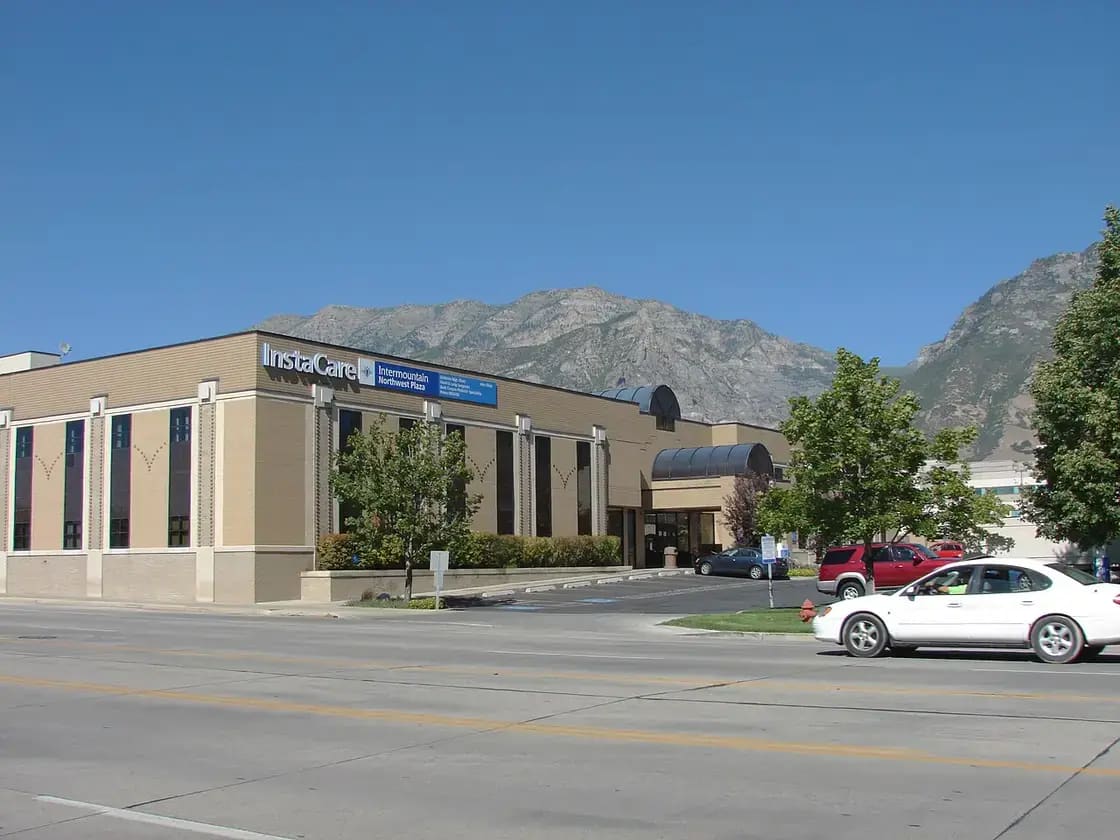
Intermountain InstaCare. The dominant walk-in brand in Utah. The flagship local site is the Utah Valley Clinic InstaCare at 395 W Cougar Blvd in Provo, on the hospital campus, and Intermountain operates additional InstaCare clinics around Utah County. Their KidsCare clinics are the pediatric-specialized version of the same idea. Intermountain says most locations run seven days a week with extended hours; check the location finder on intermountainhealthcare.org for the nearest clinic, live hours, and online check-in. Bonus if you're already in their system: your records are on file when you walk in. Every location, with hours, is in our urgent care locations guide.
Revere Health Urgent Care. Revere — the big independent physician group that was founded in Provo and still runs its main campus at 1055 N 500 W — operates walk-in urgent care clinics around the valley. Per Revere, its urgent cares are open seven days a week, generally 8 a.m. to 8 p.m., handle everything from sore throats to fractures and IV fluids, and are pitched explicitly as the lower-cost, shorter-wait alternative to the ER, with copays that match a primary care visit on most plans. If Revere is in your insurance network for primary care, their urgent care keeps everything in one chart.
CareNow Urgent Care — Orem. MountainStar's urgent care brand, at 117 N State St near Orem City Center, with another clinic in American Fork. Open seven days a week with extended evening hours, equipped with X-ray and lab, and notable for its Web Check-In — you claim your place in line online and show up when it's close to your turn, which is worth a lot with a miserable toddler in the back seat.
Wait times at all of them swing with the season — expect longer lobbies during flu season, the first weeks of a semester, and Monday evenings. Bring a photo ID, your insurance card, and a current medication list, and use online check-in wherever it's offered.
If you're a student
Both universities run their own clinics, and they should usually be your first stop for non-emergencies — they're cheaper, they're on campus, and they know the student-life failure modes cold. BYU's Student Health Center and UVU's Student Health Services both handle routine illness and injury for enrolled students at student prices; our Student Health & Wellness Guide covers both in detail, including the mental-health side. For evenings, weekends, and anything beyond a campus clinic's scope, everything above applies to you too — the InstaCare on Cougar Blvd is a short trip from either campus.
The billing protection that changed emergency care
Since January 1, 2022, federal law has removed the worst financial surprise from the decision above. The No Surprises Act requires that emergency services be billed at your plan's in-network cost-sharing level — your normal deductible, copay and coinsurance — regardless of whether the emergency room, or the physicians working in it, are in your insurer's network. You cannot be balance billed for the difference between what the hospital charges and what your plan pays. The protection follows you through stabilization, and continues afterward until you can safely be moved.
This matters more than it sounds. Emergency physicians are frequently contracted separately from the hospital that employs the building, which is how patients used to end up with an in-network hospital bill and an out-of-network doctor bill from the same visit. That specific trap is closed.
Two limits are worth knowing before you rely on it.
Your cost-sharing still applies. "No balance billing" does not mean "no bill." If your plan has a $3,000 deductible and 20% coinsurance, you still owe the deductible and the coinsurance — the law caps the rate at which you are charged, not your exposure under your own policy. An emergency visit remains expensive; it just cannot be arbitrarily expensive.
Ground ambulances were left out. This is the single largest gap in the federal law, and it is the one most likely to affect a Utah Valley household. Air ambulances are covered by the No Surprises Act; the ground ambulance that shows up when you call 911 is not. A federal advisory committee on ground ambulance billing was convened to study the problem and reported recommendations, but closing the gap federally would take an act of Congress.
Utah closed the ambulance gap itself
Utah is one of the states that did not wait. HB 301, the Ambulance Provider Payment Amendments, took effect May 7, 2025 and rebuilt how ground ambulance transports are billed in this state. The enrolled bill codifies a base rate for ground ambulance transports in Utah Code § 53-2d-503, prohibits providers from charging above the established rates, prohibits balance billing, and requires health benefit plans and workers' compensation carriers to accept the state-set base rate, medication maximum cost and mileage rate as allowable expenses — then pay the ambulance provider directly, even when that provider is out of network. Disposable supplies were folded into the base rate rather than itemized separately, and the statute sets out a process for annual rate adjustment.
The Utah Insurance Department followed with Bulletin 2025-9 in September 2025, directing insurers to calculate the allowable amount at no less than the statutory base rate, medication maximum and mileage rate, and to review their claims processing for compliance.
Two caveats belong with that, and both are easy to miss.
HB 301 carried a repeal date. The 2025 bill created a sunset, and the Legislature returned to the subject in the 2026 session with HB 269, which addresses the window running from July 1, 2026 to July 1, 2027. Ground ambulance billing in Utah is therefore live, actively legislated policy rather than settled law — check the current status of § 53-2d-503 before relying on any particular figure or date.
We are deliberately not printing the rates. The base rates and the per-mile rate are set by statute and administrative rule (Rule R911-8) and adjust on a schedule tied to a medical cost index. Any dollar figure published here would be wrong within a year. The Utah Bureau of Emergency Medical Services, now housed under the Department of Public Safety, publishes the current base rates — and states plainly that it does not arbitrate billing disputes. Rate questions go to the Bureau; bill disputes go to your insurer or the ambulance service.
Also worth knowing: banning balance billing does not make the ride free. On a plan with 20% coinsurance, the ambulance company can still bill you that 20%. And billing an uninsured patient is not "balance billing" in the statutory sense at all — if you have no coverage, you are outside this protection and inside a different one, the good faith estimate described in our therapy guide.
The bottom line
Save three things in your phone tonight: 988 (mental health crisis), 1-800-222-1222 (Poison Control), and the address of your nearest urgent care. Learn the short 911 list at the top of this piece. And for everything in the middle — the Sunday fevers, the pickup-game ankles — the valley has you covered seven days a week for a fraction of an ER bill, at an InstaCare, a Revere clinic, or CareNow, usually within a ten-minute drive.
When in doubt about severity, though, there's no cleverness to it: err toward the ER. The worst outcome of overreacting is a bill. The worst outcome of underreacting is worse.
New to the valley's healthcare system? Start with our full Provo healthcare guide for finding a doctor, dentist, and pharmacy. Parents will want our guide to finding a pediatrician in Utah Valley, and for a dental emergency or just a new dentist, finding a dentist in Provo. Students should bookmark the Student Health & Wellness Guide. Looking for mental health support instead? Our guide to finding a therapist in Utah Valley covers costs, low-cost clinics, and how to get an appointment — and our What's Open Now tool can tell you which pharmacies are open at this very moment.
Related Guides
- Assisted Living & Senior Care in Utah Valley: How to Read the System
- Massage Therapy in Provo: What the Person Working on You Is Legally Required to Show
- Chiropractic vs. Physical Therapy in Utah Valley: Which One You Need (2026)
- Pharmacies in Provo: Late Hours, Transfers & What Utah Lets Pharmacists Do
- Eye Exams & Glasses in Provo: Who Takes What Insurance, and Where to Go
- Dermatology in Utah Valley: Skin Checks, Skin Cancer & Finding a Dermatologist (2026)
- The New Parent Survival Guide to Utah Valley
- Donating Plasma in Provo: How It Works, Who Can, and What the Centers Don't Advertise
- Health Insurance in Utah, Explained
- The Provo Newcomer's Guide — health setup as a first-month task rather than an urgent one
- Hearing Aids and Audiologists in Utah Valley: What Changed in 2022, and What Still Requires a Prescription
- Utah Valley Hospital: The Complete Visitor and Patient Guide
- Sports medicine in Utah Valley — when an injury needs neither urgent care nor the ER
- Intermountain, MountainStar, Holy Cross, U of U Health and Revere: Which Network Runs Which Hospital in Utah Valley
Frequently Asked Questions
When should I go to the ER instead of urgent care?
What emergency rooms are in Provo and Orem?
What urgent care clinics are in Provo and Orem?
How much more does an ER visit cost than urgent care?
Is there anywhere to get care in Provo on a Sunday or late at night?
Can I be balance billed for an emergency room visit in Provo?
Does the No Surprises Act cover ambulance rides?
If ambulance balance billing is banned in Utah, is the ride free?
Sources
The facts in this guide were checked against these sources. Hours, fees and rules change, so confirm anything time-sensitive with the source before you go. How we make Provo.com.
- 2025 Trauma Centers (05/14/25), Utah Bureau of Emergency Medical Services. Checked October 12, 2026.
- Ambulance Billing Questions, Utah Bureau of Emergency Medical Services. Checked October 12, 2026.
- H.B. 301 Ambulance Provider Payment Amendments (2025), Utah Legislature. Checked October 12, 2026.
- Timpanogos Regional Hospital, MountainStar Healthcare (HCA). Checked October 12, 2026.
- Westlake Emergency Center, MountainStar Healthcare. Checked October 19, 2026.