
Five plasma collection centers sit within a few miles of the Provo–Orem line, with more in Spanish Fork and American Fork. For a metropolitan area this size, that is a striking amount of collection capacity, and it is not a coincidence.
Plasma centers cluster around universities. The economics are simple and not especially subtle: the industry needs a large, healthy, geographically stable population of adults who have time in the middle of a weekday and a use for a few hundred dollars a month, in a town where the part-time job market is heavily oversubscribed. A college town supplies all four conditions at once, and Provo supplies them at unusual density.
That is the context most guides leave out. What follows is the practical version — where the centers are, what the process involves, what will stop you at the door, and the parts worth thinking about before it becomes a routine.
The centers
Biomat USA, Provo. Part of the Grifols network. Check its current hours, including whether it offers any Sunday hours.
Grifols, Provo. Another Grifols-network center; check its current hours.
Orem carries three more within a short drive: a Grifols center and a BioLife Plasma center, both on University Parkway near the mall, and ABO Plasma on North State Street. Because these are separate companies rather than branches of one, their compensation structures, appointment systems and screening details differ from each other.
Further out, Spanish Fork and American Fork each have a center, which matters mainly for the residency rule: most centers require donors to live within a defined radius, so the nearest center to your actual address is generally the one that will take you.
A note on choosing between them. The local review record — and there are thousands of reviews across these centers — divides fairly consistently along a single axis: speed versus payment. Donors describe one company as quicker and another as paying better, and the sensible reading is that this is a real trade-off rather than a quality difference. Which side of it you want depends on whether the scarce resource in your week is time or money.
What happens
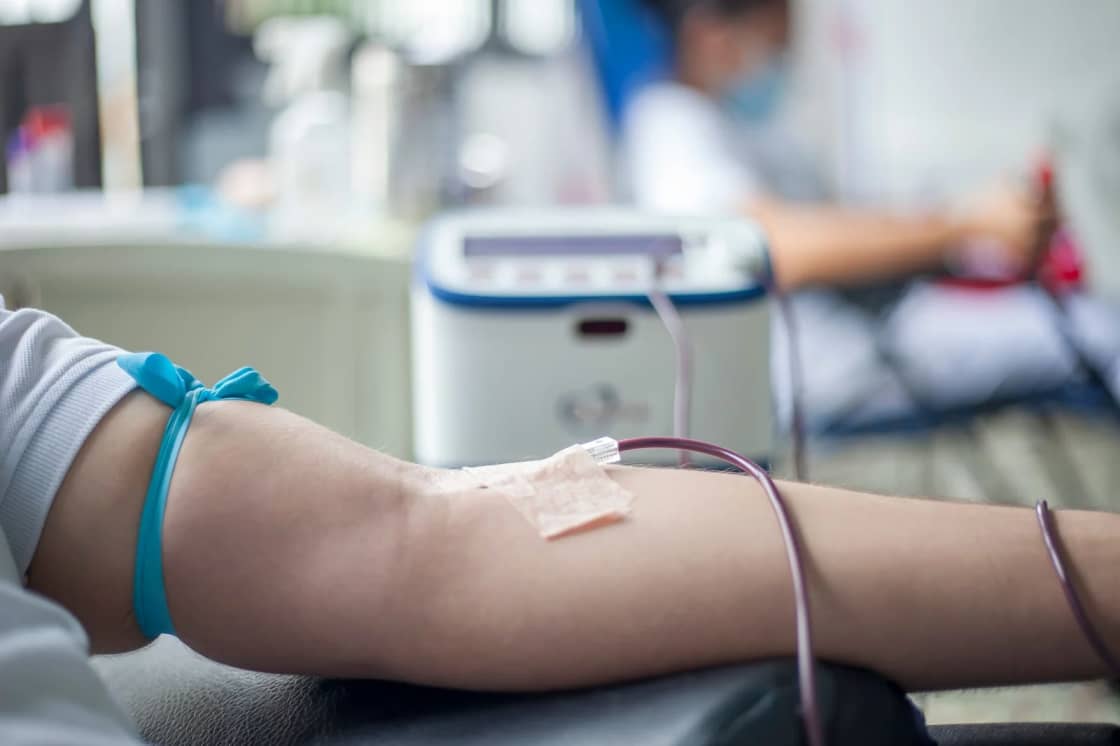
Blood is drawn from one arm. A machine separates the plasma — the straw-colored liquid portion, roughly half of blood by volume — from the red cells. The plasma is collected; the red cells are returned to you, usually with a small volume of saline.
That return is the whole reason plasma donation can be done far more often than whole blood donation. You keep your red cells. Your body replaces the plasma volume quickly, largely from the fluid you drink.
The plasma itself goes into manufacturing. It is fractionated into therapies for immune deficiencies, clotting disorders such as hemophilia, a genetic form of emphysema, and into immune globulins used against tetanus, rabies and hepatitis exposure. These are not products with synthetic substitutes. They are made from human plasma or they are not made, which is why the collection industry exists in the form it does.
The first visit is not like the others
Many first-time donors underestimate this.
The first appointment includes a full medical history questionnaire and a physical examination, in addition to everything a routine visit involves. It takes substantially longer than a return visit, and turning up an hour before closing on your first day is how you end up being asked to come back.
Bring three things:
- Photo identification that is current and valid.
- Proof of your Social Security number.
- Proof of your current address — mail, a lease, a utility bill, something with your name and the address printed on it.
Bring all three even where a center's site implies two. The address requirement is the one that catches students who have moved apartments recently and whose identification still shows a parents' address in another state, and it is a common reason a first visit fails before it begins.
Once you are enrolled, each visit includes a shorter screening: vital signs, and a fingerstick to check hematocrit and total protein. Both of those can put you out on the day even if you were fine the week before, which is why the eligibility conversation is really two conversations — are you eligible in general, and are you eligible today.
Who can and cannot donate
The general requirements are age 18 or older, a weight of at least 110 pounds, and good general health.
Beyond that, screening is a layered system. Some rules come from federal regulation, some from the individual company's own policy, and that is why the answer to "am I eligible" is not uniform across the five centers within driving distance. A deferral at one is worth testing at another before you conclude the answer is no everywhere.
Temporary deferrals are the common case and they are the ones worth understanding, because people treat them as permanent and stop coming.
- A recent tattoo or piercing carries a waiting period.
- Antibiotics generally mean waiting until the course is finished and the underlying infection resolved.
- Pregnancy, and a period following pregnancy.
- Low hematocrit or low total protein on the day's fingerstick.
- Recent illness, fever, or certain vaccinations.
- Some recent international travel.
Ask the specific question at the counter: how long is this deferral, and what date can I come back? Get the date rather than the category. Staff will tell you, and the answer is often much shorter than people assume.
Permanent deferrals attach to certain chronic diseases and long-term medical conditions. These are decided on medical criteria and are not negotiable at the desk.
The frequency ceiling, and the part worth thinking about
Federal regulation (21 CFR 640.65) says plasmapheresis collections may not occur less than 2 days apart or more than twice in a 7-day period. Centers work to that ceiling, and compensation structures are commonly built around donors who reach it.
It is worth separating two questions that the industry's marketing tends to merge.
May you donate twice a week? Yes. That is the regulatory answer and it is settled.
Should you donate twice a week, every week, for years? That is a medical question about you specifically, and the honest position is that it is not one a website should answer — including this one. The short-term effects of a single donation are well characterized and mild. The literature on sustained high-frequency donation over long periods is thinner and less settled than the confident tone of most plasma-center advertising implies, and total protein levels are monitored at each visit precisely because there is something there worth monitoring.
If plasma has become a fixed line in your monthly budget rather than an occasional thing, that is the point at which it deserves a conversation with your own doctor — someone whose relationship is with you rather than with the collection.
How the money is structured
This page does not print compensation figures, and the reason is that they would be wrong within weeks. Plasma pay in a competitive market moves constantly — promotional cycles, seasonal pushes, competing offers from the center two miles away. Any number written down here would be stale before most people read it.
The structure, though, is stable across the industry and worth understanding, because it explains behavior that otherwise looks arbitrary.
New-donor compensation is heavily front-loaded. The advertised figure is almost always a total across a set number of donations completed inside a set window — typically the first month. Miss the window and the bonus schedule collapses to the ordinary rate. This is a customer-acquisition cost, structured exactly the way one would expect.
Return pay is usually banded, and often varies by weight, because heavier donors can safely give a larger plasma volume per session. Two people leaving the same center on the same afternoon can be paid differently and both be paid correctly.
Within a week, the second donation frequently pays more than the first. The industry wants donors at the regulatory ceiling rather than below it, and prices accordingly.
Payment arrives on a reloadable prepaid card, not in cash. Read the card's own fee schedule — inactivity fees and out-of-network withdrawal fees are where a meaningful slice of the money quietly goes back.
The practical consequence of the front-loading is that the new-donor promotion at a center you have never used is the best rate available to you, and it is available exactly once per company. Some donors work through the local companies in sequence for that reason. It is not a trick; it is the offer as designed.
The registry that makes the ceiling enforceable
Here is the part that surprises people, and it answers an obvious question: if there are five centers run by four different companies within a few miles, what stops someone from donating at all of them in one week?
Centers use biometric identification at check-in — fingerprint or similar — rather than relying on a card and a name. Donors in the local review record mention it in passing, generally as something that sped up the queue.
Its real function is not queue management. Compensated plasma collection in the United States operates a cross-company deferral and frequency system, so that a donor deferred for a medical reason at one company does not simply walk into the next one, and so that the twice-in-seven-days ceiling holds across the whole industry rather than per storefront.
Two things follow. First, the ceiling is not an honor system, and attempting to work around it does not work. Second, a deferral is portable — which is the other half of the earlier point about testing a second center. Company-specific policy differences are real and worth testing; a medical deferral generally travels with you.
Plasma money is taxable, and nobody tells you at the counter
This one catches people every year and it is worth stating plainly.
Compensation for plasma donation is income. It is taxable, and it is taxable whether or not the center sends you a tax form. Many centers do not issue one, because the reporting threshold for the form is not the same thing as the threshold for the income being taxable — those are two different rules and only one of them is about you.
It is not "donation" income in any tax-relevant sense, despite the word. You are being paid for a service, and the deduction people sometimes ask about — a charitable deduction for donating — does not exist here, because you were compensated.
For a student donating occasionally, the amounts may be small enough that nothing else in the tax picture changes. For someone donating at the ceiling most weeks of the year, the annual total is not trivial and is worth tracking as you go rather than reconstructing in April from prepaid-card statements. Keep a simple running record.
If plasma is a substantial part of your annual income, this is a question for a tax professional rather than for a forum thread — and specifically it is worth asking how it interacts with anything else you are claiming, because income that nobody reported to you is still income you reported wrongly if you leave it out.
Making it go well on the day
The advice here is unglamorous and it works.
Hydrate the day before, not just the morning of. Plasma is mostly water. Arriving dehydrated makes the draw slower, makes the veins harder to find, and makes lightheadedness far more likely. Water in the evening beforehand does more than water in the parking lot.
Eat a real meal beforehand, with protein in it, and avoid a fatty meal immediately before — lipemic plasma, which looks cloudy, can get a donation rejected on the spot.
Iron matters, because hematocrit is checked every visit and a low reading sends you home. If you are being deferred repeatedly on hematocrit, that is worth investigating as a health question rather than treating as bad luck, and is a reasonable thing to raise with a regular doctor.
Skip alcohol the night before and go easy on caffeine, which is a diuretic and works against the hydration you just did.
Bring something to do. The collection is the short part. The queue is the long part, and it is longest in exactly the windows you would predict — after afternoon classes and early evening. Mid-morning on a weekday is consistently the quietest slot in a college town.
Wear a short sleeve or something you can push up easily, and eat something afterwards before you drive.
Blood donation is a different thing
People conflate these, and they should not.
Whole blood donation is volunteer and uncompensated, happens at drives and donor centers, and goes into the transfusion supply — the actual bags hung in hospital rooms. The frequency limit is far lower, because you are giving red cells and your body takes weeks to replace them.
Compensated plasma donation goes into manufactured pharmaceutical products. It is a different regulatory category, a different supply chain, and a different purpose.
Both are worth doing. They are just not substitutes for each other, and if the reason you are considering this is that you want to help the local hospital supply, the plasma center is not the route. Blood drives run regularly on both campuses and through community organizations across the valley, and they are always short in the same predictable troughs — summer, and the holidays. Our guide to blood drives in Utah Valley covers eligibility, deferrals and how to organize one.
The short version
Centers in Provo, Orem, Spanish Fork and American Fork. Check hours before you go, especially on Sunday.
Bring photo identification, proof of Social Security number and proof of address on the first visit, and budget far more time than you think. Twice in seven days with 48 hours between is the federal ceiling. Hydrate the day before, eat protein, skip the fatty meal.
A deferral is usually temporary — ask for the date, not the category. And if this has turned from an occasional thing into a standing appointment, ask your own doctor about it rather than the counter.
Related Guides
- Student Health & Wellness Resources in Provo (2026)
- Gig Work in Provo: The Honest Math on Delivery, Rideshare and Side Apps
- Part-Time Jobs in Provo: Who Hires, When They Hire, and What the Shifts Are Really Like
- Finding a Doctor in Provo: Healthcare Guide (2026)
- Urgent Care or the ER? Where to Go in Provo & Orem (and When)
- Pharmacies in Provo: Late Hours, Transfers & What Utah Lets Pharmacists Do
Frequently Asked Questions
Where can I donate plasma in Provo?
How often can you donate plasma?
What do I need to bring the first time?
What are the basic eligibility requirements?
What disqualifies you from donating plasma?
How long does a plasma donation take?
Is donating plasma safe?
How is donating plasma different from donating blood?
Sources
The facts in this guide were checked against these sources. Hours, fees and rules change, so confirm anything time-sensitive with the source before you go. How we make Provo.com.
- 21 CFR 640.65 Plasmapheresis, Electronic Code of Federal Regulations. Checked October 12, 2026.