New this season in Vineyard
Coming up
- Vineyard Days 2027 — See the organizer for daily times
Everything dated across the valley sits on the events calendar, and openings and closings are tracked at openings and closings. Neither is a scrape: an entry appears on the tracker only when this site has already published the reporting behind it.

More on Vineyard: every guide we have published there, in one place.
Vineyard is the strangest city in Utah Valley to write a things-to-do guide for, and the reason is simple: fifteen years ago it barely existed. Its population was in the hundreds. Its defining feature was an idle steel mill.
What replaced that is now one of the fastest-growing cities in the state, and it is being built in a way nothing else here has been — with the lakefront treated as an asset rather than a back fence, and with a downtown planned around a train station instead of an interchange.
So this guide is going to be honest about proportions. Vineyard is not a day-trip destination in the way Payson or Springville are, with a museum and a canyon and a century-old main street. It is a place to spend a good couple of hours — on the water, or in a downtown that is visibly under construction and interesting because of it.
The lakeshore, which is the real reason to come
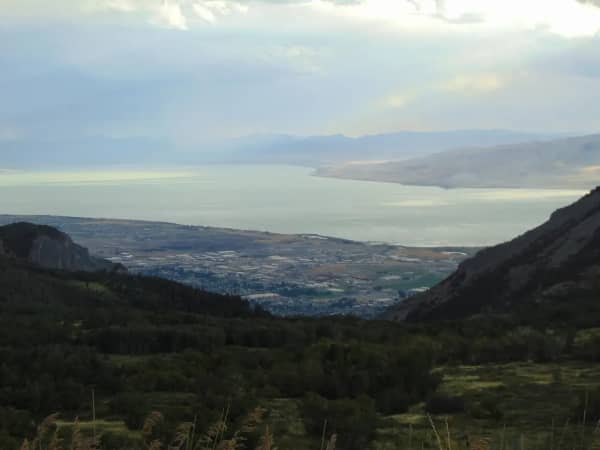
Utah Lake has a lot of shoreline and remarkably little of it is set up for the public. Vineyard's western edge is the exception on this side of the water.
The Utah Lake Shoreline Trail runs along it — mostly paved asphalt with packed-gravel sections, generally wide enough for two abreast plus a stroller, and essentially flat. It starts at Sunset Beach Park at the south end and heads north along the east shore, passing Vineyard Beach and continuing toward the Lindon Marina. A commonly ridden loop version comes out around four miles; walkers usually do an out-and-back of whatever length suits them.
Two honest warnings, both from people who use it constantly. There is almost no shade. This is open lakeshore, and in July that matters — go early or go at dusk. And the mosquitoes are real in the warmer months, particularly near the wetland sections. Bug spray is not optional in the evening, which is unfortunate, because evening is when the trail is at its best: the sun goes down over the water with the Wasatch lit up pink behind you, and it is one of the beautiful ordinary sights in Utah Valley.
Sunset Beach Park itself is about three acres with a playground, restrooms and a paved path along the water — the name is not marketing. Vineyard Beach has its own parking lot and picnic area, and a partially paved loop that circles a retention pond backing onto the lake before rejoining the shoreline trail; it is a good short walk for birdwatching, since the wetland edge draws more than the open water does.
On accessibility: the paved lot at the south end off West Vineyard Road has designated van-accessible spaces with striped access aisles, and the trail surface from there is usable with wheels — a rarer thing on Utah Lake than it should be.
For the wider picture of the lake, including the water-quality questions people ask and the answers that are current, see our Utah Lake guide. If you want to get on the water rather than beside it, our kayaking and paddleboarding guide covers launch points and conditions.
Utah City and the Greenline
This is the part of Vineyard that has changed most in the last eighteen months, and the part most worth walking through.
Utah City is a roughly 700-acre master-planned downtown going up on the old Geneva Steel land, built around the FrontRunner station rather than around parking. Its spine is the Greenline, a twelve-acre linear park running from the platform toward the lake, designed to make the train the front door of the development instead of an afterthought. Phase one opened in summer 2025 with event lawns and public space; further stretches, including the waterfront end, were still under construction this spring.
What is open and worth a visit as of this summer:
- The Berliner Play Area, an inclusive all-abilities playground on the Greenline anchored by a large hot-air-balloon climbing structure. It held its grand opening on April 18, 2026, and it is the single best reason to bring young children to Vineyard.
- Civic Park, alongside it, which runs outdoor fitness programming.
- Bella's Market, a grocery that opened on November 15, 2025, with a bakery, deli, butcher, pharmacy and produce section. It was the first grocery store to open within Vineyard city limits.
- Fini Pizza and Fini Café, which opened in spring 2026 next to the market and are the reason people from outside the city started showing up. It is the Brooklyn restaurant's first location outside New York, with a basketball court out front and a community league attached to it. Our Vineyard restaurants guide has more.
More retail is slated, including Here Here, a first phase of 10 retail spaces anchored by a central restaurant that the developers aimed at fall 2026, and the Utah City Racquet Club with outdoor padel, tennis and pickleball courts. Treat anything not yet open as a plan rather than a date — this is a development timeline, and development timelines move.
It is also worth walking in with accurate expectations. A large majority of those 700 acres is still fenced ground. The lakefront section is not connected yet. What exists is a real neighborhood you can walk end to end in twenty minutes, surrounded by a construction site the size of a small town. That is a strange and interesting thing to see in progress, and in five years it will not be seeable.
We have covered the whole project — the money, the timeline, the geothermal experiment and the skepticism — in our Utah City explainer.
Fishing, birds and the wetland edge
The stretch of shoreline Vineyard sits on is more interesting ecologically than it looks from a car.
Fishing on Utah Lake is a warm-water fishery rather than a trout one, which surprises people who arrive with mountain-lake expectations — the lake holds white bass, channel catfish and walleye among others, and the shoreline access here means you do not need a boat to reach it. Our fishing guide for the Provo area covers what is biting, where, and the regulations that apply.
Birding is the quieter reason locals walk this trail. The retention pond and wetland margin near Vineyard Beach hold considerably more life than the open water does, and the loop around it is short, flat and paved enough for a scope and a folding chair. Early morning is the window, for the birds and for the light both.
The trade-off is the same one as everywhere on this shore: wetland edge means insects. In June through August, the mosquitoes at dusk are a genuine consideration rather than a minor nuisance.
The sunsets, which are the thing people come back for
It sounds like filler until you have seen one. Vineyard faces west across open water at the widest part of Utah Lake, with nothing between the shoreline and the far side, and the Wasatch rises directly behind you. When the sun drops, the light bounces off the water and hits the range, and the whole east wall of the valley goes orange and pink for a few minutes.
There is a reason the city's main lakeside park is called Sunset Beach Park, and a reason the parking lot fills on clear evenings in a city with no nightlife to speak of. If you make one trip to Vineyard, make it an evening one — walk the shoreline trail north for twenty minutes, turn around, and walk back into it.
Bring the bug spray.
The parks inland
Away from the water, Vineyard's parks are new, well-kept and built for the demographic that moved in: a lot of young families.
Vineyard Grove Park is the biggest — sporting fields, tennis courts, playgrounds and open green space, with a city-maintained path linking it to Willows Park that gets steady traffic from walkers, runners, strollers and kids on bikes.
J. Rulon Gammon Vineyard Heritage Park carries the city's history in its name and has a short paved loop of about a third of a mile around the property, plus a playground built specifically for toddlers — soft ground, small equipment, shade. If you have a two-year-old, this is a better stop than the bigger parks.
Beyond those, Vineyard is dotted with small neighborhood parks, which is one of the advantages of a city planned in one go. For comparisons across the valley, our best parks guide has the wider list, and families working through options should see our family activities guide for Utah Valley.
The train, and why it matters here
The Vineyard FrontRunner station opened on August 12, 2022, at 130 East Market Street, just north of the Vineyard Connector. It has an island platform and a park-and-ride lot.
The reason to mention a commuter rail stop in a things-to-do guide is that in Vineyard it functions as one. Most FrontRunner stations in Utah sit a mile or more from anything you would walk to. This one has a park corridor running out of it into a downtown. You can reasonably ride in from Salt Lake or Provo, walk to lunch, spend an hour on the Greenline and ride back without a car — which is close to unheard of in Utah County.
Our FrontRunner commuting guide covers schedules, fares and the parts of the system that catch newcomers out.
What used to be here
Vineyard's history is short and unusually dramatic, and knowing it changes how the place looks.
Geneva Steel was built during the Second World War on this stretch of lakeshore, deliberately sited inland where it was thought to be safe from attack. For half a century it was one of the largest employers in the county and the defining feature of the northwest valley — and the defining feature of its air. The mill went through bankruptcy and shut down in the early 2000s, and the site was cleared over the years that followed.
The city that exists now is built on that ground. When you stand on the Greenline looking west toward the lake, you are standing on a reclaimed industrial site, which is why the whole city is flat, why the street grid is so regular, and why the housing all dates from the same decade. It also explains the ambition of the redevelopment: this is one of the last large contiguous parcels anywhere on the Wasatch Front, and it came available all at once.
Being honest about what Vineyard is not
A guide that oversells this city does nobody a favor, so plainly:
There is no historic downtown — the oldest commercial building in the city is a few years old. There are no museums. The restaurant scene is small, though it now includes one place people drive from other counties for. There is no canyon inside city limits, and the mountain trailheads are in Orem and Lindon rather than here. Shade is scarce almost everywhere, because the trees are as new as the houses.
What Vineyard has instead is lake access that the rest of the east shore has not built, the newest parks in the county, and a downtown you can watch being assembled. For a couple of hours, that is a good outing. For a full day, plan to pair it with somewhere else.
Practical notes before you drive over
Parking is easy, which is not something you can say about much of Utah Valley in summer. Sunset Beach Park and Vineyard Beach both have their own lots, the FrontRunner station has a park-and-ride, and Utah City has structured and surface parking. On a July Saturday when the Provo Canyon lots are full by nine, this is a meaningful advantage.
Restrooms exist at the main lakeside parks and in the Utah City core. Between them, on the shoreline trail, they do not — plan accordingly with small children.
Time of day matters more here than anywhere else on this shore, because of the shade situation. The shoreline is superb before nine in the morning and after seven in the evening, and unpleasant between about eleven and four in midsummer. Spring and fall remove that problem entirely and are the best seasons to walk it.
Construction changes the map. Roads inside and around the Utah City footprint have been reconfigured repeatedly as the development builds out, and the mapping apps are not always current. If a route looks odd, trust the signage over the phone.
Ten minutes out
Vineyard is small enough that most visits pair it with something adjacent, and it is well placed for that.
North, the Lindon Marina is the next lake access up the shore and the northern end of the shoreline trail. East, Orem has the theaters, University Place, the Roots of Knowledge at UVU and the mountain trailheads — ten minutes and a different kind of day. South, Provo has downtown, BYU and the canyon.
Vineyard's own restaurant options are still thin outside Utah City, so if you are planning a meal around the trip, it is worth knowing that Orem's dining corridor is closer than downtown Provo is.
Eighteen places in Vineyard, in one list
Everything below is a place you can go, inside Vineyard. Vineyard Beach, the Lakeside Trail and the Gene Fullmer fields have no coverage of their own on this site yet, so none is a numbered row. They need their own coverage before they can be numbered rows here. Hours and prices are left out on purpose: both move, and a list carrying them is wrong within a season while still looking authoritative.
If you only have three hours
Three hours is close to the natural length of a Vineyard visit — this is a city that rewards a focused outing and does not sustain a full day on its own.
The three hours to have: park at Sunset Beach Park, walk the Utah Lake Shoreline Trail north past Vineyard Beach for twenty or thirty minutes, turn around and walk back into the view. Then drive five minutes to Utah City, walk the Greenline from the FrontRunner platform toward the lake, and eat on Main Street — Fini Pizza next to Bella's Market is the reason people from other counties started showing up.
Timing matters more here than anywhere else on this shore. There is almost no shade — the trees are as new as the houses — so the shoreline is superb before nine in the morning and after seven in the evening, and unpleasant between about eleven and four in midsummer. If you can choose, make it an evening. Vineyard faces west across the widest part of Utah Lake with the Wasatch directly behind you, and when the sun drops the whole east wall of the valley goes orange for a few minutes. That is not filler; it is the thing people come back for.
Bring bug spray. The wetland margin means mosquitoes from June through August, and dusk is exactly when they and the good light coincide.
Two expectation-setters. Most of Utah City's roughly 700 acres is still fenced ground and the lakefront section is not connected yet, so what you are walking is a real neighborhood surrounded by a construction site the size of a small town. And roads inside that footprint have been reconfigured repeatedly — if a route looks odd, trust the signage over the phone.
Vineyard with kids
Vineyard is one of the easiest cities in the county to bring small children to, and it has one clear headline stop.
The Berliner Play Area on the Greenline is the single best reason to bring young children to Vineyard. It is an inclusive, all-abilities playground anchored by a large hot-air-balloon climbing structure, it opened in spring 2026, and it is new enough that it is not yet on most families' rotation. Civic Park sits alongside it.
For toddlers specifically, J. Rulon Gammon Vineyard Heritage Park is the better pick than the bigger parks — a short paved loop of about a third of a mile and a playground built for the very young, with soft ground and small equipment. Vineyard Grove Park is the largest, with sporting fields, tennis courts and playgrounds, and a city-maintained path links it to Willows Park.
On the water side, the shoreline trail is paved, essentially flat and generally wide enough for two abreast plus a stroller, which makes it one of the better stroller routes in Utah County. The paved lot at the south end off West Vineyard Road has van-accessible spaces with striped access aisles, and the surface from there is usable with wheels — rarer on Utah Lake than it should be.
Two practical warnings for families. Restrooms exist at the main lakeside parks and in the Utah City core, but not along the shoreline trail between them — plan accordingly. And the fishing here is a warm-water fishery rather than a trout one, so a child arriving with mountain-lake expectations is in for a surprise; the fishing guide covers what is biting from the shore.
Vineyard on a Sunday
Vineyard is the city in this valley where Sunday changes the most, and the reason is the train.
The whole logic of Utah City is that the FrontRunner station is the front door — the Greenline runs out of the platform into the development, and you can ride in from Provo or Salt Lake, walk to lunch and ride back without a car. That does not work on a Sunday, because FrontRunner does not run on Sundays at all. The reason is mechanical rather than cultural: most of the corridor is single-tracked, so UTA concentrates track maintenance into one day a week. The FrontRunner commuting guide has the detail. Any Sunday plan for Vineyard is a driving plan.
What is unaffected is most of what you came for. Sunset Beach Park, Vineyard Beach, the shoreline trail, Vineyard Grove, Willows and Heritage Park are open air and open all week, with their own parking lots. The Greenline and the Berliner Play Area are public park space. The lake does not keep a calendar.
Food and retail are the variable. Vineyard's restaurant scene is small and concentrated in Utah City — the restaurants guide gives the current picture, and Orem's dining corridor is closer than downtown Provo if you need a fallback. The valley-wide Sunday guide covers the rest of the county.
Vineyard in winter
The thing that makes Vineyard hard in July is the thing that makes it work in January. No shade is a problem at two in the afternoon in midsummer and simply not a problem in winter, and the mosquitoes that make the wetland edge a calculation from June to August are gone entirely.
Winter is an underrated season on this shoreline. The trail is paved, flat and open, the sunsets arrive at a civilized hour instead of after dinner, and the lot at Sunset Beach Park that fills on a clear July evening is usually not full. What you trade is wind: this is open, exposed lakeshore with nothing between you and the far side of the lake, and a west wind off the water has nothing to break it.
Utah Lake is shallow, which means it freezes in a way the deeper reservoirs around the valley do not. That draws ice anglers out onto it, and it is not a judgment to make by eye from the shore — the ice fishing guide covers which water freezes and which does not.
Indoors, be realistic: Vineyard has no museums, no historic downtown and no canyon inside city limits, so a cold day means going elsewhere. Bella's Market and the Utah City core are the walkable indoor stops the city does have. Beyond that, the indoor activities guide and the rec centers guide cover the valley's options, and Orem is ten minutes east with the theaters, University Place and the mountain trailheads.
A half-day in Vineyard that works
Morning. Park at Sunset Beach Park and walk the shoreline trail north as far as you feel like — early, before the sun is up over the Wasatch and cooking the open path.
Late morning. Drive or ride over to the Greenline. Let the kids loose on the Berliner Play Area, walk the corridor from the station toward the lake end, and take in the scale of what is still fenced.
Lunch. Fini Pizza, or a picnic assembled at Bella's Market and eaten on the event lawn.
Afternoon. Either Vineyard Grove Park if you have energy left, or ten minutes east into Orem for University Place and everything around it.
If you are thinking about Vineyard as somewhere to live rather than visit, our Vineyard city guide covers housing, schools and the growth trade-offs, and our day trips guide has the wider options if you want to build a full day around a shorter stop here.
Why the city line runs where it does, and why that is the whole story here
Every guide to Vineyard, this one included, ends up explaining the place by what it is next to. It is the lakefront Orem does not have. It is the new downtown Provo is not building. It is the FrontRunner stop that sits in town instead of a mile out. All of that is downstream of one thing that almost never gets written about, which is where Vineyard's boundary is and how it got there.
Utah does not let a city grow by simply deciding to. Growth by boundary is governed by Utah Code Title 10, Chapter 2, Part 8, and the constraints in Section 10-2-804 are strict enough to explain the odd shapes on the county map. An area proposed for annexation has to be unincorporated, has to be contiguous in itself, and has to be contiguous to the annexing city. It generally may not leave or create an unincorporated island or peninsula — a pocket of county land with city all around it, or nearly all around it. And it has to already sit inside the annexing city's declared expansion area.
The expansion area is published years before anything happens
That last requirement is the one worth knowing about if you are watching a place like this change. Under Section 10-2-803, before a city may annex anything at all, its planning commission has to prepare and its council has to adopt an annexation policy plan. The statute spells out what that plan must contain: a map of the expansion area, and a statement of the specific criteria that will guide future annexation decisions — addressing the character of the community, the need for municipal services in developed and undeveloped unincorporated areas, the city's plans for extending those services, how the services will be financed, an estimate of the tax consequences for people already inside the boundary and people in the expansion area, and the interests of all affected entities.
The plan also has to justify excluding any area containing urban development within half a mile of the city's boundary. In other words a city cannot quietly draw its expansion area around the parcels it wants and leave the awkward ones out without saying why.
For a resident, this is a public document that describes the next decade of a city's shape before any of it is proposed. It is the single most useful thing to read about a fast-growing city, and almost nobody reads it.
There is no vote, and the statute makes cities say so in bold
Here is the part that surprises people. An annexation is normally started by petition under Section 10-2-806, signed by owners of private real property inside the area — owners covering a majority of the private land area, whose property is equal in value to at least a third of the value of all private real property in the area, plus 100% of any rural real property in it. Not a majority of residents. Owners, weighted by land and by value.
And Section 10-2-806(3)(d) requires that every signature page carry, in bold and conspicuous terms, a notice stating substantially that there will be no public election on the annexation proposed by this petition because Utah law does not provide for an annexation to be approved by voters at a public election. The same notice tells a signer they may withdraw a signature in writing, no later than 30 days after the city receives notice that the petition has been certified.
That is the mechanism behind the sentence people say about the fast-growing end of this valley — that the map changed and nobody got to vote on it. It is accurate, and it is written into the petition form by statute.
Who can object, and to whom
A protest under Section 10-2-810 may be filed only by the governing body of an affected entity, by an owner of rural real property inside the proposed area, or by an owner of private real property in a mining protection area. It goes to the county clerk, not the city, and it must be filed no later than 30 days after certification. A copy goes to the city's records officer the same day.
If a protest is filed, the county legislative body must create a boundary commission within 30 days if one does not already exist (Section 10-2-809). In a county with two or more municipalities it has seven members: two elected county officers, two elected municipal officers from separate cities, and three county residents who hold no county or municipal office, chosen by the other four. The city may deny the petition at its next regular meeting within 30 days of certification — but if it does not, it may take no further action until the boundary commission decides.
If no protest is filed, the city may approve the petition, but only after a public hearing noticed as a class B notice under Section 63G-30-102 for at least seven days beforehand.
Why this matters walking around Vineyard. The fences, the half-built blocks and the roads that end in gravel are the visible part. The invisible part is a boundary that was argued over in documents anyone can request, under a process in which land ownership rather than residency does the voting. If you want to know what this city will look like in ten years, the expansion area map in its annexation policy plan is a better guide than anything you can see from the trail.
Boundaries, plans and project timelines all move. Confirm current city limits with Vineyard City and the Utah County Recorder before relying on them for anything that matters.
Related Guides
Frequently Asked Questions
What is there to do in Vineyard, Utah?
Is Vineyard worth visiting, or is it just houses?
Can you get to the lake from Vineyard?
What is Utah City in Vineyard?
Can you take the train to Vineyard?
How far is Vineyard from Provo?
Do residents get to vote on a Utah city annexation?
How can I find out where Vineyard plans to grow next?
Sources
The facts in this guide were checked against these sources. Hours, fees and rules change, so confirm anything time-sensitive with the source before you go. How we make Provo.com.
- NYC Pizza, Padel and Parks: What's Coming to Utah City in 2026, Utah City. Checked October 12, 2026.
- Introducing Bella's Market: Vineyard's first grocery store opens in Utah City, Daily Herald. Checked October 12, 2026.