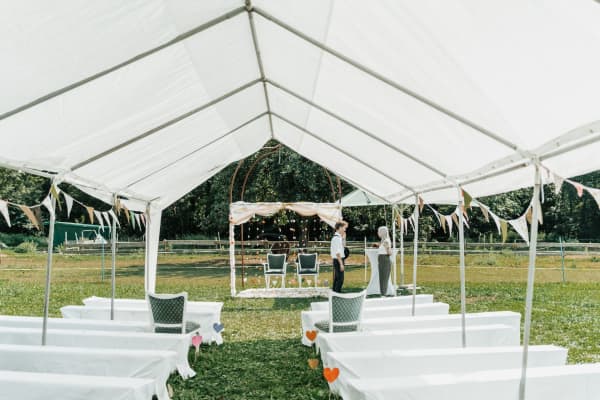

Utah Valley couples have a reputation for planning weddings fast — shorter engagements are the local norm, and the deep vendor market makes a three-month wedding doable. But fast doesn't mean disorganized, and the couples who enjoy their engagement are the ones who front-load the few decisions that are time-sensitive and relax about the rest. This is a month-by-month timeline built specifically for a Provo, Orem, or Utah Valley wedding — tuned to the local realities that generic checklists miss: the peak-season venue crunch, the two-part temple-and-reception day, and the Utah County marriage license process.
Two things make a Utah Valley timeline different from the national template. First, a large share of local weddings are structured as a temple sealing followed later by a separate reception, which means you're really scheduling two events that have to line up — and the timing between them is where plans most often slip. Second, the classic local reception is a larger, open-house-style gathering built around dessert and a receiving line rather than a smaller sit-down dinner, which changes what you book and when. Both realities are baked into the sequence below.
Treat the twelve-month version below as the full map. If your runway is shorter, don't panic — near the end there's a section on compressing it, and the core sequence (venue and photographer first, license about two weeks out) never changes.
As soon as you're engaged
The first month is about the decisions everything else depends on, so resist the urge to jump straight to the fun stuff like flowers and cake.
Set a budget and draft the guest list together. These two numbers drive every decision that follows, and they're linked — your guest count is the biggest single factor in what the day costs, because catering, rentals, and cake all scale with headcount. Our Utah Valley wedding budget guide walks through realistic local numbers and where the money goes. Start a single shared document now — budget, guest list, vendor contacts, and payment due dates in one place, visible to both of you — and you'll save yourself a hundred scattered texts over the coming months.
Pick a rough date and season. In Utah Valley, the season you choose is also a budget decision: peak months (May, June, September, October) and Saturdays are the most expensive and the most competitive, while weekdays and the off-season are cheaper and far more available. Decide how firm your date is, because that shapes your next move.
Book the venue. This is the most time-sensitive decision in the entire plan. The valley's sought-after reception centers, garden estates, and golf-course ballrooms release peak-month Saturdays six to twelve months out, and the best ones go first. Our wedding venues guide walks the standouts by area and style, with the questions worth asking each one. If a temple sealing is part of your day, sort the temple scheduling alongside the venue — the two have to line up, and that coordination is easier the earlier you start.
Book the photographer. After the venue, the photographer is the vendor whose calendar fills next, often six to nine months ahead for peak dates. Local experience pays off here — someone who already knows the light at Bridal Veil Falls and the timing of a temple exit will get shots an out-of-towner misses. Our wedding and engagement photo locations guide maps where couples shoot, season by season.
Nine to ten months out
Consider a planner or coordinator. Full planning, partial planning, and day-of coordination are three different services at three different prices. For a lot of Utah Valley weddings — where family and ward members pitch in heavily on setup — a day-of coordinator is the sweet spot: someone whose only job is running the timeline so your mom can attend the wedding instead of working it. If your day has a temple sealing plus a separate reception, ask specifically for someone who has run that two-part structure. Our wedding vendor directory covers what to ask.
Schedule your engagement session. Many photographer packages include one, and it does double duty: it gives you the images for save-the-dates and invitations, and it's a low-stakes trial run that gets you comfortable in front of your photographer before the wedding. Book it a season ahead of when you'll need the photos — and if you want a specific Utah Valley backdrop, our photo locations guide maps which spots look best in which months.
Send save-the-dates if a meaningful share of your guests will travel, especially for a peak-season or holiday-weekend date.
Start dress shopping. Made-to-order gowns need production time — often several months — plus fittings and alterations on top. Utah Valley's bridal market is unusually deep for its size, including shops that specialize in modest gowns and temple-appropriate necklines and sleeves, so there's a lot to work with. Starting now keeps you out of the rush-fee zone later.
Six to eight months out
This is the stretch where the rest of the vendor team comes together.
Book the florist, caterer, cake, and music. These fill three to six months out in general, but the best-known names in each category go sooner, and they all compete for the same peak May-through-October Saturdays. Bring your florist and caterer the venue name first — an outdoor estate in June and a downtown reception center in February are entirely different jobs. Our Provo and Orem catering guide covers the local players across every format, from drop-off trays for an open-house reception to full plated service.
Lock your reception format now, because it shapes almost everything else you book. An open-house dessert reception, a buffet, and a plated dinner are three different events with three different guest counts, staffing needs, and rental lists — deciding between them early keeps you from gathering quotes that aren't comparable and from over- or under-ordering later.
Order invitations so you have time to proof, print, and address them.
Sort wedding-party attire, set up your registry, and think through rentals. If your reception is outdoors or in a raw space, chairs, tables, linens, arches, and a dance floor may come from a rental company rather than the venue — and rental inventory runs thin in the same May-through-October window everyone else wants, so reserve it in this stretch rather than assuming it'll be there in the spring.
Block lodging for out-of-town guests. If a lot of guests are traveling, reserving a hotel room block now gives them a good rate and keeps them close together — our where to stay in Provo guide breaks down the lodging zones.
Three to four months out
Mail the invitations, with an RSVP deadline about three to four weeks before the wedding so you have a real headcount in time.
Do your trials and tastings — hair and makeup, and the cake tasting most bakers offer for a small fee that's usually credited to your order.
Build the day-of timeline with your coordinator. This is where a temple wedding needs real attention: the sequence of sealing, family photos, the gap before the reception, and the reception itself is exactly where days run late if no one has mapped the timing. Our guide for out-of-town guests explains how that day is usually structured, which helps you brief everyone.
Arrange transportation, confirm fittings, and plan the rehearsal.
Six to eight weeks out
Chase the stragglers and lock your final headcount. This number drives your final catering count and your seating plan, so it needs to be firm. Final payments to vendors typically start coming due in this window — check every contract for its schedule.
Break in your shoes, confirm the details with each vendor in writing, and finalize the seating or open-house flow.
Give your photographer a short must-have list. A handful of specific shots you'd regret missing — a particular family grouping, a detail that matters to you, the grandparents together — is more useful than a long generic checklist, and it takes the pressure off you to remember in the moment. Walk the final day-of timeline with your venue's coordinator too, so the people running the day are working from the same schedule you are.
Two to four weeks out
Get your marriage license. In Utah there's no waiting period and no blood test, so the license is usable the moment it's issued — but the Utah County Clerk recommends applying 10 to 14 days before the ceremony, which leaves room to fix any application hiccup and still use the license if your date shifts. A Utah County marriage license runs about $50 (a little more if you apply online), both of you apply — Utah County offers an online pre-application that trims the in-person time — it's valid for 32 days, and a license from any Utah county works statewide. Confirm the current fee and requirements directly with the Utah County Clerk before you go.
Do the final venue walk-through, assemble a day-of emergency kit, and put together tip or thank-you envelopes for your vendors.
Delegate. Assign specific day-of jobs — who carries the rings, who fields vendor questions, who gathers the gifts — to specific, named people, so your family isn't improvising during the ceremony.
The week of, and the day before
Rehearse. Walk the ceremony with everyone who has a role, then gather the wedding party for a rehearsal dinner — our date-night restaurants guide points to spots that handle a group and an occasion.
Deliver everything to the venue that you're responsible for, hand your coordinator (or a trusted friend) the master timeline and the vendor contact list, and then — genuinely — step back. The planning is done. The last job on the list is to be present for it.
Planning around a temple sealing
If your day includes a temple sealing, it deserves its own line on the timeline, because the sealing and the reception are two separate events with a stretch of time in between — and that gap is the single most common place a Utah Valley wedding day runs late. The sealing itself is scheduled directly with the temple, on its calendar, not your venue's, so those two dates and times have to be coordinated from the very beginning rather than assumed to fit together.
The practical sequence most couples run is a morning or midday sealing, family and wedding-party photos immediately afterward while everyone is already dressed and together, and then the reception later in the afternoon or evening. Three details are worth mapping in advance: how long your photographer needs between the sealing and the reception (temple-exit photos and a full family set take real time), what your out-of-town or non-member guests will do during the sealing and the gap that follows, and how you'll communicate the day's flow so no one is left standing around wondering where to be. A day-of coordinator who has run this exact structure earns their fee here.
None of this is complicated once it's written down — it just has to be written down, ideally by the three-to-four-month mark when you're building the master timeline. Our guide for out-of-town guests explains how the day is typically structured and what guests can expect at each temple in the valley, which is a useful thing to share with anyone traveling in.
The timing mistakes that catch Utah Valley couples
A handful of scheduling errors show up again and again here, and every one of them is avoidable if you know to watch for it:
- Waiting too long on a peak-Saturday venue. A specific venue on a specific Saturday in May, June, September, or October is the fastest thing to disappear. If that combination matters to you, it's the first call you make, not the third.
- Not coordinating the temple and the reception from the start. The sealing is on the temple's calendar and the reception is on the venue's, and assuming they'll fit together instead of scheduling them together is how couples end up with an awkward three-hour gap or a rushed exit.
- Ordering the dress late. Made-to-order gowns need production time plus alterations plus fittings. Start at four to six months out, or plan on off-the-rack and rental options if you're inside that window.
- Finalizing catering before the headcount is real. Your final guest count drives the catering order and the seating plan, so set an RSVP deadline three to four weeks out and hold to it before you confirm numbers.
- Leaving the marriage license to the last day. There's no waiting period, so it's technically fine — but the Clerk's 10-to-14-day recommendation exists so a hiccup in your application doesn't become a crisis on your wedding morning.
If your timeline is shorter
Plenty of Utah Valley weddings come together in three or four months, and the plan simply telescopes. Spend the first week on the venue and photographer, and accept that with a short runway your date may follow their availability rather than the other way around — flexibility on the day of the week is your biggest advantage. Book the florist, caterer, cake, and music over the next two to three weeks. Shop for a dress with the shortest production time you can find, or go straight to off-the-rack and rental options, which Utah Valley has in quantity. Send invitations the moment they're ready (or lean on digital invitations and RSVPs to buy time). Get the marriage license about two weeks out, same as always. And seriously consider a day-of coordinator — on a compressed timeline, one person holding the whole plan together is worth every dollar.
However long your runway, the shape of a good plan is the same: lock the few decisions that are time-sensitive, lean on the valley's deep vendor bench for the rest, and give yourself enough buffer at the end to enjoy the wedding you spent all this time planning. When you're ready to price it out, start with the budget guide; when you're ready to choose vendors, the vendor directory covers every category and what to ask each one.
The Deadlines That Are Not Yours to Move
Most of this timeline is advisory — book the photographer early because the good ones fill up, not because anything happens if you do not. A handful of dates are different in kind. They are set by someone else, they do not flex, and missing one produces a problem no amount of planning recovers. They are worth pulling out of the month-by-month flow and listing on their own.
The license has a 32-day life. A Utah marriage license that is not used within 32 days of issue is invalid. This cuts in a direction couples do not expect: the mistake is being early, not late. A license collected six weeks out has expired by the wedding. Our Utah County marriage license guide covers the counter mechanics; for the timeline, the only rule you need is that the license belongs in the final month, not in the early-admin flurry where it feels like it belongs.
Vendor balances usually fall due before the day, not on it. Most Utah Valley contracts run on a deposit at booking and a final balance somewhere between thirty and fourteen days out. Couples who budget for "paying vendors at the wedding" find several thousand dollars due in the same fortnight as the final headcount and the rehearsal dinner. Read each contract when you sign it, write the balance date into this timeline immediately, and you avoid the single most common cash-flow surprise in wedding planning.
Catering headcount locks earlier than the RSVP deadline. These are two different dates and they are frequently confused. Your RSVP date is when you ask guests to reply; your guaranteed count is when the caterer stops letting you reduce the number. The guarantee is typically a week to ten days out, and it is usually a floor — you can add, you cannot subtract. Set your RSVP date at least a week before the guarantee so there is room to chase the people who have not replied.
Alterations are the longest lead time nobody plans for. A bridal gown ordered to size is not a finished garment, and fittings run in a series rather than a single appointment. Six to twelve weeks before the wedding is the normal window, and peak season compresses availability rather than expanding it. Our dress shopping guide covers why the order date matters even more than the alteration date.
Anything with a hair or makeup trial has to precede the engagement shoot, if you want the trial to be useful, because the trial is where you find out the look photographs the way you imagined.
A wind-down worth knowing about, if you are not marrying formally
One time-limited item sits outside the ordinary planning calendar. Utah has long allowed a court to recognize a marriage that was never solemnized, and that route is closing. Under the current statute a petition may be filed before May 5, 2027, and on and after that date it may not be filed at all. If you and a partner have lived as spouses without ever holding a ceremony, that is a real deadline rather than a planning nicety, and it is explained in our marriage license guide. For couples planning a wedding it changes nothing at all — but it is the only date on this page that expires permanently.
Dates, fees and vendor terms change. Confirm each one with the vendor or the county rather than relying on a published timeline, including this one.
Related Guides
- Civil Wedding Officiants in Utah Valley
- Wedding Invitations & Stationery in Utah Valley
- Wedding Rentals in Utah Valley
- Honeymoon Ideas for Utah Valley Couples (2026)
- Getting a Marriage License in Utah County: Cost, Timing & the 32-Day Clock
- Engagement Rings in Utah Valley: A Buyer’s Guide
- Renting a tuxedo or suit in Utah Valley
- Wedding Luncheon Venues in Utah Valley: The Meal Nobody Plans Until Late
- Bachelorette and Bachelor Party Ideas in Utah Valley
Frequently Asked Questions
How far in advance should you plan a wedding in Utah Valley?
What should you book first when planning a Utah Valley wedding?
When do you get a marriage license in Utah County?
How far ahead do Utah Valley wedding venues book?
Can you plan a Utah Valley wedding in three months?
When should we get our Utah marriage license?
When are wedding vendor final payments due?
What is the difference between our RSVP date and the catering guarantee?