
Somewhere in the middle of planning a Utah Valley wedding — after the temple date is set, after the reception venue is booked, after the dress and the photographer and the flowers — most couples arrive at a question nobody warned them about.
Where is everyone going to eat lunch?
The wedding luncheon is a genuine institution here, it involves the people the couple cares most about, and it is reliably the last thing anyone books. That ordering is backwards, and it produces the two most common wedding-day complaints in this valley: a rushed meal that nobody enjoyed, and a two-hour hole in the afternoon where thirty relatives stood in a parking lot.
What the luncheon is
For couples married in a temple, the ceremony itself is small. The sealing takes place with a limited group present, and the large celebration — the reception — happens in the evening and includes everyone.
The luncheon sits between them. It is the meal for the people who were in the sealing room, held after the ceremony and the temple photographs and before the couple has to be back for the reception. It is the one part of the day where the immediate families are together, seated, unhurried, and not receiving a line of two hundred guests.
Some families still call it the wedding breakfast, and will do so while serving it at one in the afternoon. The name is a survival from older usage and nobody local finds it strange.
The distinction worth holding onto: the reception is for everyone; the luncheon is for the inner circle. They are different events with different purposes, and treating the luncheon as a small reception is how it goes wrong.
Who comes, and the conversation nobody enjoys
The traditional guest list is the people who attended the sealing, plus a small number of others.
In practice: parents, grandparents, siblings and often their spouses, sometimes aunts, uncles or a handful of friends who are functionally family. Most luncheons land between 20 and 50 people.
The difficulty is that the list has no natural edge. Every addition is defensible and each one makes the next harder to refuse, and because two families are involved, the pressure arrives from both directions and rarely symmetrically. A bride with three siblings and a groom with eight starts from an imbalance that no amount of goodwill removes.
Two things help. First, decide the principle before the names — "everyone who was in the sealing room, plus grandparents" is a rule you can state out loud without anyone feeling individually excluded. Second, remember the constraint is not only cost. A luncheon of eighty is a different event with a different feeling, and the intimacy is the point of having it at all.
The timing is tighter than anyone expects
This is where luncheons fail, and it is almost always an arithmetic problem rather than a taste problem.
A realistic Utah Valley sealing day runs roughly like this. The sealing itself is relatively brief. Then the group comes outside for formal family photographs on the temple grounds, which routinely take 45 to 60 minutes and frequently overrun, because grouping and regrouping extended families is slow and the photographer is working around other wedding parties doing the same thing. Then couple portraits, which may or may not happen before the luncheon.
Then everyone travels to the luncheon venue. Then the meal. Then the couple needs to be back for the reception, which usually means getting ready again.
The luncheon window is therefore ninety minutes to two hours, and it is squeezed from both sides. Schedule an hour and it will feel like a service station. Schedule three and you have invented an awkward gap in which nobody knows what to do and elderly relatives are looking for somewhere to sit.
The specific failure to guard against: photographs running long is not a possibility, it is the default. Build the cushion into the front of your schedule, tell the venue a start time that already includes it, and tell your family a slightly later arrival time than you tell the caterer.
The venue options, ranked by what they solve
There is no single right answer, because different families are solving different problems — proximity, cost, capacity, or simply not wanting to be responsible for anything.
A private room at a restaurant
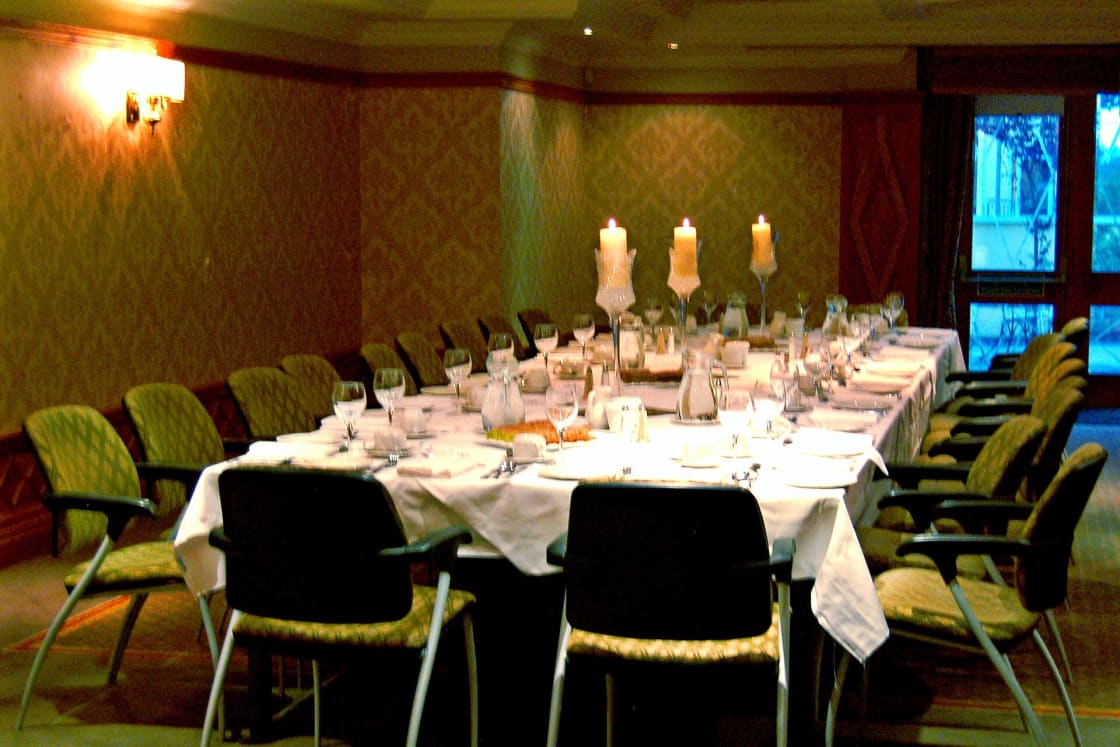
The most popular middle path, and for good reason. Somebody else cooks, somebody else clears, and the room is finished.
Utah Valley has a reasonable supply of restaurants with private or semi-private dining rooms, concentrated in downtown Provo, along the University Parkway corridor and around University Place. Most price with a food-and-beverage minimum rather than a flat room charge, which means a group of thirty ordering a real meal often clears it without a separate fee.
What to ask: whether the room is private or a curtained-off section of a busy dining room on a Saturday afternoon; whether they will do a set menu with limited choices, which is dramatically faster than thirty people ordering individually; and how long the room is held. Our guide to group and family restaurants covers which places handle large parties well.
The weakness: restaurants are busy at lunchtime on Saturdays, and a set menu you have not tasted is a small risk.
A reception or event venue
Some Utah Valley venues will host the luncheon as well as the evening reception, or host a luncheon alone.
The advantage is enormous when the venue is close to the temple. La Fête in Provo, for example, markets itself explicitly around the Provo City Center Temple sealing day and is a short walk from it, with a bridal suite and capacity that spans an intimate family gathering through a full reception. Proximity of that kind removes the single most fragile part of the day — moving thirty people, several of them elderly, between locations on a schedule.
The thing to interrogate is how the venue bills it. Many price in blocks of hours. A luncheon at noon and a reception at six may mean paying for the entire day rather than two short windows, which can make a "convenient" option the most expensive one on your list. Ask for the number before you fall in love with the walk.
A cultural hall
A very large share of Utah Valley families do this, and it is under-discussed in wedding guides because there is no vendor to advertise it.
The building is free or nearly so to members, the capacity is generous, the kitchen exists, and the location is usually convenient to somebody's family. Catering is brought in or the meal is made by relatives.
The trade-offs are honest ones: the room looks like what it is without decoration, availability runs through the building's scheduling rather than a booking system, and somebody in your family is now responsible for setup, service and cleanup on the morning of a wedding. That last cost is real and it lands on the people you were trying to celebrate with.
A family home or backyard
Works beautifully for small groups and in good weather, and it is the warmest option of the four.
The constraints are seating, restrooms, parking on a residential street, and June weather in a valley that can produce a hot afternoon or a thunderstorm. It also means somebody's house is being prepared for a wedding event on the same day as a wedding. Our comparison of reception centers and backyard weddings works through the same trade-offs at reception scale, and most of it applies here.
Catering into a rented space
The most controllable and usually the most expensive: rent a neutral room, bring in a caterer, and specify everything.
This is the right answer for larger luncheons, for families with significant dietary requirements, or where the meal itself is meant to be a highlight rather than a refuelling stop. Utah Valley has a deep catering market — see our guide to catering in Provo — and most caterers here are entirely familiar with the luncheon format and its timing.
What people serve
The luncheon menu is not the reception menu, and the differences are practical.
It is a seated meal in a fixed window, which favors dishes that hold: roasted chicken, a beef option, pasta, a salad course, rolls. Buffets serve a group of forty faster than plated service and are common. Plated service looks better and takes longer, and thirty minutes lost to service is thirty minutes you did not have.
Portions run smaller than a dinner, because it is the middle of the day and there is an evening event to come.
Dessert is often deliberately restrained for the same reason — the cake belongs to the reception, and a heavy dessert at 1 p.m. competes with it.
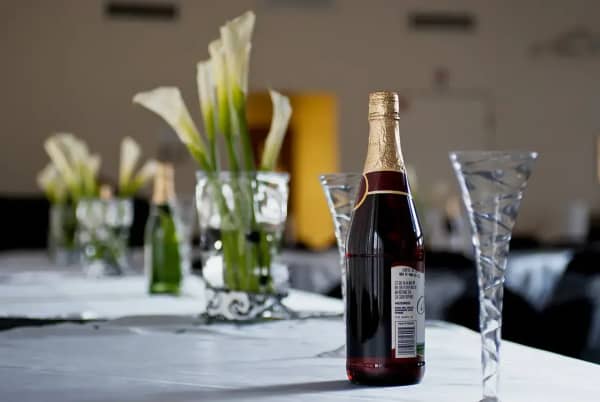
And a point for visitors: this is an alcohol-free event. So is the reception, in the overwhelming majority of cases. Sparkling cider is the standard toast, venues in this market are set up for it without being asked, and a bottle of wine is not the gift to bring.
Which temple you are sealed in changes the geography
Utah Valley has more operating temples than almost anywhere, and which one you use determines what a convenient luncheon venue even looks like. This is worth working out before you shortlist rooms.
A Provo City Center Temple sealing sits in the middle of downtown, which is the best case. Restaurants with private rooms, event spaces and parking structures are within a few blocks, and some venues are close enough to walk. The constraint is downtown parking on a Saturday, which the downtown parking guide covers.
The Mount Timpanogos Utah Temple in American Fork, the Orem Utah Temple and the Lindon Utah Temple all put you nearer the north-county corridor, where the private-room supply clusters around University Place and the Thanksgiving Point and Traverse Mountain areas. The Payson Utah Temple and Saratoga Springs Utah Temple anchor the south and west ends of the county respectively, and both have thinner immediate options — plan on a short drive rather than a walk.
One navigational warning worth repeating, because it has caught out wedding parties: the original Provo Utah Temple near the mouth of Rock Canyon has been renamed the Provo Utah Rock Canyon Temple and is closed for reconstruction. It is not hosting sealings. If your invitation says Provo City Center Temple, your luncheon logistics are downtown, and anyone in the party navigating to the older hillside site will arrive at a construction project.
The general rule: measure the drive at the actual time of day it will happen, on a Saturday, not on a Tuesday evening when the roads are empty. Fifteen minutes on a map can be thirty in June with a wedding party of four cars trying to stay together.
The program, and how much of one to have
A luncheon is not a reception and does not need a run of speeches, but it usually has some structure, and deciding it in advance prevents the awkward silence where everyone looks at the parents.
What commonly happens: a blessing on the food, a welcome from one parent, and a small number of short toasts or remarks — frequently from the fathers, sometimes from a sibling or the couple themselves. Some families do a brief slideshow. Some do nothing at all beyond eating together, which is a legitimate choice.
The failure mode is length. Four speakers who each planned three minutes will take twenty-five, and the luncheon does not have twenty-five spare minutes. If you want remarks, name the speakers in advance, tell them the limit, and tell them it is a limit. Anyone not told is likely to assume they should speak and then find they cannot.
Seating is the other quiet decision. At twenty-five to forty people, a single long table or a small number of round tables both work, but the two produce very different events — a long table is one conversation, rounds are five. Couples who want the intimacy that is the entire point of a luncheon generally want the long table, and should ask the venue whether it is possible before booking, because not every private room can accommodate one.
The thing to delegate
Of every component of a Utah Valley wedding, the luncheon is the one that hands off best.
It is small. It is contained. The guest list is family, so the person hosting knows everyone. And there is very often someone — a mother, a future mother-in-law, an aunt — who enjoys hosting and would be pleased to be asked rather than burdened by it.
Give them the whole thing: venue, menu, seating, timing. Keep one shared document with the headcount, the address, the arrival time and the phone numbers, so the plan does not live in one person's head on a day when that person will be at a temple with their phone in a locker.
What the couple should retain: the guest list and the start time. Everything else can go.
Booking, and why the good options are gone
Utah Valley wedding venues commonly book peak Saturdays six to twelve months ahead. May, June, September and October are the pressure months, and Saturdays in them are contested.
A 30-person luncheon has far more options than a 200-person reception, so the situation is not dire. But the specific thing most couples want — a good private room within a few minutes of the temple, at midday on a Saturday in June — is a narrow category, and it is booked by the people who thought about it in January.
Since the luncheon is almost always planned last, the practical advice is simply to move it earlier in your sequence: book it when you book the reception, not after. Our wedding timeline for Utah Valley puts the whole sequence in order, and the wedding budget guide covers where this line item usually lands.
Guests traveling in from outside Utah
If you are flying in for a wedding here and have been invited to the luncheon, a few things are useful to know.
You have been invited to the small event, which means you are close family or close to it. It is not optional in the way a reception drop-in is.
There will be a gap between the luncheon and the reception, often several hours. Plan for it — that gap is when out-of-town guests either rest at a hotel or wander, and knowing in advance prevents an aimless afternoon. Our guide to things to do in Provo in 48 hours fills it usefully.
And if you are not a member of the church, you may not be able to attend the sealing itself but will absolutely be at the luncheon and the reception. That is normal, it is not a slight, and our guide to temple wedding logistics explains how the day works for guests who wait outside.
The honest assessment
The luncheon is the best part of a Utah Valley wedding day and it gets the least planning attention.
The reception is lovely and it is also two hours of standing in a line saying thank you to people you half recognize. The luncheon is the meal where the couple sits down with the twenty-five people who raised them, at a table, with time.
Treat it accordingly. Book it early, give it two hours rather than one, hand it to someone who wants it, and keep the guest list small enough that it stays what it is meant to be.
The families who get this right describe it afterward as the part of the day they remember. The ones who leave it until three weeks out describe a rushed hour in a restaurant that could not seat them together.
Related Guides
- Wedding Rentals in Utah Valley
- Temple Wedding Logistics in Utah Valley: What Guests Need to Know
- Wedding Venues in Utah Valley: The Complete Guide
- Reception Centers vs Backyard Weddings in Utah Valley
- The Utah Valley Wedding Timeline
- What a Utah Valley Wedding Actually Costs
- Best Catering in Provo
- Group & Family Restaurants in Utah Valley
Frequently Asked Questions
What is a wedding luncheon?
Who gets invited to the wedding luncheon?
How long should a wedding luncheon last?
How much does a wedding luncheon cost in Utah Valley?
Can you have the luncheon at the reception venue?
Should the couple plan the luncheon themselves?
How far in advance should you book a wedding luncheon venue?
Do people serve alcohol at a Utah Valley wedding luncheon?