
Every Utah Valley wedding budget hits the same fork, usually early and usually late at night: book a reception center, or do it at home?
The backyard option looks obviously cheaper. There is no venue fee. Someone in the family has a nice yard. It sounds warmer, more personal, less transactional.
Sometimes it truly is all of those things. Sometimes it costs more than the venue would have, consumes three months of family labor, and turns a parent's home into a construction site for a fortnight.
This guide is the honest comparison, including the parts that only become visible once you have already committed.
The mistake in the comparison itself
The error most couples make is comparing a venue fee against zero.
That is not the comparison. A reception venue is not selling you a room. It is selling you a bundle, and the fee is the price of the bundle. Remove it and you have not removed the costs — you have moved them onto yourself, item by item.
The correct comparison is:
Venue fee versus the sum of every line the venue was quietly covering, plus your own labor.
Once you write it that way, the decision changes for a lot of couples. Not all — backyard weddings are the right answer for plenty of people — but the ones for whom it is right are usually a specific type, and we will get to who.
What a venue fee is buying
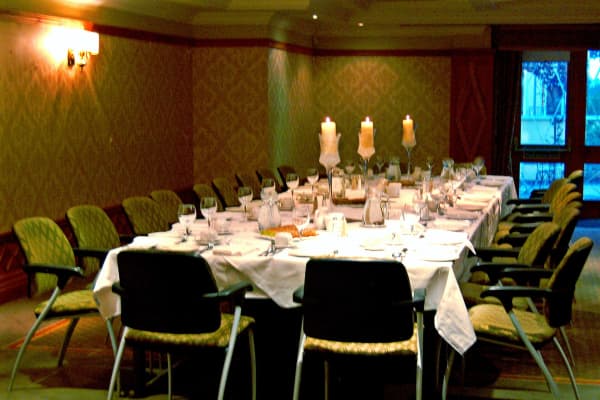
Reception centers vary enormously in what they include, and that variation is the single most important thing to establish before comparing any two prices.
The full list a more inclusive venue may cover:
- Tables and chairs, in the right quantity, already there
- Linens
- Setup and takedown, by people who are not you
- Cleanup, including the part after midnight
- Restrooms, plumbed, adequate for the guest count
- Parking, off-street and legal
- Power sufficient for catering, sound and lighting
- Lighting, including after dark
- Climate control
- Staff present during the event
- A coordinator, at least for the building
- Liability insurance for the premises
- A weather plan, because you are indoors or under permanent cover
- Kitchen or catering facilities vendors know how to work in
A venue supplying most of that is doing considerable work. A venue supplying a hall and a parking lot is doing much less and should cost much less.
Never compare venues on headline price. Get the itemized inclusion list from each, put them side by side, and price the gaps. The cheaper venue is frequently more expensive once you have rented what it does not provide.
Our wedding venues guide covers the specific options in the valley, and the wedding budget guide covers the wider arithmetic.
What a backyard wedding adds back
Now the other column. Assume nothing here — every one of these is a real line item.
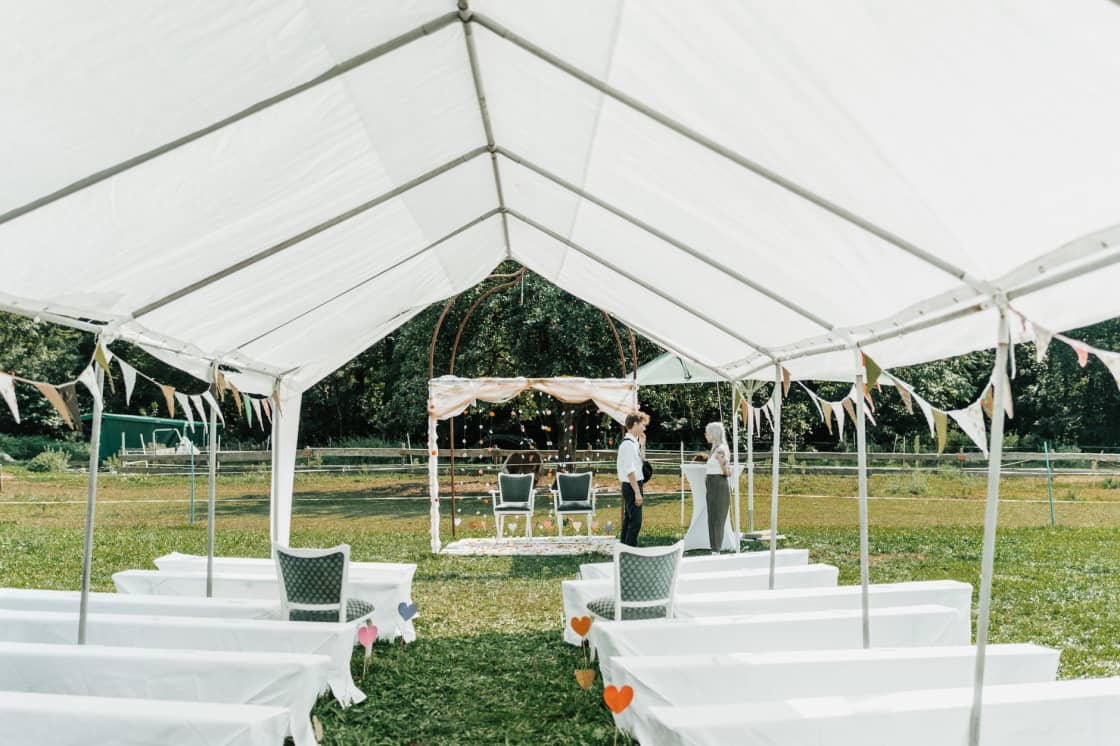
Rentals. Tables, chairs, linens, and possibly a tent. Delivery and collection are usually charged separately, and weekend delivery windows in wedding season fill early.
Restrooms. This is the item couples most reliably forget and most regret forgetting. A house bathroom cannot serve a hundred guests over five hours. Portable facilities exist at a range of quality levels, and the gap between the basic unit and a decent trailer is large in both price and guest experience.
Parking. Covered in its own section below, because it is the most common source of actual conflict.
Power. Catering equipment, amplified sound and lighting draw more than a residential circuit expects. Tripping the house breaker mid-reception is a common and entirely avoidable failure.
Lighting. An outdoor reception continuing after dark needs planned lighting. String lights are lovely and are not sufficient for serving food or navigating steps.
Yard preparation. Frequently the hidden cost. Lawns get overseeded and babied for weeks, sprinkler heads get moved, flower beds get planted, fences get painted, and someone spends a fortnight on a yard that was fine.
Cleanup. Somebody does it. If that somebody is family, they are doing it at midnight after a long emotional day.
Insurance. See below.
Weather contingency. Either a tent already reserved or a genuine alternative plan.
Neighbor management. Not a cost, exactly. Definitely a task.
Parking is the constraint that bites first
Couples plan around how many people fit in the yard. The yard is rarely the limit.
Parking is, and in the older Provo and Orem neighborhoods where the nicest yards tend to be, streets are narrow, driveways are short, and the houses were built when families had one car.
A hundred guests arrive in a large number of vehicles. Those vehicles go somewhere. Options are limited: the street, which annoys neighbors and may be restricted; a nearby lot, which requires permission; or shuttling from somewhere else, which is a real solution and an added cost.
Three things worth doing early:
Count honestly. Estimate vehicles rather than guests, and walk the street counting how many fit without blocking driveways.
Check the city's rules on street parking and on any closure or use of the right-of-way. Requirements vary by city and by street.
Tell the neighbors first. Not because you must, but because a neighbor who has been told, and offered a place to be, is an ally. A neighbor who discovers it when the street fills is the person who calls to complain about the music at nine.
Noise: the rule that ends the music
Utah Valley cities regulate noise, generally with time-based restrictions that tighten at night and provisions addressing amplified sound. Our guide to the noise ordinance in Utah Valley covers how these work.
The practical consequence for an outdoor reception is simple and non-negotiable: the music has an end time, and it is set by the ordinance rather than by your timeline.
This surprises people because a reception center in a commercial zone operates under different constraints from a house in a residential one. A venue that runs until late is not evidence you may.
What to do:
- Check the specific city's ordinance for the address. Provo, Orem, Springville, Pleasant Grove and the rest are separate jurisdictions with separate rules.
- Build the timeline around the limit, working backward from it rather than hoping to run over.
- Plan the ending deliberately. A last dance and a send-off at a chosen moment is far better than music cutting off mid-song because someone complained.
- Talk to neighbors in advance. The single highest-value action available, and it costs nothing.
Tents, permits and the things people find out late
Requirements vary by city and by specifics, which is precisely why you call rather than read.
The categories to ask about:
Temporary structures. Utah's State Fire Code incorporates the International Fire Code, so larger tents can trigger permit requirements, and there may be conditions covering anchoring, fire safety and occupancy. Ask the rental company what they have needed at similar events in that city, then confirm with the city — the company knows the pattern, the city knows the rule.
Use of the street. Any closure, or reserved parking on the right-of-way, generally involves the city.
Amplified sound. Some jurisdictions handle this through the noise ordinance alone; others have a separate mechanism.
Food service. Whether a caterer serving at a private residence triggers any requirement is a question for the health department, and the caterer should already know. If they do not, that is informative. Our guide to food permits and inspections in Utah County covers how that side works.
Call at least a couple of months out. Municipal processes are not fast, and the failure mode — discovering a requirement days before the wedding — is entirely preventable.
The insurance question
Most couples never ask this and they should.
A standard homeowner policy is not written with a hundred-guest catered event in mind. Whether it covers injury to a guest, damage caused by a hired vendor, or an incident involving a rented structure is not something to assume in either direction.
Single-event liability policies exist and are typically not expensive relative to a wedding budget. Some venues require them, which is itself a signal about the risk.
Call your insurer. Describe the event accurately — guest count, tent, catering, whether alcohol will be present. Get the answer in advance. This is a fifteen-minute phone call that occasionally prevents a catastrophe.
The Utah Valley structure most guides miss
There is a local pattern that changes this decision and that national wedding advice does not account for.
Where a ceremony takes place at a temple, only guests attending the ceremony itself are present for it. What commonly follows is a wedding luncheon for family and close friends, with a larger reception later that day or on another day. Our guides to temple wedding logistics and the wedding day timeline cover the sequencing.
Two consequences for this comparison:
You may be planning two catered events, not one, with two guest lists. That materially changes where a venue fee sits in the overall budget.
Reception guest counts here are frequently large. The open-house-style reception, where a wide circle of ward members, extended family and neighbors come through over a couple of hours, is common. Several hundred people passing through is not unusual — and that is a guest pattern most backyards cannot absorb, regardless of how nice the yard is.
If your reception is that kind of event, the decision is largely made for you by the numbers.
The labor cost nobody prices
The truly invisible line item is family labor, and it is worth naming because it is usually paid by a small number of people who did not choose it.
A backyard wedding typically means weeks of yard work, a full day of setup, a day of running the event, and a late night of cleanup. That work is generally done by parents and siblings — the exact people who might otherwise be experiencing the wedding.
Worth asking plainly before deciding:
- Who is setting up, and when?
- Who is cleaning up at midnight?
- Who is managing vendors during the event, if not a coordinator?
- Is the mother of the bride going to enjoy this day, or run it?
Some families truly want this. Building a daughter's wedding in the yard is meaningful work and people treasure it. But it should be a decision made openly, not a cost that lands on whoever is least able to refuse.
The season changes the answer
Which month you marry in alters this decision more than most couples expect, and Utah Valley's climate is less forgiving than its summer reputation suggests.
Midsummer. The obvious choice and the one with the least examined risk. Afternoon heat in this valley is punishing for guests in formal clothing, particularly on an unshaded lawn, and it lands hardest on the oldest and youngest people present. Afternoon and evening thunderstorms build over the mountains through the warmer months with limited warning. The real hazard is not rain — it is wind, which arrives ahead of a storm and is what damages tents, topples arrangements and ends outdoor events early.
Late spring and early autumn. Frequently the sweet spot for an outdoor reception here: milder afternoons, longer comfortable evenings, lower storm frequency. Early autumn in particular is underused.
Winter. A backyard reception is not realistic, which resolves the decision entirely. Venue availability is better and pricing is often softer, so a winter wedding has genuine advantages if the outdoor setting was never the point.
Two scheduling realities worth knowing regardless of format. Peak season books far ahead — popular venues and the better vendors are committed many months out for summer Saturdays. And the valley's calendar has its own congestion: graduation weekends, major university events and the days around Pioneer Day in late July all compete for vendors, rentals and out-of-town guests' hotel rooms.
Whichever season you choose outdoors, the contingency has to be an actual plan. "We will watch the forecast" is not one. A tent already reserved, or a defined decision deadline with a named alternative location, is.
What goes wrong
Backyard receptions rarely fail dramatically. They degrade, in a small number of predictable ways. Every one of these is preventable and every one is common.
The power trips. Catering equipment plus sound plus lighting exceeds what a residential circuit expects, and everything stops at once. Establish the circuit load in advance and spread the draw.
The restroom queue. One or two house bathrooms against a large guest list produces a line that becomes the thing people remember. It also puts strangers in the family's home all evening.
The wind. Light decor, place cards, floral arrangements and inadequately anchored tents all go at the same moment. Anchor properly and weight anything light.
It gets dark. Outdoor light fades faster than people plan for, and a reception with a beautiful golden hour and an unlit second half is a common shape.
The lawn is wet. Sprinklers that ran the night before, or a system on an automatic schedule nobody remembered to disable, produce a soggy lawn and heels sinking into it. Turn the irrigation off days ahead, not hours.
Nobody is running it. Without a venue coordinator, someone has to direct vendors, keep the schedule and solve problems. If that person has not been designated, it defaults to the bride's mother, and she misses the wedding.
A neighbor complains. Almost always avoidable by telling them first.
When each option is right
A backyard wedding is the better choice when:
- The guest list is modest, and stays modest
- The yard is already suitable — flat, shaded, with a usable surface
- Parking exists without imposing on the neighborhood
- You have real, willing, capable help
- The setting means something specific to your family
- You want a personal event rather than a large one
A reception center is the better choice when:
- The guest count is large, particularly for an open-house-style reception
- You are also planning a luncheon and cannot run two events
- Nobody in the family has the time or capacity to run the day
- Weather risk is unacceptable to you
- You value the day being over when it is over
The hybrid worth considering: a small backyard event for the people who matter most, and no large reception at all. Couples who take this route report the fewest regrets. It is not a compromise between the two options so much as a rejection of the premise that the reception has to be enormous.
How to decide in an afternoon
Rather than agonize, do this.
- Settle the guest count first. Everything follows from it, and it is the number couples most consistently avoid pinning down.
- Price the venue properly — three venues, itemized inclusions, gaps priced.
- Price the backyard properly — every line above, quoted, not estimated.
- Call the city about tents, street use and noise for the specific address.
- Call your insurer.
- Name the labor. Who does what, and have they agreed?
- Compare the two totals, and add the labor honestly.
If the backyard is still cheaper and the people doing the work want to do it, it is a good decision made well. If it is not, you have learned that before committing rather than in July.
Related Guides
- Wedding Rentals in Utah Valley
- Civil Wedding Officiants in Utah Valley
- Utah Valley wedding venues — what is available
- Utah Valley wedding budget — the wider arithmetic
- Wedding timeline — sequencing luncheon and reception
- Temple wedding logistics — the ceremony half
- Noise ordinance in Utah Valley — when the music stops
- Catering in Provo — feeding either version
Frequently Asked Questions
Is a backyard wedding cheaper than a reception center?
Do I need a permit for a wedding in my own backyard in Utah Valley?
What are the noise rules for an outdoor reception?
How many guests can a backyard realistically hold?
What does a reception center typically include?
Do I need event insurance for a home wedding?
What is the weather risk in Utah Valley?
Is the wedding luncheon a separate event here?
Sources
The facts in this guide were checked against these sources. Hours, fees and rules change, so confirm anything time-sensitive with the source before you go. How we make Provo.com.
- Utah State Legislature. Checked October 12, 2026.