
Most people in Utah Valley will never see the inside of a probate courtroom, and the reason is a single dollar figure buried in Title 75.
That is the good news. The bad news is what the same title does when somebody dies without a will — because at that point a statute written in Salt Lake City, not the family sitting around the kitchen table, decides who gets the house.
This is what the Utah Uniform Probate Code says, which threshold matters, and the one provision that blended families almost never see coming. Planning a remarriage? See second marriages and blended families in Utah Valley.
The short version
$100,000. Below that, an affidavit usually replaces probate entirely.
30 days. The waiting period before that affidavit can be used.
120 hours. How long an heir must outlive you to inherit.
$75,000 plus half the balance. What a surviving spouse takes when a child from outside the marriage survives you.
Fourth District Court. Where Utah County probate is filed — never a justice court.
The threshold that keeps most estates out of court
Utah Code 75-3-1201 is the most practically important sentence in the whole title for ordinary families, and almost nobody has read it.
Thirty days after a death, anyone who owes the deceased money or holds their tangible personal property — a bank, an employer holding a final paycheck, a credit union, a transfer agent holding stock — must pay or deliver that property to a person claiming to be the successor, on presentation of a sworn affidavit stating four things:
- the value of the entire estate subject to administration, wherever located, less liens and encumbrances, does not exceed $100,000
- 30 days have elapsed since the death
- no application or petition for appointment of a personal representative is pending or has been granted in any jurisdiction
- the claiming successor is entitled to the property
Read that list carefully, because each clause does work. "Wherever located" means a rental property in Idaho counts. "Less liens and encumbrances" means a house worth $600,000 with a $540,000 mortgage contributes $60,000, not $600,000 — which is how estates that look far too large on paper turn out to qualify.
And "no application… has been granted in any jurisdiction" means the affidavit route closes the moment somebody opens a formal case. The order of operations matters: value the estate first, then decide the procedure. Doing it the other way around is how families end up paying for a probate they never needed.
The $100,000 figure comes from an amendment in Chapter 123 of the 2025 General Session. Any guide, form or well-meaning relative quoting an older number is quoting a superseded one.
Vehicles get their own carve-out
Subsection (3) of the same section is easy to miss and saves a great deal of trouble.
The Motor Vehicle Division must transfer title to no more than four boats, motor vehicles, trailers or semitrailers on presentation of the affidavit and payment of the usual fees. For that transfer, the affidavit states that the estate is under $100,000 excluding those vehicles.
So a modest estate with three vehicles in it does not get pushed over the ceiling by the vehicles. They are set aside for the arithmetic and transferred alongside. If you are handling this, the DMV guide covers which office processes the paperwork; any Utah office will serve you regardless of county.
Water shares are the exception that bites. Shares of stock in a water company transferred under Section 73-1-10 or under the Uniform Commercial Code's investment securities article are explicitly not eligible for transfer under this part. In a valley where irrigation shares are attached to a surprising number of older residential lots, that carve-out is not academic. If water shares are in the estate, the affidavit will not move them and you need the formal route for that asset.
The affidavit has teeth
People sometimes treat the small estate affidavit as a polite request. Utah Code 75-3-1202 disagrees.
An institution that pays, delivers or transfers property on the strength of a valid affidavit is discharged and released exactly as if it had dealt with a court-appointed personal representative. It is not required to inquire into the truth of any statement in the affidavit or to police how the property is used afterward.
And if an institution refuses? The successor can compel the transfer in court, and the statute gives the court discretion to award up to three times the value of the property, plus costs of suit and reasonable attorney fees.
That treble-damages provision is the lever. A bank branch that has never seen the form before and wants to "escalate it" indefinitely is not on solid ground, and a short letter citing 75-3-1202 usually ends the conversation.
The person receiving the property remains accountable to any later-appointed personal representative or to anyone with a superior right. The affidavit moves the asset; it does not adjudicate who ultimately deserves it.
Dying without a will: what the code decides for you
If there is no will — or if a will fails to dispose of some part of the estate — Utah Code 75-2-101 sends that property through intestate succession.
One point first, because it is the single most common misconception: dying without a will does not mean the state takes your property. Escheat under 75-2-105 sits at the very bottom of a long chain, and reaching it requires that no descendant, no parent, no sibling or their descendants, no grandparent or their descendants on either the paternal or maternal side, and no descendants of a deceased spouse survive you. That is an empty family tree.
What happens is that a statute distributes your property using rules that may or may not match what you would have chosen.
The surviving-spouse rule, and where blended families get hurt
Utah Code 75-2-102 sets the spouse's intestate share, and it has exactly two branches.
The spouse takes the entire intestate estate if:
- no descendant of yours survives you, or
- all of your surviving descendants are also descendants of your spouse
Otherwise — meaning one or more of your surviving descendants is not your spouse's descendant — the spouse takes:
- the first $75,000, plus
- one half of any balance of the intestate estate
The remainder passes to your descendants under 75-2-103.
Sit with the second branch, because it is where the real damage happens. Consider a Utah Valley couple: he has two children from a first marriage, they have been married nineteen years, the house is worth $650,000 with $200,000 left on the mortgage. He dies without a will.
The spouse does not simply keep the house. She takes $75,000 plus half the balance of the intestate estate; his two adult children — who may live in another state and may not have spoken to her in a decade — take the rest as tenants in common with her. If they want their money, the practical route to it is selling the house.
Nothing about that outcome is a mistake in the law. It is the law working exactly as written. It is also almost never what the person who died intended, and a will costs a fraction of what unwinding this costs.
There is a further wrinkle in subsection (2): if the estate passes to both the spouse and other heirs, any nonprobate transfer received by the surviving spouse — the payable-on-death account, the beneficiary designation — is added back into the probate estate when calculating the shares, and is conclusively treated as an advancement against the spouse's share. Beneficiary designations do not sit outside the arithmetic here. They are pulled into it.
Who inherits when there is no spouse
Utah Code 75-2-103 sets the order for everything not going to a spouse:
- Descendants, per capita at each generation
- If none: parents equally, or the survivor
- If none: descendants of parents — your siblings, then nieces and nephews
- If none: split in half, one half to the paternal grandparents or their descendants, one half to the maternal grandparents or their descendants
- If one side is empty: the entire estate goes to the side that has surviving members
- If none of the above: to the descendants of a deceased spouse who survive you — and where there was more than one deceased spouse with surviving descendants, each set of descendants takes an equal share
Step six is unusual and worth noting. Stepchildren you never adopted can inherit under Utah law, but only after every blood relative in the preceding chain has been exhausted.
Per capita at each generation — defined at 75-2-106 — is the division method. Rather than following separate family branches down, the estate divides at the first generation where somebody is alive, and the shares of deceased members at that level are pooled and split equally at the next. Two grandchildren in the same generation receive equal amounts regardless of how many siblings their parent had. The older "per stirpes" intuition, where a large sibling group dilutes each child's share, produces the wrong answer in Utah.
The 120-hour rule
Utah Code 75-2-104 requires an heir to survive the decedent by 120 hours — five days — before they are treated as having survived at all, for intestate succession, homestead allowance and exempt property.
The evidentiary standard runs against the heir: it must be established by clear and convincing evidence that the person survived the full 120 hours. Absent that proof, the law presumes they did not.
A person in gestation at the time of death is treated as living at the death if they live 120 hours after birth, on the same evidentiary standard.
The purpose is to prevent an estate from passing twice in the aftermath of a shared accident, dragging two sets of heirs, two sets of costs and two sets of delays into what should be one administration. The one exception: the rule does not apply if applying it would cause the estate to pass to the state.
Disinheriting somebody, and doing it properly
Utah Code 75-2-101(2) permits a will to expressly exclude or limit the right of an individual or a class to take by intestate succession. When it does, the excluded share passes as if that person had disclaimed it.
The operative word is expressly. Silence is not exclusion. A will that leaves everything to two of three children without mentioning the third invites a fight about whether the omission was deliberate or an oversight — and that fight is expensive and public in a way the testator would have hated.
Naming the person and stating the exclusion is the clean approach. Note too that a surviving spouse has separate statutory protections that a will cannot simply write away; disinheriting a spouse is a materially different question from disinheriting an adult child, and it is one worth professional advice rather than a form.
Which court, and which court has nothing to do with this
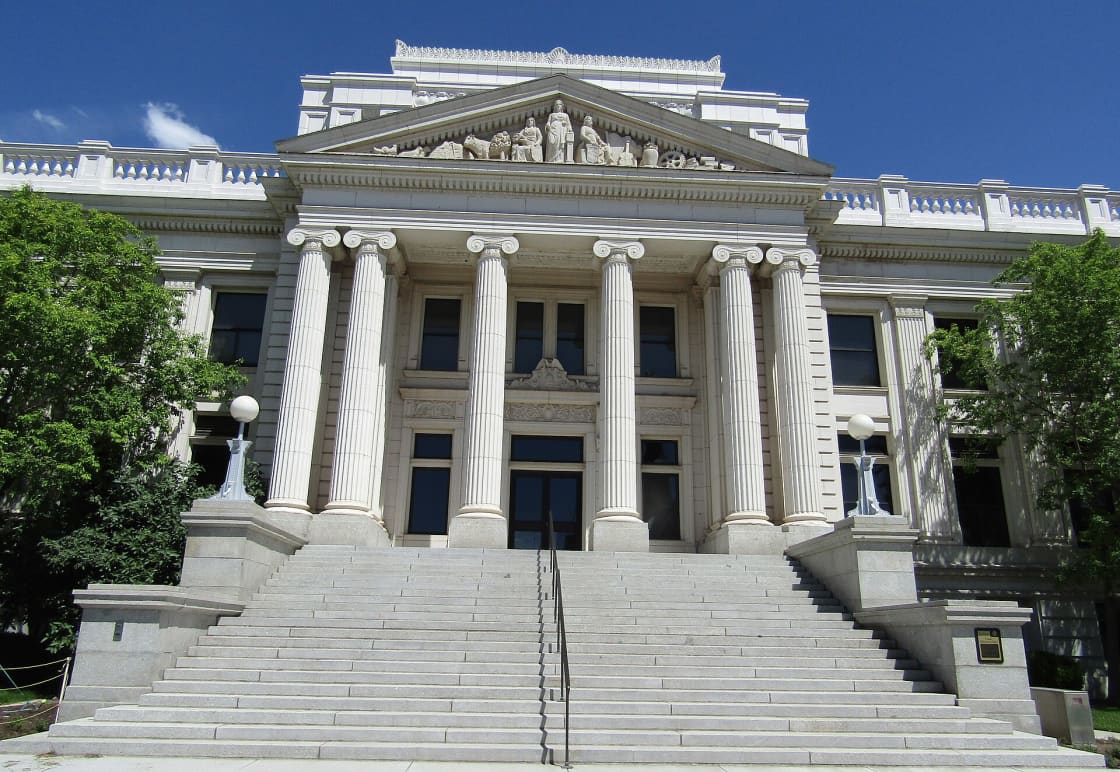
Probate in Utah is district court work. In Utah County that is the Fourth District Court.
The Provo City Justice Court and the Utah County Justice Court have no probate jurisdiction at all. They handle class B and C misdemeanors, infractions and traffic matters, and they will not open an estate. Our guide to the Utah County courts sets out which building holds which kind of case and what each one charges — worth reading before you drive anywhere, because the county's court map is less intuitive than it looks.
For the certified death certificate that nearly every institution will ask for, vital records in Utah County covers who can order one and how many you should order at the outset. The answer is usually more than you think: banks, insurers, the DMV and title companies each tend to want their own original.
If cost is the obstacle, free and low-cost legal help in Utah County covers the hotline, the clinics and the eligibility rules. Probate advice sits within what several of those services will handle, and the court's self-help resources can point to the right form even though staff cannot tell you which one to use.
The personal representative's job
Where formal administration is required, someone has to do the work, and the role is more demanding than the title suggests.
The personal representative — the term Utah uses rather than executor or administrator — gathers and safeguards the assets, identifies and notifies creditors, pays valid claims and taxes in the proper order, keeps records, and finally distributes what remains to the beneficiaries or heirs.
Three things people underestimate.
It is a fiduciary role. The personal representative owes duties to the estate and its beneficiaries, and can be held personally accountable for mishandling. Paying the sympathetic creditor first, or distributing to a beneficiary before the creditor period closes, is a route to personal liability.
Order of payment matters. Claims are paid in a statutory order. Distributing to family before that sequence is complete is one of the more common and expensive errors, because the money is usually gone by the time the problem surfaces.
It takes months, not weeks, even in an uncomplicated estate, because the creditor notification period has to run its course.
Anyone asked to serve should understand that they are taking on an obligation with real exposure, and that declining is a legitimate answer.
Formal and informal probate are not the same thing
Utah's probate code offers more than one path, and the distinction has real cost implications.
Informal probate proceeds administratively, without a judge adjudicating each step, and suits the ordinary case: a valid uncontested will, cooperative heirs, no dispute about who should serve.
Formal probate brings the court in to adjudicate. It is the route when a will's validity is questioned, when heirs disagree about who should be appointed, when there is a dispute about what belongs to the estate, or when a determination of heirs is needed.
Most Utah Valley estates that cannot use the small estate affidavit are informal probate cases. Estates that turn formal usually do so because of a family dispute rather than legal complexity — which is worth knowing, because the cost difference is substantial and the dispute is often avoidable with a clearly drafted will and a conversation held while everyone is still alive.
The practical sequence
1. Establish the value. Everything, wherever located, minus liens and encumbrances. Vehicles set aside for the arithmetic. This single number determines the entire procedure.
2. Wait the 30 days. Not optional; the affidavit must recite it.
3. Under $100,000? Prepare the affidavit and take it directly to whoever holds the property. No court, no filing fee.
4. Over $100,000, or water shares involved, or real property that must be sold? Formal administration in the Fourth District Court.
5. Order certified death certificates early, and more than one.
6. Do not open a court case "just to be safe." An appointment granted in any jurisdiction closes the affidavit route permanently.
What this cannot tell you
This is an explanation of what the statutes say, not advice about your family.
Estates with a business interest, a blended family, out-of-state real property, water shares, a contested beneficiary designation or an heir who cannot be located are complicated, and the cost of getting them wrong dwarfs the cost of an hour with a lawyer. Utah's probate code is also amended most years — the small estate threshold moved in 2025 — so a figure you read anywhere, including here, is worth confirming against the current text at le.utah.gov before you rely on it.
What is worth taking away is smaller and more durable: if you die without a will in Utah, a statute divides your property according to bloodlines, and if your household does not match those bloodlines, the result will not match your intentions.
Related Guides
- Title Insurance and Closing Costs in Utah — how an unadministered estate becomes a defect in the chain of title
- Debt Collection and Wage Garnishment in Utah — creditor claims against an estate
- Legal Name Changes in Utah County — the other probate-court filing people encounter
- Getting Something Notarized in Utah County — self-proved wills and the disqualification rule
- Unclaimed Property in Utah: The Money the State Is Holding in Your Name — the search most executors never run
Frequently Asked Questions
Does every estate have to go through probate in Utah?
What happens if I die without a will in Utah?
Does my spouse inherit everything if I die without a will in Utah?
How long do you have to wait before using a small estate affidavit in Utah?
What is the 120-hour survival rule in Utah probate?
Can a Utah will disinherit someone?
What does per capita at each generation mean in Utah?
Where do I file a probate case in Utah County?
Sources
The facts in this guide were checked against these sources. Hours, fees and rules change, so confirm anything time-sensitive with the source before you go. How we make Provo.com.
- Utah Code 75-3-1201 Collection of personal property by affidavit, Utah Legislature. Checked October 12, 2026.
- Utah Code 75-2-102 Share of spouse, Utah Legislature. Checked October 12, 2026.