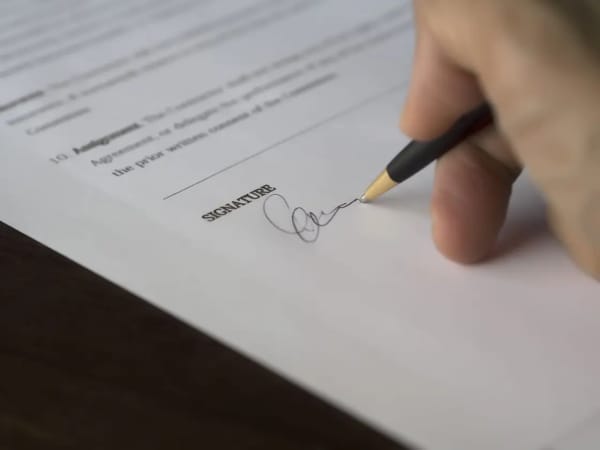

Notarization is one of those errands that feels like it should be simple and periodically is not. You turn up with a document, someone stamps it, you leave. Except sometimes they will not stamp it, or they charge more than you expected, or the bank down the road does it for nothing, or the person you assumed could do it turns out to be exactly the person who legally cannot.
Utah's rules for all of this live in Title 46, Chapter 1 of the Utah Code — the Notaries Public Reform Act. It is a short chapter for how much of daily life it touches, and reading it answers most of the questions people have.
What a notary is doing, and what they are not
A notary verifies that the person signing is who they claim to be, that they are signing willingly, and that the act happened. That is essentially it.
A notary does not verify that a document is true, that it is legally effective, that it says what you think it says, or that signing it is a good idea. This is the most common misunderstanding in the whole area, and Section 46-1-11 puts it beyond doubt: a nonattorney notary may not provide advice or counsel concerning legal documents or legal proceedings, and the statute names immigration matters expressly.
The statute goes further on that point. A nonattorney notary who advertises notarial services in a language other than English must state in the advertisement that they are not an attorney, and must include the statutory fees. That provision exists because of a specific and well-documented pattern of harm, and the drafting is not accidental.
Section 46-1-10 also forbids a notary from using their title or seal to endorse or promote a product, service or contest.
The fee caps, in full
Section 46-1-12 sets maximums, not prices. The distinction matters, because plenty of notaries charge less and some charge nothing at all.
| Act | Maximum |
|---|---|
| Acknowledgment | $10 per signature |
| Certified copy | $10 per page certified |
| Jurat | $10 per signature |
| Oath or affirmation without a signature | $10 per person |
| Signature witnessing | $10 each |
| Any of the above as part of a remote notarization | $25 |
A notary may also charge a travel fee for coming to you, capped at the approved federal mileage rate — but only if they explain that the travel fee is separate from the notarial fee and is neither specified nor mandated by law, and only if the two of you agree the amount in advance. A travel fee sprung on you at the door does not meet that standard.
There is a separate and lower cap for immigration work: a notary may not charge more than $10 per individual for each set of forms relating to a change of that individual's immigration status, and that limit applies whether or not the notary is acting as a notary. It does not apply to a licensed attorney rendering professional services on immigration matters.
Finally, a notary is required to display an English-language schedule of fees. If you cannot see one, you may ask for it.
They generally cannot refuse you
Section 46-1-8 is short and worth knowing:
A notary shall perform notarial acts in lawful transactions for any requesting person who tenders the appropriate fee.
The same section forbids a notary from influencing a person to enter into, or refuse to enter into, a lawful transaction involving a notarial act by that notary.
This is a duty of impartiality. A notary is exercising a public function, not running a business that selects its customers, and disapproval of a lawful transaction is not a lawful ground for refusal.
There are real grounds for refusal, and a competent notary will use them:
- The notary is disqualified under Section 46-1-7 (below).
- The signer cannot be identified to the standard the chapter requires. Section 46-1-2 defines "personally knows" as familiarity resulting from interactions over a period sufficient to eliminate every reasonable doubt as to identity — a demanding standard, which is why identification documents are usually the practical route.
- The certificate would be false or materially incomplete, which Section 46-1-9 prohibits, along with performing any notarial act with intent to deceive or defraud.
- The signer does not appear to understand what they are signing, or is not acting freely.
The disqualification rule that catches families
Section 46-1-7 is the provision most likely to send you home without a stamp, and it is the one nobody knows about in advance.
A notary may not perform a notarial act if the notary:
- is a signer of the document to be notarized;
- is named in the document to be notarized;
- will receive direct compensation from a transaction connected with a financial transaction in which the notary is named individually as a principal; or
- will receive direct compensation from a real property transaction in which the notary is named individually as grantor, grantee, mortgagor, mortgagee, trustor, trustee, beneficiary, vendor, vendee, lessor, lessee, buyer or seller.
Read prong two again, because it is broader than people expect: named in the document is enough, whether or not you are signing it.
The exceptions are narrow and specific. Self-proved wills under Sections 75-2-504 and 75-2-1408 are carved out of the first two prongs. So is a licensed attorney listed in the document only as representing a signer or another person named in it. So is a licensed escrow agent who acts as the title insurance producer in signing closing documents and is not named individually as a party.
The practical upshot: if the notary is your co-buyer, your co-signer, your business partner in the transaction, or simply appears by name in the paperwork, find a different notary. A notarization performed by a disqualified notary is a problem discovered later, usually by someone who is not on your side.
The journal rule that changed in 2026
This is the live development in Utah notary practice, and it is phasing in rather than switching on.
For notaries commissioned before May 6, 2026, Section 46-1-13(1) is permissive: the notary may keep a chronological, permanently bound official journal with numbered pages. The one hard requirement in that subsection is for remote notaries, who shall keep a secure electronic journal of each remote notarization.
For a notary who receives a commission, or a new commission, on or after May 6, 2026, Section 46-1-13(2) is mandatory. That notary shall keep a physical journal of each notarial act other than a remote notarization, and a secure electronic journal of each remote notarization, in accordance with Section 46-1-14.
Because it attaches to the commission rather than to a calendar date, coverage of the existing notary population phases in across a commission cycle. Two notaries sitting in the same office today can be under different obligations, and both are complying with the law. Anyone reading "Utah requires notary journals" as a flat statement is reading something that is not yet true for every notary and will become true for all of them in time.
Retention is ten years. Section 46-1-13(3) requires the notary to retain the journal for 10 years after the day the last notarial act is recorded in it, and that duty survives the commission — it applies regardless of whether the person has ceased to be a notary. After ten years the journal must be destroyed by shredding or another means that renders the information unreadable. Section 46-1-14 governs required entry information and Section 46-1-15 governs inspection, safekeeping and custody.
If a journal was kept for your signing, that record now has a defined ten-year life, which is worth knowing if the transaction is ever disputed.
The four acts, and why the difference matters
People say "get it notarized" as though there is one thing. There are several, they are not interchangeable, and the document usually specifies which one it needs.
An acknowledgment is the most common. The signer appears before the notary and acknowledges that they signed the document willingly for its stated purpose. The signature does not necessarily have to be made in front of the notary — what is being certified is the acknowledgment of it. Deeds, powers of attorney and most real property instruments use this form.
A jurat is different in a way that catches people out. Here the signer swears or affirms that the contents of the document are true, and signs in the notary's presence. This is the form used for affidavits and sworn statements. If your document needs a jurat, do not sign it in the car.
An oath or affirmation without a signature is a notarial act in its own right. Section 46-1-2 defines it as an act in which the notary certifies that a person made a vow or affirmation in the notary's presence on penalty of perjury.
A certified copy is the notary certifying that a reproduction is a true copy of an original. Note the fee is charged per page, which makes a long document meaningfully more expensive than a single-signature acknowledgment.
Signature witnessing is the fifth act carrying its own fee line in Section 46-1-12.
The practical instruction: read the certificate block on your document before you go. It will usually tell you which act is required, and turning up asking for the wrong one wastes a trip.
Remote notarization, and its limits
Utah recognizes remote notarization, and Section 46-1-2 defines it precisely: a notarial act performed by a remote notary for an individual who is not in the physical presence of the notary at the time the act is performed. A remote notary is a notary holding an active remote notary certification — so it is a specific credential, not something every notary can do.
Three practical points follow.
Not every notary is a remote notary. Ask specifically rather than assuming that because a service exists, the person in front of you can provide it.
The fee cap is different. Section 46-1-12(1)(b) sets the maximum at $25 for an item performed as part of a remote notarization, against $10 for the same act in person.
The recipient may not accept it. This is the one that causes problems. A lender, a court, a registry or a foreign institution can impose its own requirements beyond what Utah law permits. Confirm acceptance with whoever is receiving the document before you arrange a remote signing, not after.
Remote notaries must keep a secure electronic journal of each remote notarization under Section 46-1-13, and that obligation applies regardless of when they were commissioned.
If something goes wrong
Notaries are bonded. Section 46-1-4 deals with the bond, and Section 46-1-18 with liability — a notary is liable for damage caused by their official misconduct, which Section 46-1-20 ties into the requirement to file a bond policy rider on a change of name or address.
Official misconduct is defined broadly at Section 46-1-2(20): a notary's performance of any act prohibited, or failure to perform any act mandated, by the chapter or by any other law in connection with a notarial act.
Section 46-1-19 provides for revocation or suspension of a commission. Complaints about a notary's conduct go to the commissioning authority — the Lieutenant Governor's office administers notary commissions in Utah — rather than to the business where the notary happened to be working.
Two things worth knowing that cut the other way. Section 46-1-22 provides that a notice is not invalidated in certain circumstances, and Section 46-1-16 covers the official seal, its destruction, and unlawful use of it. If your seal or journal is lost or stolen, that is a matter to report promptly rather than to manage quietly.
Where to go in Utah County
Banks and credit unions are the usual first answer and frequently notarize free for account holders. Our guide to credit unions and banks in Provo covers who is where. Call the specific branch — whether a notary is on duty at a given branch on a given afternoon is not a safe assumption.
Shipping and print shops are the reliable paid option, generally at or near the cap, and they usually have someone available during opening hours.
Title and escrow offices notarize constantly because closings require it. If your document is part of a property transaction, this is often the natural route — and note the escrow-agent exception in Section 46-1-7 exists precisely because of how closings work.
Law offices notarize, and are the right destination if you also need advice, since a notary who is not an attorney cannot give it.
Public offices, including county offices, are worth checking. If your errand also involves records, the Utah County Clerk's office guide covers what is handled where.
Because the fee is a maximum rather than a set price, it is worth asking. The same act can be free at your credit union and $10 down the street.
Before you go
Do not sign it yet. For an acknowledgment or a jurat the signature generally belongs in front of the notary. Turning up with it already signed can mean starting over.
Bring acceptable identification, current and government-issued unless the notary personally knows you to the demanding standard the statute sets.
Bring every signer. Each person signing needs to be present and identified.
Bring the complete document. A notary cannot complete a certificate that would be materially incomplete.
Check who is named in it against who is notarizing it, before you drive anywhere.
Ask the fee first, and ask about any travel fee separately, because the statute requires that it be agreed in advance.
Confirm the recipient's requirements if a remote notarization is in play — not every institution accepts one.
If the document is part of a larger legal matter and you are unsure what you are signing, free and low-cost legal help in Utah County sets out where advice is available. That is a different service from notarization, and the notary cannot provide it.
Related Guides
- The Utah County Clerk's Office — records, licenses and what is handled where
- Credit Unions and Banks in Provo — where free notarization usually lives
- Legal Help in Utah County — when you need advice, not a stamp
- Wills, Probate and Dying Without One in Utah — where self-proved wills come in
- Title Insurance and Closing Costs in Utah — the closing table, where notaries work hardest
- Passports in Utah County — the other identity errand
Frequently Asked Questions
What can a notary legally charge in Utah?
Can a notary refuse to notarize my document?
Can my spouse or my business partner notarize it?
What changed on May 6, 2026?
How long does a notary keep the journal?
Can a notary help me fill out the form?
Where can I get something notarized in Utah County?
Do I have to appear in person?
Sources
The facts in this guide were checked against these sources. Hours, fees and rules change, so confirm anything time-sensitive with the source before you go. How we make Provo.com.
- Utah Code Title 46 Chapter 1 Notaries Public Reform Act, Utah State Legislature. Checked October 12, 2026.