
The single most common thing a new graduate in Utah Valley gets wrong about their first job offer is believing they signed a non-compete when they did not, or believing a non-compete they did sign is enforceable when it is not. Both errors are expensive in the same way: they make people turn down work they were free to take.
Utah has one of the more restrictive non-compete statutes in the country, and it got considerably more restrictive in 2026. The whole thing lives in Title 34, Chapter 51 of the Utah Code — the Post-Employment Restrictions Act. It is short. You can read the operative provisions in about fifteen minutes, and if you are about to sign something, it is fifteen minutes well spent.
This guide walks the chapter as it stands after the amendments made by Chapters 341 and 66 of the 2026 General Session, which took effect on 6 May 2026. Those amendments are recent enough that a fair amount of what is written online about Utah non-competes — including material published by people who ought to know better — describes the law as it was before that date.
The one-year cap, and what "void" means
Start with the rule that has been in place since 2016 and remains the backbone of the chapter.
Section 34-51-201 provides that for a non-compete agreement entered into on or after 10 May 2016, an employer and an employee may not enter into a non-compete for a period of more than one year from the day on which the employee is no longer employed. A non-compete that violates that limit is void.
The word doing the work there is void. In a lot of states, an overreaching restrictive covenant gets what practitioners call blue-pencilled: a judge strikes the unreasonable part, keeps the rest, and enforces a trimmed-down version. Utah's statute does not say a non-compete longer than a year is enforceable for one year. It says it is void.
That is a meaningful difference in negotiating posture. If an employer hands you a two-year non-compete and you sign it, you have not agreed to a one-year restriction. On the face of the statute you have agreed to nothing enforceable under this chapter at all. The practical caution is that "void" is a conclusion a court reaches, not a status that announces itself, and getting there still costs time and nerves — which is exactly why the fee-shifting provision discussed below matters so much.
Note also what the section preserves. The one-year cap applies "in addition to any requirements imposed under common law." The statute sets a ceiling; it does not certify that everything under the ceiling is reasonable. A one-year restriction can still fail on ordinary common-law grounds — no legitimate protectable interest, absurd geographic scope, no consideration. The statute is a floor of protection for the employee, not a safe harbor for the employer.
What is not a non-compete, which is most of what you will sign
This is the section that changes the most minds, so read it slowly.
Section 34-51-102 defines a non-compete agreement as an agreement, written or oral, between an employer and employee under which the employee agrees that after the employment ends they will not compete with the employer in providing a product, process, or service similar to the employer's. Then it says, in plain terms, that a non-compete agreement does not include:
- a nonsolicitation agreement
- a nondisclosure agreement
- a confidentiality agreement
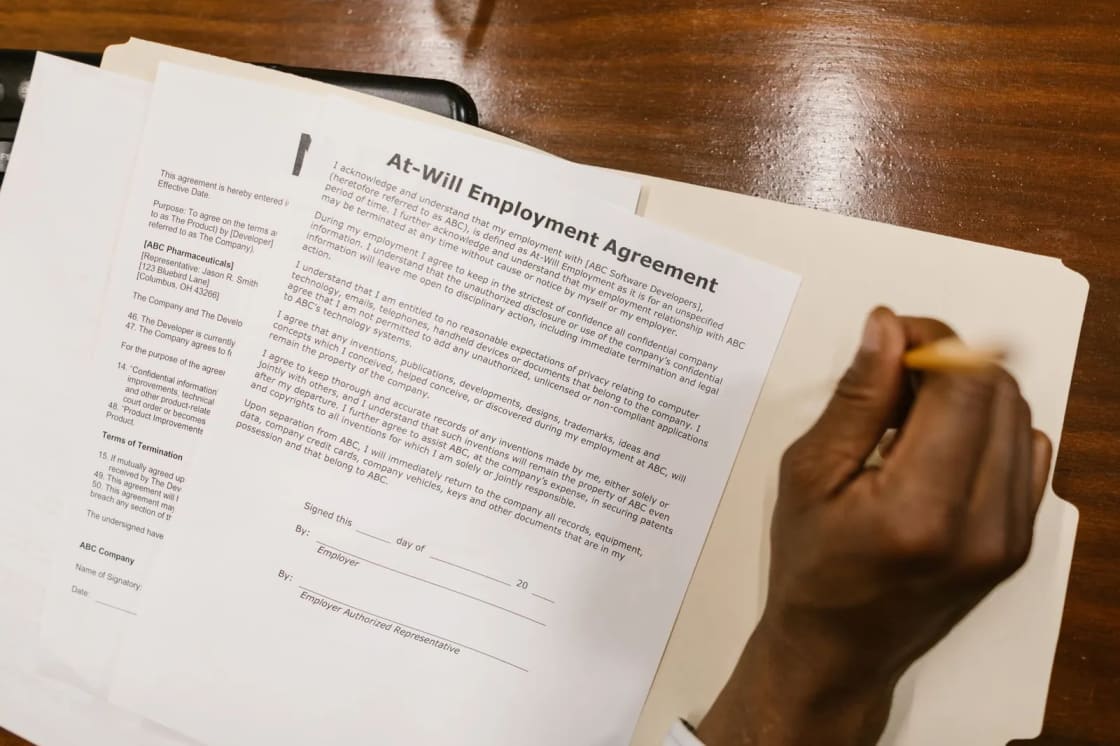
Look at a typical first-job offer packet from a Lehi software company or a Provo agency. You will usually find a confidentiality clause, an invention assignment clause, sometimes a nonsolicitation clause, and an at-will acknowledgment. Frequently there is no non-compete at all. Yet the person who signed it will tell you for years afterward that they are "under a non-compete" and cannot go work for a competitor.
They are not. They have agreed not to disclose the employer's confidential information and not to poach the employer's customers or staff, which are different and much narrower promises. Both are generally enforceable in Utah. Neither prevents you from taking a job.
The invention assignment clause deserves its own moment of attention, because it is the one people skim hardest and it is the one that reaches furthest into your life. Read what it covers. Some are limited to work made in the scope of employment using company resources. Others sweep in anything you conceive during the term of employment that relates to the company's business or anticipated research. If you have a side project — and in this valley a great many graduates do — the difference between those two drafts is the difference between owning your project and not.
What changed on 6 May 2026
Chapter 341 of the 2026 General Session made three substantive additions. All of them narrow what employers can do.
Healthcare non-competes are banned outright. Section 34-51-201 now provides that on or after 6 May 2026, a person and a healthcare worker may not enter into a healthcare non-compete agreement, and an agreement that violates the subsection is void. A healthcare non-compete is defined in Section 34-51-102 as an agreement under which a healthcare worker agrees that after they stop working for or with the person, they will not engage in a service they may provide under the scope of their license — either for a restricted period of time or within a specific geographic area.
The definition of healthcare worker is not a vague gesture at people who work in hospitals. It is an enumerated list of more than thirty licensure categories, running from advanced practice registered nurses and registered nurses through physicians, physician assistants, dentists, optometrists, podiatric physicians, naturopathic physicians, nurse midwives, psychologists, certified and clinical social workers, marriage and family therapists, clinical mental health counselors, behavior analysts, physical therapists, radiology practitioners, respiratory care practitioners, licensed massage therapists, certified dietitians, genetic counselors, medication aides certified, behavioral health coaches and technicians, and substance use disorder counselors.
For Utah Valley this is not an abstraction. Healthcare is one of the region's largest employment sectors, and BYU and UVU both feed nursing, social work, and behavioral health programs directly into it. A nursing graduate signing an offer this autumn is signing under a materially different legal regime than one who signed in early 2025.
There is a carve-out worth knowing. The definition excludes an individual who holds one of the listed licenses but whose employment or contractual agreement does not require or involve practicing under the scope of that license. Holding the credential is not the trigger; the job requiring you to practice under it is.
Veterinarian non-competes are banned, with an ownership exception. Section 34-51-201 also provides that on or after 6 May 2026, a person and a veterinarian may not enter into a veterinarian non-compete agreement, and one that does is void. The exception is narrow and specific: it does not apply if the veterinarian has at least a five percent ownership interest in the person's business.
Tucked into the same section is a provision with wider significance than its subject matter suggests. If a veterinarian non-compete entered into on or after 6 May 2026 requires the parties to resolve a dispute in a forum outside Utah, that provision is void and unenforceable, and is considered against the public policy of this state. Out-of-state forum selection is a common tool for multi-state employers, and the Legislature closed that door for this category.
A new section on nonsolicitation. Section 34-51-203 was enacted outright in 2026. It provides that on or after 6 May 2026, a person and a healthcare worker may not enter into a nonsolicitation agreement that prevents the healthcare worker from informing a patient of their current place of employment or their future place of employment. Such an agreement is void.
Veterinarians got two more protections in a separate 2026 bill. Chapter 66 of the 2026 General Session, also effective 6 May 2026, enacted Section 34-51-205, which voids a nondisclosure clause in which a veterinarian agrees not to disclose or discuss their experience working for or with the person, and Section 34-51-206, which provides that a person and a veterinarian may not enter into a nonsolicitation agreement at all.
This addresses a real and specific harm. When a therapist or a nurse practitioner moves practices, the people most affected are patients mid-course of care who simply cannot find out where their clinician went. The section does not make all healthcare nonsolicitation agreements unlawful. It makes unlawful the specific term that keeps a patient in the dark about where their provider now works.
The fee-shifting provision nobody mentions
Section 34-51-301 is four lines long and it is the most practically powerful thing in the chapter.
If an employer seeks to enforce a non-compete agreement, a healthcare non-compete agreement, a nondisclosure clause, or a nonsolicitation agreement — through arbitration or by filing a civil action — and it is determined that the agreement is unenforceable, the employer is liable for the employee's costs associated with arbitration, attorney fees and court costs, and actual damages.
Consider what that does to the economics of a threat letter. The classic restrictive-covenant play against a junior employee is not litigation; it is the prospect of litigation. A demand letter from a firm with a good letterhead is often enough, because a twenty-three-year-old six months into a first job cannot fund a defense and the employer knows it. Section 34-51-301 puts a price on losing that fight, and note carefully that the 2026 amendment widened the list. Before, the fee exposure attached to non-competes. Now it attaches to nondisclosure clauses and nonsolicitation agreements as well.
This does not make hiring a lawyer unnecessary. It makes hiring one findable. A Utah employment attorney reading a facially void agreement and a statutory fee-shifting provision is looking at a considerably more attractive case than the same facts in a state without one.
The broadcasting exception, and why a whole industry got its own subsection
Section 34-51-201 contains a carve-out that looks strange until you know what it is for. A non-compete between a broadcasting company and a broadcasting employee is valid only if a specific set of conditions all hold: the employee must be an exempt broadcasting employee; the non-compete must be part of a written employment contract of reasonable duration, judged against industry standards, the position, the employee's experience, geography, and the parties' unique circumstances; and either the company terminates the employee for cause, or the employee breaches the contract in a way that ends the employment.
Even then, the agreement is enforceable for no longer than the earlier of one year after the employment ends or the day the original term of the employment contract ends. One that does not comply is void.
The definitions give away the reasoning. A broadcasting company is a person in the business of distributing or transmitting electronic or electromagnetic signals to the general public by television, cable, or radio, or preparing programs or messages for such distribution. An exempt broadcasting employee is one compensated on a salary basis, as defined in 29 C.F.R. Section 541.602, at a rate at or above the greater of $913 per week or the threshold at which an employee qualifies as exempt under the Fair Labor Standards Act.
That salary floor is the tell. The exception was written for on-air talent whose personal following is the station's asset, and it was deliberately gated so it cannot be used on the production assistant or the overnight board operator. If you are taking a media job in Utah Valley, the practical question is whether you clear that salary threshold. Below it, the exception does not reach you and the ordinary rules apply.
Three situations that come up here
The Lehi software offer. A computer science graduate accepts a junior developer role and signs a four-document packet. Reading it against the statutory definitions, there is a confidentiality agreement, an invention assignment, a twelve-month nonsolicitation of employees, and an at-will acknowledgment. There is no non-compete. Eighteen months later a competitor recruits them. Nothing in what they signed prevents the move. What does bind them is the nonsolicitation — so bringing two former teammates along is the part that carries risk, not the job change itself. The invention assignment is the clause that deserved the most reading and got the least.
The clinic offer. A social work graduate is offered a position at a behavioral health practice and the agreement includes a term saying that for two years after leaving they will not provide clinical services within fifteen miles. Certified social workers, clinical social workers, and clinical mental health counselors are all named in the Section 34-51-102 list. If the agreement is entered into on or after 6 May 2026, that is a healthcare non-compete and the statute says a person and a healthcare worker may not enter into one. It is void — and independently it would have failed the one-year cap anyway.
The agency offer. A marketing graduate joins a small Provo agency and signs a one-year non-compete covering "any business providing marketing services in Utah County." The duration is inside the cap, so the statute does not void it on its face. That does not end the inquiry, because the chapter operates in addition to common-law requirements. Whether a junior employee with no client relationships and no trade secrets presents a legitimate protectable interest at all is a real question, and it is the question a lawyer would ask first. This is the category where the answer depends on facts, and where Section 34-51-301's fee exposure most changes who is willing to take the case.
Reading your actual offer
A short and unglamorous procedure, in order.
Find every document. The restrictive terms are frequently not in the offer letter. They are in a separate employee agreement, a confidentiality and invention assignment agreement, an equity grant, or an employee handbook you acknowledge electronically on day one. Ask for all of them before you sign any of them. An employer that will not send the full set before your start date has told you something.
Classify each clause. Non-compete, nonsolicitation, nondisclosure, confidentiality, invention assignment, at-will acknowledgment. Use the statutory definitions in Section 34-51-102 rather than the heading on the paper. Documents are frequently labeled in ways that do not match what they do.
Check the duration on anything that is a non-compete. Over one year and the statute says void.
Check whether you are a healthcare worker or a veterinarian under the definitions, and if so whether the agreement was entered into on or after 6 May 2026.
Read the invention assignment clause as though you have a side project, because you might within two years even if you do not today.
Ask about severance now, not later. The Section 34-51-202 exception for severance agreements is real, which means a restriction you could not lawfully be given at hiring can lawfully arrive at departure, attached to money. Knowing that in advance is the difference between negotiating and being surprised.
Where this sits in a first year
None of this is a reason to be afraid of an offer. Utah's default employment relationship is at will, and the great majority of first jobs in this valley end with somebody simply taking a better one. The Post-Employment Restrictions Act exists because the Legislature concluded, repeatedly and with increasing conviction, that restricting where people may work after they leave is a disfavored thing that needs statutory limits.
What it asks of you is fifteen minutes and a willingness to name the documents correctly. If you are weighing a first offer against staying in school, the grad school and job market comparison covers the other half of that decision. If the offer is what keeps you in the valley, the guide to graduating and staying covers the practical mechanics. If you are thinking about working for yourself instead, starting a business the year you graduate walks the registration path. And for the wider picture of who is hiring here and at what wage, see the Utah Valley jobs guide, the salary guide and the first job guide.
One last note on sourcing, because it matters for a subject that changed this year. Everything above is drawn from the operative text of Title 34, Chapter 51 as amended by Chapter 341 of the 2026 General Session. This is a guide, not legal advice, and it cannot account for the specific language in your specific agreement. For that, an employment lawyer reading your actual paper is worth the consultation fee — and under Section 34-51-301, possibly worth rather less than you fear.
Frequently Asked Questions
How long can a non-compete last in Utah?
Can a hospital or clinic in Utah County make me sign a non-compete?
I have a nursing license but my job is not a nursing job. Does the healthcare ban cover me?
Is a confidentiality agreement a non-compete?
What happens if my employer sues me over a non-compete and loses?
Are there exceptions to the one-year cap?
What is a nonsolicitation agreement and can my employer still use one?
Does any of this apply if I am an independent contractor rather than an employee?
Sources
The facts in this guide were checked against these sources. Hours, fees and rules change, so confirm anything time-sensitive with the source before you go. How we make Provo.com.
- Utah Code 34-51-201 Non-compete agreements, Utah Legislature. Checked October 12, 2026.
- Utah Code 34-51-102 Definitions, Utah Legislature. Checked October 12, 2026.
- Utah Code 34-51-202, 203, 205, 206, 301, Utah Legislature. Checked October 12, 2026.