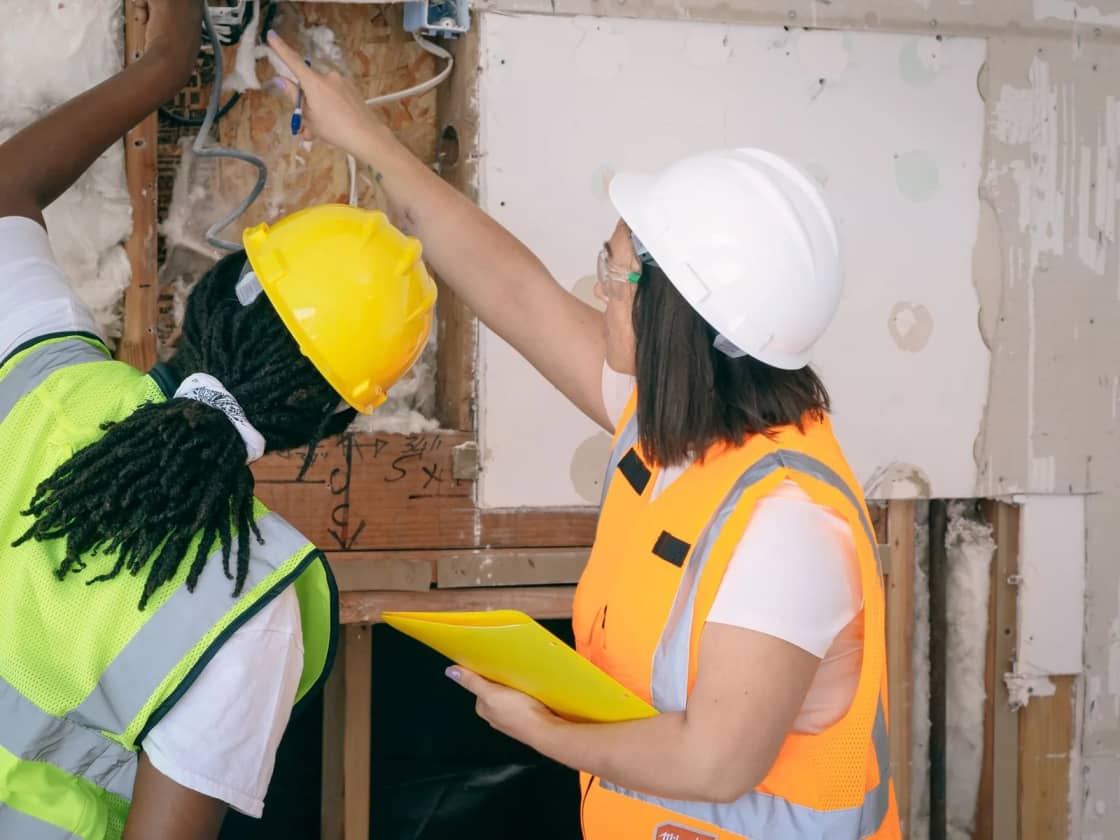

Almost every article about entering the trades gives the same advice in the same order: pick a trade, enroll in a program, get certified, find a job.
In Utah, that order is close to backwards. For the licensed construction trades here, the sequence generally runs employer first, license second, classroom third — and people who follow the standard advice arrive at a technical college to be told they cannot register for the evening course until they already have both a job and a license.
That single structural fact is what this page exists to explain.
The sequence, stated in the order it happens
Here is the shape of it for a licensed construction trade in Utah.
One: get hired. You need an employer who will take on an apprentice and provide supervision by a licensed journeyman or master.
Two: register with DOPL through that employer. Utah's Division of Professional Licensing, which sits inside the Utah Department of Commerce, licenses the apprentice — and the registration runs through the employer rather than being something you do alone in advance.
Three: enroll in the classroom component. Mountainland Technical College states the requirement plainly on its own program pages: students must be registered with DOPL through an employer, and evening students must already hold an apprentice license before registering for a course.
Four: accumulate hours. Classroom hours and on-the-job hours run in parallel for years.
Five: sit the exam and apply for the journeyman license.
The trap is between steps one and three. Someone who has decided to become an electrician, saved for tuition and called the college is at step three holding nothing from steps one and two.
The way in when you have no employer yet
If the sequence above were absolute, nobody could ever start, and obviously people do. The resolution is that daytime programs at the technical colleges are structured differently from the evening ones.
MTECH's program materials distinguish between the two, and the DOPL-through-employer requirement is applied to the evening cohort rather than to daytime students. The evening programs exist to serve people already working in the trade; the daytime programs exist partly to serve people who are not yet.
The practical implication is precise and worth acting on: if you have no job in the trade, ask specifically about daytime enrollment. Do not ask whether you can enroll — ask which cohort accepts students without an employer. Those are different questions and they get different answers.
The other route in is to skip the college entirely at the start and go looking for a helper or laborer position with a contractor, then let the employer bring you into the licensing system. That is slower to formalize and it is how a great many people in this valley got started.
What the hours are
For a journeyman electrician in Utah, the widely cited standard is 576 hours of classroom instruction — typically eight semesters — plus 8,000 hours of on-the-job training under supervision. Eight thousand hours is about four years of full-time work.
Plumbing follows a comparable shape: a four-year apprenticeship combining full-time on-the-job training in the region of 8,000 hours with classroom instruction.
There is an alternative path and it is worth knowing about, because it changes who can qualify. Utah has accepted documented supervised experience in place of the formal apprenticeship — in the region of 16,000 hours, roughly eight years. That exists for the person who has been doing the work for a decade without ever formally entering a program.
It is twice as long. It is not a shortcut and nobody should choose it deliberately. But for someone already eight years into informal work, it is the difference between having a path and not having one.
Treat every number above as a starting point for a phone call. Hour requirements, exam standards and fees are set by rule and they move. DOPL is the authority; a blog is not.
Apprentice, journeyman, master, contractor
Four words that get used loosely and mean four specific things in Utah, each a separate credential.
Apprentice is a licensed status, not an informal one. You work under supervision and you cannot work unsupervised.
Journeyman means the training is complete and the exam is passed. You can generally work without direct supervision.
Master requires additional years beyond journeyman — for electricians, on the order of four years as a licensed journeyman, or a related degree plus a year of journeyman experience — and carries broader authority.
Contractor is a different category entirely. It is permission to run the business rather than to do the work, and it comes with its own requirements: a pre-license course, proof of general liability insurance, and registration as a business entity.
That last distinction is the one that trips up tradespeople who decide to go independent. Being an excellent journeyman does not entitle you to contract. Our guide to the Provo business license covers the registration side, and the electrical trade's supervision rules are covered in more depth in our electricians guide.
Not every trade is licensed the same way
DOPL regulates a long list of occupations, and the list is not confined to construction — the same division handles health professions, cosmetology, accountancy and much else.
Within the building trades, electrical and plumbing are licensed at every level from apprentice up. Other skilled work is regulated differently, and some is not licensed at the individual level at all even though the contractor performing it must be licensed.
This matters before you commit, because it determines whether the employer-first sequence applies to you. A trade with no individual apprentice license has a very different entry path — usually a much simpler one. Check your specific trade against DOPL's own list rather than assuming construction works one way.
Where to train in Utah County
Mountainland Technical College is the main public technical college serving this county, with campuses including Lehi and Orem, and it runs the apprenticeship classroom programs for electrical and plumbing among other construction trades. It is the default answer for most people reading this.
Utah Valley University carries technical and trade programs alongside its degree offerings, which suits people who want a route that can later convert into a degree.
Union apprenticeship programs operate in Utah and run their own selection processes and training. They are frequently overlooked by people who assume the technical college is the only door, and the terms — including how training is paid for — can differ substantially.
Employer-run training exists at larger contractors and is the least visible route because it is never advertised as a program.
Program costs, schedules and entry requirements change every year. Any tuition figure you find in a search result is a number from some past year, and the college will tell you the current one in a five-minute call.
HVAC sits in a different regulatory place, and there is a reason
HVAC is the trade people are most often confused about, because it does not map neatly onto the electrical and plumbing pattern.
Part of the confusion is a genuine overlap in the work. An HVAC installation touches electrical wiring, and Utah's electrical rules contain an accommodation for exactly that situation — there is a limited allowance under which HVAC work can involve connections that would otherwise require an electrical license. Our electricians guide covers how that boundary works in practice, because it is the reason a homeowner sees an HVAC company handling wire without an electrician present.
The federal layer is the other difference. Anyone handling refrigerants works under EPA certification requirements, which is a national credential rather than a Utah one, and it exists independently of whatever the state requires. That is a real and separate qualification with its own testing.
For someone choosing between trades, HVAC has two arguments in its favor in this valley specifically. The work is year-round in a climate with genuine extremes at both ends — furnaces in January, air conditioning in July — which smooths the seasonality that affects some construction trades. And the service side of the business generates recurring maintenance work rather than depending entirely on new construction.
Check the current Utah requirements for HVAC directly rather than assuming they mirror plumbing. This is the trade where the general pattern is least reliable.
What the licensing exam involves
The exam is the step people imagine least clearly, and knowing its shape removes a lot of unnecessary anxiety.
Utah's trade licensing exams are administered through third-party testing providers rather than by DOPL itself, and for the electrical trades the examinations have typically come in more than one component — a written portion covering theory and code, and a practical portion.
Two features are worth planning around. Passing scores are set per component, so a strong theory result does not carry a weak practical one. And code knowledge is a large share of the written exam — for electricians, familiarity with the National Electrical Code is not a background skill, it is much of the test. MTECH's electrical program is described as weighting NEC compliance heavily, which is a curriculum choice made for exactly this reason.
The testing provider publishes a candidate information bulletin describing content, format and rules. Read it early rather than the week before, because it tells you what reference material you may bring into the room, and in a code-heavy exam that single detail changes how you prepare.
Exam fees and application fees exist at each stage and are modest relative to the earnings involved, but they are real and they are not always mentioned by programs recruiting students.
The high-school route is the cheapest door in the state
The most underused entry point in Utah is the one available to people still in high school.
Utah's technical colleges enroll high school students, and tuition arrangements for high school students at these institutions have historically been substantially reduced or waived. A student who begins technical training at sixteen or seventeen can enter the workforce with a meaningful share of the classroom requirement already behind them, at a fraction of the cost, before ever making a decision about a degree.
The reason this is underused in Utah Valley is cultural rather than practical. This is a county where the four-year degree is the assumed default and where a high schooler asking about technical college is sometimes treated as narrowing their options. It does not narrow them. Technical training and a later degree are not mutually exclusive, and the trades pay for the degree considerably more comfortably than the reverse arrangement works.
If you are a parent reading this, the question to ask at the high school is not whether your child should go to college. It is what concurrent technical enrollment is available, what it costs, and what it counts toward. Those are three specific answerable questions and the answers are usually better than expected.
Why the case is unusually strong in this valley
The generic argument for the trades is that they pay reasonably and cannot be offshored. The Utah County argument is more specific.
This valley has been building continuously for years. Residential development runs the length of the county. The north end carries a chip fabrication and data infrastructure buildout of a scale that has reshaped the local labor market. Commercial and institutional construction has followed the population.
None of that happens without licensed electricians, plumbers and HVAC technicians, and it is not work that can be performed from another country.
The financial structure is the other half of the case. An apprenticeship pays you while you train. A four-year degree charges you while you study. That is not an argument that one is better than the other — it is an argument that they are different financial instruments, and the comparison is rarely made to eighteen-year-olds in this valley, where the degree path is culturally dominant.
What this page will not do is print a wage. Trade wages vary by trade, employer, union status, overtime availability and where the construction cycle sits. A number published today would be wrong within a year and would be used to make a decade-long decision. Ask employers directly, and ask more than one.
What it is like, honestly
The trades are physical work, and the physicality is not evenly distributed across a career. An apprentice does the carrying. That is the deal, and it is the part that filters people out in year one.
Construction in Utah Valley is seasonal at the margins. Winter slows some work and stops other work. Inversion season is a genuine consideration for anyone working outdoors in this valley with respiratory sensitivity.
Early starts are normal. Job sites frequently begin at or before seven, which means leaving home in the dark for a good part of the year.
The work is cumulative on the body, and the tradespeople who are still working comfortably at fifty are generally the ones who took knees, backs, hearing and eyes seriously at twenty-two. The protective equipment is not optional and the people who treat it as optional pay later.
None of that is a reason not to do it. It is the information that should be in the decision.
Verifying a license, in both directions
DOPL maintains a public license lookup, and it takes about a minute to use.
If you are hiring, it tells you whether the person doing licensed work in your house is entitled to do it. If you are training, it shows you what your own credential will look like publicly once you have it.
One caution that applies broadly in Utah: different regulated fields run through different lookup systems. DOPL is not a single window onto every licensed occupation in the state, and someone checking one database may believe they have checked everything. Confirm which system covers the credential you care about.
If you are starting from zero this month
The sequence that works, compressed.
Pick the trade before you pick the school, because the trade determines whether you need an employer first. Call MTECH and ask specifically which cohort accepts students without an employer. In parallel, apply directly to contractors for helper or apprentice positions — many will hire someone with no experience and put them into the licensing system themselves. Ask every employer you speak to whether they pay for the classroom component, because some do and it is rarely advertised. And check DOPL's requirements for your trade yourself rather than relying on any summary, including this one.
The first job is the hard part. Everything after it is time.
One last thing worth saying to anyone who has been talked out of this. The reason the employer-first sequence exists is that Utah decided the training should happen on real job sites rather than only in classrooms, which is a defensible choice and produces good tradespeople. It just makes the first step a door rather than a form — and doors open for people who knock on enough of them.
Related Guides
- Jobs Without a Degree in Provo
- Electricians in Provo
- Plumbers in Provo
- Provo Business License
- Summer Jobs in Utah Valley
- Hiring Home Pros in Utah Valley
Frequently Asked Questions
Do I need a job before I can start an apprenticeship in Utah?
How long does it take to become a journeyman electrician in Utah?
What is the difference between an apprentice, journeyman and master?
Which trades does Utah license?
Where can I do trade training in Utah County?
Can I get into the trades without a high school diploma?
Are the trades a good career in Utah Valley?
How do I check whether a tradesperson is licensed?
Sources
The facts in this guide were checked against these sources. Hours, fees and rules change, so confirm anything time-sensitive with the source before you go. How we make Provo.com.
- Utah Code 58-55-302 Qualifications for licensure, Utah Legislature. Checked October 12, 2026.