
Utah has about three and a half million people. It has produced a startling number of restaurant chains that operate in a dozen or more states.
Kneaders started in Orem. Cafe Rio started in St. George and was made famous in Provo. Costa Vida started in Layton and franchised first into Provo. Swig started in St. George and built an entire beverage category around a state's drinking habits. Crumbl started in Logan and went everywhere.
This page is about how that happened, what Utah Valley specifically contributed, and the parts of the story that most write-ups get wrong.
Kneaders: the one that is ours
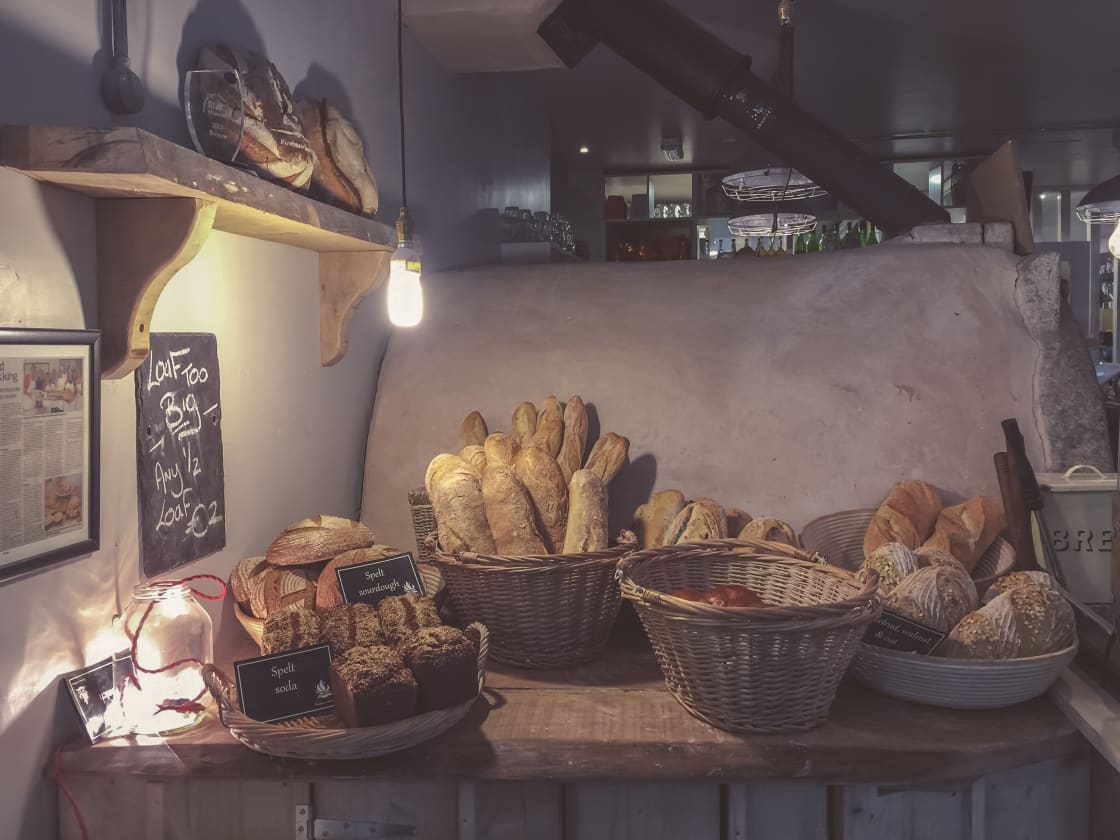
If you want a chain that Utah Valley can claim without an asterisk, it is Kneaders Bakery and Cafe.
Gary and Colleen Worthington founded it in Orem in 1997, and the company is still headquartered in Orem. That is unusual on its own — most successful regional chains are absorbed, relocated, or handed to professional management within a decade or two.
The founding story is better than the usual origin myth because it is so unglamorous. The Worthingtons had run Subway franchises and retired. Retirement did not take. Colleen Worthington's own description was that being retired was incredibly boring, and that having come from parents who thought hard work filled your life, they simply could not do it.
So they went and learned to bake properly: formal baking training, recipe testing, and working out a flour blend.
And here is the detail that ties the whole thing to this valley. Accounts of the founding describe the Worthingtons working closely with Lehi Roller Mills to develop an exclusive flour mixture, and sourcing a traditional hearthstone oven from Italy. A bakery in Orem, building its signature product on a mill in Lehi that has been grinding Utah County wheat since 1906. Our Lehi Roller Mills guide covers the mill's own long history.
They opened in the fall of 1997 selling European hearth breads, and within a few months had added sandwiches, soups, salads and pastries — which is essentially the menu the chain still runs.
Kneaders has since expanded across the West; by its 20th anniversary in 2017 it had 59 stores in eight states. It has also taken outside investment, with a consumer-focused investment firm listing it among its partner companies. Both things can be true at once, and anyone making claims about who owns it today should check rather than assume.
Cafe Rio, and a founding-location error worth correcting
Cafe Rio Mexican Grill was founded in 1997 in St. George by Steve and Tricia Stanley. Steve Stanley was a chef; he had pitched the idea of a fast-casual restaurant serving freshly prepared Mexican food to potential partners who were not interested, and went into business with his wife instead.
The recipes drew on the cooking of the Rio Grande region — northern Mexico, southern Texas and New Mexico — and the operating rule was that everything is made fresh, in each restaurant's kitchen, every day.
Now the correction. Several reference pages state that Cafe Rio started in Salt Lake City. It did not. Salt Lake City is where the company is headquartered, and the error is almost certainly a headquarters-versus-founding confusion propagating from one infobox to the next. The Stanleys opened in St. George.
This is a small thing, but it is the exact shape of error this site runs into constantly: the most-repeated fact about a business tends to be the most convenient one, not the most accurate one, and a corporate address is far easier to find than a founding address.
By 2004 the chain had grown to six restaurants and was sold, going on to expand well past a hundred locations and into a dozen-odd states.
Why Provo matters to a chain founded 250 miles away
Cafe Rio's first location was in St. George. But ask anyone who grew up in Utah Valley in that era and they will tell you about the Provo store.
A Cafe Rio opened near the BYU campus at the end of the 1990s, and the accounts of it are consistent: the line to order wrapped around the interior of the restaurant and out the door. One Deseret News writer who grew up here described it as not the chain's first location but the one that felt like the first restaurant of its kind — not quite Mexican, not quite Tex-Mex, something in between, lime-and-cilantro forward with enormous portions.
That is Utah Valley's actual role in the story of Utah restaurant chains, and it is worth stating clearly because it is not the role people assume.
This valley is rarely where the concept is invented. It is where the concept is proven.
A restaurant near BYU is testing against a customer base that is young, extremely price-sensitive, eats in groups, turns over completely every few years as students cycle through, and talks constantly. A format that works there is a format with demonstrated word-of-mouth mechanics and demonstrated unit economics under heavy volume. A format that dies there dies cheaply.
Costa Vida's pattern says the same thing in a different way. The first store was in Layton. The first franchise location was in Provo. When you are choosing where to prove that your concept travels beyond its founders, the college town two counties south is a rational answer.
The lawsuit nobody won in public
The rivalry between Cafe Rio and Costa Vida is a genuine Utah cultural fixture, and it has a legal history underneath it.
Costa Vida launched in 2003 in Layton, originally under the name Costa Azul. The concept was Baja-styled — beach imagery, surfing memorabilia — against Cafe Rio's more traditional Mexican-restaurant look, but the menus were close enough that customers noticed immediately.
In 2005, Cafe Rio sued Costa Azul Holdings, the company behind Costa Vida, alleging that a former Cafe Rio general manager and others had copied its trade secrets, recipes, menu, layout and food presentation. Costa Azul's marketing director said the allegations were not true. We found no public ruling on the merits.
Two things about that outcome are worth sitting with.
First, without a public ruling, the underlying question was never answered in public. Anyone who tells you confidently which chain copied which is telling you a preference, not a verdict.
Second, the folk explanation you will hear locally — that the two restaurants were once one business and split after a feud — appears to be legend rather than documented history. It is repeated widely, including in student newspapers, always with some version of "at least, that's the story that has always been told." That phrasing is doing a lot of work, and it is the tell.
Bajio, a third chain in the same genre with a green chili chicken salad, is usually the forgotten party in this rivalry.
Costa Vida's contested founders
Here is a case where we are going to document a disagreement instead of resolving it.
One account says that in 2003, friends Kenny Prestwich and JD Gardner opened the first Costa Vida in Layton, and that Sean Collins and Dave Rutter opened the first franchise location in Provo shortly afterward, gaining a controlling interest in the company in 2008.
Several other write-ups, including a couple of school and aggregator publications, instead name JD and Sarah Gardner as the founders.
Those accounts cannot both be complete. KSL is the stronger source — an established news organization with an editorial process — and the Collins-and-Rutter detail it adds is specific enough to be checkable. But two named versions circulate, and a local guide that silently picks one and states it as fact is manufacturing a certainty that the record does not support.
What every account agrees on: 2003, Layton, the Costa Azul name, and rapid growth to dozens of locations across more than a dozen states plus Alberta.
The dirty soda economy
The most distinctively Utah thing on this list is not a restaurant at all.
Swig was founded in April 2010 in St. George by Nicole Robison and her then-husband Todd Tanner, in a small space near what was then Dixie State University and is now Utah Tech. It sells dirty sodas — soft drinks mixed with add-ins like cream and flavored syrups — from a drive-through, alongside cookies and pretzel bites.
By 2026 it operated more than a hundred and sixty locations across sixteen states, with the Larry H. Miller Company as majority owner. Its corporate address has moved around northern Utah; it was in Lehi as of 2018, and more recent listings place it in Sandy.
The reason this category exists in Utah and barely exists elsewhere is not mysterious, and it is worth being direct about it. In a state where a large share of the population does not drink alcohol or coffee, the commercial and social space those drinks occupy in other places was simply vacant. Somebody was going to fill it. What filled it was a drive-through selling elaborately customized fountain drinks at a price point students and teenagers can hit several times a week.
Utah Valley did not invent this either. But it is one of the densest markets for it in the world, and our soda shops guide covers where to go locally.
The pattern, and why the state keeps doing this
Put the cases side by side and some structural reasons emerge.
A young population that eats in groups. Utah's household sizes and median age both skew young, and Utah Valley's more so. Formats built for groups — big portions, shareable menus, fast lines, no reservations — fit the market natively. Every chain on this list has that shape.
Returned missionaries. A large share of the young adult population has spent eighteen months to two years living abroad, often speaking another language and eating another cuisine daily. That produces an unusual concentration of people who have both the exposure to a foreign food tradition and the willingness to adapt it heavily for a domestic palate. The Utah-Mex genre is exactly what that produces.
Franchising as a local competency. Note the Kneaders detail: the Worthingtons had run Subway franchises before they baked a single loaf. They did not learn multi-unit operations at Kneaders; they arrived with them. Utah has a deep bench of people who understand unit economics, supply agreements and franchise law, and that is the difference between a beloved single restaurant and a chain.
A distinct beverage market. Covered above, and it created a category from nothing.
Cheap early real estate and a compact geography. A concept can be tested in St. George, proven in Provo, scaled along the Wasatch Front and pushed into Idaho and Nevada without ever running a truly long supply line.
What this means if you live here
Two practical things.
You are eating in a test market, whether or not you signed up for it. New concepts appear in Provo and Orem earlier and denser than the population alone would justify, because operators want to know whether the format survives contact with this customer base. Some of what opens near campus this year will be in six states in a decade, and most of it will be gone by spring.
And the local original is often still there. Kneaders is still headquartered in Orem. Lehi Roller Mills is still milling. For a valley that exports restaurant formats efficiently, it retains its originals better than you would expect — which is the more interesting half of the story, and the half the national coverage never gets to.
The cookie wars, and the same story a second time
If you want evidence that the pattern above is a real mechanism rather than a retrospective story, watch it happen again with cookies.
Crumbl launched in Logan and expanded at a speed that startled the industry, running a rotating weekly menu, a pink box built for photography, and a delivery-and-pickup model that suited a customer base already organized around social media. Within a few years it had thousands of storefronts. We cover it separately in our Crumbl guide.
What followed was almost a rerun of the Cafe Rio and Costa Vida episode: a wave of competing Utah cookie brands with strikingly similar formats, comparable packaging, weekly rotating menus, and overlapping customer bases — followed, predictably, by litigation between rivals over how much similarity is too much.
The structural reading is more interesting than the gossip. Utah keeps producing categories rather than single businesses. Somebody proves a format works against this population, several competitors appear immediately because the local operator bench is deep and the capital is available, the category gets large enough to travel, and then the founders argue in court about who owned the idea. Utah-Mex did it in the 2000s. Dirty soda did it in the 2010s. Cookies did it in the 2020s.
The thing to watch for is which category is doing it right now. There is always one.
How to check any "founded in Utah" claim yourself
Because this genre of article is unusually full of errors — as the Cafe Rio location mix-up above shows — here is the method rather than just the results.
Separate the founding location from the headquarters. These diverge constantly, and the headquarters is what appears in business directories, infoboxes and press releases. Any claim about where a company started should be sourced to something describing the first store, not the corporate office.
Prefer the company's own history page for founders and dates, and a news organization for anything contested. A company will reliably know when it opened. It is less reliable about disputes, ownership changes and the parts of its history it would rather not foreground.
Treat location counts as perishable. Every number in this article about how many stores a chain operates was accurate to a specific date and will drift. They are useful for scale, not for precision.
Be suspicious of the origin story that is too neat, especially when it is told with a hedge attached. The Cafe Rio and Costa Vida "they used to be one restaurant" legend is repeated everywhere, always with some form of that's the story that has always been told — and that hedge is the sound of a source that knows it cannot back the claim.
Check whether the founders still run it. This changes quietly and often, usually via a private-equity transaction that generates a single press release and no follow-up. Kneaders is notable precisely because the answer has stayed unusual for nearly thirty years.
Applied consistently, that checklist will put you ahead of most published writing on this subject, including a fair amount of it produced by people who live here. The Utah chain story gets retold so often, and so casually, that the retellings have become the main source — and each pass smooths off another detail. The founding addresses, the original names, the settlements that resolved nothing publicly: those are the parts worth holding onto, because they are the parts that go first.
Related Guides
- Lehi Roller Mills: Utah's Landmark Mill
- Crumbl Cookies: The Utah Story
- Soda Shops in Provo and Orem
- Companies Founded in Utah Valley
- The Oldest Businesses in Provo
- Silicon Slopes Explained
- The Best Mexican Food in Provo
- Startup Candy: Provo's Oldest Candy Company
Frequently Asked Questions
Which national restaurant chains were founded in Utah Valley?
Where was Cafe Rio founded?
Did Cafe Rio really sue Costa Vida?
Who founded Costa Vida?
Is Kneaders still owned by the family that started it?
What is a dirty soda and why is it a Utah thing?
Why does Utah produce so many restaurant chains?
What connects Kneaders to Lehi Roller Mills?
Sources
The facts in this guide were checked against these sources. Hours, fees and rules change, so confirm anything time-sensitive with the source before you go. How we make Provo.com.
- Back in Business: Retiring from Retirement, BYU Magazine (Brigham Young University). Checked October 12, 2026.
- Cafe Rio fills burritos and its restaurants, Deseret News. Checked October 12, 2026.
- Kneaders Bakery & Cafe celebrates 20 years, Franchising.com. Checked October 12, 2026.
- Cafe Rio suit targets Costa Azul's style, Deseret News. Checked October 12, 2026.


