
More on Lehi: every guide we have published there, in one place.
Almost everyone in Utah County can picture this building. Far fewer could tell you its current name.
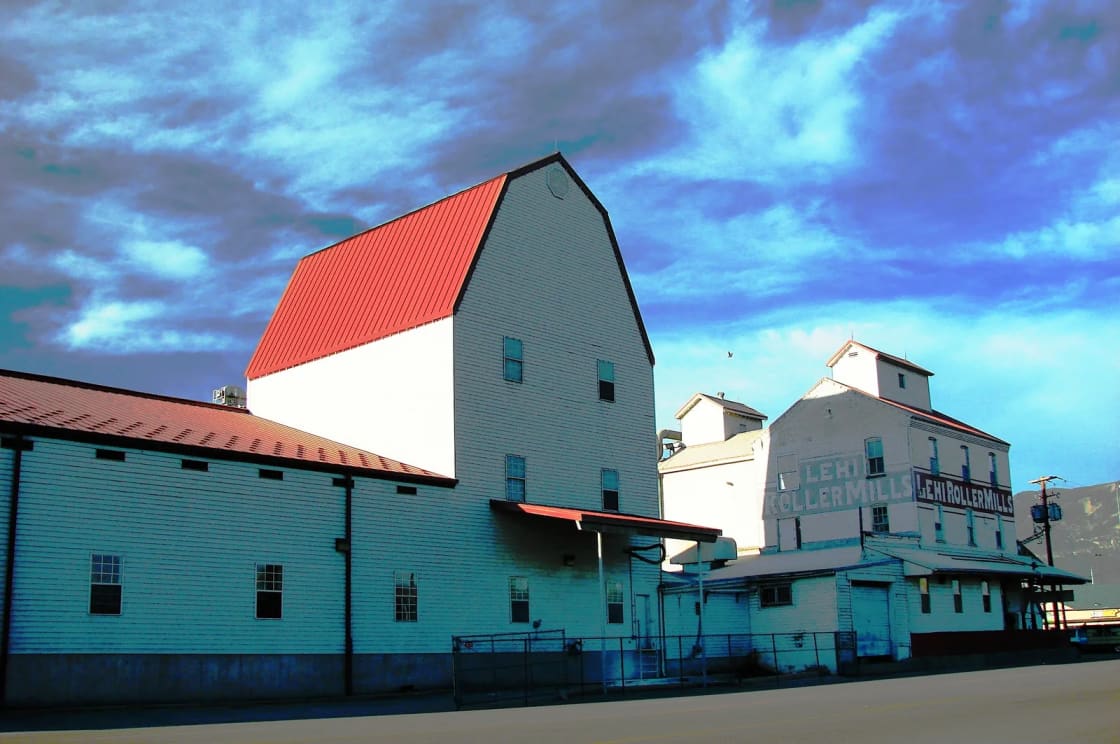
The mill on Lehi Main Street with the painted silos has been grinding wheat since the administration of Theodore Roosevelt, appeared in one of the defining teen films of the 1980s, and in 2018 quietly rebranded itself as Lehi Mills — a change that most of the internet, and most of the people searching for it, have not caught up with.
The short version
A working flour mill dating to 1905–06 on Lehi Main Street, a National Register site, the Footloose filming location, and — since 2018 — trading as Lehi Mills. There is a retail store. There are no tours. It is worth the stop for the building and the flour, not for an attraction experience.
The name change nobody announced loudly
If you search for Lehi Roller Mills you will find the mill, the film, and a certain amount of confusion about whether the place still exists.
It does. In 2018 the business rebranded as Lehi Mills, and in 2021 it went through a further refresh aimed at naturally flavored products, with packaging deliberately styled as a nod to the mill's retro past.
The historic name has not disappeared — the building is still Lehi Roller Mills on the historical marker and in every local conversation — but the company you buy from is Lehi Mills. Both are correct. Only one is on the packaging.
Where it is
833 East Main Street, Lehi. That address matters more than it looks.
Most visitors' mental map of Lehi is Thanksgiving Point, the outlets at Traverse Mountain and the tech corridor along I-15. The mill is in none of those places. It is in the old town, east along Main Street, in the part of Lehi that existed before any of the rest of it.
You do not pass it on the way to anything. You go to it deliberately.
A cooperative, not a company
The mill began as an arrangement among farmers. Lehi's agricultural economy needed local milling capacity, and a coalition of growers put up a mill rather than ship wheat elsewhere.
That origin is worth holding onto, because it explains the building's position in the town. It was not built by an outside industrialist. It was built by the people whose wheat went through it.
The Robinson family
In 1910 George G. Robinson bought the new mill. He had learned milling from his father back in Delaware, and he brought that trade west with him.
The Robinsons have been millers for five generations. Ownership has changed — a local entrepreneur, Ken Brailsford, purchased the mill in 2013 — but accounts of the business consistently describe the family as still heavily involved.
There is a detail in the Salt Lake magazine account that says more than a paragraph of history could: the mill still buys wheat from Cedar Valley Farm, whose owners still hold a Lehi Roller Mills check dated a hundred years ago.
The silos, and why they look like that
Decades ago a local artist painted the storage silos with the mill's brand imagery — a turkey and a peacock, drawn from the flour sacks.
This is the reason the mill is a landmark rather than a large functional building. Industrial architecture becomes iconic when someone decorates it, and somebody decorated this generations ago for commercial reasons that have long since stopped mattering.
Footloose
In 1984 Paramount shot Footloose in Utah, and the mill served as the backdrop for several scenes. Kevin Bacon, the painted silos, a small town with a dance problem.
Four decades later the film is still the first thing most people mention about Lehi, and the silos are still instantly recognizable to anyone who has seen it.
The part of the Footloose story people leave out
Local historical accounts are refreshingly unromantic about what the film did commercially. The consistent line is that the movie did not substantially increase business.
That is a useful corrective to the way film-location tourism is usually described. Being in a famous movie made the mill famous. It did not make it richer. The mill survived on flour, which is what it had always survived on.
The 2019 renovation
In 2019 the mill got a complete repaint by a crew that specializes in flour mills, the first full repaint in a long while.
The work included fixing a sagging porch. A working mill in the middle of a residential Main Street has neighbors, and dust is the thing neighbors notice.
It is a real mill, not a museum piece
This is the part visitors most often get wrong. The building is not preserved industrial heritage with a gift shop bolted on. It is a production facility that happens to be old.
That is why there are no tours. Food production plants do not walk the public through the process, and a century-old one has more reasons than most.
What you can do there
Visit the store, buy things, and take photographs of the outside.
That is the honest list. Visitors expecting an attraction leave disappointed; visitors expecting a good farm-shop-style store attached to a landmark leave happy. Manage the expectation and it is a pleasant twenty minutes.
What to buy
The flours are the core product, including organic lines and hard white wheat. The baking mixes are what most people carry out — pancake, cookie, brownie, muffin and cornbread recur in visitor accounts with striking consistency.
The Turkey-brand flour is the direct descendant of the imagery on the silos, which makes it the souvenir that means something.
Gift boxes and shipping
The store sells gift boxes, which solves a recurring Utah County problem: what to send to relatives out of state that is not another photograph of a mountain.
Lehi Mills also ships, with a free-shipping threshold that makes bulk flour orders viable for people nowhere near Utah. If you want the product but not the drive, that route exists.
Sunday closing
The store is closed on Sundays. This catches out-of-state visitors constantly, because a Sunday afternoon in Utah County is exactly when someone decides to go and photograph a film location.
The building is just as photogenic on a Sunday. The door is locked.
The National Register listing
Lehi Roller Mills was added to the National Register of Historic Places in 1994 — before the current rebrand, before the renovation, and a decade after the film.
The listing is a statement about the building's architectural and historical significance rather than a visitor amenity. It comes with no tour, no interpretive center and no staffing. What it does is make demolition considerably harder, which over a long enough timeline is the only preservation that counts.
The 2026 historical marker
Lehi has been installing historical markers across the city, and the mill has one. More markers are planned.
Other marked sites include the Jordan River Bridge and the Utah Southern Railroad. If you are making the trip, the marker program turns a single stop into a walkable local history route.
Photographing it
The silos are the shot. Morning light works better than afternoon for the east-facing frontage, and the building is large enough that stepping back across Main Street gets you more than crowding it does.
It is an active industrial site on a public street. Photograph from the road and the car park, not from anywhere that involves stepping past a fence.
How long to allow
Thirty minutes covers the store and the photographs comfortably. An hour if you are reading the marker and walking a little of old Main Street.
This is a stop, not a destination, and building a day around it will not work.
What to combine it with
Lehi has more than the mill. The Hutchings Museum is a few blocks away on Center Street and is the natural pairing — two pieces of old Lehi within walking distance of each other.
Beyond that, things to do in Lehi covers the wider city, and Thanksgiving Point is the obvious anchor if you need to fill a full day.
Where to eat nearby
Old Main Street is not the restaurant district; the newer commercial areas near I-15 are. Our guide to restaurants in Lehi covers the options across the city.
If you are combining the mill with the museum, plan to eat before or after rather than expecting to walk out of one into the other.
The wheat connection is still live
The mill continues to source from local growers, and the relationship with Cedar Valley Farm is a working one rather than a heritage anecdote — including work on developing new wheat strains.
A hundred and twenty years on, the arrangement is broadly the thing the founding farmers set up: grow it here, mill it here.
1905 or 1906?
You will see both years, and they are not in conflict. The original brick building is generally dated to 1905; the milling business is generally dated to 1906.
A building goes up before the business inside it starts trading, so a one-year gap between construction and operation is exactly what you would expect rather than a discrepancy that needs resolving. Sources that quote a single date are usually picking one of the two events and not saying which.
The more precise sequence, for anyone who wants it: the Lehi Banner announced the mill on June 22, 1905, the first sack of flour came off the line on April 2, 1906, and the company took the name Lehi Roller Mills in 1907. Why the town needed a new mill at all — and why it was built on the sugar factory's rail spur — is covered in a short history of Lehi.
Parking and the Main Street problem
There is parking at the mill, and on a quiet weekday it is a non-issue.
Old Main Street in Lehi is a working street with through traffic, and the mill sits directly on it. This is not a pedestrianised heritage precinct with a coach park. Park in the mill's own lot rather than improvising on the street, and be aware that delivery vehicles use the site because it is an operating business.
Accessibility
The retail store is a ground-floor shop in a modernized part of the site rather than a scramble through a historic building, which puts it well ahead of most heritage stops in the county.
That said, this is a century-old industrial site on an older street, and neither the surrounding pavements nor the yard were designed with accessibility standards in mind. If it matters, phone ahead on (801) 768-4401 rather than relying on a listing.
Finding it after the rebrand
The name change created a small practical problem that is worth naming. Mapping apps, review sites and older listings variously carry Lehi Roller Mills, Lehi Mills, or both, sometimes as separate entries at the same address.
Search either name and you will get there. But if a navigation app returns two pins, they are the same place, and the address — 833 East Main — is the thing to trust over the label.
You can also just buy it at the supermarket
Some Lehi Mills products launched into local grocery stores following the rebrand, which means the flour and mixes are not exclusively a Lehi Main Street purchase.
That is worth knowing before you build a trip around it. If the goal is the product, check a Utah County grocery aisle first. If the goal is the building, go to the building.
What locals use it for
Visitors treat this as a film location. A large number of Utah County households treat it as where the flour comes from.
That distinction shapes the store. It is stocked like a supply point for people who bake in volume — bulk flour, familiar mixes, sensible pricing — rather than like a souvenir shop trading on a movie. If you arrive expecting merchandise, you will find a lot of flour instead, and that is the correct outcome.
Best time of year to go
Autumn and the run-up to Christmas are when the store makes most sense, because that is when a sack of good flour and a stack of baking mixes are things a household wants.
Summer works for the photographs and the light. Winter works for the baking. There is no season in which the building is closed to being looked at, which is more than can be said for most of Utah Valley's outdoor attractions.
Why this building matters to Utah County
Lehi in 2026 is a technology city. Data centers, chip fabrication, corporate campuses, some of the fastest population growth in the state.
The mill is what Lehi was before all of that, still operating, still making the same product, on a street that has otherwise been overtaken. Utah Valley does not preserve much of its agricultural past in working condition. This is the largest and most visible thing it does preserve.
The thing that nearly always gets lost
Utah County has plenty of old buildings. What it has very little of is old buildings still doing the exact thing they were built to do.
Most preserved structures in the valley have been converted — into museums, offices, event venues, restaurants. The pioneer-era properties that survive mostly survive as something else. This mill takes wheat in one end and sends flour out the other, on the same site, under a version of the same name, a hundred and twenty years after a group of farmers decided they would rather not ship their crop somewhere else to be ground.
The painted silos and the Kevin Bacon connection are why people stop. The fact that the machinery inside them is still running is the better story, and almost nobody tells it.
The honest verdict
Go for the building and the flour. Do not go expecting a tour, an attraction or a Footloose experience — there is no museum, no exhibit and no dance floor.
What there is, is a 1905 mill still doing its job behind painted silos that a local artist decorated nearly a century ago, in a town that has changed around it beyond recognition. That is worth thirty minutes of anyone's Saturday.
Related Guides
- Dinosaur Museums in Utah Valley: The Big One in Lehi, the Free One in Provo, and Which Your Kid Actually Wants
- Hines Mansion: Provo's Victorian Landmark, and the B&B That Says It Isn't One
- The Soap Factory in Provo: What It Is and Whether It Is Worth It
- Museum of Natural Curiosity: A Complete Guide to Thanksgiving Point's Play Museum
- Butterfly Biosphere: Utah's Only Butterfly Conservatory
- Jack and Jill Lanes, Lehi: The 1957 Bowling Alley Named After Two Daughters
- Ashton Gardens at Thanksgiving Point: What It Costs, What's Open, and the Waterfall Problem
- All-Together Playground: The Park 4,100 Volunteers Built in Six Days
- The Chains Utah Built: Kneaders, Cafe Rio and Costa Vida
- Movies and TV Filmed in Utah Valley
Frequently Asked Questions
Is Lehi Roller Mills still open?
Can you tour the mill?
Was Footloose really filmed here?
How old is the mill?
Why are the silos painted?
What should I buy there?
Are they open on Sunday?
Where exactly is it?
Sources
The facts in this guide were checked against these sources. Hours, fees and rules change, so confirm anything time-sensitive with the source before you go. How we make Provo.com.
- Lehi Roller Mills (Lehi City history sheet), Lehi City. Checked October 12, 2026.
- Lehi Mills FAQ, Lehi Mills. Checked October 12, 2026.
- Lehi's "lady" gets a facelift, Lehi Free Press. Checked October 12, 2026.
- The Lehi Roller Mills, Intermountain Histories. Checked October 12, 2026.