
Provo has one genuinely old business and a small number of merely old ones, and the gap between them is about eighty years.
That is the honest shape of it. What makes the subject worth a page is not the ranking, which is short, but what happens when you try to pin down the dates: Provo's oldest surviving business has a founding year published at least four different ways, in two different English cities, and its own website disagrees with itself. That turns out to be the most interesting thing about it.
Startup Candy: the anchor, and the mess
Startup Candy is the oldest continuously operating business in Provo on any candidate date, and it is not close. Our full history of the Startup Candy Company tells the story end to end — the founder killed by a cooling slab, the widow who kept it going, the Opera Bar, and the 1900 factory that still stands on 100 West.
The broad outline is agreed. A candy-making family named Startup emigrated from England. William Daw Startup brought the tools of the trade across the plains — scales, iron edging bars, a drop machine, shears and hooks — and after a period working in Salt Lake City he moved his operation to Provo, where the family built a factory beside their home. He died young. His widow Hagar ran the business while raising four children. Their sons revived and incorporated it. The company grew into one of the larger confectionery makers in the West and is still making candy today.
Every date in that paragraph is contested.
The founding date, published four ways
- 1820 — the company's own homepage says William Startup began making candy in a basement in Manchester, England, in 1820.
- 1823 — the company's own social profile says it has been known for its candies since 1823, and a Deseret News account dates the original business to London in 1823.
- The 1830s — two Utah tourism sources say Manchester in the 1830s, describing a hard candy sold as a medicine under the name American Cough Candy.
- 1868 / 1874 / 1875 — the Utah dates. The 1969 Daughters of Utah Pioneers marker says William brought his tools across the plains in 1868 and, after working in Salt Lake City, built the first candy factory in Provo in 1875. The company's own About page and several local histories say the family moved to Provo in 1874 and opened a store at 230 West Center Street, near the old Brigham Young Academy. The building's National Register nomination uses 1875 for the start of production in Provo.
Note what is happening there. This is not a case of careless blogs versus careful institutions. The company's own homepage says 1820; the company's own social bio says 1823. One of the two English cities is wrong and the business does not appear to know which. And the same company page that dates the origin to 1820 also advertises recipes used for over 150 years — a span that would put the founding after 1870, not before 1830. The internal arithmetic does not close.
There is a further wrinkle in the secondary record: at least one Provo guide site prints the family's arrival as 1984, an obvious transposition of 1874 that has been sitting there long enough to be copied.
The death that changed the company
William died in 1878, and the manner of it is specific enough to be memorable and inconsistent enough to be a good example.
He was struck by a heavy stone slab used for cooling candy, which ruptured a blood vessel. Wikipedia and the National Register nomination call the slab limestone and say he died ten days later, on January 28. A local guide account calls it sandstone and says he died three days later. The event is not in doubt; the material and the interval both are.
Hagar Startup carried the business for about a decade with four young children, and by 1892 the company had become the third wholesale manufacturing operation in Utah. That is the part of the story that gets least attention and probably deserves the most: the reason there is a 150-year-old candy company in Provo is that a widow kept a factory running through the 1880s.
The sons took ownership in 1894 by two accounts and 1895 by three others, with George as president, Harry Walter as vice president and William J. as treasurer.
The Opera Bar, and a superlative that keeps shrinking
The company's famous product is the Opera Bar: three layers of cream filling — chocolate, vanilla and strawberry — in a bar that sold for ten cents, in a wrapper reading "Provo, Utah, The Candy City."
The claim attached to it is where the sourcing gets interesting, because the superlative gets weaker the more rigorous the source:
| Source | The claim |
|---|---|
| National Register nomination, citing Ripley's Believe It or Not | the first candy bar made in the United States |
| Local histories and a Provo guide | the first candy bar in America with a filling |
| A Utah tourism listing | the first filled candy bar |
| Wikipedia | some of the first candy bars in America |
The strongest version of the claim rests on Ripley's, which is a poor authority for a first-in-nation industrial claim. The narrower version — first filled bar — is specific, plausible, and the one repeated by the sources closest to the company. That is the version worth saying out loud. The date is given as 1895 in some accounts and 1896 in others.
The company's other period products included Magnolias, tiny perfume candies with liquid centers, sold in small boxes.
The building
The Startup Candy Factory at 534 South 100 West was built in 1900 to house the expanded business. It was added to the National Register of Historic Places on October 28, 1983. The family later sold the building; it has since served as event space and offices.
Which produces the best accidental joke in Provo. The complex became known as the Startup Building, and it filled up with small technology companies and a coding campus. The word does exactly the same work in both eras and the overlap is pure coincidence — "Startup" here is a surname, carried by an English candy family, applied to a building that now houses startups.
The ownership fact that is out of date at the source
In 2018, after five generations, the company left the Startup family.
Even that is reported two ways. One account names an individual buyer who purchased it from the Startups. Another says a member of the family retired and sold the company to the owners of an ice cream business. We are not going to pick between them.
What is worth flagging regardless of which is right: the company's own About page still describes the business in the present tense as having passed through five generations of Startups, and its social profile still states it is owned by the Startup family. A National Register–era architectural summary likewise refers to "the family that still carries on the business."
This is a pattern we keep running into on this site, and it is worth naming plainly: the most-cited fact about a business is usually the oldest fact about it, because it has had the longest time to be copied and the least reason to be revisited. An ownership change is precisely the kind of fact that never propagates, because nobody rewrites an About page for it.
If you are quoting Startup Candy's history — for a school project, a listing, a tour script — the ownership line is the one most likely to be wrong.
The 1950s tier
After Startup, Provo's continuity record jumps forward roughly eighty years.
Brick Oven dates to 1956, when a corner cafe called Stadium Lunch was converted into one of Utah's first pizza parlors. A naming contest produced "Heaps A Pizza" — a pun on the surname of the man who opened it, Kent Heaps. It shortened to Heaps and later became Brick Oven, though plenty of longtime locals never made the switch. In 1956 Utah, pizza was a novelty most customers had never eaten. The restaurant turns seventy in 2026. Full story in our Brick Oven guide.
Los Hermanos dates to the 1970s and is a Provo-founded institution, though it has relocated from its longtime downtown address — a reminder that "still open" and "still where you remember it" are different tests.
Provo's other long-running food landmark is on BYU's campus rather than in the commercial core: the BYU Creamery, whose ancestry runs back through a Dairy Products Lab and a market whose owner's widow willed the building to the university, which is how it became the first full-service grocery store on any US college campus. That history — and the fact that the flagship building everyone pictures closed in December 2025 and was replaced days later — is in our BYU Creamery guide.
Provo Bakery, at 190 East 100 North, is the other name that belongs in this tier — and it comes with a caution that fits the theme of this page exactly. Utah's state tourism office describes it as having been in operation over 75 years. A recent roundup article says the same thing in one sentence and then, a sentence later, says its history "stretches past a full century." Those cannot both be right, and they are in the same paragraph. Over 75 years is the claim with the better source behind it. Mark and Stefanie Tuckett bought the bakery in 2002; Mark had learned the trade through his family's bakery operation in Lehi, so the craft continuity is real even where the arithmetic is not.
The buildings outlived the businesses
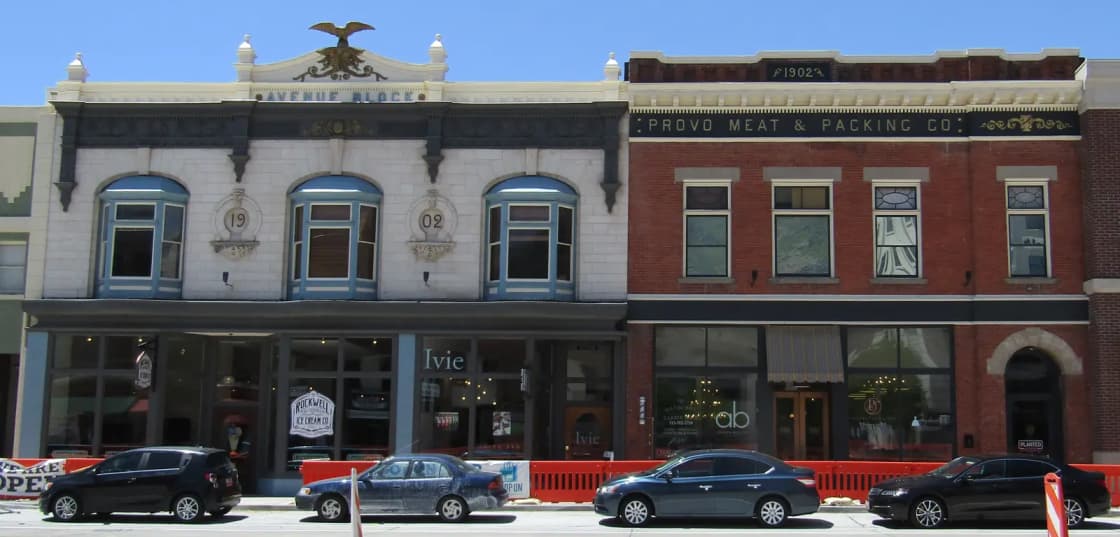
Provo's downtown is full of nineteenth-century commercial architecture, and it is easy to mistake an old building for an old business. Almost none of them are the same thing.
The Taylor Brothers Building went up in 1866, three stories, one of the tallest structures downtown and considered an architectural marvel in its day. It declined badly by the mid-twentieth century, was rescued and remodeled, and now operates as multi-use retail and office space. The building is original. The business is not.
The Provo West Co-op building at 466 West Center Street, built around 1866 and remodeled around 1890, is historically significant as the oldest surviving example of the cooperative stores established under the church-sponsored merchandising movement. The co-op itself went out of business when the economics and politics of the cooperative movement changed. Today the building houses a florist.
The Provo Downtown Historic District was added to the National Register on May 1, 1980.
And the fullest illustration of the gap is an inventory rather than a building. By the end of 1852, Provo supported a pottery, two grist mills, a sash factory, three cabinet shops, a wooden bowl factory, three shoe shops, two tailor's shops, a meat market, two store houses and two lime kilns. Not one of those enterprises survives. The city's first merchant, Andrew J. Stewart, ran a general store from his home before building on what became Center Street — and his store is gone too, though the street he helped establish is still where Provo does business.
How to check a founding date yourself
Since this article is largely about dates that do not hold up, here is the method, which works for any business in any town:
- Look for a physical marker. Daughters of Utah Pioneers markers, city landmark plaques and National Register nominations were researched at a specific moment by someone who had to cite something. They can still be wrong, and they can be decades stale on ownership, but they are anchored. If you cannot get to the plaque itself, Open Road Guide has transcribed every historical marker in Utah with its full text, organized by county — which makes it possible to check what a marker actually says before driving to it.
- Read the National Register nomination, not the Wikipedia summary of it. Nominations carry footnotes and dates of research.
- Check the business's own About page against its own social bio. As Startup Candy demonstrates, a company can contradict itself across two channels it controls.
- Distinguish four different dates that get collapsed into one: when the family started the trade, when they arrived in the state, when they opened in this city, and when the current legal entity was formed. Most disputed founding years are really two of those four being compared.
- Treat aggregator listings as unsourced. A founding year on a directory site is a field someone typed once.
Why this list is short on purpose
There are longer lists of "historic Provo businesses" on the internet. Most of them are longer because they have not been checked.
Business directories are unusually bad at this particular job. A listing persists after a closure, after a sale, and after a move, and aggregators copy each other's founding years without ever touching a primary source. A page claiming a dozen century-old Provo businesses is nearly always a page that inherited a dozen unverified claims.
Our standard here is the same one we apply everywhere on the site: a named business is verified open before it is published, and a founding date is attributed to something better than a listing. Applying that honestly to Provo produces a short list. We would rather publish the short correct one.
If you run or know a Provo business with a documented pre-1950 founding and continuous operation — with something to point at, a marker, a Register nomination, a newspaper record — that is exactly the kind of correction we want.
What the gap actually tells you
The eighty-year hole between Startup Candy and Brick Oven is not a record-keeping artifact. It is a real feature of the city.
Provo was substantially rebuilt three times inside that window — by the railroad and the woolen mills in the 1870s, by the academy's growth into a university after 1903, and by Geneva Steel and the wartime economy in the 1940s. Each of those reshaped who was downtown, what they sold, and who could afford the rent. Very few storefront businesses survive three transformations of their own customer base.
The one that did survive made candy, was run by a widow through its hardest decade, and now has a founding date nobody can agree on — including itself.
For the wider arc, see a short history of Provo. For how the valley's business landscape looks now, see companies founded in Utah Valley.
Related Guides
- Food Handler Cards & Health Permits in Utah County: What Every Food Job Requires First
- Getting a Business License in Provo: The Four Agencies, the Two Home-Occupation Tiers, and the Short-Term Rental Trap
- Hines Mansion: Provo's Victorian Landmark, and the B&B That Says It Isn't One
- The Provo Woolen Mills
- The Chains Utah Built: Kneaders, Cafe Rio and Costa Vida
Frequently Asked Questions
What is the oldest business in Provo that's still operating?
When was Startup Candy actually founded?
Did Startup Candy really invent the first candy bar in America?
Is Startup Candy still owned by the Startup family?
Is the Startup Building in Provo named after tech startups?
What are the oldest restaurants in Provo?
Why is this list so short?
How old does a Provo business have to be to count as historic?