
An old case does not stop mattering when the sentence ends. It shows up in a rental application in Provo, in a licensing packet, in a background check for a job at a Silicon Slopes employer that runs one on everybody.
Utah has a route to sealing it. The route is more generous than most people assume in one direction and considerably stricter in another, and the single most consequential detail — when the waiting period starts — is the one most often described wrongly.
This is what Chapter 40a says.
The short version
Expunge means seal, not destroy.
Waiting periods: 3 years for an infraction or class C · 4 for a class B · 5 for a class A · 5 for felony drug possession · 7 for a felony · 10 for an alcohol-related driving misdemeanor.
The clock starts at whichever came last: conviction, or release from incarceration, parole or probation.
Fines and restitution must be paid in full. No partial credit.
Some cases expunge automatically with no petition and no fee.
What "expungement" means
Utah Code 77-40a-101 defines expunge as to seal or otherwise restrict access to a record. Not to destroy it.
This distinction is not pedantry. The record persists. Specified agencies retain access under 77-40a-403 and 77-40a-404. What changes is that the record stops surfacing in the ordinary channels — the routine employment screen, the tenant check, the volunteer application.
For nearly every practical purpose that drives people to seek expungement, that is the outcome they wanted. But the gap between "sealed" and "erased" matters when a form asks a carefully worded question, particularly in licensing, immigration and firearms contexts. Answering "I have no record" because a record was expunged can create a fresh problem worse than the original one. If a form's wording is doing something unusual, that is the moment to get advice rather than guess.
The waiting periods, and the clause that moves them
Utah Code 77-40a-303(1)(c) sets the periods:
| Conviction | Wait |
|---|---|
| Class C misdemeanor or infraction | 3 years |
| Class B misdemeanor | 4 years |
| Class A misdemeanor | 5 years |
| Felony drug possession offense | 5 years |
| Felony (generally) | 7 years |
| Misdemeanor under 41-6a-501(2) — alcohol-related driving | 10 years |
Now the clause that matters more than the table. Those periods run from the day the petitioner was convicted or released from incarceration, parole, or probation — whichever occurred last.
That phrase relocates the start date for most people. Someone convicted of a class B misdemeanor in March 2021 who served eighteen months of probation ending in September 2022 does not become eligible in March 2025. The clock started in September 2022, so eligibility arrives in September 2026.
Probation almost always ends after sentencing, which means the conviction date is almost never the right date to count from. People who calculate from sentencing consistently apply eighteen months to two years too early, pay the application fee, and are denied.
Before you count anything, confirm the actual date probation terminated. That is a court record, and it is the date the statute cares about.
Money first
Utah Code 77-40a-303(1) makes two payment conditions absolute before the Bureau of Criminal Identification can issue a certificate of eligibility:
- all fines and interest ordered by the court in connection with the conviction, paid in full
- all restitution ordered under 77-38b-205, paid in full
No partial credit. No hardship carve-out in that subsection.
Outstanding restitution is the most common quiet blocker. Balances accrue interest, get transferred to collection, and drift out of view years after a case felt finished — and people discover the balance only when their eligibility application is denied. Call the court and get the current payoff figure before you spend anything on the process.
If the balance itself is the obstacle, free and low-cost legal help in Utah County covers the hotline and the clinics, several of which handle exactly this kind of untangling.
What cannot be expunged at all
Under 77-40a-303(2)(a), these convictions are outside the scheme:
- a capital felony
- a first degree felony
- a felony conviction of a violent felony as defined in 76-3-203.5(1)(c)(i)
- a felony conviction described in 41-6a-501(2) — the alcohol-related driving definition
- an offense, or combination of offenses, requiring registration as a sex, kidnap or child abuse offender under Title 53, Chapter 29, either at sentencing or at the time of application
There is one narrow exception at subsection (3): the exclusion does not apply to a conviction for a qualifying sexual offense as defined in 76-3-209 where the petitioner was at least 14 but under 18 at the time of the offense — unless they were convicted as an adult in district court under Title 80, Chapter 6, Part 5.
Note the contrast in the fourth bullet against the ten-year row in the table. A misdemeanor alcohol-related driving conviction is expungeable after ten years. A felony one is not expungeable at all. DUI in Utah covers how that grading ladder works. Same statutory definition doing two different jobs.
What blocks you temporarily
Separately from the permanent exclusions, 77-40a-303(2) blocks a certificate while:
- a criminal proceeding for a misdemeanor or felony is pending against you — unless it is a traffic offense
- a plea in abeyance for a misdemeanor or felony is pending — unless it is a traffic offense
- you are incarcerated, on parole, or on probation — unless for an infraction, traffic offense or minor regulatory offense
- a civil protective order, criminal protective order, or criminal stalking injunction is in effect against you
And a warning with real consequences: providing false or misleading information on the application is itself disqualifying under 77-40a-303(2)(e). Under 77-40a-301(2), doing so intentionally or knowingly is a class B misdemeanor prosecutable under 76-8-504.6 — and regardless of prosecution, the Bureau may deny the certificate. Do not round anything on that form.
The criminal-history ceilings
Even when a specific conviction qualifies, your record as a whole can disqualify you. Under 77-40a-303(4), the Bureau may not issue a certificate if your criminal history — including previously expunged convictions — contains:
- two or more felony convictions other than drug possession offenses, each in a separate criminal episode
- any combination of three or more convictions other than drug possession offenses that includes two class A misdemeanor convictions, each in a separate criminal episode
- any combination of four or more convictions other than drug possession offenses
Two structural points. First, previously expunged convictions still count toward these ceilings. Sealing a record does not remove it from this arithmetic — another reason the seal-versus-erase distinction is more than semantics.
Second, "separate criminal episode" is doing heavy lifting. Multiple charges arising from one incident are generally one episode. Whether two arrests months apart constitute separate episodes is a question with a real answer in the case law, and it can decide eligibility outright. If you are near a ceiling, this is not a self-service determination.
Drug possession offenses are excluded from the counting throughout, which is a deliberate legislative choice and materially widens eligibility for people whose record is substance-related.
Arrests that never became convictions
Utah Code 77-40a-302 is the separate track for records of arrest, investigation and detention — and it is far faster.
Thirty days after arrest or charge, you may be eligible if one of these is true:
- the investigating agency and the prosecutor screened the case and decided not to file
- all charges were dismissed with prejudice
- a charge was dismissed without prejudice or without condition, and either the prosecutor consents in writing or 180 days have passed
- you were acquitted at trial on all charges
- the statute of limitations expired on all charges
Two additional waits apply where the same case carried a traffic conviction: three years for a class C misdemeanor or infraction traffic conviction, four years for a class B misdemeanor traffic conviction.
The same temporary blockers apply — pending proceedings, plea in abeyance, current incarceration or supervision, and a criminal protective order or stalking injunction in effect for the case.
The dismissed-without-prejudice route is the one worth flagging. Many people assume a dismissal ends the matter and never learn that the arrest record persists and is visible. It does, and it is.
Clean Slate: the cases that expunge themselves
Part 2 of Chapter 40a creates automatic expungement and deletion — no petition, no application fee, no hearing.
The court identifies qualifying cases and acts on its own. Traffic offense records are deleted in defined circumstances, including a traffic case dismissed with prejudice, with the statute setting out different handling depending on whether the case was resolved before or after specified dates. For certain other cases, the court issues an expungement order without a petition where the case qualifies and the prosecuting agency does not object — and the statute gives the agency a defined notice window, after which the court proceeds if no written objection has arrived.
Two realistic caveats. First, automatic does not mean instantaneous or comprehensive; it applies to categories the statute specifies, not to everything. Second, if you believe a case should have been handled automatically and it still appears on your record, that is worth checking rather than assuming — identification depends on data matching, and data matching is imperfect.
The upside is straightforward: for the cases it covers, the cost is zero. Confirm what your record shows before paying for a process you may not need.
The three-step process, and what each step costs
Step one — apply to the Bureau of Criminal Identification. BCI determines eligibility and issues a certificate of eligibility. There is an application fee at the time of submission, and a separate issuance fee if you qualify. A certificate is valid for 180 days from issue, which is a real deadline — let it lapse and you start again, and pay again.
The statute contemplates fee relief: 77-40a-304(3) and (7) provide exceptions, and a petitioner may indicate on the application that they reasonably believe the filing fee for the petition is likely to be beyond their means.
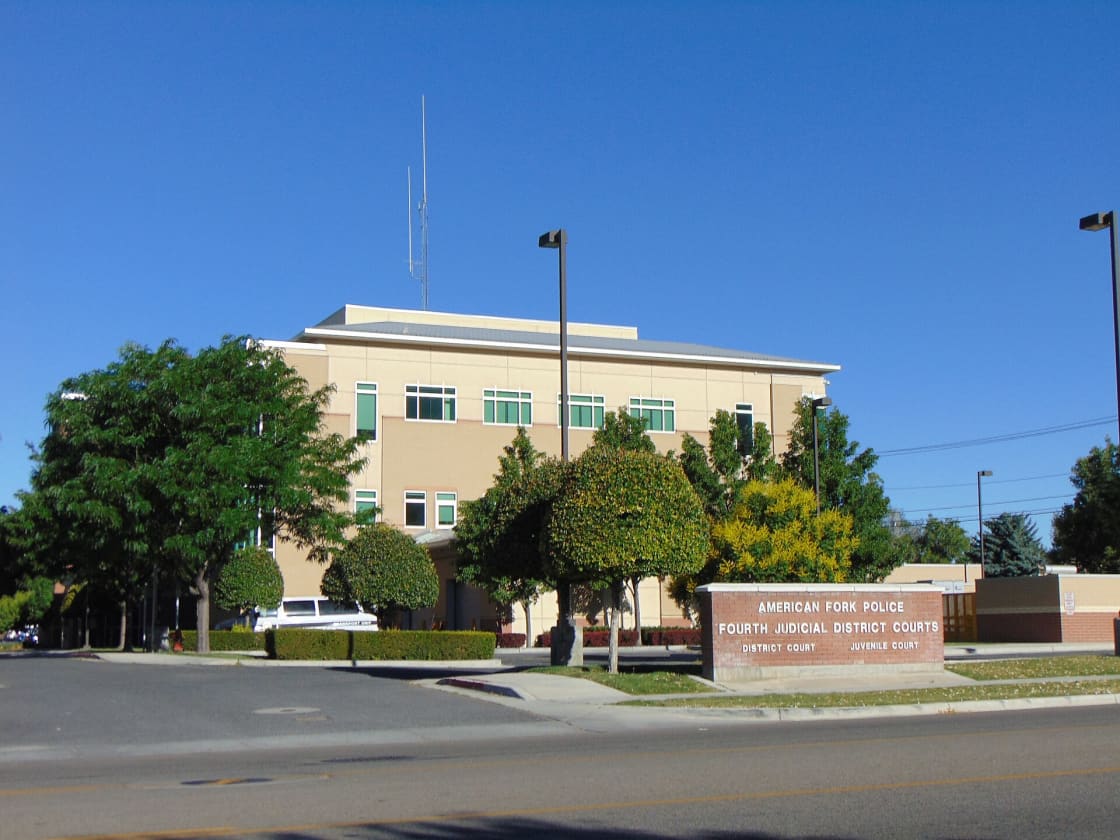
Step two — file the petition in district court. In Utah County that is the Fourth District Court, the building pictured at the top of this page in American Fork, or its Provo and Spanish Fork locations. Justice courts do not grant expungements even where the underlying case was theirs. Our Utah County courts guide maps which building holds what and what each charges.
Step three — the court decides. The prosecuting agency and any victim receive notice and may object. Where there is no objection and the statutory requirements are met, an order issues.
Budget for the full stack — BCI application fee, certificate issuance fee, court filing fee — and for the 180-day certificate window, which is the piece that most often forces a costly restart.
What a sealed record does and does not do in practice
The practical question is not what the statute calls it. The practical question is what a landlord in Provo or an employer in Lehi sees.
Routine background checks. A commercial screening company pulls from court records and state repositories. Once a record is sealed and the order propagates, it generally stops appearing in those pulls. This is the ordinary case and the reason most people go through the process.
The propagation gap. The order does not update every database simultaneously. Commercial data brokers hold cached copies, and stale records can surface for a period afterward. If a sealed record appears on a report, that is a dispute with the reporting agency, and consumer reporting law provides a route to correct it. Keep a certified copy of the order — you will need it to make that dispute.
Where access survives. Sections 77-40a-403 and 77-40a-404 govern who may still reach an expunged record. Certain criminal justice, licensing and screening contexts retain access. If you are entering a regulated profession, working with vulnerable populations, or dealing with a federal agency, do not assume a sealed record is invisible to them.
Answering the question. How you answer a form asking about criminal history depends on how the question is worded and who is asking. Some questions are framed to exclude expunged records; others are not. This is precisely where the seal-versus-erase distinction stops being semantic, and it is worth thirty minutes of advice rather than a guess that becomes a separate problem.
Juvenile records run on a different system
Nothing on this page describes juvenile records, which are governed by their own provisions and their own procedures.
The two systems are frequently conflated, including by people who assume an adult expungement petition will reach a juvenile matter, or that a juvenile record disappeared automatically at eighteen. Neither assumption is reliable.
One point of contact between the systems is worth knowing: under 41-6a-501, an admission to a violation in juvenile court is treated as the equivalent of a conviction for the purposes of counting prior convictions in the driving context. Juvenile history is not always sealed off from adult consequences, which is another reason to establish what your record contains rather than assuming.
Two things people get wrong
Counting from the wrong date. The waiting period runs from release from probation or parole where that came after conviction. Most people count from sentencing and apply too early.
Assuming a dismissal cleaned itself up. A case dismissed without prejudice leaves an arrest record that continues to appear. Clean Slate covers some categories automatically, not all of them.
If a background check has already cost you something concrete — a tenancy, a job offer — it is worth checking what the record says before assuming the process is hopeless. Utah Valley employers run these checks routinely, and an inaccurate record is a separate and more easily fixed problem than an accurate one. The Silicon Slopes technology employers that dominate hiring along the corridor screen almost universally.
A note on currency
The waiting periods, exclusions and criminal-history limits on this page were checked against Section 77-40a-303 as in effect from 6 May 2026. The Legislature has revisited Chapter 40a repeatedly in recent sessions, so check the current text at le.utah.gov before relying on any single provision.
That is not a reason to distrust the structure described here — the waiting periods, the disqualifiers and the three-step process have been stable. It is a reason to confirm the specific figure you intend to rely on against the current section text before filing, and to treat any number quoted by a third-party website with more suspicion than the one you read directly from the code.
Nothing here is legal advice. Eligibility questions involving separate criminal episodes, a conviction near a criminal-history ceiling, or a form whose wording seems to demand disclosure of a sealed record are worth an hour with a lawyer.
Frequently Asked Questions
How long do you have to wait to expunge a conviction in Utah?
Can you get a DUI expunged in Utah?
What is Clean Slate automatic expungement in Utah?
What disqualifies you from expungement in Utah?
How many convictions can you have and still get an expungement in Utah?
Do I have to pay off my fines before expungement in Utah?
How do I expunge an arrest that never led to charges in Utah?
Does expungement in Utah destroy the record?
Sources
The facts in this guide were checked against these sources. Hours, fees and rules change, so confirm anything time-sensitive with the source before you go. How we make Provo.com.
- Expungements | DPS - Criminal Identification (BCI), Utah Department of Public Safety, Bureau of Criminal Identification. Checked October 12, 2026.
- Utah Code 77-40a-303: Requirements for a certificate of eligibility to expunge records of a conviction (effective 5/6/2026), Utah State Legislature. Checked October 12, 2026.
- Utah Code 77-40a-304: Certificate of eligibility, Utah State Legislature. Checked October 12, 2026.
- Utah Code 77-40a-302: Requirements for a certificate of eligibility to expunge records of arrest, investigation, and detention, Utah State Legislature. Checked October 12, 2026.