
Two quite different things get sold under the same label in Utah Valley, and the difference has real consequences.
One is a legally age-restricted community operating under a federal exemption, where the restriction is enforceable and the community must actively verify ages. The other is an ordinary neighborhood built with older buyers in mind — single-level homes, low maintenance, no age rule at all. Local listings call both "55+."
If you are buying, you need to know which one you are looking at, because the age-restricted version comes with obligations and the unrestricted version comes with none.
This guide explains the rule, then maps what Utah County has.
Community rules, fees and availability change constantly, and Utah is a non-disclosure state where verified sale prices are not published. Nothing here is legal advice. Confirm specifics with the community and your own professionals.
The rule almost everyone gets wrong
Age-restricted housing is an exception to fair-housing law rather than the default, and the exception has conditions.
Under the federal housing-for-older-persons framework, a community relying on the 55-and-over exemption generally must satisfy three things:
At least 80 percent of occupied units must have at least one occupant aged 55 or older.
The community must publish and adhere to policies and procedures demonstrating intent to operate as housing for older persons.
It must comply with verification rules, meaning it collects and periodically updates age documentation for its residents rather than assuming.
Read that first condition carefully, because it contains two separate surprises.
It is 80 percent, not 100. A compliant community can have a share of units with no qualifying occupant at all. Many communities set their own internal rules stricter than the federal floor precisely to preserve headroom, but the legal threshold is not universal occupancy.
It is one occupant per unit, not every occupant. The unit qualifies if somebody in it is 55 or older. That is why a younger spouse is normally fine.
What that means for real households
The practical questions people have, answered against that framework.
A 58-year-old and a 51-year-old buying together. Normally fine — the unit has a qualifying occupant. But check the community's own rules, because some set a minimum age for the second occupant that is higher than the law requires.
A surviving spouse under 55. Many communities address whether a surviving under-age spouse may remain. Do not assume; this is exactly the scenario to confirm in the governing documents before buying, because it is the one that matters most and gets asked about least.
An adult child moving in. Varies enormously. Some communities permit it, some impose a minimum age like 19 or 25, some prohibit it outright. This is a written-rules question.
Grandchildren visiting or staying. Visits are normally fine and often explicitly time-limited. Long-term occupancy by a minor is usually where the rules bite, and in a state with Utah's family structures this comes up more than the national norm.
Renting your unit out. Frequently restricted, and where permitted the tenant household must usually also satisfy the age rule — which shrinks the tenant pool considerably.
The 62-and-over route is a different animal
A separate exemption exists for housing intended for people 62 and older, and its requirement is far stricter: all occupants must meet the age threshold.
That eliminates the younger-spouse accommodation entirely, which is why it is uncommon in ordinary residential development and appears mostly in specific senior-housing contexts.
If a community describes itself as 62+, understand that the flexibility of the 55+ framework is not available to you there.
The third category: "55+ alternative"
Utah Valley listings use a phrase that does not exist in law — the 55+ alternative, or "designed for active adults."
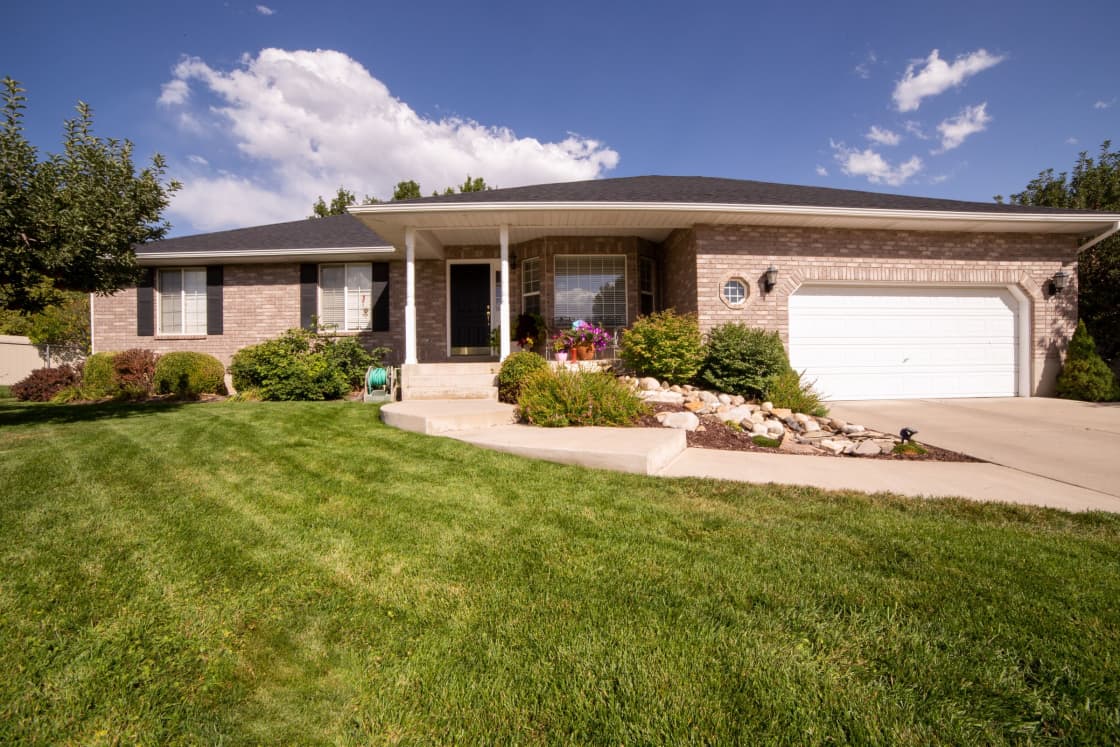
These are ordinary, unrestricted neighborhoods that happen to suit older buyers: single-level living, main-floor primary bedrooms, low-maintenance yards, HOA-managed exteriors, and a resident population that skews older by self-selection rather than by rule.
Provo has several of these, particularly in the north Provo area, and they are worth taking seriously as an option.
The advantages are real. No age verification, no restriction on who can live with you, no rules about grandchildren, a larger buyer pool at resale, and often lower fees.
The disadvantage is that nothing preserves the character. A neighborhood that is quiet and older today can turn over toward families, and you have no recourse because there was never a rule.
Which you prefer is a genuine question rather than an obvious one, and it depends heavily on whether the age restriction is the point or merely a proxy for what you want.
Active adult is not assisted living
The terminology in this field is confusing and the distinctions are financial as much as practical.
Active adult and 55+ is ordinary housing. You own or rent, you live independently, no care is provided, and you pay a mortgage or rent plus HOA dues. Nothing is bundled.
Independent living communities provide housing plus services — meals, housekeeping, transportation, activities — usually for a monthly fee, without personal care.
Assisted living adds help with daily activities and is licensed and regulated as a care setting.
Memory care and skilled nursing are further along the same continuum, with correspondingly higher cost and regulation.
The point for a buyer: an active-adult purchase does not solve a future care need. It is a housing decision, not a care plan, and households sometimes buy one believing they have arranged the other.
Where they are in Utah County
The distribution is scattered and the communities tend to be small.
Established communities in older, central cities are mostly resale, while new construction follows the county's growth into newer areas. Before you shop, confirm with the community itself whether it is age-restricted under the 55-and-over rules or simply marketed to older buyers, and ask when it was built and what the fee covers.
The Utah-specific consideration
Utah Valley is an unusual place to retire, and the reasons cut both ways.
The county has one of the youngest median ages in the country. That means fewer age-peers, a public realm oriented around families and students, and a social calendar that is not built for retirees.
It also means the single strongest reason people buy 55+ housing here: staying near adult children and grandchildren. Utah's family geography is unusually tight, and many active-adult buyers here are downsizing near where they already live, to be near people.
That changes what matters. Proximity to a specific family's neighborhood, ward or school often outweighs amenities. It also means many buyers are choosing between two or three small communities in one city rather than shopping the county.
The other local factor is the ward structure of the predominant faith, which provides a ready-made social network that does not depend on the community's clubhouse. For members, that reduces the value of a community's social programming; for non-members, it can make an amenity-rich community relatively more valuable.
What the fee buys, and what to verify
Dues in these communities usually cover exterior and landscape maintenance, snow removal, and shared amenities where they exist. In smaller communities without a clubhouse, the fee is essentially a maintenance contract — and for many buyers that is the actual product.
Before buying, establish four things in writing:
What exactly is maintained. Front yard only, or full exterior? Roofs? Is snow removal to the door or only the street?
The reserve position. Ask for the reserve study. A small community with an aging clubhouse and thin reserves is a special assessment waiting to happen.
The dues history. Five years of figures tells you more than the current number.
The age-rule specifics. Minimum age for a second occupant, surviving-spouse provisions, adult-child occupancy, guest limits, and rental rules.
The honest downsides
Small communities are fragile. A forty-home association has forty households funding everything. One major repair moves everyone's dues.
Resale pools are narrower. Age restriction removes most buyers from consideration. In a slow market that matters.
Amenities may be modest. Utah Valley's communities are mostly small, and a "clubhouse" can be a room. Visit before assuming.
Rules can be tight. Parking, exterior storage, pets and guests are frequently more regulated than in a conventional neighborhood.
The population ages together. A community built in 2006 has residents fifteen years older than at move-in, which changes its character and sometimes its volunteer capacity to run itself.
The alternatives worth weighing
Before committing to age-restricted housing, two other paths deserve comparison.
Aging in place with modifications — a main-floor bedroom and bathroom, grab bars, better lighting, and a maintenance arrangement — keeps you in a familiar neighborhood and near existing relationships.
Unrestricted downsizing into a single-level home or townhouse with an HOA gets you most of the maintenance benefit with none of the age rules or resale narrowing.
The age restriction is worth paying for when the peer community itself is the thing you want. If what you want is a smaller house you do not have to maintain, you can buy that without the restriction.
The property-tax angle worth asking about
Utah has property-tax relief programs aimed at older and lower-income homeowners, and a surprising number of eligible households never apply.
The main routes are a state circuit-breaker program for qualifying low-income homeowners who are 66 or older (67 or older for those born on or after January 1, 1960), and county-administered abatements and deferrals. Utah County administers applications for the programs available locally, and there are annual filing deadlines that do not move for anyone.
Two things matter for a buyer considering a 55+ purchase.
Eligibility is age- and income-tested, not automatic. Being in an age-restricted community confers nothing by itself. You apply as an individual homeowner.
Deferral is not forgiveness. Where a deferral program lets an older homeowner postpone tax, the obligation generally accrues against the property rather than disappearing, which matters for heirs.
Figures, income thresholds and deadlines change annually and vary by program. Check with the Utah County Treasurer or Auditor for the current year rather than relying on any published number, including a general description like this one.
Healthcare proximity, which should be on the shortlist
For a household making a housing decision in its sixties or seventies, distance to care is a genuine variable and one that varies a lot across Utah County.
Central Utah Valley is well served. Utah Valley Hospital is in Provo, and the Provo and Orem corridor has many specialist practices, imaging and outpatient services.
The western cities are further out. Saratoga Springs and Eagle Mountain sit a meaningful drive from the main hospital campuses, and that drive is on roads that congest.
The south county has its own hospital provision but a thinner specialist layer, with more referrals northward.
We cover which network runs which hospital in Utah Valley separately, because the ownership map is confusing and it determines where your insurance works.
The honest framing: a beautiful new clubhouse community forty minutes from your cardiologist is a different proposition at 80 than it is at 58. Buy for the whole span, not the first decade of it.
Getting around when you stop driving
This is the variable that most often forces a second move, and it is worth confronting at purchase.
Utah Valley is car-dependent. Public transportation exists — UTA buses across the central corridor, FrontRunner along the spine — but coverage is thin in exactly the western and southern cities where most new age-restricted housing is being built.
Practical questions to ask about any specific community:
Can you walk to anything? A shop, a pharmacy, a park, a place to have coffee. Many suburban communities fail this test, so check before you buy.
What paratransit serves it? UTA operates demand-response service for eligible riders within a defined distance of fixed routes; communities outside that distance are not covered.
How far is the nearest family member? In Utah Valley this is frequently the actual transportation plan, and it is worth being explicit about rather than assuming.
A community that works beautifully while both spouses drive can become isolating when one stops. The communities closest to the central corridor hold up best on this measure, which partly offsets their older housing stock.
The money side of downsizing, briefly
The assumption behind most downsizing plans is that selling a larger family home releases capital. In Utah Valley over the last decade that has often been true, but it is not automatic.
New age-restricted construction is not cheap, and a smaller new home with a clubhouse can cost more than a larger older one. Run the numbers with fees included before assuming the move saves money.
Run the arithmetic on the whole picture rather than the purchase price: sale proceeds after costs, purchase price, monthly HOA dues over your expected tenure, property tax at the new assessment, and what maintenance you were spending before.
If the monthly dues exceed what you were spending on yard care and repairs, the trade is convenience rather than savings — which can still be the right call, but should be a decision rather than a surprise.
The short version
The 55-and-over rule is an 80 percent threshold with one qualifying occupant per unit, not a requirement that everyone be over 55 — which is why a younger spouse is normally fine and why the surviving-spouse and adult-child questions have real answers you should read before buying.
Utah County's communities are small and scattered.
And for a great many local buyers the deciding factor is not the amenity package at all. It is how close it is to the grandchildren.
One last practical note. Because these communities are small and turnover is slow, the right home in the right one may simply not be for sale when you are ready. It can pay to find your community first and then wait for a listing, rather than deciding to move and shopping whatever is available that month. If you are two or three years out, start visiting now.
Related Guides
- Provo for Retirees: The Other Demographic in America's Youngest College Town
- Senior Centers in Utah Valley: The Agency Behind Them, and Everything They Do That Is Not Lunch
- Intermountain, MountainStar, Holy Cross, U of U Health and Revere: Which Network Runs Which Hospital in Utah Valley
- Utah Valley Hospital: The Complete Visitor and Patient Guide — Parking, the ER, Visiting Hours, the Tower, and What to Bring
- Property Tax in Utah County: How It's Assessed, How to Appeal & When It's Due
Frequently Asked Questions
Does everyone in a 55+ community have to be 55?
Can a younger spouse live in a 55+ community?
What is the difference between 55+ and 62+ housing?
Is an active-adult community the same as assisted living?
Where are Utah County's 55+ communities?
What does a 55+ HOA fee usually cover?
Are there age-restricted rentals in Utah Valley?
Can I keep pets in a 55+ community?
Sources
The facts in this guide were checked against these sources. Hours, fees and rules change, so confirm anything time-sensitive with the source before you go. How we make Provo.com.
- Utah Code Title 59 Chapter 2a Tax Relief Through Property Tax, Utah State Legislature. Checked October 12, 2026.
- Utah County Auditor: Tax Relief, Utah County Auditor. Checked October 12, 2026.
- 24 CFR 100.305 80 percent occupancy, Electronic Code of Federal Regulations. Checked October 12, 2026.
- 24 CFR 100.303 62 or over housing, Electronic Code of Federal Regulations. Checked October 12, 2026.
- 24 CFR 100.306 and 100.307 intent and verification, Electronic Code of Federal Regulations. Checked October 12, 2026.