
There is a moment, usually in the week before a wedding or the month before a trip, when a person in Utah County discovers that the office they need is not the one they assumed.
The Utah County Clerk runs elections. The Clerk also issues marriage licenses. The Clerk also takes passport applications. The Clerk also keeps the minutes of the county commission.
That list reads like an administrative accident. It is not. It is what a clerk has always been — the keeper of the record — and every one of those four duties is a record-keeping function wearing different clothes.
The four jobs
Elections. The Clerk prepares, administers, processes and maintains all countywide elections — county, state and national offices. That covers the voter roll, ballot production and mailing, drop boxes, in-person voting locations, tabulation and the official canvass. When you read a Utah County election result, the Clerk's office produced it.
Marriage licenses. Utah county clerks are authorized by statute to issue marriage licenses. Cities have no part in this. A license issued in any Utah county is good for a ceremony anywhere in the state, and the completed license returns to the issuing county.
Passports. The Clerk's office functions as a passport acceptance facility: it accepts and processes applications on behalf of the U.S. Department of State, which is the body that issues the passport.
The county's official record. The Clerk prepares agendas and takes minutes for the Board of County Commissioners and holds official documents on file. This is the least visible duty and arguably the most consequential, because it is the mechanism by which county decisions become reviewable after the fact.
Who holds the office
Aaron R. Davidson is the elected Clerk of Utah County, elected in 2022 to a four-year term. His background is in accounting and real estate — a bachelor's degree in accountancy plus master's degrees in accounting and business administration.
Two things about that are worth pausing on.
First, county clerk in Utah is an elected office, not an appointed administrative job. The person who runs your elections is themselves a candidate on a ballot, in a partisan race. Reasonable people hold different views about whether that is a feature or a defect, and it is a fact either way.
Second, a four-year term beginning in 2022 places this seat back before voters in 2026 — meaning the office that administers the county's elections is itself on the ballot in a year when two of the three county commission seats are also up.
Where the office is, and why that is confusing
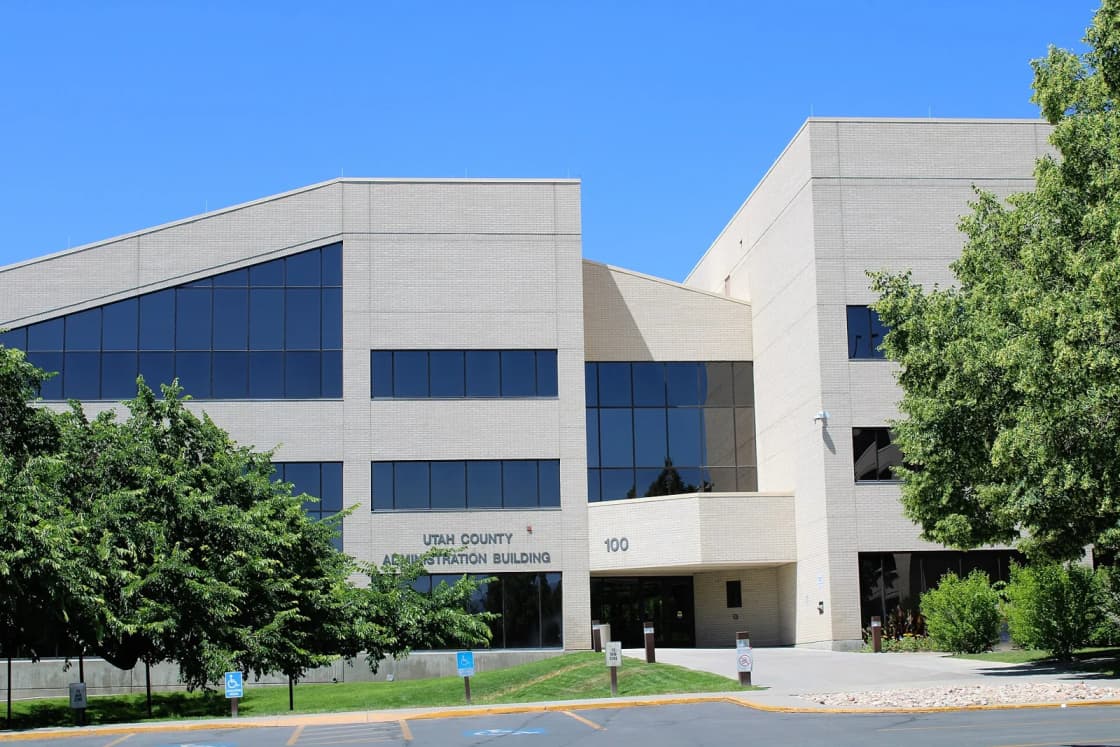
The Utah County Elections Office is at 100 East Center Street, Suite 3100 — third floor — in Provo. Phone (801) 851-VOTE, which spells (801) 851-8683. Email elections@utahcounty.gov.
Note what just happened: the elections function has its own street address, its own phone number, its own email and its own website, distinct from Utah County's main site.
This is a recurring characteristic of Utah County's web presence rather than a one-off, and it has bitten us before on this site. Several county departments live on subdomains rather than as sections of the main county site, and some of the old main-site department paths now serve pages that look like content and are not. A page can return a normal-looking response, render a header and a menu, and contain nothing — which is indistinguishable from a working page until you read the body.
The practical rule: when you are looking for a Utah County department, search for the department by name and expect to land on a subdomain. Do not assume a path on the main county site is current just because it loads.
The Clerk-or-Auditor question, unresolved on purpose
Here is something we could not settle, and we would rather say so than guess.
Some Utah County material describes a combined Clerk/Auditor office, with the Clerk handling elections, marriage licenses, passports and commission records, and the Auditor handling countywide financial administration, budget preparation and internal audit — one office, two functions.
The county's current elected officials listing describes the Clerk and the Auditor separately, as distinct elected offices with distinct duties.
Both descriptions are published under the county's own name. We cannot tell from the outside whether this reflects a genuine reorganization, a partial website migration, or legacy pages that were never retired. What we can tell you is that the older combined-office material sits on exactly the kind of legacy path that has proven unreliable elsewhere on the same domain.
If you are addressing correspondence, filing something formal, or citing an office in a document that matters, confirm the current name directly rather than trusting either description — including ours.
What the Clerk is not
A large share of wasted trips to county offices come from four confusions. All four are easy to avoid once named.
Not the Recorder. Property records — deeds, mortgages, plats, ownership maps — belong to the County Recorder, a separate elected office. If you are researching who owns a parcel or what is recorded against it, property records is your destination, not the Clerk.
Not the courts. Utah's district and justice courts are part of the state court system. Case files, dockets and case lookup are court functions. If you have a case, the Utah County courts guide covers which court has it. The Clerk keeps the county government's record, not the judiciary's.
Not the Assessor or Treasurer. Valuation is the Assessor. Billing and collection is the Treasurer. If your question involves a number on a tax notice, property tax walks the chain.
Not the city. Building permits, business licenses, utilities, streets and code enforcement are municipal. Provo runs its own permit and business licensing processes, and the county has nothing to do with them.
The rough test: if it concerns your parcel or your street, it is a city question. If it concerns records, elections, courts or countywide services, it is a county question.
Elections: the part that touches the most people
Most residents interact with this office exactly once every year or two, through a ballot, and never think about the machinery behind it.
That machinery is substantial. The Clerk maintains the voter roll, which means processing registrations, updates and removals under state law. It produces and mails ballots. It manages drop box locations and in-person voting sites. It tabulates. It runs the canvass, which is the formal certification step where results stop being reported numbers and become official ones.
The canvass is the underappreciated part. Election night numbers are preliminary by design — provisional ballots have not been adjudicated, and ballots still in transit have not arrived. The gap between election night and certification is not delay; it is the process working. Close municipal races in Utah County are certified roughly two weeks after election day, which is exactly the interval you would expect.
For deadlines, registration mechanics, drop box handling and how ballots are processed in this county, our voting in Utah County guide goes considerably deeper than this page does. For the other half of the question — which contests are on the ballot and what each of those offices decides — see our Utah County ballot guide. It also covers a rule change that catches people every cycle.
Marriage licenses, briefly
We keep a full guide to getting a marriage license in Utah County, so this is the short version and the pointer.
The license comes from a county clerk. Any Utah county's license works for a ceremony anywhere in Utah. There is a window between issue and use, and a window for the officiant to return the completed license, and missing either one creates a genuine problem rather than an inconvenience. Requirements involving minors are handled through the courts and are substantially more involved.
Do not treat the specifics as stable. Fees, accepted payment methods and processing details differ between counties and change over time. Confirm with the issuing office in the week you need it.
Passports: the distinction that ruins trips
The Clerk's office is an acceptance facility. It accepts and processes your application. The U.S. Department of State issues the passport.
People conflate these and then plan around the wrong timeline. Your appointment at the county office is one step; the processing clock that determines whether you have a passport before your flight is federal and moves with demand.
Two practical notes. Check current processing times at the State Department directly, because any figure quoted on a local page — including this one, if we printed one — is a snapshot of a number that moves. And never pay a website for passport application forms. The forms are free from the government. Paid form sites are a persistent, entirely legal, entirely unnecessary business.
Candidate filing: the deadline almost nobody knows exists
There is a second election function that gets almost no public attention and shapes every ballot you ever see.
Before there is an election, there is a filing period — a defined window during which anyone who wants to run for a county, municipal or state office submits a declaration of candidacy. Miss it and you are not on the ballot, regardless of support, funding or intent. The county clerk administers filing for the offices within its jurisdiction.
This is where the actual bottleneck in local politics sits. Races go uncontested in Utah County with some regularity, and the reason is rarely that nobody wanted the job. It is that the window opened and closed while the people who might have run were not paying attention, because filing periods are noticed in exactly the way legal deadlines are noticed — properly, publicly, and invisibly.
The clerk's office also handles what happens after filing: verifying eligibility, resolving ballot order, and managing withdrawals. If you have ever wondered why one candidate's name appears above another's, that is an administrative determination rather than an accident.
If you have ever thought about running for something local, the single most useful thing you can do is find out when the filing window opens — not next year, now — and put it in a calendar. Everything else about a campaign can be improvised. That one cannot.
GRAMA: how to get a county record
Utah's public records law is the Government Records Access and Management Act, universally shortened to GRAMA, and it is the mechanism by which anyone can request records from a government body in this state.
A few things about it are worth knowing before you need it.
You request from the agency that holds the record. There is no central clearinghouse. A county record comes from the county; a city record comes from the city; a court record follows the court system's own rules. Sending a GRAMA request to the wrong body does not get forwarded so much as delayed.
There is a statutory response clock, measured in business days, with a shorter deadline for requests that qualify as expedited — typically those made by a member of the media or where the request primarily benefits the public rather than the requester. The clock is a response deadline, not a delivery deadline, and a response can be a denial or a request for clarification.
Specificity is the whole game. A request for "all emails about the project" is a request that will take months and may be denied as unreasonably burdensome. A request for correspondence between two named people, on a named subject, between two dates, is a request that gets filled. Records officers are not adversaries; they are people trying to run a search query.
Fees are allowed, and a fee estimate is a normal step rather than an obstruction. Waivers exist for requests that serve the public interest.
Not everything is public. GRAMA classifies records, and private, protected and controlled classifications exist for real reasons — personnel files, some law enforcement material, information that would compromise security. A denial can be appealed, and the appeal path is part of the statute.
For county records, the Clerk's office is the natural starting point for anything touching commission proceedings, elections administration or official county documents. For anything else, work out which office holds the record first. That single step is most of the work.
Before you go: the five-minute check
County offices are a bad place to improvise, and almost every wasted trip we have heard about traces to one of five things. Confirm all of them before you leave the house.
Confirm the office is the right one. Clerk, Recorder, Assessor, Treasurer and the courts are five separate destinations, and only one of them has what you need.
Confirm the address and the floor. The elections operation sits at its own address on its own floor, and several county functions live on their own subdomains with their own contact details. The main county site is not reliably current about any of them.
Confirm the hours today. County offices observe holidays that private employers do not, and some run compressed weeks.
Confirm what you must bring. Identification requirements, acceptable payment methods and whether both parties need to appear differ by transaction and change without announcement.
Confirm whether an appointment is required. Passport acceptance in particular is frequently appointment-only, and turning up without one is the most common version of this mistake.
Five minutes on the phone is worth more than any guide, including this one.
The record-keeping function nobody watches
The Clerk prepares agendas and takes the minutes for the Board of County Commissioners.
That sounds procedural. It is the reason county decisions can be examined at all.
An agenda is a legal instrument, not a courtesy: bodies subject to Utah's open meeting requirements generally cannot act on matters that were not properly noticed, which is what prevents consequential decisions from arriving without warning. Minutes are the durable record of what was decided and by whom, and they are what a journalist, a resident or a future commission reads when reconstructing how something happened.
If you want to follow county government the way you might follow Provo City Council, the agenda and minutes archive is the primary source, and the Clerk is the office that produces it.
- Voting in Utah County
- The Utah County Commission, Explained
- Getting a Marriage License in Utah County
- Looking Up Property Records in Utah County
- The Utah County Courts, Explained
- Property Tax in Utah County
- Jury Duty in Utah County
- The Provo Mayor's Office
- Getting a Passport in Utah County: Two Payments, One Building, and the Check Nobody Brings
The Clerk's Duties Are a Numbered List, and It Moved in November 2025
Almost everything written about Utah county clerks cites 17-20-1 or 17-20-4. Both are dead. Utah
recodified Title 17 through SB 1006 and SB 1007 of the 2025 First Special Session, effective
November 6, 2025, and the county clerk chapter moved from Chapter 20 to Chapter 70. Some of
the old sections were renumbered; others were repealed with their substance folded elsewhere. Old
§ 17-20-4, Duties of county clerk, is one of the repealed ones — its substance now lives in
§ 17-70-302. The Office of Legislative Research and General Counsel published a crosswalk
mapping every old section to its new home, which is the only dependable way to read a pre-2026
source without inheriting a dead citation. Our guide to
who can perform a Utah wedding hit the same problem from
the other direction, and it is worth reading for how widely the old numbers still circulate.
Section 17-70-302 is a bare list of duties — two dozen of them since the 2026 amendments, and reading it changes what you ask the office for. The clerk shall record all proceedings of the county legislative body (1); make full entries of its resolutions and decisions (2); and record the vote of each member on any motion where the body divides (3). The clerk authenticates the body's proceedings with a signature and the county seal (10), does the same for every ordinance the body passes and records it in the ordinance book (11), and records all orders levying taxes (12).
Then comes the subsection most people never learn about. Under § 17-70-302(13)–(14), the clerk must keep at the clerk's office all county books, records and accounts the clerk is required by law to keep — and during regular business hours, provide them for public inspection. That is a standing statutory inspection right attached to a defined set of records, and it sits alongside a GRAMA request rather than replacing it. If what you want is an ordinance, a levy order, or how each member voted on a divided motion, you are asking for something the clerk is already required to have on a shelf and show you. A records request is the right tool for the harder cases; it is the slow tool for this one.
Subsections (16) through (18) are the marriage license work: the clerk establishes policies to issue licenses to county residents and to people getting married in the county, keeps a register of them, and makes sure the clerk or a willing designee is available to solemnize. That is the hook the designee system hangs from, and it is why the current officiant statute points at § 17-70-302.
Two more sections are worth knowing by number. Section 17-70-201 requires the clerk to complete elections training under § 20A-1-107 — a small provision that says a great deal about which of the office's jobs the Legislature treats as the one with the highest stakes. Section 17-70-301(1) states plainly that the county clerk is the clerk of the county legislative body, and Subsection (2) sets out when a clerk also acts as clerk of the district court and performs the duties listed in § 78A-5-108.
One repeal is worth flagging because it removes a service people still ask for. Old § 17-20-3 required the county clerk to keep a record of notaries public. The recodification repealed it outright rather than renumbering it, so that is no longer a function of the office. Our notary guide covers where notary commissioning sits now.
Related Guides
- Cómo votar en el condado de Utah (guía en español)
- Civil Wedding Officiants in Utah Valley
- Getting Something Notarized in Utah County — where to go and what it costs
- Why Your Utah Valley City Is Run Differently From the Next One — municipal elections, terms and candidate disclosures
Frequently Asked Questions
What does the Utah County Clerk do?
Who is the Utah County Clerk?
Where is the Utah County Elections Office?
Do I get my marriage license from the city or the county?
Can I get a passport at the Utah County Clerk's office?
Is the Utah County Clerk the same as the Auditor?
Does the Clerk's office register voters?
Where do I look up a court case or a property deed?
Sources
The facts in this guide were checked against these sources. Hours, fees and rules change, so confirm anything time-sensitive with the source before you go. How we make Provo.com.
- Information For Voters, Utah County Elections. Checked October 12, 2026.
- Public Notice: Proposition 11 (Aaron R. Davidson, Clerk), Utah Public Notice Website. Checked October 12, 2026.
- Utah Code 17-70-302 Duties, Utah State Legislature. Checked October 12, 2026.
- Utah Code 17-70-201 and 17-70-301, Utah State Legislature. Checked October 12, 2026.