
Walk north from Center Street a couple of blocks and you are standing where the largest industrial enterprise in Utah Territory used to be. There is no sign of it. No brick shell, no smokestack, no converted loft apartments with exposed beams and a plaque.
Just a small marker on 100 West, and a lot of ordinary Provo.
For roughly sixty years, though, this block held a four-story stone factory full of spinning and weaving machinery, employing around 150 people, producing blankets and flannel sold across the Intermountain West. It was, by common description, the first large factory in Utah — and it was built for a reason that had almost nothing to do with making money.
The problem the railroad created
In May 1869 the transcontinental railroad was completed at Promontory Summit, and territorial Utah's economy changed overnight.
Until then, distance had done the work of a tariff. Manufactured goods from the East were expensive in Utah because getting them there was expensive, which meant local production had natural protection. The railroad removed it. Suddenly cheap eastern manufactures could reach Salt Lake City and Provo in bulk and undercut anything made locally.
Latter-day Saint leaders had spent two decades building a deliberately self-contained economy, and they read the railroad as a threat to it. Money spent on outside goods left the territory and did not come back.
The response was a wave of cooperative enterprises intended to make locally what had previously been imported. The Provo Woolen Mills was the most ambitious of them.
Why wool, and why Provo
Wool was the obvious candidate. Sheep did well on Utah's landscape, the territory already had a growing flock, and small-scale carding and weaving operations had proven the basic process worked in frontier conditions.
Provo had the other necessary ingredient: water. A mill site on the Provo River system could supply both process water and power, and the city sat in the middle of a valley that could feed raw wool into it.
And the same railroad that created the problem provided the solution's logistics. Heavy textile machinery — the kind that had never previously been movable into the Great Basin in quantity — could now be ordered from Philadelphia and shipped west.
How a cash-poor territory paid for it
The financing is the part that reveals what kind of project this really was.
Provo mayor Abraham O. Smoot pressed the case from around 1868, arguing the territory needed to stop the outflow of cash. Brigham Young committed church support, which made the enterprise viable. Together with other leaders they organized the Timpanogos Manufacturing Association, the parent company of the mills, with Young as its president.
Then they raised the rest from the community in kind. Residents were invited to contribute labor, materials or cash in exchange for stock. Builders came from across the territory. When resources ran short, the city of Provo supplied wheat to feed the workmen, and Utah County sold its courthouse — a building erected on the adjoining block in 1867 — to the new corporation in exchange for stock.
A county selling its courthouse to a textile company for equity is not an ordinary capital raise. It tells you the project was understood as public infrastructure.
What was built
The Daughters of Utah Pioneers marker records the dimensions, and they are worth stating because they are hard to picture otherwise.
The main building was stone, 65 by 145 feet, four stories high. A second structure ran 33 by 134 feet at two and a half stories. Additional outbuildings filled out the block. John Taylor's flour mill, already on the site, was absorbed into the plant.
Construction ran 1870 to 1872 at a recorded cost of $155,000, with $75,000 more for the machinery. The cornerstone was laid on 28 May 1870 by Smoot, with Andrew Hunter Scott serving as general superintendent of construction. Masons built the basement and three stories in stone, with a fourth story tucked under a mansard roof.
The mill began operating in 1872. Its first cloth was produced in 1873, dyed by H. B. Smart.
Who worked there
Around 150 people at the early peak, in a Provo that was still a small settlement. That ratio made the mill the dominant employer in town by a wide margin.
Many of the first workers were recent immigrants who had learned textile work in British mills — people who arrived in Utah already knowing how to run a loom, which is exactly the skill a brand-new factory could not train locally at speed. Later the mill turned substantially to young women to run the looms, which followed the pattern of textile employment across the United States in the same period.
The scrip question
Workers were paid in factory scrip rather than cash.
This is the detail modern readers find most jarring, and it deserves context rather than either defense or indictment. Scrip was company-issued credit, redeemable at cooperative stores within the local network. In a territory deliberately trying to prevent currency from leaving, paying wages in a medium that could only be spent locally was internally consistent with the entire point of the enterprise.
It was also, unavoidably, a constraint on workers. Scrip is worth what merchants will accept it for, and a wage you cannot spend outside a defined network is a weaker wage than cash. Both things are true, and the arrangement was common enough in territorial Utah that the mill was not an outlier.
Thirty good years
The mill's first three decades were a genuine success.
It produced a full range of woolen goods — blankets, shawls, yarns, flannels, cloth — and specialized in the heavy end of the market. Latter-day Saint households bought the output as a matter of both convenience and principle. Roughly a third of production was exported out of the territory, which meant the mill was not merely substituting for imports but earning outside money.
Sheep raising boomed across Utah between 1880 and 1900, and growers in Utah Valley and beyond had a buyer close to home. The marker's claim that it was the largest manufacturer of woolen fabrics west of the Mississippi River dates from that era.
The cloth had a reputation: extremely durable, and not as finely finished as eastern goods. That summary appears repeatedly in the historical accounts, and it captures the mill's whole commercial position. It was making serviceable things for people who valued serviceability and had a reason to buy local.
What the machinery did
"Woolen mill" is a phrase most people accept without picturing, and the process explains why the building had to be four stories and why it cost what it did.
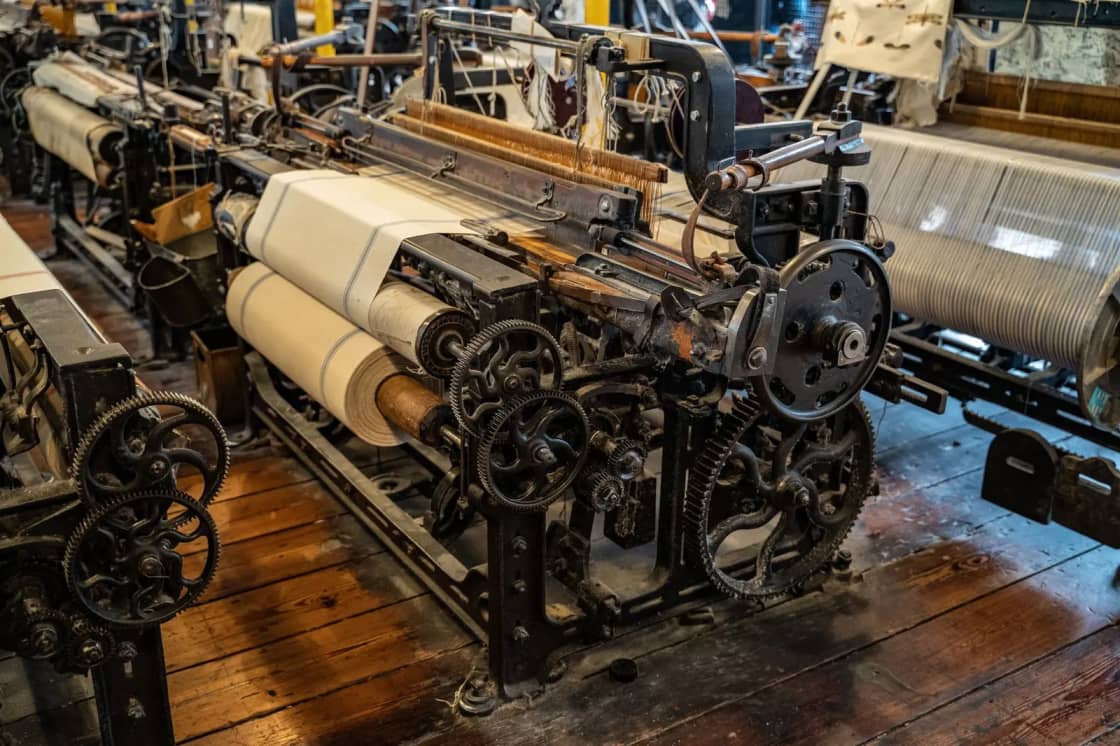
Raw wool arrives greasy, tangled and full of vegetable matter. It first has to be scoured — washed to remove lanolin and dirt — then dried. Next comes carding, in which the fibers are drawn between rollers covered in fine wire teeth until they lie roughly parallel and emerge as a soft rope. Carding machines are large, heavy and power-hungry, and they are the reason a woolen mill is a factory rather than a workshop.
The carded rope is then spun into yarn, twisted to give it strength. Spun yarn is warped onto beams and woven on looms into cloth. Woven woolen cloth is then fulled — deliberately agitated in water so the fibers mat and shrink together, which is what turns a loose weave into a dense, weather-resistant fabric. Finally the cloth is dyed and finished.
Each of those stages is a separate machine, a separate skill, and in a mill of this era usually a separate floor. That is what the Provo plant contained, and why importing it from Philadelphia cost half again what the building did.
It also explains the reputation. Heavy blankets and flannels sit at the durable end of that process and are relatively forgiving to produce. The fine finishing that eastern mills did better is the last stage, and it is the one requiring the most specialized equipment and the most practiced hands.
The cooperative economy this belonged to
The mills were not a standalone idea. They were one piece of a coordinated economic program that ran through territorial Utah in the late 1860s and 1870s.
The same period produced Zion's Cooperative Mercantile Institution — a church-backed retail cooperative intended to concentrate purchasing and keep margins inside the community — along with dozens of local cooperative stores, and a broad encouragement to buy from members rather than from outside merchants. Leaders spoke openly about home manufacture as a religious obligation rather than merely a commercial preference.
Understood inside that frame, the woolen mills make sense as something other than a business. The community was being asked to build production capacity for goods it was otherwise importing, and to buy the results even when they were rougher than the alternatives. That is a coherent strategy, and it worked for about a generation.
It also carried the seed of the failure. An enterprise whose demand rests partly on loyalty is exposed the moment loyalty relaxes — and the arrival of the railroad, followed by the gradual integration of Utah into the national economy, guaranteed that it would.
Water was the reason for the site
Modern readers underrate how completely early industry was located by water, because we site factories near highways and power lines instead.
The mill stood on the Provo mill run, a channel drawing off the river system, and that channel was the plant's power supply as well as its process water. Scouring, dyeing and fulling all consume water in quantity, and the carding and spinning machinery needed continuous mechanical power delivered by water wheel or turbine before electrical distribution existed.
This is why the factory sat where it did rather than beside the railroad or on Center Street. The block was chosen by hydrology. A flour mill was already operating on the site for exactly the same reason, and was simply absorbed into the new plant.
It is also a reminder of how thoroughly the Provo River shaped this city before it became a recreation amenity. Our guide to the Provo River Parkway follows the corridor the mill once ran on.
What went wrong
Several things at once, and none of them were fixable from Provo.
The depression of the 1890s hit demand hard. More fundamentally, the economic logic that created the mill was eroding: the cooperative boycott of outside goods weakened over time, and eastern textiles were both cheaper and better finished. A factory built to serve a closed economy struggles when the economy opens.
Accounts describe the operation faltering and closing in the mid-1900s. In 1910, Jesse Knight bought it and renamed it the Knight Woolen Mills — a decision generally described as risky and civic rather than shrewd. In 1918, per the Provo City Library's account, the mill was devastated by fire. Operation is most commonly recorded as continuing until 1932.
About those conflicting dates
Different sources will tell you the mill closed in 1904, or 1932, or that it burned in 1918, and the disagreement is worth naming rather than smoothing over.
They are describing different events in a long decline: a first closure after the 1890s depression, a purchase and restart under Knight, a major fire, and a final end during the Great Depression. A source citing any one of those as "the" closing date is not wrong so much as compressed.
If you need a single figure, 1932 is what the Daughters of Utah Pioneers marker and Utah state history sources most commonly give. But the honest version is that this factory ended several times.
The Jesse Knight thread
Knight is worth following, because he connects this story to another one.
He made his money in the Tintic Mining District, in the hills southwest of Utah Valley, where the settlement of Knightsville carried his name. That fortune funded a great deal of Provo — buildings at Brigham Young University among them — and it bought the woolen mills in their decline.
So the same man's money runs through Provo's industrial history and Utah County's mining history, and the two stories meet on a block downtown. Our guide to Eureka and the Tintic ghost towns covers where that money came from.
Why nothing survives
This is the question people ask once they learn the mill existed: how does a four-story stone factory on a full city block disappear completely?
Ordinarily, industrial buildings survive because someone finds a second use for them. A mill becomes a warehouse, then offices, then apartments. That chain requires the building to still be standing when preservation becomes fashionable, which in most American cities meant surviving until roughly the 1970s.
The Provo mills closed in the 1930s, in a depression, in a small city with no demand for enormous stone industrial space and a fire-damaged structure. The land near the center of a growing city was worth more empty. By the time anyone thought of preservation, the decision had been made decades earlier.
What the loss costs
A city's sense of itself follows its visible history, and Provo's visible history is overwhelmingly a story about a university and a religion.
Both are true. But for about sixty years this was also a factory town, with an industrial workforce, immigrant loom operators, company scrip, and a labor economy that had nothing to do with either institution. That period is nearly invisible on the ground, which makes it easy to conclude it did not happen.
It is a useful corrective when reading the valley today. The tech corridor to the north is often described as Utah Valley's first real industrial economy. It is at least the second.
How to see what remains
Realistically this is a documentary visit rather than a site visit, but there is something to stand next to.
The Daughters of Utah Pioneers marker sits at 125 North 100 West in Provo, erected in 1964, recording the dimensions and dates. It notes the factory stood four rods north of that point — about sixty-six feet.
The marker is within walking distance of several others downtown, including the Knight Block, Brigham Young Academy and the historic Utah County courthouse, so it works well as one stop on a short walk rather than a destination.
For the substance, the standard scholarly account is Leonard J. Arrington's 1953 article in the Utah Historical Quarterly, volume 21 — Arrington being the economic historian who did more than anyone to document territorial Utah's cooperative enterprises. The Provo City Library also maintains a page on the mills as a local historical place.
Our guides to Provo's history and the oldest businesses in Provo cover the wider commercial story this was the largest part of, and our Startup Candy history covers the one early Provo manufacturer that is still operating today. Between them they sketch a commercial Provo that existed long before either the university or the technology corridor.
Related Guides
- The History of Provo
- The Oldest Businesses in Provo
- Startup Candy: Provo's Oldest Manufacturer
- Eureka and the Tintic Ghost Towns
- The Provo River Parkway
Frequently Asked Questions
What were the Provo Woolen Mills?
Why was the Provo Woolen Mills built?
Where were the Provo Woolen Mills located?
How big was the Provo Woolen Mills factory?
Were workers really paid in scrip?
Who was Jesse Knight and what did he have to do with the mills?
When did the Provo Woolen Mills close?
Is there anything left of the Provo Woolen Mills to visit?
Sources
The facts in this guide were checked against these sources. Hours, fees and rules change, so confirm anything time-sensitive with the source before you go. How we make Provo.com.
- Utah's First Large Factory Opened in Provo in 1872, Utah History To Go (Utah Division of State History). Checked October 12, 2026.
- Provo Woolen Mills, Provo City Library. Checked October 12, 2026.
- The First Large Factory in Utah, Utah History To Go. Checked October 12, 2026.