Provo has a founding story that most cities would put on a plaque, and a second founding story that most cities would not. Both are documented. This is an attempt to tell the whole sequence in order, and to be honest about which parts of it the sources actually agree on — because on several of the most-repeated facts, they do not.
The lake came first
Everything about why people live here starts with water. Utah Lake is a large, shallow freshwater lake in a basin where almost nothing else is fresh, and for centuries it was the most dependable food source in the region. It held thirteen native fish species. People organized their year around that.
The Fremont lived near the lake more than a thousand years ago. By the time Europeans arrived, the valley was Timpanogos country — a Ute-affiliated people whose villages clustered near the lake and the river mouths, both for the fishery and for the protection the position offered.
The naming is worth pausing on. Early written accounts call Utah Lake Timpanogos Lake, and the Provo River the Timpanogos River. The name is still all over the map — the mountain, the cave, the storytelling festival, the canyon trail — but it has been lifted off the two features it originally described. The lake now carries the name of a different people and the river carries the name of a trapper. That substitution is the compressed version of the next hundred years.
1776: the first written description
In September 1776, the Domínguez–Escalante expedition came into Utah Valley looking for an overland route to California. They are generally credited as the first Europeans to see Utah Lake. They described the valley in favorable terms, noted the fish and the people, and told the Timpanogos they would return.
They did not. Spain's colonizing energy went elsewhere, and the valley stayed as it was for another two generations. That gap matters, because it means the first sustained European presence here was not Spanish and not colonial in the formal sense — it was commercial, and it arrived alone, on foot, trapping beaver.
A name that arrived before the town did
Étienne Provost was born in Chambly, Quebec, in 1785 and was in the St. Louis fur trade by about 1814. He worked out of Taos from roughly 1822, in what was then Spanish and later Mexican territory, and had been arrested by Spanish authorities more than once. His contemporaries rated him extremely highly. Some called him the man of the mountains.
In 1824 he and his partner François Leclerc led a company north from Taos into the Great Basin. Somewhere on that trip, Provost's party was ambushed by a band of Shoshone during what had been presented as a peace parley — the trappers were asked to set their metal aside, and were attacked once they had. Provost and a small number of others fought their way out.
Here is where the city's own origin story stops being firm. The details of that ambush are published at least three different ways by sources that are all reputable:
- The date. Utah's state history office places the party near Utah Lake in October 1824. A widely reprinted account gives spring 1825, while noting that some tellings say fall 1824. Other summaries simply say Provost arrived in the region in 1825.
- The place. The state's account says the camp was "probably along the present-named Jordan River" — the river that flows out of Utah Lake toward the Great Salt Lake. Other accounts put it at the mouth of what is now the Provo River. Kit Carson, retelling it secondhand, said only that it happened on the river named for Provost, which does not settle it, because both rivers were at one time called after him.
- The death toll. A contemporary federal document — William Gordon's 1831 report to the Secretary of War on the fur trade — records eight men killed in Provost's company. A trapper's later narrative gives about fifteen. Historians generally consider eight the better-supported number.
So the city is named, at one remove, for an event whose date is uncertain, whose location may have been a different river, and whose casualty count doubles depending on which document you open. What is not in doubt is the naming chain itself: the river took a phonetic version of Provost's surname, and the settlement took its name from the river twenty-five years later.
There is a quiet detail in the state's own write-up worth repeating: it seems likely that most of Provo's early settlers had no idea about the killings that put the name on the map. They named their town after a river.
1849: Fort Utah
Mormon settlers moved south from the Salt Lake Valley and built Fort Utah on the Provo River in the spring of 1849 — roughly thirty families, on ground the Timpanogos had used as a major campsite and that sat across established hunting trails.
That last point is not incidental and it is usually omitted. The fort was not built on empty land at the edge of somewhere. It was built on the best-positioned piece of the valley, which is precisely why it was already in use.
The first months were uneasy rather than violent. There was trade. There was also friction over livestock, crops, and water, and the settlers had arrived with no intention of leaving.
The part the plaques leave out
Provo's second founding story is a sequence of killings, and it is well enough documented that leaving it out is a choice rather than an oversight.
Battle Creek, March 5, 1849. Before the fort was finished, a detachment of about thirty-five militiamen under Captain John Scott tracked a group of Timpanogos into a canyon near what is now Pleasant Grove, surrounded the camp, and killed four men. It was the first violent engagement between settlers and the valley's inhabitants. The creek is named for it, and so, originally, was the town: Pleasant Grove was called Battle Creek first. A settlement in Utah County is named, to this day, after the killing that opened its own history.
Old Bishop. Three settlers confronted a Timpanogos man they had nicknamed Old Bishop, accusing him of stealing a shirt from a clothesline. He said he had traded for it. They took it back by force and one of them shot him, then hid his body in the Provo River. The date is contested — the Provo historian D. Robert Carter places it in the summer of 1849, while other accounts put it in January 1850 — but the substance is not, and the killing was concealed from territorial leadership, at least at first.
The Provo River, February 1850. Reports of livestock theft went north, the killing of Old Bishop did not, and on January 31, 1850, Special Order No. 2 went out over the signature of Daniel H. Wells. Beginning February 8, roughly ninety militiamen surrounded a Timpanogos encampment on the Provo River and besieged it for two days, using guns and a cannon, then pursued, captured, and executed groups that fled during the last night. Published death tolls run from about forty to about a hundred Timpanogos men, and one or two women. One militiaman was killed; eighteen were wounded.
Afterward, settler accounts record that the dead were decapitated, that the heads were displayed at Fort Utah, and that skulls were sent east for medical study. Two of those accounts came from women who were young at the time and wrote about it later — one was eight years old and remembered it as a horrifying scene; another, then a teenager, estimated forty to fifty heads.
Two honest caveats. First, nearly all of this record is settler-written; the people on the other side of it did not control the archive, which is one reason the casualty range is as wide as it is. Second, this is not settled history in the sense of being over. The Timpanogos Nation continues to press the significance of that order and that February, and Utah newsrooms were still covering it as a live subject in 2026.
What happened after 1850
Most Provo histories stop at the massacre, if they mention it at all, and pick up again at the railroad. The intervening twenty years are the part that actually determined who lives in Utah Valley.
The Walker War, 1853–54. Friction had been building over settlement expansion onto Ute land and over Mormon restrictions on the established slave trade, which cut into the trading position of Wákara's band. On July 17, 1853, a settler in Utah Valley named James Ivie intervened in an altercation between a Timpanogos man and woman and mortally wounded the man. Brigham Young wrote immediately to Wákara and his brother Arapene urging peace, and local settlers tried to negotiate, but the relationship did not hold. The following day a settler named Alexander Keel was killed, and raiding continued across central Utah. Young and Wákara met in person in May 1854 and reached a peace agreement; Wákara died early the next year.
The Tintic War, 1856, was briefer. Then came roughly a decade of uneasy quiet.
The Black Hawk War, 1865–72, was the longest and widest of them. It is named for Antonga, called Black Hawk by settlers — a man who as a young combatant had been involved in the earlier conflicts, in one account coerced into guiding a punitive expedition against his own people.
And then the piece almost nobody prints. In June 1865, Ute leaders met at the Indian Farm in Spanish Fork and signed a treaty ceding their lands in Utah in exchange for the Uinta Basin, annual payments, promised mills, homes and a school. It is known as the Spanish Fork Treaty, signed on June 8, 1865.
The United States Senate never ratified it. It sat for years, was finally reported to the Senate floor in March 1869 with a negative recommendation, and was rejected. By the summer of 1867 the Utes at the Uintah Reservation had received essentially no annuities and scarcely any provisions. The removal happened anyway.
So the legal instrument that moved the Timpanogos off the valley their name is still stamped all over was never actually a treaty. The obligations in it were never binding because it was never ratified, and the benefits in it were never delivered. That is not a revisionist reading — it is the documented sequence, and it is why the Timpanogos Nation's claims remain a live subject rather than a settled one.
From fort to city
Flooding pushed the settlement off the river bottoms, and in 1850 the fort relocated to higher ground near what is now North Park. The same year, Fort Utah was renamed Provo and the settlement was incorporated. Provo became the county seat in 1852.
That year the townsite residents petitioned Brigham Young to send George A. Smith to Provo to organize the county's affairs, and the place started behaving like a town rather than a garrison. By the end of 1852 Provo had a pottery, two grist mills, a sash factory, three cabinet shops, a wooden bowl factory, three shoe shops, two tailor's shops, a meat market, two store houses and two lime kilns. The first merchant was Andrew J. Stewart, who ran a general store out of his home before building on what became Center Street — which is why Center Street is the commercial spine of the city to this day.
Then the railroad changed the scale of everything. A line reached Provo in 1872, and the Provo Woolen Mills opened the same year — the valley's first real industrial employer. Orchards and gardens spread far enough that Provo picked up the nickname the Garden City. For a while it was the second-largest city in the territory, until Ogden's railroad hub outgrew it in the 1870s.
1875: the decision that still runs the city
Brigham Young Academy was established in 1875 and became a university in 1903.
It is difficult to overstate how much of present-day Provo is downstream of that. The city's median age, its housing market, its restaurant economy, its traffic patterns, its winter-versus-summer population swing, and the reason a city of this size supports a stadium of that size all trace back to a small academy that spent its early decades looking fragile. Provo did not grow into a college town. It was rebuilt around one.
The Candy City
Between the woolen mills and the steel, Provo had a sweeter industrial phase, and it left a name behind that nobody uses now.
Startup Candy set up in Provo in the mid-1870s and grew into one of the larger confectionery makers in the West. By 1919, Utah had the highest per-capita sugar consumption in the United States and nine wholesale candy producers. Startup's most famous product, the Opera Bar, went out in a wrapper that read Provo, Utah, The Candy City.
The company is still going, the factory building still stands, and almost every date attached to it is disputed — including by the company. That is a story of its own, which we tell in Provo's oldest businesses.
Steel, software, and fiber
Geneva Steel began producing in 1944, built inland as a wartime hedge against coastal vulnerability, and ran for the rest of the century. Its shutdown is misreported almost everywhere, which we untangle in the Geneva Steel history.
Then Provo industrialized a second time, in software. WordPerfect and Novell built a technology corridor in Utah Valley a decade before anyone was calling it Silicon Slopes — the background to both Silicon Slopes and the companies founded here. And in 2004 the city started building its own municipal fiber network, which it sold twice and eventually handed to Google for one dollar while residents kept paying the bond. That is the iProvo story.
Fire, and a rebuilt landmark
The Provo Tabernacle, finished in the 1880s, was the city's civic room for well over a century. It burned in December 2010. What was left of the shell became the Provo City Center Temple, and one photograph from the aftermath became far more famous than the building ever was — for reasons that turn out not to be quite what people think. That is the tabernacle story.
The timeline, compressed
- ~1,000+ years ago — Fremont settlement near Utah Lake; later, Timpanogos villages organized around the fishery
- September 1776 — Domínguez–Escalante expedition reaches Utah Valley
- 1824–25 — Étienne Provost's company ambushed near the lake; date, place, and toll all contested
- March 5, 1849 — Battle Creek killings near present-day Pleasant Grove
- Spring 1849 — Fort Utah built on the Provo River
- 1849–50 — Old Bishop killed; body concealed in the river
- January 31, 1850 — Special Order No. 2 issued
- February 8–17, 1850 — siege and massacre on the Provo River
- 1850 — fort relocated after flooding; Fort Utah renamed Provo; settlement incorporated
- 1852 — Provo becomes the seat of Utah County
- 1872 — railroad arrives; Provo Woolen Mills open
- 1875 — Brigham Young Academy established
- mid-1870s — Startup Candy sets up in Provo
- 1903 — the academy becomes Brigham Young University
- 1944 — Geneva Steel begins production
- 1980s–90s — WordPerfect and Novell build the valley's software corridor
- December 2010 — Provo Tabernacle burns
- 2013 — the municipal fiber network is transferred to Google
Where to see it
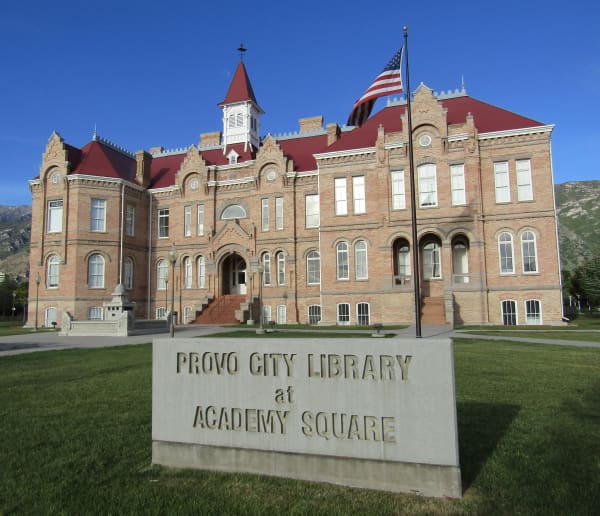
The Startup Candy Factory on 100 West has been on the National Register of Historic Places since 1983 and is the most visible surviving piece of the industrial city. North Park sits near where the fort moved in 1850. The original Brigham Young Academy building downtown is now the city library, which means the 1875 decision and the 2020s city occupy the same walls. The Provo City Center Temple is literally the 1880s tabernacle with a new interior. And Utah Lake is both the least-changed and most-changed thing on this list — the same water in the same basin, holding almost none of the same fish.
For where to go with all of this, our guide to things to do in Provo covers the sites that are actually open to visit. For the people this history produced — including the Provo-born physicist who helped lay out the Y and later became the father of stereophonic sound — see famous people from Provo and Utah Valley.
Related Guides
- Brigham Young Academy: The Building That Became the Library
- Seven Peaks: How Provo's Water Park Nearly Died
- The Legend of Timpanogos Was Written by a Track Coach in 1922
- New FEMA flood maps take effect in Provo on June 23 — what homeowners and renters should know
- The Pros and Cons of Living in Provo
- Family History Centers in Utah Valley
- The Orem Line: The Electric Railroad That Named a City
- The Timpanogos of Utah Valley
- The Provo Woolen Mills
- Provo's Sister Cities: Meissen, Nanning and the BYU Connection
- The Thistle Landslide of 1983: The Town That Drowned
- Provo's Historic Districts — where that history still stands
- A Short History of Orem: From the Provo Bench to Family City USA
- Center Street, Provo: A Self-Guided Historic Walking Tour
Frequently Asked Questions
Who is Provo named after?
When was Provo founded?
What was Provo called before it was Provo?
What happened at Fort Utah in 1850?
Why is Provo's history tied to Utah Lake?
When was BYU founded, and was it always called that?
Was Provo ever an industrial city?
Where can I actually see Provo's history in person?