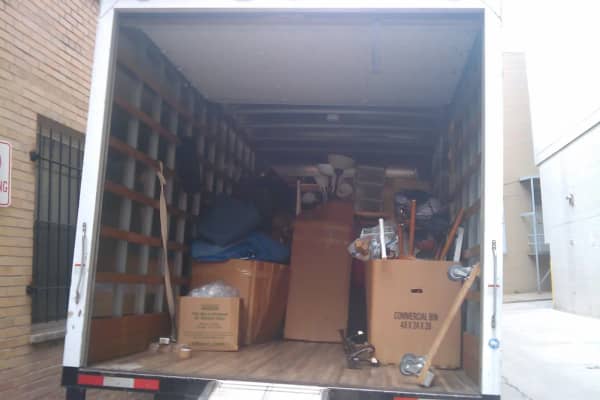

Self-storage looks like the most generic business in America — orange doors, a gate code, a padlock — right up until you try to rent a unit in Provo in the last week of August. Then you discover that this valley has its own storage economics, driven by two universities, a lease calendar that strands the whole city's furniture at once, and, improbably, a local startup that rewired the entire industry from an office in Lehi.
This guide covers how storage works here: when the crunch hits, where the facilities are, when climate control earns its premium in Utah's peculiar climate, what to check in the lease, and the alternatives most renters never hear about.
The Provo storage calendar
Storage demand everywhere follows moving season. In Provo it follows the academic lease cycle, and the difference matters.
Most student housing here runs on contracts, and the contracts cluster: a huge share end in the third week of August, while fall contracts begin in early September. That gap — ten days, give or take — leaves a city's worth of beds, couches, and boxes with nowhere to live, every single year, all at once. It is common enough that local facilities plan and price around it. The spring echo comes in late April, when BYU and UVU let out and students who aren't staying for spring term need somewhere to park their lives until fall — often for a four-month stretch, which is the classic "summer storage" rental this market is built on.
The practical rule falls out directly: if your move touches late April or the back half of August, reserve the unit before you arrange anything else — before the truck, before the movers, before the cleaning schedule. A full facility in the last week of August reroutes your entire plan, and by then its neighbors are full too. The rest of the year, Provo storage is a renter's market with move-in promotions to shop; in the crunch weeks it is not.
If you're a student reading this before your first turnover, our college move-in guide covers the whole late-August choreography, and the first-time renter's checklist covers the contract mechanics that create the gap in the first place.
Where the units are
Provo's storage geography is lopsided, and knowing it saves you a drive. The heaviest concentration is the industrial corridor in south Provo — South State Street and Ironton Boulevard, down near East Bay — where multiple large facilities operate within blocks of one another. That clustering is useful: it means you can tour two or three facilities in twenty minutes and compare real availability rather than website promises. National operators (Extra Space Storage — which, Utah trivia, is headquartered in Salt Lake City and is among the largest storage operators in the country — and others) mix with regional and independent facilities through the same corridor.
Beyond the south-Provo row, facilities scatter along the commercial corridors of Orem, Springville, and Spanish Fork. Don't over-weight the address: for a summer-long student rental you'll visit the unit exactly twice, and a facility ten minutes farther that has the right size at the right price beats the close one that doesn't. For a during-renovation rental you'll visit weekly, flip the priority.
Climate control in Utah: when it's worth it, honestly
Storage marketing sells climate control as always essential. In Utah the honest answer is more interesting, because our climate cuts both ways.
The case for it: Provo summers are hot — triple-digit stretches are normal — and the inside of a standard metal drive-up unit runs hotter still. Winters drop well below freezing for weeks. That annual swing is brutal on electronics, wood furniture, instruments, photographs, vinyl, candles, and anything held together with glue or finish. If your stored goods will cross a full summer or winter and include anything on that list, climate control earns its premium.
The case against paying for it reflexively: Utah's saving grace is humidity — we barely have any. The mold and mildew problems that make climate control near-mandatory in the Southeast are far weaker threats in a high desert. Sturdy furniture, boxed clothing and books, dishes, camping gear, and tools handle a standard unit fine, especially for a short stay. A few weeks of August gap storage does not need climate control. Four years of your grandmother's piano does.
One Utah-specific note: dust. High-desert storage is dusty storage, and a drive-up unit's door gasket is not a seal. Cover soft furniture with sheets or shrink wrap regardless of which unit type you choose; it's the cheapest protection you'll buy.
The Neighbor story: the storage industry got disrupted from Lehi
Here's the part of Utah Valley storage that surprises people. Neighbor, the peer-to-peer marketplace that turned the self-storage industry into a sharing economy, was founded in 2017 by three BYU graduates and is headquartered in Lehi — twenty minutes up I-15 from the storage units it competes with. The pitch is Airbnb's model applied to empty space: homeowners list garages, basements, sheds, driveways, and RV pads; renters book them alongside traditional facility listings; the platform verifies hosts and handles payment. It has since grown into the leading marketplace of its kind in the country, with national venture backing — one more entry in the valley's Silicon Slopes ledger, and one with unusually local roots.
What it means practically, on both sides:
If you need storage, peer-to-peer listings add options standard search never shows you — including in residential neighborhoods with no facility for miles — and residential space frequently undercuts facility pricing. The trade-offs are real: access on a host's terms rather than a 6-a.m.-to-10-p.m. gate, no on-site manager, and protection plans instead of a facility's standardized insurance. For a summer of boxes, many students find the trade easy.
If you own a home here, the same marketplace runs in reverse: an empty garage bay or a wide RV pad in a county full of boats and trailers is rentable space. Plenty of Utah Valley homeowners quietly do exactly that.
Vehicles, boats, and the RV problem
Utah County owns toys — boats for Utah Lake and Deer Creek, trailers, four-wheelers, and a striking number of RVs — and many neighborhoods and HOAs restrict parking them at home. That makes vehicle storage its own market here: uncovered lots, covered canopies, and fully enclosed units, priced in that order. Two things to know before you shop. First, facilities storing a registered vehicle will require proof of insurance on it — that's standard, not an upsell. Second, winter is the crunch season for boat and RV spots, the mirror image of the household-goods calendar: everyone wants the boat put away in October and back out in May, so lock in a covered spot before the first storm, not after. (Related: if you're winterizing the vehicle yourself first, our car wash and detailing guide covers where to get it cleaned up before it sleeps.)
Students with a car and no parking spot have a cheaper version of the same question — our student car guide covers the parking side.
Reading the lease like an adult
Storage agreements are short, and the important parts are shorter:
Month-to-month is the norm. Standard facility leases here renew monthly with no long-term commitment — which is what makes the four-month summer rental work. Confirm the notice required to vacate; leaving mid-month usually doesn't prorate.
The lien clause is real. Storage leases give the facility a lien on your stored goods, and state law allows facilities to auction the contents of a delinquent unit after the required notices. The reality-TV version is dramatized, but the mechanism is genuine. Keep your payment method current — especially on a unit you plan to ignore for four months — and keep your contact information updated so the notices can reach you.
Insurance: check before you buy. Facilities typically require coverage on stored goods and will happily sell you a policy. Before accepting, check whether your renters or homeowners policy already extends off-premises coverage to stored belongings — it often does, within limits.
The prohibited list is not negotiable. No fuel, propane, fireworks, or anything combustible; no perishable food (which in this valley of well-stocked pantries needs saying: your food storage cannot live in storage — heat ruins it and the pest clause forbids it); no living things; and no people, ever. Facilities also prohibit running a workshop or band practice out of a unit, however tempting the garage-band lore makes it sound.
What the lien law says, and the 2024 change to rate increases
Reading the lease matters. Knowing what sits behind the lease matters more, because Utah's self-storage statute sets terms the lease cannot rewrite and grants the operator powers a lease does not have to spell out. It is Title 38, Chapter 8 of the Utah Code, and almost nobody renting a unit has read it.
The lien attaches the day you move in. Not when you fall behind — on the date the property is brought to the facility. It covers rent, labor, other charges, the expense of preserving your property, and the cost of selling it, and it continues as long as the operator has possession.
Late fees have a safe harbor. The statute treats a late fee of the greater of $20 or 20% of the monthly rent, per late period, as reasonable and not a penalty — provided the fee and the conditions for charging it are stated in the rental agreement. That is a per-period figure, so on a long delinquency the fees compound faster than most people picture.
Enforcement cannot begin until you are 30 continuous days in default. After that the operator may act, but only after written notice.
Notice has to travel one of three ways: in person, by certified mail to your last known address, or by email to your last known email address. Email carries a condition — if the operator sends it and receives no response, return receipt, or delivery confirmation within three business days, it must then deliver in person or by certified mail. The notice must contain an itemized statement of what is owed and when it came due, a description of the property sufficient to identify it, the name, street address and phone number of a person you can contact, a demand for payment not less than 15 days after delivery, and a conspicuous statement of what happens if you do not pay.
The newspaper advertisement, and the exception that usually swallows it. The statute requires the operator to publish the sale once in a newspaper of general circulation in the county, with the sale no sooner than 15 days after publication. But that requirement drops away if the operator gave notice by email and got a response or return receipt, or gave notice by certified mail and has evidence of it. In practice a facility that keeps clean certified-mail records can proceed without any public advertisement at all, which is why "I never saw it in the paper" is not the defense people assume.
The sale may be held online. The statute expressly permits it alongside a sale at the facility or the nearest suitable place.
You can redeem right up to the sale. Paying the amount owed plus the reasonable expenses incurred gets your property back, and once the operator receives that payment it must return the property.
Surplus money is yours, for a year. After the operator satisfies the lien and any prior lienholder's claim, the balance is held for you. If nobody claims it within one year of the sale, it becomes the property of the Utah state treasurer as unclaimed property.
Vehicles follow a separate track. For a car, boat, trailer or off-highway vehicle, the default period is 60 continuous days, and rather than selling it the operator may have it towed by a carrier certified by the Utah Department of Transportation. Written notice by certified mail must follow within one day of the tow, stating the date and the tower's address and phone number.
The office has to post a notice, in words the statute prescribes, warning that goods unpaid for 30 days will be sold and that a vehicle not sold will be towed after 60 days of nonpayment. If you cannot find it on the wall, that is worth a question.
The 2024 change, which is the one that will affect you. Utah Code § 38-8-6 was enacted by Chapter 383 of the 2024 General Session, and it is the rent-increase mechanism. An operator may modify the terms of a rental agreement by giving written notice by first-class mail or by email at least 30 days before the modified terms take effect — and you are bound by the new terms if you keep storing your property there after that date. Continuing to pay is the acceptance. There is no negotiation step and no requirement that the increase be justified.
That single provision explains the pattern renters describe: a promotional rate for the first months, then a letter, then a materially higher rate. The counters are unglamorous but they work. Keep the email address on your account current, since an emailed notice to a stale address still starts the clock. Read anything the facility sends rather than filing it. And diary your own rate every six months, because the increase is easiest to accept when you have forgotten what you were paying.
This is a summary rather than legal advice, the chapter has definitions and exceptions this does not cover, and it has been amended repeatedly — most recently in 2024 — so read the current text before relying on any of it.
What storage doesn't solve
A last honest note, because late August tempts everyone toward the same mistake: a storage unit is a terrible place for furniture you don't want. Rent paid on regret compounds monthly. And the curb is not the fallback here — Provo collects nothing that doesn't fit inside the can, discarded furniture is named in the city code as a nuisance, and the city's free spring and fall cleanup windows don't cover the August peak. Our movers guide walks through the real disposal routes — selling, donating, the Spanish Fork transfer station, private haulers.
The valley's secondhand market is the better exit anyway: with two universities turning over housing every year, used furniture moves fast here, and the thrift and vintage scene that benefits is one of the area's quiet strengths. Store what you'll want back. Sell the rest to the next student who needs it — in this town, there's always one.
Related Guides
- Ventana: The Four-Bedroom Student Complex South of UVU
- Wolverine Crossing: The UVU Student Housing Complex Across the Skybridge
- Tattoo & Piercing in Provo: Shops, Utah Law & What to Check First
- Pawn Shops in Utah Valley: The Loan, the Sale, and the Law Behind the Counter
- The Provo Newcomer's Guide — the weeks either side of moving week, printable
- When a Storage Facility Can Sell Your Things: Utah's Self-Service Storage Lien — the notice steps before an auction
Frequently Asked Questions
When is the hardest time to find a storage unit in Provo?
Do I need a climate-controlled storage unit in Provo?
Where are the storage facilities in Provo?
What size storage unit does a student apartment need?
What is Neighbor, and is it a Provo thing?
Can I just leave unwanted furniture at the curb instead of storing it?
Can a Utah storage facility raise my rent without asking?
How long before a Utah storage facility can sell my belongings?
Sources
The facts in this guide were checked against these sources. Hours, fees and rules change, so confirm anything time-sensitive with the source before you go. How we make Provo.com.
- Seasonal Cleanup | Provo, UT, Provo City. Checked October 12, 2026.
- Utah Code 38-8-6: Renewal (Self-Service Storage Facilities), Utah State Legislature. Checked October 12, 2026.
- Utah Code 38-8-3: Enforcement of lien, Utah State Legislature. Checked October 12, 2026.