
A car wash guide sounds like the least necessary article a local site could write — until you move here, wash your car in the driveway, and watch it dry into a constellation of white spots. Utah Valley is hard on cars: hard water that spots, a dry climate that dusts, canyon roads that mud, a lake that splatters boat trailers, and a winter road-treatment program that coats everything below your door handles in corrosive brine. Washing a car here is not one errand; it is a small system. This is the local map of it.
The two things this valley does to your car
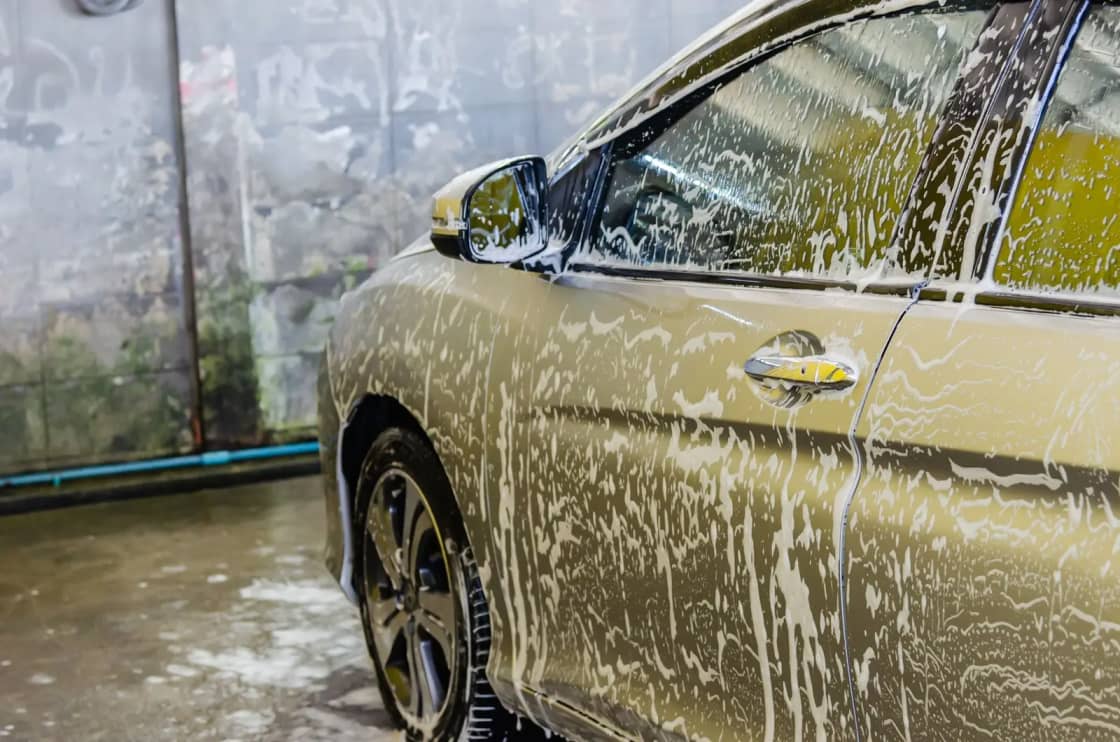
First, the water. Utah Valley's water comes off the Wasatch loaded with dissolved calcium and magnesium — the same hardness that scales up water heaters and dishwashers here (our HVAC and home systems guide covers that side of it). On a car, hard water is why a driveway wash that dries in the sun turns into spots: the water evaporates, the minerals stay. It is also why the express tunnels all advertise spot-free rinses — that final arc of purified water is doing real work in this valley, not marketing.
Second, the winter roads. When storms come through, UDOT and city crews lay down salt and brine to keep I-15, University Parkway, and the canyon roads drivable. It works, and your rocker panels pay for it. Brine residue clings to the undercarriage and wheel wells and keeps attracting moisture long after the road is dry, which is exactly the condition metal corrodes in. The practical rule locals converge on: in winter, wash the car every few weeks and after every major storm cycle, and pay for the tier that includes the undercarriage rinse. That is the whole reason that tier exists. The rest of what winter demands of a car here — tires, emissions, registration — is in our car ownership guide.
The express tunnels: who's who
The express wash boom reached Utah Valley in force, and the practical differences between the chains come down to Sundays, vacuums, and membership math. Every operation below was verified current as of August 2026; hours shift, so check before a special trip.
Quick Quack Car Wash — the yellow duck — is the market's biggest national presence, with tunnels in Provo (1710 N State St) and Orem (855 N State St) among others, plus one in Midway if you want a clean car in the Heber Valley. Exterior express only, free vacuums, unlimited memberships, and open Sundays. The company's Utah roots are real: it was co-founded in 2004 by Jason Johnson with his father-in-law, who ran a Utah car wash, and it has grown into one of the largest chains in the country.
Wiggy Wash is the Utah-grown counterweight, with Utah Valley locations in Orem, Springville, and a three-site cluster in Spanish Fork, plus Saratoga Springs. Two things distinguish it: it offers interior cleaning and detailing services, not just the exterior tunnel — which most express chains here do not — and it is closed Sundays. For a lot of Utah Valley households that closure is a feature, not a bug; either way, it is the fact to know before you drive over on a Sunday afternoon.
Shiny Shell Carwash in Provo (1188 S University Ave) is the amenity-forward option: the free vacuum lot comes stocked with microfiber towels, air guns, cleaning sprays, and mat cleaners, there is a members' lounge with a free soft drink, and — a genuine tell about who washes cars in this valley — a playground, so the kids have somewhere to be while you do the floor mats. Open Sundays.
Mister Car Wash (1408 State St, Orem) is the national giant's local outpost, an express tunnel with membership plans and Sunday hours; it absorbed some longtime local operations on its way into the market. Take 5 Car Wash in Orem rounds out the chain roster with free vacuums and a free self-serve detail center attached to its express line.
Provo also keeps a bench of smaller and longtime operations — self-serve bay washes where you feed the machine and wield the pressure wand yourself, which remain the right tool for muddy trail-day trucks, dog beds, and floor mats that need the high-pressure treatment. They come and go more often than the chains, so treat any specific listing as a lead to verify rather than a promise.
The membership question
Every chain sells the same basic product: an unlimited monthly plan, priced by wash tier, usually contract-free. Whether it is worth it is arithmetic, not ideology. The break-even on most base plans lands around two to three washes a month — below that you are donating; above it you are saving, and members also skip lines at some locations.
The honest local pattern: memberships earn their keep in winter, when brine removal makes a weekly-ish wash worthwhile, and go underused in summer. Since most plans can be paused or canceled without penalty, a winter-only membership from November through March is a legitimate strategy, and nobody at the counter will be surprised by it. One caution that applies everywhere: sign-up is easy at the kiosk and cancellation is a customer-service interaction, so know the cancellation route before you subscribe.
When to skip the tunnel: detailing
An express wash cannot fix oxidized paint, a toddler's back seat, swirl marks, or five years of never once vacuuming under the seats. That is detailing, and Utah Valley has a deep bench of it — from established shops to a striving ecosystem of mobile detailers who come to your driveway with water and power on board. The market splits roughly into:
Interior resets — deep vacuum, shampoo or steam on seats and carpet, panel cleaning. The most commonly needed service in a family-car valley, and the one to book before selling a vehicle. Paint correction and protection — clay bar, machine polish to remove swirls, then wax, sealant, or a ceramic coating for durable protection. Ceramic coatings have gone from exotic to mainstream here; they will not make a car scratch-proof, but they make hard-water spots and road film release far more easily, which is a bigger benefit in this valley's water than in most. Paint protection film (PPF) — the premium option for new-car fronts, and worth a thought here specifically because winter roads throw sand and gravel with the brine.
Prices vary too much by vehicle condition and shop to print usefully — get two quotes, and ask specifically whether the quote covers the problems you have rather than a package name. A detailer who asks to see the car before quoting is a good sign.
The do-it-yourself notes that matter here
If you wash at home, the valley's conditions rewrite the standard advice a little. Wash in shade and never let water dry on the car — with our water and our dry air, evaporation is the enemy; dry with a towel or blower, working in sections. Two buckets (wash and rinse) keep the grit you just removed from going back onto the paint. Do not wash on the driveway right before a hard freeze — ice sheets on the sidewalk are your civic responsibility. And after a canyon or lake day, use a self-serve bay's pressure wand on the wheel wells and undercarriage before that mud sets up like pottery.
One more local note: if your car lives outside, the summer cottonwood fluff and fall leaf drop along the tree-lined streets of older Provo and Orem neighborhoods will find your cowl vents. Clearing the plastic trough under the wipers takes two minutes and prevents the musty-vent smell that otherwise becomes a detailing bill.
Getting out of the membership, and why the rules are thinner than you would expect
The section above weighs whether an unlimited plan pays for itself. This is the other question people ask only once they want to stop paying, and the honest answer is that a wash membership sits in a gap between two sets of rules.
The Utah statute people reach for does not reach this. Utah's Service Contracts Act, Title 15, Chapter 10, is the law that forces disclosure and advance notice before a service agreement automatically renews, and that voids the renewal outright when a company gets it wrong. It is useful — it is why a pest control or HVAC plan on your house comes with notice obligations. But the Act defines a service contract as one for service, maintenance, or repair in connection with real property, or that provides a benefit to the real property. A car wash membership is neither. On the definition's own terms, the protections that cover the furnace do not cover the wash tunnel.
The federal rule that would have covered it was struck down. The Federal Trade Commission's amended Negative Option Rule — universally called the "click to cancel" rule — would have required businesses to make canceling a subscription about as easy as signing up, across essentially all auto-renewing programs. On July 8, 2025, in Custom Communications, Inc. v. FTC, the Eighth Circuit vacated it in its entirety, days before the July 14 compliance date. The court did not rule on whether the requirements were good policy; it held that the Commission had skipped a preliminary regulatory analysis that is mandatory for a rule with an annual economic effect of at least $100 million, and that the omission was prejudicial enough to require full vacatur.
Vacatur reinstated the original 1973 Negative Option Rule, which reaches only prenotification plans — the book-of-the-month-club shape, where you are sent something periodically unless you decline in advance. It does not address continuity programs, automatic renewals, or free-trial conversions, which is to say it does not address a monthly wash plan.
Where the rulemaking stands. The FTC submitted a draft advance notice of proposed rulemaking to the Office of Information and Regulatory Affairs on January 30, 2026, announced it on March 11, 2026, published it in the Federal Register on March 13, 2026, and set a comment deadline of April 13, 2026. An advance notice is the first step of a process, not a rule; the Commission has said it may retain the 1973 rule, amend it, adopt some of the vacated provisions, or pursue guidance instead. This is actively moving, and any article you read on the subject — including this one — should be checked against the FTC's current position before you rely on it. A great many consumer write-ups still describe click-to-cancel as though it took effect.
What protects you right now is a patchwork the FTC itself describes that way: Section 5 of the FTC Act, the Restore Online Shoppers' Confidence Act if you signed up online, the Telemarketing Sales Rule if you signed up by phone, state automatic renewal laws, and the terms of the contract you agreed to.
So the practical burden sits with you, and five habits carry most of it.
Screenshot the cancellation terms at sign-up, not later. If the plan requires cancellation in person at the site where you enrolled, or written notice a set number of days ahead, that is the moment to learn it.
Put the renewal date in a calendar with a reminder a week ahead. Monthly plans renew twelve times a year and none of those dates will be memorable.
Know what your plan is keyed to. Most unlimited plans are tied to a single vehicle, usually read by a license plate camera or a windshield tag. Selling the car does not cancel the plan, and neither does removing the tag. The billing continues against the card on file.
Cancel in a way that produces a record, and keep the confirmation number or email. If cancellation is only offered by phone, note the date, time, and the name of the person you spoke with.
Watch the card on file. A card reissued after fraud or expiry sometimes carries the subscription forward automatically through account updater services, so a new card number is not a cancellation either.
One local wrinkle worth planning around. In a valley where a large share of drivers leave for four months, a plan signed in September is a plan that bills through the following summer unless someone cancels it. If you are a student, or you have one in the family, the membership math above changes considerably once you count the months the car is parked in another state.
This is general information rather than legal advice, and the federal picture in particular is mid-rulemaking. The Utah Division of Consumer Protection takes complaints about billing and cancellation practices.
What ROSCA requires, since it is doing most of the work here. The Restore Online Shoppers' Confidence Act is a statute rather than a rule, so the Eighth Circuit's decision did not touch it, and it applies to any membership you signed up for online. It prohibits charging a consumer through a negative option feature in an internet transaction unless the seller does three things: clearly and conspicuously discloses all material terms of the transaction before obtaining billing information, obtains the consumer's express informed consent before the charge, and provides simple mechanisms to stop recurring charges. Those obligations sound a great deal like the vacated rule, which is the point — the FTC has continued to bring enforcement actions under ROSCA and Section 5 in the meantime. What ROSCA does not do is define "simple," and it does not reach a membership you signed up for on a tablet at the pay station rather than online. The gap between those two sign-up paths is, at the moment, a real difference in your legal position for exactly the same product.
A note on the state layer, because the FTC's own framing of the current landscape leans on it. Automatic renewal laws are state law, they differ substantially, and they generally attach to where the consumer resides rather than where the company is incorporated. Several states impose their own disclosure, consent and easy-cancellation duties on subscription sellers, which is why a national chain's cancellation flow sometimes behaves differently depending on the address on the account. Utah's own contribution, the Service Contracts Act, is aimed at real-property service agreements rather than at subscriptions generally, so it does not fill this gap. If you are comparing a national operator's terms against what a friend in another state describes, you may both be reading your contracts correctly.
A clean car is not a moral achievement, but in this valley it is a small, cheap act of maintenance — mostly because of what the water leaves behind and what the winter roads put on. Know which wash is open on the day you go, buy the undercarriage rinse from November to March, and save the detailing money for the problems a tunnel cannot touch.
Related Guides
- Buying a Used Car in Utah Valley: Titles, KSL, and the As-Is Rule
- Car Insurance in Utah: The Minimums Changed, and What Actually Drives Your Rate Here
- Living in Provo Without a Car: An Honest Assessment
- Driving Schools in Provo: Driver Ed, Road Tests & the Third-Party Shortcut
- Towed in Provo: The Sign at the Entrance Decides Whether They Were Allowed To
- Cracked Windshields in Provo: The Utah Rule Everyone Quotes Wrong
- The UVX Is the Best Thing About Getting Around Provo
- Winter Tires & Canyon Driving in Utah: What You Actually Need
- The Provo DMV, Decoded: Two Agencies, Two Buildings
Frequently Asked Questions
Which car washes in Utah Valley are open on Sunday?
Why does my car spot so badly after washing it at home in Utah Valley?
Do I really need to wash my car more in winter here?
Are unlimited wash memberships worth it?
What is the difference between an express wash and detailing?
Is a touchless wash better for my car's paint?
Can I cancel an unlimited car wash membership in Utah at any time?
Does selling my car cancel my unlimited wash plan?
Offer detailing to Utah Valley neighbors, or find someone who does.
Sources
The facts in this guide were checked against these sources. Hours, fees and rules change, so confirm anything time-sensitive with the source before you go. How we make Provo.com.
- Negative Option Rule | Federal Trade Commission, Federal Trade Commission. Checked October 12, 2026.
- Custom Communications, Inc. v. FTC (8th Cir. July 8, 2025), U.S. Court of Appeals for the Eighth Circuit. Checked October 12, 2026.
- Revision of the Negative Option Rule ... (Federal Register, Feb. 12, 2026), Federal Register. Checked October 12, 2026.
- Utah Code 15-10-102: Definitions (Service Contracts Act), Utah State Legislature. Checked October 12, 2026.