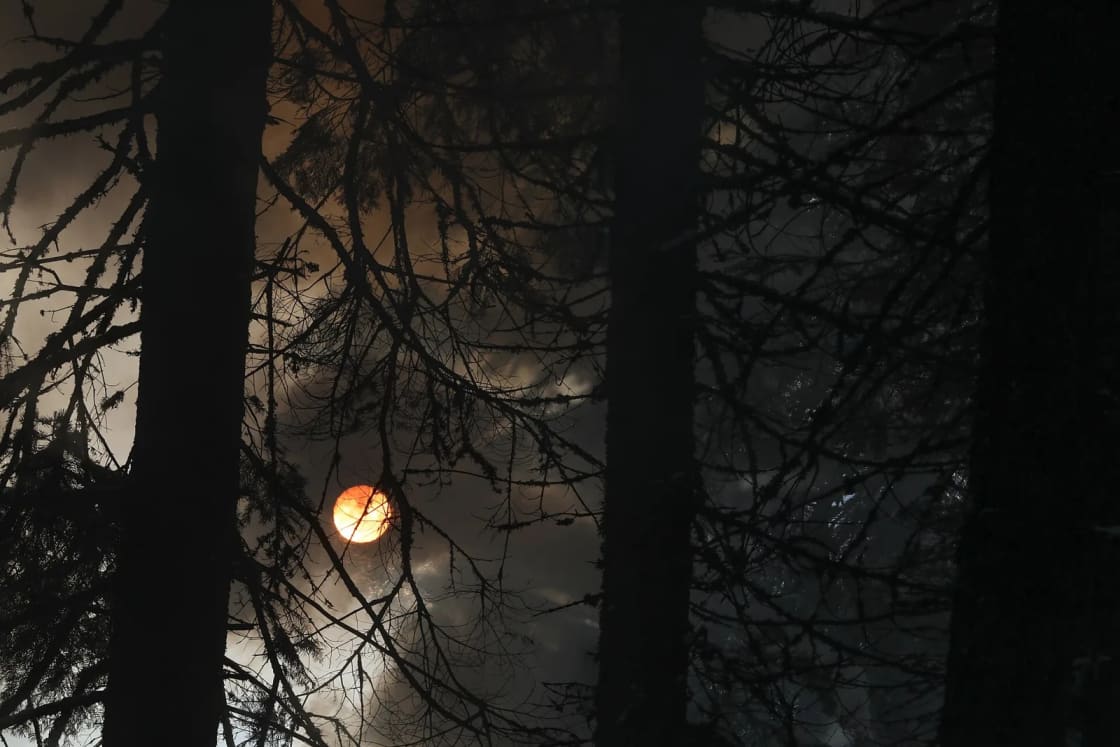

Somewhere around the second week of October, in a valley full of people who spent the summer growing things, a large volume of dead vegetation needs to go somewhere. And the oldest solution — light it — turns out to be governed by a state air quality rule, a county fire authority, a National Weather Service number most residents have never heard of, and a seasonal calendar that is shorter in Utah County than almost anywhere else in the state.
That last part is the piece nobody expects. The neighboring county's rules are not your rules. A relative in Sanpete or Sevier can burn on a January afternoon that would be flatly unlawful in Springville.
The reason is a designation, and the designation is the whole story.
Why Utah County has fewer burn days than most of Utah
Utah's Division of Air Quality regulates open burning under Utah Administrative Code R307-202. The rule sets seasonal windows, and it sets different windows depending on whether an area meets federal air quality standards.
Fetched live from AirNow when this page loads, so it is current whichever day you are reading this.
On a mandatory no-burn day in Provo, a fire in your fireplace is against state rule, not just discouraged.
- Unrestricted. Wood, pellet and coal stoves and fireplaces may be used, but should be used in a way that keeps smoke down.
- Voluntary. Voluntarily do not use wood, pellet or coal stoves or fireplaces.
- Mandatory. Wood, pellet and coal stoves and fireplaces are prohibited. Natural gas appliances and propane stoves are still allowed.
The rule is Utah Administrative Code R307-302. It covers 7 counties including Utah County — all regions of utah county west of the wasatch mountain range — which is the entire valley floor, provo included. The season runs November 1 to March 1, though no-burn actions are typically called inside that window, but udaq states they may be called at any time of year. UDAQ says it enforces no-burn actions with compliance officers using infrared cameras that detect heat plumes even where there is no visible smoke. UDAQ's published figure is fines of up to $150 for households found violating the ban. Households that rely on solid fuel as their only source of heat can register with UDAQ for an exemption.
For attainment areas — the parts of Utah with clean enough air to have never been designated otherwise — permits may be issued:
- April 1 to May 31, and September 15 to October 31, when the clearing index is above 500; and
- November 1 to March 31, when the clearing index is above 250.
For nonattainment and maintenance areas, the November-to-March window does not exist. Those areas get the two shoulder-season windows and nothing else.
Utah County is in the second group. The Wasatch Front's PM2.5 problem is a winter problem — cold air pools settle into the valleys, cap them, and hold everything emitted underneath. R307-302's own geographic definition of the nonattainment and maintenance plan areas names all regions of Utah County alongside Salt Lake, Davis, Cache Valley, and portions of Weber, Box Elder and Tooele.
So the practical calendar for a Provo or Payson homeowner is two windows a year:
Spring: April 1 – May 31. Fall: September 15 – October 31.
And even inside those, you do not simply light a match.
The clearing index, and why a valid permit can be void
The clearing index is a National Weather Service product measuring atmospheric mixing and wind speed — in plain terms, how well the air above you is capable of carrying smoke away. DAQ's guidance states the operative threshold directly: a clearing index of 500 or less is considered poor atmospheric ventilation.
Under R307-202-7(9), individual permits may be issued when the clearing index is 500 or greater. And then the sentence that catches people:
When the clearing index is below 500, any permits issued for that day shall be void until further notice from the county or municipal fire authority.
Read that carefully, because it inverts how permits normally work. A permit in your hand is not authorization. It is conditional authorization, and the condition is re-evaluated daily by the atmosphere. You can hold a properly issued permit for a specified date, wake up to an index of 380, and have no legal authority to burn that day.
The index is published by airshed rather than by county, which is a finer-grained division reflecting how valleys trap air. Utah's air quality site publishes the current index by airshed, and checking it on the morning of the burn — not the week before — is the only version of this that works.
Several fire districts around the state add a further wrinkle worth knowing about: when a burn is not conducted on the same day the permit was issued, or when a permit covers multiple days, the applicant is expected to notify dispatch on each burning day. Practices differ by jurisdiction, so ask the authority that issues yours.
What may be burned, and what absolutely may not
R307-202 allows residential open burning of a narrow category: clippings, bushes, plants, and prunings from trees incident to property and residential clean-up activities. Natural growth, in other words. The material must be thoroughly dry.
The prohibitions are stated with unusual care, because the drafters clearly anticipated the workaround. No trash, rubbish, tires or oil — and the rule specifies that these may not be included in the material burned, used to start the fire, or used to keep it burning. Dousing a damp brush pile with used motor oil is not a gray area.
R307-202-4 separately prohibits open burning at sites used for the disposal of community trash, garbage and other wastes. And dimensional lumber is commonly excluded by local authorities even where it is not called out in the state rule, which is a reasonable rule of thumb: if it was manufactured, it does not belong in an open burn.
The permit itself carries obligations under R307-202-7. It is valid only on the lands specified on it. No material may be burned unless it is clearly described and quantified as material to be burned on the permit. No burning may be conducted contrary to the permit's conditions. And the permit is subject to all other local, state and federal rules — a state burn permit does not override a municipal fire restriction or a county-wide closure during a dry summer.
One more limit sits in R307-202-7(8): permits may be issued only when a nuisance, as defined in Utah Code Section 76-10-803, is not created and the burn does not impact public health and welfare. Smoke settling into a neighbor's open windows is not made lawful by a permit.
Winter: the other rule, the one about your fireplace
Open burning is R307-202. Your fireplace is R307-302, and it operates on a completely different trigger.
When PM2.5 measured by monitors in Box Elder, Cache, Davis, Salt Lake, Tooele, Utah or Weber counties is forecast to reach or exceed 25 micrograms per cubic meter, the director issues a public announcement declaring a mandatory no-burn period for solid fuel burning devices in the counties identified.
DAQ's action forecast uses three levels, and the difference between them is legal rather than advisory:
- Unrestricted. Solid fuel devices may be used, but visible emissions must still meet air quality regulations.
- Voluntary. Residents are asked to refrain — from solid fuel devices, from open burning, and to consolidate trips.
- Mandatory. Solid fuel burning devices must not be used, including wood and coal burning stoves and fireplaces. Open burning may not occur, including fire pits, fire rings and campfires.
That last clause is the one that surprises people every winter. A backyard fire pit on a clear-feeling January evening feels categorically unlike burning a brush pile. During a mandatory action it is prohibited all the same, because the restriction attaches to the combustion rather than to its purpose.
What remains acceptable on a mandatory day: natural gas appliances and propane stoves. Which is the entire reason gas inserts have proliferated along the Wasatch Front.
Two further details in R307-302 deserve a mention. There is a PM10 trigger as well as the PM2.5 one — reaching 120 micrograms per cubic meter with a forecast inversion expected to persist at least 24 hours. And there is a contingency provision: if the PM2.5 contingency plan in the State Implementation Plan has been implemented for an area, the trigger level in that area drops from 25 to 15 micrograms per cubic meter, which is a substantially more sensitive threshold.
The no-burn season is generally described as running November 1 to March 1, though DAQ is clear that actions may be called any time of year.
The sole-source exemption, and the deadline inside it
R307-302-3(1) provides that a person using a solid fuel burning device as a sole source of heat must register with the director in order to be exempt during mandatory no-burn periods.
Two conditions, both strict. The device must heat an entire residence — a fireplace that supplements a gas furnace does not qualify, however much of the heating it does in practice. And the exemption depends on registration having happened, which is an administrative step to complete before the season rather than an argument to make to a compliance officer during an inversion.
Materials describing the program have referenced a registration deadline that has long since passed for the original cohort, so anyone whose situation has changed — a furnace failure, a new property, a wood stove installed since — should contact DAQ directly rather than assume the door is open or closed.
Enforcement, and a number we are not going to pretend to know
DAQ describes its enforcement of no-burn actions as vigorous, and the method is more sophisticated than most residents realize: compliance officers monitor neighborhoods using infrared cameras that detect heat plumes even when there is no visible smoke. The folk belief that a hot, clean-burning fire is undetectable is exactly backwards.
On the penalty, the published record is inconsistent, and we would rather say so than pick the number that reads better.
DAQ's own page on mandatory no-burn days states that officers assess fines of up to $150 to households found violating the ban. A Utah county health department page describing the identical program — same infrared cameras, same registration deadline, same action levels — states up to $299.
These are not describing different programs. The likeliest explanation is that one page has been revised and the other has not, and without a citation to the penalty schedule itself there is no honest way to determine which is current. If the figure matters to a decision you are making, call the Division of Air Quality at the number on their site. What is not in dispute is that a fine exists, that enforcement is active, and that the detection method works.
Why the valley traps air, and why that is the whole reason for these rules
None of the above makes sense without the geography, and the geography is unusually stark here.
Utah Valley is a basin. Mountains rise steeply on the east, a lake sits on the west, and the valley floor is effectively a bowl. In winter, a high-pressure system parks over the region and the ordinary vertical structure of the atmosphere inverts: instead of cooling with height, the air above the valley becomes warmer than the air in it. That warm layer acts as a lid.
Underneath the lid, nothing mixes out. Tailpipe emissions, industrial output, and smoke from every wood stove and fireplace in the basin accumulate for days at a time, and the cold pool at the bottom is where people live. A persistent inversion can hold for a week or more, and the PM2.5 concentration climbs the entire time.
This is why the clearing index exists as a permitting condition rather than as advice, and it is why Utah County lost the winter burn window that attainment counties keep. In an airshed that ventilates normally, a January brush fire disperses. In this one, it does not — it joins the pool.
Agricultural burning operates under its own provisions and is not what this page describes. The state rule treats farming operations differently, generally limited to specific purposes such as ditch banks, fence lines, field stubble and open grazing areas, and typically requiring agricultural land use rather than a large residential lot. Recent regulatory changes have brought permit requirements into areas that previously had none, so an agricultural operator should confirm current requirements with the local fire authority rather than rely on long-standing practice.
A note on where Utah County's designation sits
One complication worth flagging rather than glossing. EPA has, in the years since the original 2009 nonattainment designations, moved through a redesignation process for the Provo PM2.5 nonattainment area, and it finalized the redesignation to attainment for the 2006 24-hour standard, under a maintenance plan, effective December 19, 2025.
For the purposes of this page it changes nothing, and that is worth stating plainly: R307-202 applies the same two-window calendar to nonattainment and maintenance areas. An area redesignated to attainment enters a maintenance plan, and maintenance areas are grouped with nonattainment areas for burn windows. Either way, Utah County does not get the November-to-March window.
The reason to mention it at all is that designation status is the kind of thing that changes, and a page that asserted "Utah County is nonattainment" as a permanent fact would eventually be wrong in a way that mattered. The rule's own phrasing — "nonattainment and maintenance areas" — is the durable version.
The practical sequence
- Check the window. April 1 – May 31, or September 15 – October 31. Outside those dates, in Utah County, the answer is no.
- Apply for the permit through the Division of Air Quality's online open burn application, which routes to your county or municipal fire authority. Describe and quantify the material.
- Check the clearing index for your airshed on the morning of the burn. Below 500, your permit is void for the day.
- Check the action forecast. A mandatory action overrides everything above.
- Burn only dry natural growth. No trash, no tires, no oil, no dimensional lumber.
- Consider whether you need to burn at all. The county's solid waste district takes green waste, Provo runs spring and fall cleanup dumpsters with a coupon for a free load, and a compost yard operates most of the year. For most household volumes that is faster than waiting for a window and an index to line up.
That last point is not editorializing. Given two narrow windows, a daily atmospheric veto and an active enforcement program with infrared cameras, hauling the pile is frequently the path of least resistance — and it is available in January.
Related reading
- Getting Rid of the Big Stuff in Utah Valley — green waste, the transfer station and the cleanup dumpsters
- Chimney & Fireplace Safety in Utah Valley — the device the no-burn rules apply to
- Tree Removal in Utah Valley — where the brush pile came from in the first place
- HOAs in Utah Valley: What You're Actually Signing Up For
- Backyard Chickens in Provo: Six Hens, No Roosters, and a Lot Size That Decides Everything
- Provo's Last Frost Is May 1. It's Also May 21. Both Numbers Are Right.
- Building Permits in Provo: When You Need One and When You Don't
- Does Provo Have Hard Water? Yes — Here's What It Costs You & What Helps
- Allergies and Asthma in Utah Valley: The Nine-Month Season, and Why the Air Here Makes It Worse
The other burning permit: closed fire season, Red Flag Warnings and who pays
Air quality is one regulator. Fire is a different one, with a different permit, a different season and a criminal penalty attached — and a great many people who have carefully checked the clearing index have never heard of it.
Utah Code § 65A-8-211 establishes a closed fire season running from
June 1 to October 31 of each year, throughout the state. (2)(b) lets the state
forester advance or extend it wherever and whenever necessary, and (2)(c)
requires notice of any alteration by posting the proclamation on the division's
website and on the Utah Public Notice Website at least seven days in advance
of the effective date. So the dates are a default, not a guarantee, and the
advance-notice requirement is what makes the change findable.
During the closed season, § 65A-8-211(3) makes it a class C misdemeanor to
set on fire, or cause to be set on fire, a forest, brush, range, a field,
cultivated land or a debris pile without three things: first securing a written
permit from the state forester or a designated deputy; complying fully with
that permit; and first notifying the state forester, the forester's designee,
or the applicable public safety answering point of the approximate time the
burning will occur.
That third element is the one people drop. A valid permit plus an unannounced burn is still an offense, because the notification is a separate condition. The "applicable public safety answering point" means the dispatch center for the jurisdiction where the burning occurs — a call to dispatch, in practice, so the smoke report that follows does not launch a response.
§ 65A-8-211(4) adds a parallel offense that operates whenever a Red Flag
Warning is issued, regardless of the date, and its list of protected features is
longer. Alongside forest, brush, range, field and cultivated land, it adds a
fence line, a canal and an irrigation ditch. Those three are exactly
what gets burned along the benches and the older agricultural edges of this valley
in spring — outside the June-to-October window and therefore outside (3)
altogether. A Red Flag Warning is defined at (1)(d) as a National Weather Service
forecast, published on a publicly available website or notification system,
indicating weather conditions associated with the outbreak of wildfires. It is a
condition you have to check on the day, not a season you can plan around.
The liability provisions are where this gets expensive, and they are worth reading in full before lighting anything.
§ 65A-8-211(6)(a) states that the burning permit does not relieve an individual
from personal liability as a result of damage caused by the fire. A permit is
permission, not protection.
§ 65A-8-211(6)(b) goes further: a fire escaping the control of the permittee
that necessitates fire control action, or does injury to the property of another,
is prima facie evidence that due care was not used in the burning and that the
fire was not safe. That is a burden-shifting rule. Ordinarily someone alleging
negligence has to prove it; here the escape itself establishes the case, and the
permittee is the one explaining. Given what a suppression response costs, that
sentence is the most financially significant line in the chapter.
The surrounding structure explains who turns up. § 65A-8-201 declares that any
fire on forest, range, watershed or wildland urban interface land burning
uncontrolled and without proper and adequate action is a public nuisance.
§ 65A-8-202 makes a county responsible for abating that nuisance on
unincorporated private or county-owned land of those types within its boundaries,
and allows a county to participate in the division's wildland fire protection
system by agreement; § 65A-8-202.5 addresses city and town responsibilities, and
§ 65A-8-203.2 deals with billing a county or municipality not covered by a
cooperative agreement. § 65A-8-209 and § 65A-8-209.1 set out the roles of
county sheriffs and the county fire warden in controlling fires.
§ 65A-8-212 gives the state forester power to close hazardous areas outright,
with violations of a closure order as a separate offense — the mechanism behind
canyon and forest closures in a bad year.
The short version, for anyone with a burn pile: the air-quality clearance and the fire permit are two different approvals from two different authorities. Check the season, check for a Red Flag Warning on the day whatever the season, get the written permit, call dispatch before you light it, and understand that none of it transfers the risk if the fire gets away.
Frequently Asked Questions
When can I legally burn yard waste in Utah County?
What is the clearing index and where do I check it?
Do I need a permit, and who issues it?
What can I burn?
What is a mandatory action day and what does it prohibit?
Are fire pits and backyard fire rings covered by no-burn days?
Is there an exemption if wood is my only heat source?
What is the fine for burning on a no-burn day?
Sources
The facts in this guide were checked against these sources. Hours, fees and rules change, so confirm anything time-sensitive with the source before you go. How we make Provo.com.
- Open Burning (Residential Regulations) - Utah Department of Environmental Quality, Utah Division of Air Quality. Checked October 12, 2026.
- DEQ - Open Burning - Utah Air Quality, Utah Division of Air Quality. Checked October 12, 2026.
- Mandatory No Burn Days: Stationary Source Compliance, Utah Department of Environmental Quality. Checked October 12, 2026.
- Open Burning - City of Orem, City of Orem. Checked October 12, 2026.
- Utah Code 65A-8-211: Closed fire season -- Burning permits -- Red Flag Warning, Utah State Legislature. Checked October 12, 2026.
- Approval and Promulgation of Implementation Plans; Utah; Salt Lake City and Provo PM2.5 redesignation, Federal Register (EPA). Checked October 12, 2026.